
Reviewed · OSAKA TOURS
Osaka: Private and Fully Customized Tour with Hotel Meet Up
Osaka’s best introduction may be a private walk that lets you switch gears quickly: grand castle grounds in the morning, old-school Shinsekai next, then market snacks and neon-lit Dotonbori. Your guide meets you at your accommodation, so you skip the usual scramble to find a meeting point.
I like the personal approach, especially the chance to shape the day around food, children, history, or a short list of must-see sights. I also like the local focus: guide Kieran has helped people find specific foods, suggested places for later meals, and adjusted plans on the fly. The main tradeoff is cost. At $109 per person, this is far more than a group walk, and transportation, food, and entry tickets are extra.
Key points at a glance
- A private Osaka day built around you: The route can be adjusted to suit your interests, pace, and family needs.
- Four very different city stops: See Osaka Castle, Shinsekai, Kuromon Ichiba Market, and Dotonbori in one compact outing.
- Hotel pickup saves time: Your guide meets you in your hotel or accommodation lobby, or at another agreed location.
- Kieran brings practical local help: He has tailored tours for children, answered detailed questions, and helped people track down nostalgic Japanese candy.
- Public transit keeps the tour local: You ride trains and walk rather than viewing Osaka through a tour bus window.
- Check the route before booking: The highlights also mention Kyoto’s Ninenzaka, Sannenzaka, and Yasaka Shrine, while the detailed route lists Osaka sights. Ask which plan applies to your booking.
A private start from your Osaka hotel
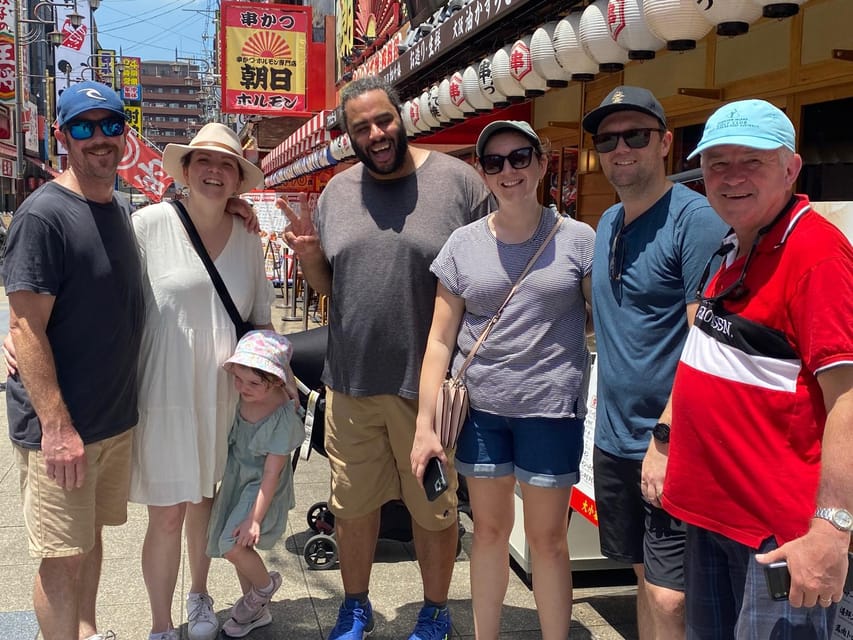
The tour begins at your accommodation in Osaka. The guide meets you in the lobby and can also arrange a meeting at a particular train station or another spot you prefer.
That small detail matters. Osaka’s rail system is useful but can feel confusing at first, especially when you are trying to match station exits with a fixed meeting time. Starting at your door gives you more time with the guide and less time standing beside a ticket machine wondering which way is up.
The tour lasts three to five hours. That range is important because this is not a tightly scripted sightseeing conveyor belt. You might spend more time on history, food, shopping, or family-friendly stops, depending on what you tell the guide before and during the walk.
The tour is private, so you are not sharing the guide with a large group. That makes it easier to ask basic questions, change direction, or slow down when a street market catches your eye. It also makes the $109 price easier to justify for a family or small group, though solo visitors and couples should compare the cost with a regular group tour.
A few more Osaka half-days to weigh up
- Osaka Go Karting Tour with Funny Costume
★ 5.0 · 2,658 reviews - Osaka Castle: Museum and Tower Entry Ticket
★ 4.5 · 2,380 reviews - Osaka: Shinsekai Food Tour with 13-15 Dishes at 5 Eateries
★ 4.8 · 2,204 reviews
Osaka Castle: a grand first chapter
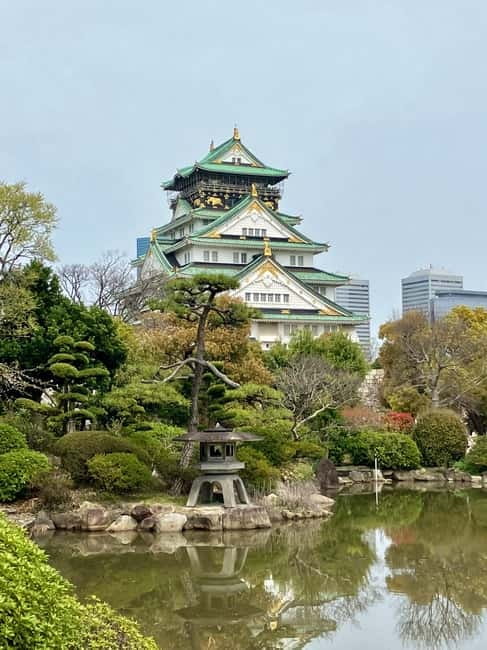
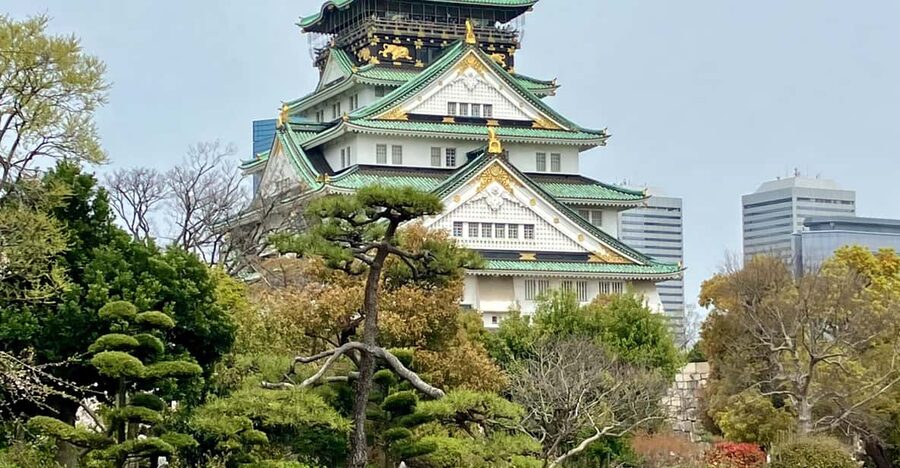
The standard route begins with about an hour at Osaka Castle. The castle and its surrounding park offer a strong introduction to Osaka’s past, and the site gives the tour a spacious opening before it moves into tighter city streets.
Your guide can explain the background of the castle and help you understand what you are seeing rather than leaving you to admire the walls and take photos. The exact balance between outdoor grounds and the castle attraction should be confirmed before you go, since the Osaka Castle entry ticket is not included and costs ¥600.
That extra ticket is modest, but it affects the real price of the tour. If you are mainly interested in the park and exterior, you may not want to pay for the interior. If you care about Osaka’s history, the admission may be worthwhile.
The one-hour estimate also requires sensible expectations. You will get an orientation, not every corner of the complex. If Osaka Castle is your main reason for booking, tell the guide early so the time is used well.
Ten minutes by train, then old Osaka in Shinsekai
From Osaka Castle, the route uses a train ride of about ten minutes before reaching Shinsekai. The train fare is paid separately, with total transportation costs listed at roughly ¥200 to ¥1,500 depending on the route and any changes made to your customized plan.
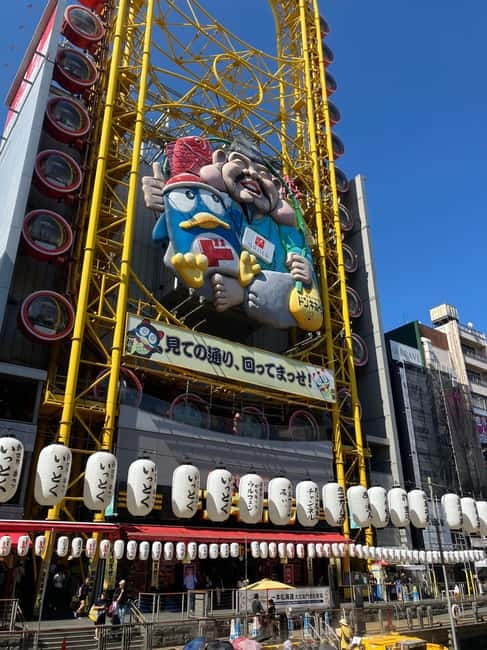
Shinsekai gives you a sharp contrast with the castle grounds. This is the nitty-gritty city side of Osaka, with older streets, local character, and a less polished feel than the city’s major shopping areas. The guide spends about an hour showing you around and explaining how this part of Osaka fits into the city.
I like this pairing. Osaka Castle can feel formal and monumental, while Shinsekai gives you a more everyday view. You are not only collecting famous sights. You are seeing how Osaka shifts from historic landmark to working neighborhood within a short train ride.
Your guide may also help you decide what to eat later in the day. Food advice is one of the practical strengths of this format. You can ask what is worth trying, where to find it, and which parts of the city suit your budget or tastes.
Kuromon Ichiba Market in 30 minutes
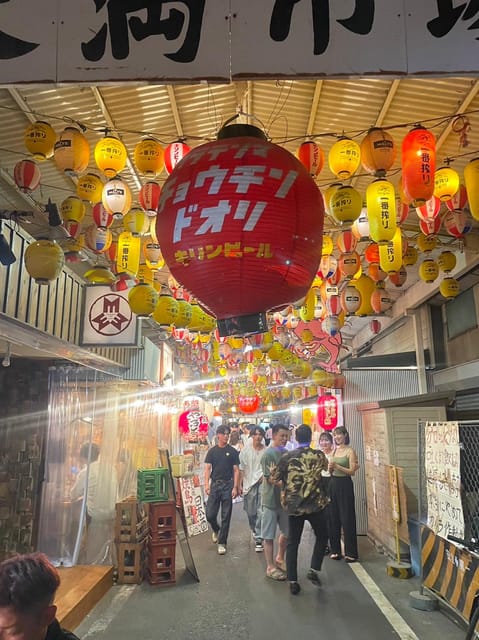
Next comes Kuromon Ichiba Market, reached on foot in about ten minutes. The planned visit lasts around half an hour, which is enough for a first look and perhaps a snack, but not a leisurely market meal.
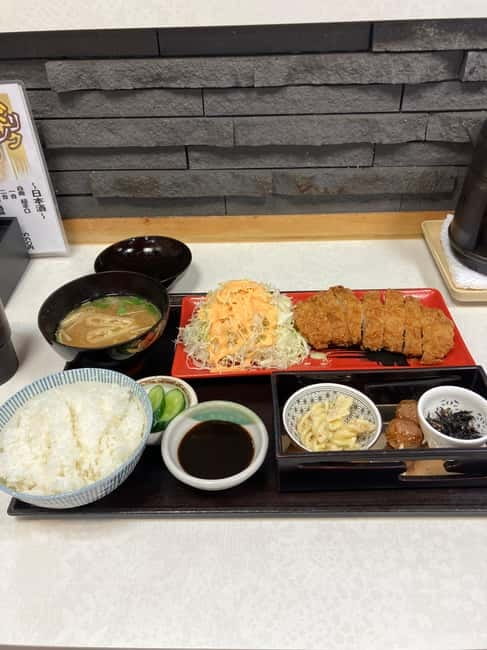
Food and drinks are not included. That is both a cost and an advantage. You choose what you want instead of paying for a package that may include foods you do not like. Bring some yen and leave room in your budget for small purchases.
Kuromon is best treated as a guided introduction, not a full food tour. Your guide can point out local specialties and help you make sense of the market, while you decide how much to eat. If food is your main interest, tell the guide before the tour and ask if more time can be shifted here.
The half-hour timing may feel short if you want to browse every stall. On the other hand, it keeps the outing moving and leaves time for Dotonbori, the most recognizable entertainment district on the route.
Same base, a completely different sort of day:
- Osaka Food Tour: 13 Dishes at 5 Local Eateries
★ 5.0 · 2,149 reviews - Hungry Osaka Street Food Tour:15 Tastings & 3 Drinks with a Local
★ 5.0 · 1,727 reviews - Osaka: teamLab Botanical Garden Entry Ticket
★ 4.5 · 1,710 reviews - Osaka: Tea Ceremony Experience
★ 4.9 · 1,426 reviews
Dotonbori: Osaka’s famous finish
The final scheduled stop is Dotonbori, with about an hour on foot from Kuromon Ichiba Market taking only five minutes. This is the place for bright signs, canal-side views, food streets, and the concentrated energy that many people picture when they think of Osaka.
A guide adds useful context here. Dotonbori is easy to photograph but less easy to understand at a glance. You can ask where to eat, which nearby streets are worth exploring, and what to save for the rest of your stay.
The area can be crowded, so a private guide is helpful if you are traveling with children or want to avoid wandering without a plan. One family booking was adjusted mainly around Namba to suit young children, and the group received food and entertainment suggestions for later. That is a good example of what customization means in practice: you are not locked into the printed sequence.
Dotonbori also makes sense as the endpoint because you can continue your evening from there. The tour does not include food, so you can finish with a meal of your own choosing rather than being rushed into a set restaurant.
What the customization really adds
The word customized can mean little on some tours. Here, it appears to be the central service. You can discuss your interests in advance, and the guide can adjust the route during the outing.
Guide Kieran has been particularly flexible with families, short visits, and unusual requests. One booking involved searching for a candy remembered from the 1970s. That detail says more than a general claim about personalization. If you have a specific food, neighborhood, shopping item, or cultural question in mind, tell the guide before the day begins.
This format suits several kinds of visitors:
- First-time visitors: You get a broad orientation and practical advice for the rest of your stay.
- Short-stay visitors: The route covers several major Osaka areas without requiring you to plan every train and transfer.
- Families: The pace and stops can be adjusted, as shown by the Namba-focused outing for young children.
- Food-focused visitors: You can ask for market guidance and restaurant suggestions, though you pay for your own food.
- Repeat visitors: You can spend less time on famous sights and ask for less familiar parts of the city.
- People with detailed questions: A private guide gives you room to ask about customs, history, daily life, and local food.
The key is to communicate clearly. A private tour is only as useful as the brief you give the guide. Tell the provider if you want more history, more eating, fewer stairs, extra time with children, or a particular district.
The Kyoto references need checking
There is one important point to clear up before you pay. The highlights describe Ninenzaka and Sannenzaka, two scenic Kyoto lanes, followed by Yasaka Shrine. The detailed route instead lists Osaka Castle, Shinsekai, Kuromon Ichiba Market, and Dotonbori.
These are not small variations. Kyoto and Osaka are separate cities, and adding the Kyoto streets and shrine would change the travel time and shape of a three-to-five-hour tour. Contact GoWithUs Tours and confirm the exact route for your date.
If your goal is Osaka, the detailed route is the one to discuss. If you specifically want Ninenzaka, Sannenzaka, and Yasaka Shrine, ask whether a Kyoto version is available and how transportation would affect the duration and price. Do not assume both Osaka and Kyoto can fit comfortably into the same short private outing.
The real price at $109 per person
The listed price is $109 per person. It includes the English-speaking local guide, hotel pickup, a private group, and the customized walking experience.
You pay extra for:
- Osaka Castle admission, ¥600
- Other attraction tickets, roughly ¥200 to ¥1,800
- Train fares, about ¥200 to ¥1,500
- All food and drinks
The value depends on how much help you want. If you are comfortable planning Osaka’s trains, choosing food stalls, and learning the basics from a guidebook, the price may feel high. If you have only one morning, are traveling with children, or want a local person to shape the day around your interests, the cost buys convenience and flexibility.
For a family or small private group, the price can make more sense because the guide’s attention is shared only with your party. For a solo visitor, I would book only if personal guidance is a priority.
The reserve-now-and-pay-later option helps if your schedule is still moving. Free cancellation is available up to 24 hours before the tour for a full refund. Check the final transportation plan, since a more ambitious custom route could raise the train cost.
Walking, access, and physical demands
The tour uses public transportation and walking. The listed route includes roughly ten minutes on foot between Shinsekai and Kuromon Ichiba Market, followed by about five minutes to Dotonbori, plus walking within each area and around Osaka Castle.
The activity is marked wheelchair accessible, but the route still involves city walking, stations, crowds, and changes between transport and streets. If you use a wheelchair, ask the provider to confirm the exact route and station access before booking.
The experience is not suitable for people with back problems or heart problems. Anyone who finds several hours of walking difficult should discuss a slower plan and alternative transportation. Alternative transport is possible at your own expense, but the amount is not specified.
Wear comfortable shoes and tell the guide about mobility limits at the start. A private tour gives you more room to adjust the pace than a fixed group outing, but it does not remove the physical demands of moving through a large city.
How to get the best morning or afternoon
Before the tour, send the guide three useful pieces of information: your top two interests, the foods you want to try or avoid, and the sights you have already seen. That gives the guide a clearer starting point than simply saying you want to see Osaka.
If this is your first visit, the standard route is a sensible sampler. Osaka Castle gives you a major landmark, Shinsekai adds local texture, Kuromon brings in food, and Dotonbori finishes with the city’s famous entertainment center.
If you have been to Osaka before, ask to reduce time at the major sights and focus on neighborhoods, food, or shopping. If you are with children, say so early. The tour has already been adapted for young children, and a Namba-centered plan may work better than forcing everyone through a full sightseeing loop.
Also ask where the tour ends. The detailed route finishes in Dotonbori, but a customized plan may differ. Since your guide can meet you at a hotel, station, or preferred location, the ending point is worth confirming too.
Should you book this Osaka tour?
Book it if you want a private local guide, have limited time, or value an adjustable plan more than the lowest possible price. It is especially useful for families, first-time visitors, and people who want direct advice on food and what to do next.
Skip it if you prefer exploring independently or need a full-day deep historical tour of Osaka Castle. You should also pause until the Osaka and Kyoto references are clarified.
For most suitable customers, the strongest reason to book is Kieran’s practical flexibility. He has adjusted routes for children, changed plans during the tour, answered detailed cultural questions, and helped with very specific local searches. That personal attention is what separates this from simply hiring someone to walk you between four landmarks.
FAQ
Where does the tour begin?
The guide meets you in the lobby of your hotel or accommodation in Osaka. You can also arrange to meet at a specific train station or another preferred location.
How long does the tour last?
The tour lasts between three and five hours. Available starting times depend on the date you select.
What sights are included in the standard Osaka route?
The detailed route includes Osaka Castle, Shinsekai, Kuromon Ichiba Market, and Dotonbori.
Are transportation costs included?
No. Train fares are paid separately and are estimated at about ¥200 to ¥1,500, depending on the route.
Is Osaka Castle admission included?
No. The Osaka Castle attraction ticket is not included and costs ¥600.
Is food included?
No. Food and drinks are not included, so you pay directly for anything you buy at Kuromon Ichiba Market or elsewhere.
Is the tour private?
Yes. The tour is offered for a private group with an English-speaking guide.
Can I cancel for a full refund?
Yes. You can cancel up to 24 hours in advance for a full refund.
Just added around Osaka
- Discover Real Osaka: A Cultural Walk with Food & Drink★ 5.0 · 13 reviews
- From Osaka/Kyoto: Kyoto & Nara Day Trip with Optional Lunch★ 4.5 · 79 reviews
- Osaka 6hr Private Walking Tour with Government Licensed Guide★ 5.0 · 174 reviews
- Private Airport transfer Kansai Intl. Airport(KIX) to OSAKA CITY★ 4.5 · 12 reviews
- Osaka: Namba Local Food Walking Tour (Taste 15 Dishes)★ 5.0 · 20 reviews
- Osaka Delights: Traditional Japanese Food Tour★ 4.5 · 33 reviews
- Badminton in Osaka & Kyoto with Locals!★ 5.0 · 15 reviews
- From Osaka or Kyoto: Kyoto and Nara 1-Day Bus Tour★ 3.5 · 141 reviews
Osaka Tours, compared.


Shinsekai Food Tour with 13-15 Dishes at 5 Eateries
Read our review →
Osaka Food Tour: 13 Dishes at 5 Local Eateries
Read our review →
Hungry Osaka Street Food Tour:15 Tastings & 3 Drinks with a Local
Read our review →



Hotspots & Hidden Gems Walking Tour Private or Group
Read our review →Browse the lists this tour appears in