
Reviewed · TAKAYAMA TOURS
Departing from Takayama [Regular sightseeing bus] World Heritage Sites Shirakawago and Gokayama Ainokura
Shirakawa-go is famous, but Ainokura Gassho Village may be the real surprise. This small World Heritage settlement feels quieter and more closely tied to the surrounding mountains, while Shirakawa-go gives you the classic postcard view, lunch choices, museums, shops, and the well-known lookout.
I like two things here: you see two very different gassho villages in one day, and the bus guide gives useful advice before you arrive, including walking routes, food, local customs, and seasonal conditions. The main drawback is that this is not a walking tour with a guide beside you at every stop. It is chiefly comfortable transport with guided commentary on the bus, and some people may find Shirakawa-go’s timetable tight.
Key points at a glance
![Departing from Takayama [Regular sightseeing bus] World Heritage Sites Shirakawago and Gokayama Ainokura - Key points at a glance](https://media3.thejapanesetraveller.com/wp-content/uploads/departing-from-takayama-regular-sightseeing-bus-world-heritage-sites-shirakawago-and-gokayama-ainokura-1.jpg)
- Ainokura comes first: Spend about 50 minutes in a smaller, quieter World Heritage village.
- Shirakawa-go gets the longest visit: Allow about two hours in the main village, plus time for the museum and observatory.
- The bus guide sets you up well: Expect information in Japanese and English, maps, suggested routes, and practical tips.
- The Minkaen entrance is included: This open-air museum adds context that you may miss by walking the village streets alone.
- Lunch is your responsibility: You have time to eat in Shirakawa-go, but the meal is not included.
- It is a shared Nohi Bus service: You ride with other participants in a medium or large air-conditioned bus.
Why these mountain villages are worth the ride
From Takayama, the gassho settlements are not simple places to reach on your own. The journey takes you into Gifu and Toyama prefectures, where steep-roofed farmhouses were designed for heavy snow. The roofs look like two hands pressed together in prayer, which explains the name gassho-zukuri.
The real value of this trip is not just getting from one place to another. You receive a practical introduction before each stop, then have time to choose your own pace. You can look for old houses, visit museums, eat lunch, buy local goods, or simply walk along the lanes and river.
I especially like the order of the day. Ainokura is smaller and calmer, so it gives you a sense of what these settlements are like before you reach the much more popular Shirakawa-go. By the time you arrive at Shirakawa-go, you understand the basic form of a gassho village and can spend your time comparing the two.
The rating is strong at 4.7 out of 5 from 137 ratings, with 92 percent recommending the experience. That lines up with the tour’s main strengths: careful driving, clear organization, useful bus commentary, and enough free time to explore without being led from one photo stop to the next.
More history-led days in Takayama:
- Kanazawa: World Heritage Shirakawa-go Morning Guided Tour
★ 4.9 · 988 reviews - Kanazawa: World Heritage Shirakawa-go & Two Local Experience
★ 4.9 · 274 reviews - World Heritage Shirakawa-go and Experience Tours from Kanazawa
★ 5.0 · 4,049 reviews
Starting at Takayama Bus Center
![Departing from Takayama [Regular sightseeing bus] World Heritage Sites Shirakawago and Gokayama Ainokura - Starting at Takayama Bus Center](https://media3.thejapanesetraveller.com/wp-content/uploads/departing-from-takayama-regular-sightseeing-bus-world-heritage-sites-shirakawago-and-gokayama-ainokura-2.jpg)
The meeting point is at 6-chōme-125 Hanasatomachi, near Takayama’s public transport links. The bus leaves at 8:30 a.m., and the full outing lasts about 7 hours and 20 minutes, returning to the same point.
Allow a few extra minutes before departure to exchange your voucher for the actual bus ticket at the Nohi Bus station. This step has caused confusion for some people because the email voucher is not the final boarding ticket. The process itself is described as easy, but it is better not to arrive at the last moment.
Once aboard, the guide handles the practical side of the day. That can include maps, directions, suggested walks, restaurant ideas, and reminders about when and where to return. Some guides have been named Yamashia and Ikuichinami, though the assigned guide can vary.
The guide speaks in Japanese and English when needed. The amount of commentary seems designed to be useful rather than nonstop. You get the village background, advice on the main sights, and seasonal information about Hida food and local dialect without having to listen to a lecture for the entire ride.
Ainokura: a quiet first look at gassho life
Ainokura Gassho Community in Nanto, Toyama Prefecture, is the first stop. You have about 50 minutes here, with no admission charge for the village itself.
Around 20 gassho-zukuri houses remain in Ainokura. Because the settlement is small, you can cross much of it on foot during the allotted time. The setting feels more intimate than Shirakawa-go, with houses gathered close to the mountain and fewer large-scale visitor facilities.
This is the place to slow down and look carefully. The steep roofs, timber walls, small lanes, and surrounding forest give Ainokura a strong sense of an old mountain community. In winter, snow can transform the village into a storybook scene. In autumn, the contrast between the dark wooden houses and seasonal color is especially appealing.
Fifty minutes is enough for a first visit, but not enough for a long museum stop, a leisurely meal, and every viewpoint. You will need to keep moving. The village is compact, which helps, and the bus guide’s route suggestions can save you from wandering in circles.
Ainokura works best as a visual introduction. It is less crowded than Shirakawa-go, and its smaller scale makes it easier to understand how the houses fit together. If you prefer quiet lanes and a rural feel, you may find this the most memorable stop of the day.
Shirakawa-go: the famous village with more choices
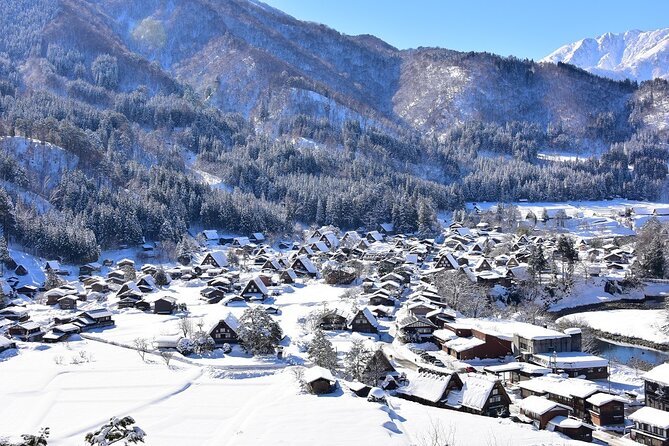
The main Shirakawa-go visit lasts about two hours, with additional time allocated for the Minkaen museum and the observatory. The historic village of Ogimachi has 114 thatched gassho-zukuri houses, so it is far larger than Ainokura.
This is the destination most people picture when they think of the region. You can walk between old houses, cross the river, browse gift shops, stop for coffee, and find a restaurant for lunch. The village is attractive in every season, but snow gives the roofs their most dramatic appearance.
The practical challenge is time. Two hours sounds generous until you add lunch, a museum, a walk through the village, and the observatory. A restaurant queue can consume a large part of your stop. If Shirakawa-go is your main reason for booking, decide before arrival what matters most.
A sensible plan is to listen closely to the guide’s route advice, choose lunch without delay, and save the lookout for the right moment. If you want a relaxed meal and several indoor visits, you may need to skip some streets or the observatory. If you bring your own lunch, you can use the time more freely, though the supplied information only confirms that lunch is not included, not that a specific picnic area is provided.
Shirakawa-go can also feel crowded. That is part of the trade-off for seeing Japan’s most famous gassho settlement. Ainokura provides the quieter contrast, and the bus makes it possible to enjoy both without arranging separate connections.
A few more Takayama half-days to weigh up
- Kanazawa/Takayama: Shirakawago & Takayama Private Day Tour
★ 4.8 · 172 reviews - From Takayama: Guided Day Trip to Takayama and Shirakawa-go
★ 4.9 · 113 reviews - Private Afternoon Cycling Tour in Hida-Furukawa
★ 5.0 · 109 reviews - Private-group Morning Cycling Tour in Hida-Furukawa
★ 5.0 · 105 reviews
Minkaen: the included museum stop
![Departing from Takayama [Regular sightseeing bus] World Heritage Sites Shirakawago and Gokayama Ainokura - Minkaen: the included museum stop](https://media3.thejapanesetraveller.com/wp-content/uploads/departing-from-takayama-regular-sightseeing-bus-world-heritage-sites-shirakawago-and-gokayama-ainokura-4.jpg)
The Shirakawago Gassho-zukuri Minkaen is an open-air museum, and its entrance fee is included. You have about 30 minutes for this stop.
The Minkaen matters because it gives you a closer look at the buildings than a quick village walk can provide. A village street shows you the outside of a house, while an open-air museum can help explain how older structures were used and preserved.
Thirty minutes is not a lot, so treat this as a focused visit rather than an attempt to see every display. It is a good choice if you want context, architecture, and a more structured look at gassho construction. Some people prefer spending this time in the village instead, especially if they have already visited a similar museum in Ainokura.
There is one seasonal detail to note. The park is closed on Thursdays from December through March. If it is closed during your trip, the tour provides an original mascot instead of the museum visit. That is a small consolation, so check the day of the week if the included admission is important to you.
The Tenshukakau Observatory and the classic view
The Tenshukakau Observatory sits on a hill northwest of Shirakawa-go. You have about 20 minutes scheduled here, and the entrance is included.
This is the view used on many posters and travel photographs. From above, you can see the gassho village arranged below, with the steep roofs forming a clear pattern against the surrounding mountains. It is the best stop for understanding the whole settlement at once.
The timing deserves attention. Some people find that reaching the viewpoint and returning takes close to an hour, depending on the route and pace. If you have only 20 minutes in the formal schedule, follow the guide’s instructions carefully and do not linger too long at the start.
This stop is most valuable on a clear day, but weather changes quickly in mountain areas. Snow, cloud, or rain may soften the view. Even so, the higher angle helps you see why the houses were built in this particular form and why the village is recognized as a World Heritage site.
What the bus guide does, and what the guide does not do
![Departing from Takayama [Regular sightseeing bus] World Heritage Sites Shirakawago and Gokayama Ainokura - What the bus guide does, and what the guide does not do](https://media3.thejapanesetraveller.com/wp-content/uploads/departing-from-takayama-regular-sightseeing-bus-world-heritage-sites-shirakawago-and-gokayama-ainokura-5.jpg)
This experience is best understood as a guided bus excursion, not a fully escorted walking tour. The guide explains the region during the ride and gives directions before each stop. Once you arrive, you generally explore on your own and return to the bus by the stated time.
That arrangement suits me because I can choose what to see. I am not forced to follow a group through every lane, and I can spend more time on architecture, food, shopping, or photos. The guide’s maps and route advice make that free time easier to use.
If you want detailed explanations inside every historic house, this may feel light. One rating described the experience as mainly transport, with the guide offering information about what to do rather than accompanying the group through each village. That is a fair description.
The quality of the day depends heavily on clear timing and careful driving. The bus driver and guide have been praised for smooth organization, and one account noted that the bus took an alternate route around traffic to reach the parking area. That kind of behind-the-scenes coordination is easy to overlook, but it matters on a fixed schedule.
Price, group size, and what you get for $64.80
At $64.80 per person, the price is reasonable if you value convenience. You get the return bus from Takayama, an air-conditioned vehicle, the bus guide, entry to the Minkaen, and visits to two World Heritage settlements plus the observatory.
You do not get lunch, and the village admissions themselves are free. So the fare is mainly paying for transport into a difficult-to-reach area, the driver, the guide, and the planning that connects all the stops in one day.
One important comparison: a direct Nohi Bus purchase has been cited at about 8,000 yen. Prices can change, so compare the current direct fare before booking online. An online booking may still be worthwhile if you want to reserve ahead, but the difference is worth checking.
The service is shared with other people and can operate by medium or large bus. The booking form allows a maximum of four participants at one time, which appears to refer to the size of one booking rather than the total bus capacity. Expect a public sightseeing service, not a private vehicle.
Seasonal conditions and practical planning
Weather matters here. The experience requires good conditions, and if poor weather causes cancellation, you are offered another date or a full refund. Snow can make the villages spectacular, but it may also affect roads and walking conditions.
Wear shoes suitable for village lanes and allow extra care in winter. The supplied information does not specify a footwear requirement, so use your judgment based on the forecast and season. The bus is air-conditioned, giving you a comfortable base between stops.
Plan your priorities before leaving Takayama:
- At Ainokura, focus on the village streets and overall setting.
- At Shirakawa-go, choose between lunch, the village walk, the museum, and the observatory.
- Keep your return time in mind at every stop.
- Ask the guide for the best route if you want to fit in the main sights.
Most people can participate, and the meeting point is near public transport. The experience ends back where it begins, which makes it easy to continue exploring Takayama afterward.
Who should book this day trip?
I would choose this tour if I were staying in Takayama and wanted to see Shirakawa-go without handling regional buses, road conditions, parking, or separate museum planning. It is also a good fit if you want to add Ainokura, since reaching both villages independently takes more effort.
The tour suits first-time visitors who want a clear introduction and enough independence to explore alone. Families and couples may appreciate the comfortable ride and simple plan, while photographers will value the changing views and the chance to see the villages in different weather.
I would hesitate if you want a slow, deeply guided cultural visit. The day is fixed, Shirakawa-go can be busy, and lunch queues can cut into sightseeing. A person who wants to explore every museum, eat without watching the clock, or spend a full day in one village may prefer a longer independent visit.
Should you book the Ainokura and Shirakawa-go bus tour?
Book it if your priority is easy access to two World Heritage villages from Takayama. The combination is the strength: quiet Ainokura first, larger Shirakawa-go second, with the Minkaen and observatory added to the day.
Before booking, compare the current Nohi Bus direct price with the $64.80 online fare, and decide what you want to do in Shirakawa-go. If you accept that the guide mainly briefs you on the bus rather than walking beside you, this is a practical and well-organized way to see a remarkable corner of rural Japan.
FAQ
How long does the tour last?
The experience lasts approximately 7 hours and 20 minutes, including transport and visits to Ainokura, Shirakawa-go, the Minkaen, and the observatory.
Where does the tour begin?
It begins at 6-chōme-125 Hanasatomachi, Takayama, Gifu 506-0026, Japan, near public transportation.
What time does the bus leave?
The scheduled departure time is 8:30 a.m.
Where does the tour end?
The activity returns to the same meeting point in Takayama.
Is lunch included?
No. Lunch is not included, but you are given time to eat in Shirakawa-go.
Is the Minkaen entrance included?
Yes. Admission to the Shirakawago Gassho-zukuri Minkaen is included.
What happens if the Minkaen is closed?
The park is closed on Thursdays from December through March. If it is closed, the tour provides an original mascot instead.
Can I cancel for a full refund?
Yes, if you cancel at least 24 hours before the experience start time. Cancellations or changes made less than 24 hours before the start are not refunded, and poor-weather cancellations offer a different date or a full refund.
Just added around Takayama
- Private Afternoon Cycling Tour in Hida-Furukawa★ 5.0 · 109 reviews
- Gifu Samurai Sword Town;Japanese Damascus Knife Making Experience★ 5.0 · 27 reviews
- Private-group Morning Cycling Tour in Hida-Furukawa★ 5.0 · 105 reviews
- Short Morning Cycling Tour in Hida★ 5.0 · 17 reviews
- Magome & Tsumago Nakasendo Full-Day Private Trip with Government-Licensed Guide★ 5.0 · 20 reviews
- Magome & Tsumago Nakasendo Trail Day Hike with Government-Licensed Guide★ 5.0 · 38 reviews
- Frozen fall trekking★ 5.0 · 21 reviews
- Explore Kiso Valley : Magome – Tsumago Mountain Trail Walk★ 5.0 · 33 reviews
Takayama Tours, compared.
World Heritage Shirakawa-go Morning Guided Tour
Read our review →
World Heritage Shirakawa-go & Two Local Experience
Read our review →
Kanazawa/Takayama: Shirakawago & Takayama Private Day Tour
Read our review →
Private Afternoon Cycling Tour in Hida-Furukawa
Read our review →
Private-group Morning Cycling Tour in Hida-Furukawa
Read our review →
Onigiri and miso soup making at a buddhist temple
Read our review →
Browse the lists this tour appears in