
Reviewed · TAKAYAMA TOURS
Gifu Samurai Sword Town;Japanese Damascus Knife Making Experience
Seki City is the place to make a knife, not just buy one. In this small-group workshop, you move from a museum of blades to a working factory, then sit down with craftsmen to assemble, polish, sharpen, and sign your own Damascus knife. The last step is practical: you cut fresh vegetables and discover how sharp your new blade really is.
I especially like two things here: you learn to sharpen the knife yourself, and the group is limited to five people, so the workshop can feel personal rather than factory-like. Guides including Hiro, Sumi, and Yoshi are praised for their warm, helpful approach, and Hiro may be able to provide pickup in some arrangements. The main drawback is the location. Seki is off the usual tourist route, and the $250.38 starting price rises with some knife choices.
Key points before you book
- Seki’s sword-making tradition reaches back to the 13th century, giving the workshop a genuine local setting rather than a generic craft class.
- The Knife Museum sits beside the G.SAKAI factory in an unusual Canadian-style log house, combining exhibits with a look at modern production.
- You choose among three knife styles: a Japanese Damascus kitchen knife, a folding Damascus hunting knife, or a Chinese Damascus kitchen knife.
- Sharpening is part of the class, so you leave with a useful skill, not only a souvenir.
- You test the finished blade on fresh vegetables, a simple but memorable way to feel the edge you helped create.
- The 10:30 a.m. start and 2.5-hour length make this workable as a half-day outing from Gifu, and possibly as a long day trip from Kyoto.
Why Seki is the right place to make a knife
Seki’s cutlery story begins with geography. The local Nagaragawa River supplied iron sand, and that resource helped sword makers establish themselves here as early as the 13th century. By the Edo period, several hundred blacksmiths were making samurai swords and knives in the area.
That background matters because you are not making a knife in an unrelated tourist studio. You are working in a city whose identity was shaped by blades. Today, Seki is recognized alongside Sheffield in Britain and Solingen in Germany as one of the world’s leading cutlery centers.
The experience also shows how the old craft fits modern manufacturing. G.SAKAI produces knives for cooking, hunting, outdoor sports, and other professional uses. You get a look at both sides: historic objects and current production methods, followed by a hands-on session that puts the tools in your own hands.
More Samurai and Ninja Experiences in Takayama
- Ninja Experience in Takayama – Basic Course
★ 5.0 · 62 reviews - Seki: Samurai Knife Making Experience at the Knife Museum
★ 5.0 · 61 reviews - Ninja Experience in Takayama – Basic Course
★ 4.6 · 59 reviews
Starting at Sekitomioka Station at 10:30
The stated meeting point is Sekitomioka Station in Hidase, Seki, with the activity ending back at the same meeting point. The scheduled start is 10:30 a.m., so plan your morning around arriving early and finding the meeting place without a rush.
Pickup is offered, but the exact arrangement should be confirmed when you book. One guide, Hiro, has provided hotel pickup and transportation for some participants, so it is worth asking if this option applies to your accommodation. Do not assume it is included automatically.
Seki is not a quick walk from central Kyoto. The journey is described as roughly 1.5 to 2 hours by train from Kyoto, making this possible as a day trip but not a casual side stop. From Gifu, the outing is easier to fit into a day. The off-route location is the price you pay for reaching a real production center instead of staying in a major sightseeing district.
The small maximum of five people is a real advantage. A knife class works better when you can see what the instructor is doing and ask for help without waiting behind a large group. It also makes the experience more suitable for a parent and child, a couple, or a small group of friends.
The Knife Museum in its Canadian-style log house
Your first stop is the Knife Museum, located next to the G.SAKAI factory. The building itself is a talking point: it is an attractive Canadian-style log house, an unexpected setting for a collection devoted to cutlery.
Inside, you can see rare pieces and knife exhibits from Japan and other parts of the world. This stop gives you useful context before the workshop begins. You can compare different forms, uses, and traditions, then look at your own knife choice with a better sense of what makes each style distinct.
The museum is not the whole reason to make the trip, but it helps prevent the class from feeling like a stand-alone souvenir activity. You see that knives have different purposes and designs before you begin working on one. If you like tools, material culture, or traditional crafts, this part will likely hold your attention.
The available information does not give a detailed list of museum displays or the exact amount of time spent inside. I would treat it as a compact introduction rather than plan the day around a large museum visit.
Seeing how G.SAKAI makes knives today
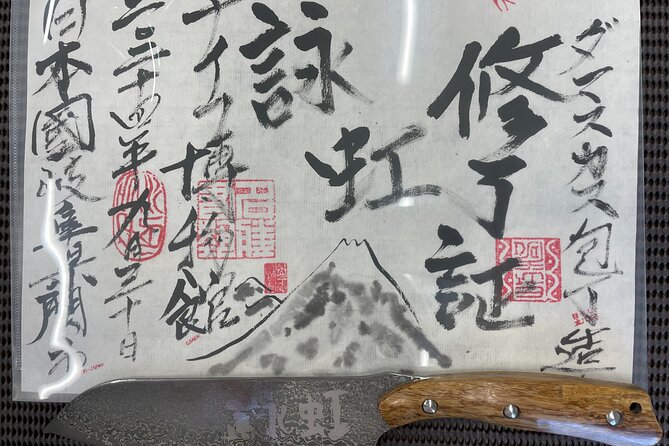
Next, you enter the factory and see how Japanese knives are produced in a modern setting. The experience connects the museum’s older examples with the company’s current work.
That contrast is one of the better features of the itinerary. Seki’s sword-making past can easily become a decorative story, but a factory visit shows that the area remains a working center for cutlery. G.SAKAI supplies knives to customers around the world and makes products for professional cooking, hunting, and outdoor sports.
The factory portion is also useful when you begin the workshop. You have already seen that a finished knife is the result of several separate stages. When you later assemble, polish, and sharpen your own blade, those steps make more sense.
The precise factory route and demonstrations can vary, so you should not expect a full industrial tour with every production detail explained. The main value is the connection between Seki’s craft tradition and present-day knife making.
More samurai and ninja sessions in Takayama:
- Knife Making Experience in Samurai Sword Town
★ 5.0 · 29 reviews - Ninja experience in Takayama – Special Course
★ 4.9 · 13 reviews - Tokyo: Samurai Restaurant Show Ticket with 2 Drinks
★ 4.5 · 1,307 reviews - Kyoto Samurai Experience
★ 5.0 · 1,294 reviews
Choosing your Damascus knife
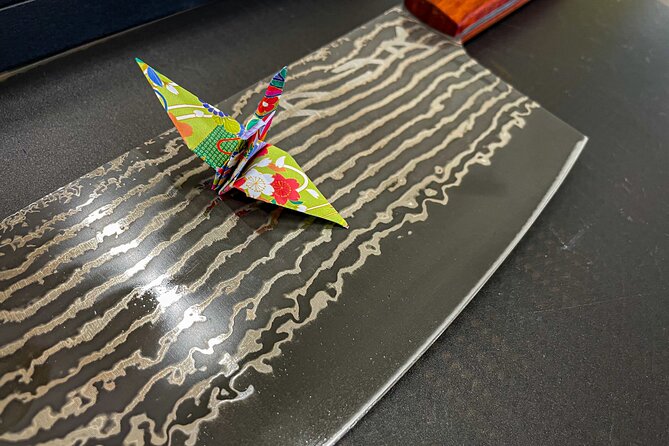
You can choose from three knife types, and the price changes according to the selection:
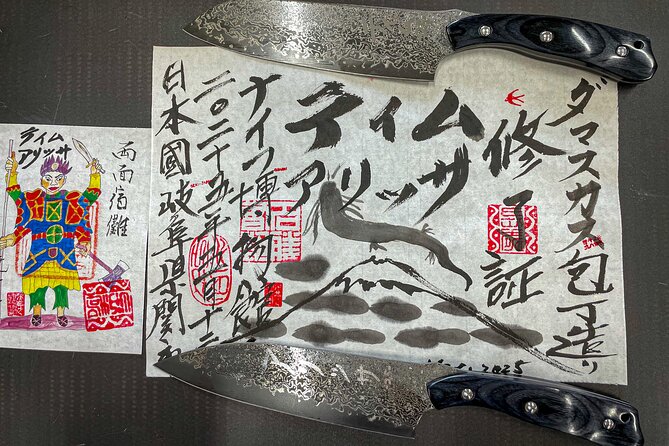
- Japanese Damascus kitchen knife: the most natural choice for everyday cooking and a practical souvenir for home use.
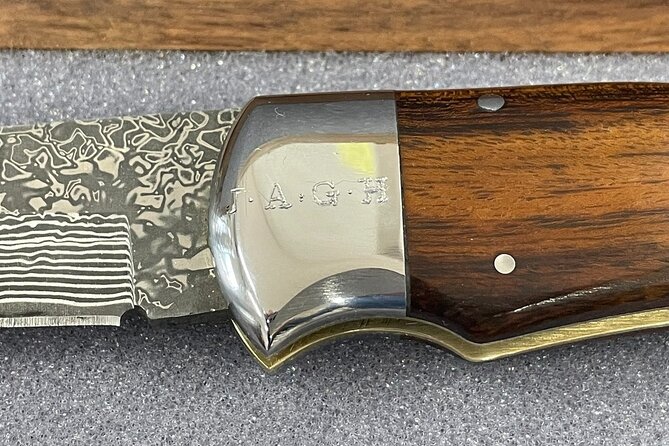
- Folding Damascus hunting knife: a portable option aimed at outdoor use.
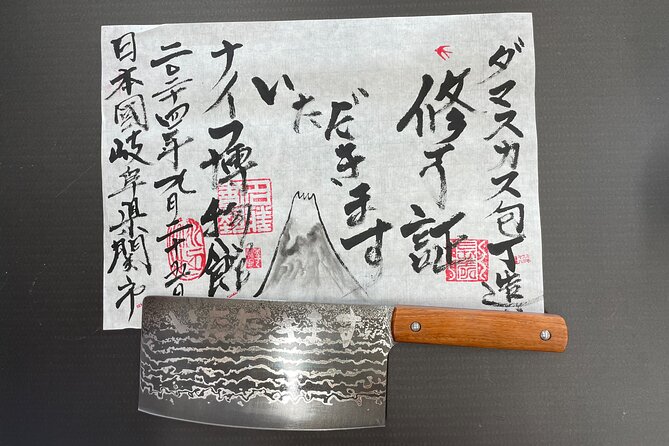
- Chinese Damascus kitchen knife: designed with traditional Chinese cooking techniques in mind.
This choice deserves a little thought. If you want to use the knife often in your own kitchen, the Japanese kitchen knife is the straightforward pick. If you spend time outdoors, the folding hunting knife gives the experience a different purpose. The Chinese kitchen knife may suit you if its shape and intended cooking style match the way you prepare food.
Damascus steel is part of the appeal. The patterned surface makes the finished knife attractive, but the workshop is not only about appearance. You also learn how to maintain the cutting edge, which is more useful over the long term than simply taking home a handsome object.
The advertised price is $250.38 per person before any adjustment for the knife type. That is a serious amount for a 2.5-hour activity. I would judge the value this way: you are paying for a guided craft session, access to a major Japanese cutlery maker, a museum and factory visit, a personalized knife, and instruction in sharpening. If you only want a low-cost souvenir, this is too expensive. If you value a usable object and the process behind it, the price is easier to defend.
Assembling, polishing, and signing your blade
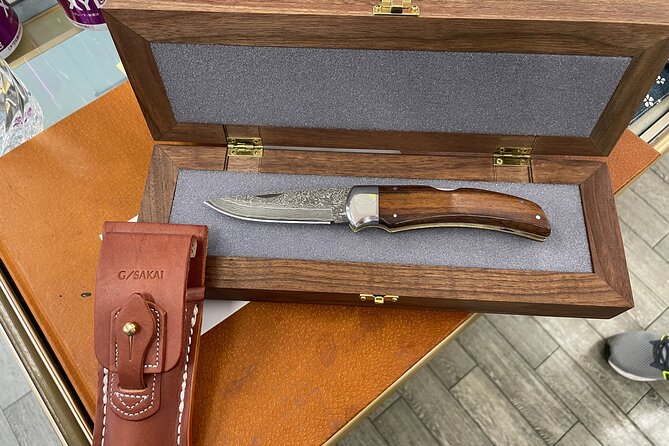
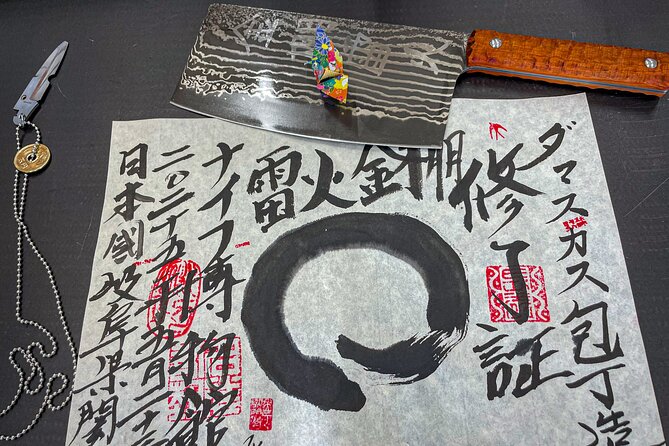
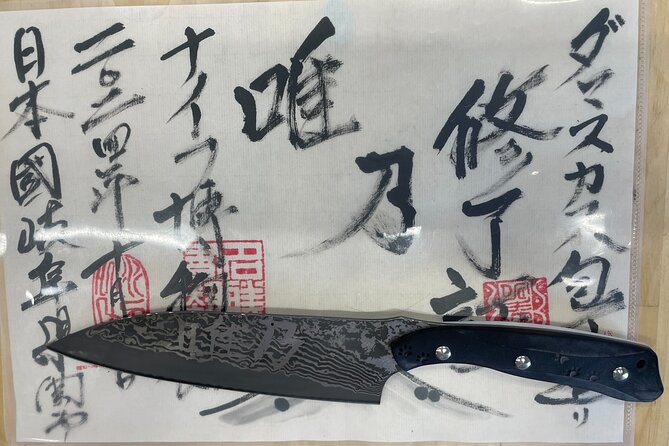
The workshop takes place in the atelier, where you construct your knife with the help of a knife craftsman. The listed stages include assembling, polishing, sharpening, and writing your name on the knife.
This is a hands-on class, but it is not presented as a blacksmithing session in which you heat raw steel and hammer out a blade from nothing. That distinction matters. You are working on the finishing and construction of a quality knife rather than forging every part from raw material.
For many people, that is the better format. You can spend your time learning the details that affect daily use, especially the final edge and finish, without needing advanced metalworking skills. Most people can participate, and the small group gives the craftsman room to guide you through each step.
The name inscription adds a personal touch without turning the knife into a fragile display piece. You can use it, maintain it, and still have a clear reminder that you made the final version yourself.
Expect the work to require attention. Polishing and sharpening are not flashy steps, but they are where the character of the finished knife develops. Follow the instructor closely, take your time, and ask questions when something is unclear.
Learning to sharpen a knife you can keep using
The sharpening lesson is one of the strongest reasons to choose this activity over a simple demonstration. Many knife owners know a blade should be sharpened but are unsure how to do it safely or correctly. Here, you learn the basic skill as part of making your own knife.
The practical benefit is clear. A good knife will not remain at its best forever if you never maintain the edge. Leaving the workshop with the ability to sharpen it means the experience continues after you return home.
The supplied information does not specify the exact sharpening equipment or method, so you should listen carefully to the instructor and ask how the lesson applies to your chosen knife type. Japanese, Chinese, and folding knives may have different shapes and uses, and the most useful advice will be the advice matched to your own blade.
This is also a good reason to avoid rushing through the final stage. The vegetable test is fun, but the sharpening technique may be the part you remember most when the knife has been in your kitchen for several months.
Testing the edge on fresh vegetables
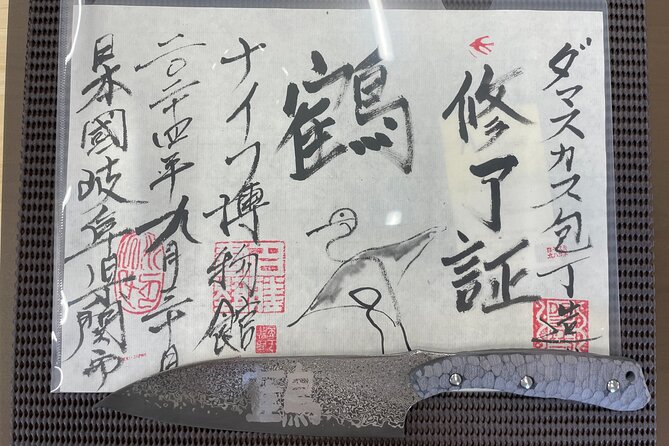
Once the knife is assembled and sharpened, you test it by cutting fresh vegetables. It is a simple finish, but it gives you immediate feedback. You do not have to take the instructor’s word for it. You feel how the blade moves through food.
The test also makes the lesson more concrete for children and first-time makers. A museum exhibit can be interesting, and a factory tour can be informative, but cutting a vegetable with a blade you helped finish turns the process into something you can understand through your hands.
Handle this stage with care. The point is not to show off by cutting quickly. Use the technique demonstrated by the craftsman and pay attention to the knife’s sharpness. The very quality that makes the test satisfying also means the blade deserves respect.
This is likely to be the emotional high point of the class. You have seen the history, watched modern production, worked on the knife, and now get proof that the edge is functional.
The guides and the feel of the workshop
Hiro, Sumi, and Yoshi are the guides associated with this experience. Their role goes beyond explaining the steps. They help create the relaxed, friendly tone that makes a technical craft easier to approach.
Hiro is described as speaking English well, which can help if you need clear explanations of the tools and sharpening process. He has also assisted with transportation and added visits to a sword museum and local sword shop for some participants. Those extras are not stated as part of every booking, so confirm what your own schedule includes.
Sumi and Yoshi are also named as hosts who help make the workshop enjoyable. The consistent praise for the hosts suggests that the human side is a major part of the experience. Still, I would keep expectations practical: the class has a set duration, and additional sightseeing should never be assumed unless it is arranged in advance.
The small group is particularly helpful if English is not your first language or if you want to ask detailed questions. You have more opportunity to watch hand movements closely and receive corrections while polishing or sharpening.
Who should book this Seki knife experience?
I would recommend it most strongly to people who like useful souvenirs, Japanese craftsmanship, cooking, or tools. It also fits families with older children, couples, and friends who want a shared activity rather than another passive sightseeing stop.
It suits a parent and child especially well because the finished knife creates a lasting reminder of the trip. One participant attended with a son, and the format clearly works for that kind of shared project, provided the child can follow safety instructions.
You should think twice if you dislike structured workshops or do not want to travel outside the main tourist centers. The price is high for the duration, and the journey from Kyoto takes planning. You also need to be comfortable taking responsibility for a very sharp knife after the class.
The activity ends back at the meeting point, so your onward transport should be planned around that. Since the meeting point is near public transportation, you can join by train, but leave enough time for the morning journey.
Booking, cancellation, and final verdict
Confirmation is provided when you book, and free cancellation is available up to 24 hours before the local start time for a full refund. Cancellations or changes made within 24 hours are not accepted for a refund, so check your train plans before that deadline.
The current price of $250.38 per person makes this a special-occasion activity, not an everyday tour. Its value improves if you want the knife itself, plan to use it, and care about learning how to maintain it. The value drops if you mainly want a quick look at a factory or museum.
I would book this if you are willing to make the trip to Seki and want a personal connection to Japanese cutlery. The combination of Seki’s sword-making background, G.SAKAI’s factory, a small workshop, a named knife, and a real sharpening lesson gives the outing substance.
I would skip it if you are short on time in Japan, watching every dollar, or hoping to forge a blade from raw steel. For the right person, though, this is a memorable half-day built around an object you can keep using long after the trip ends.
FAQ
Where does the experience start?
It starts at Sekitomioka Station, Hidase, Seki, Gifu 501-3911, Japan.
What time does the activity begin?
The scheduled start time is 10:30 a.m.
How long does the experience last?
The experience lasts approximately 2 hours and 30 minutes.
Where does the activity finish?
It ends back at the meeting point.
Is pickup available?
Pickup is offered. Confirm the exact pickup location and arrangements when booking.
How many people can join?
The activity has a maximum of five participants.
Which knives can I choose to make?
You can choose a Japanese Damascus kitchen knife, a folding Damascus hunting knife, or a Chinese Damascus kitchen knife.
Does the price change depending on the knife?
Yes. Prices vary according to the type of knife you choose. The stated price is $250.38 per person.
Can I cancel for a full refund?
Yes, if you cancel at least 24 hours before the experience start time. Cancellations or changes made less than 24 hours before the start are not accepted for a refund.
Just added around Takayama
- Private Afternoon Cycling Tour in Hida-Furukawa★ 5.0 · 109 reviews
- Private-group Morning Cycling Tour in Hida-Furukawa★ 5.0 · 105 reviews
- Short Morning Cycling Tour in Hida★ 5.0 · 17 reviews
- Magome & Tsumago Nakasendo Full-Day Private Trip with Government-Licensed Guide★ 5.0 · 20 reviews
- Magome & Tsumago Nakasendo Trail Day Hike with Government-Licensed Guide★ 5.0 · 38 reviews
- Frozen fall trekking★ 5.0 · 21 reviews
- Explore Kiso Valley : Magome – Tsumago Mountain Trail Walk★ 5.0 · 33 reviews
- Takayama: Private Night Walking Tour with Dinner★ 4.5 · 13 reviews
Takayama Tours, compared.

World Heritage Shirakawa-go Morning Guided Tour
Read our review →
World Heritage Shirakawa-go & Two Local Experience
Read our review →
Kanazawa/Takayama: Shirakawago & Takayama Private Day Tour
Read our review →![Departing from Takayama [Regular sightseeing bus] World Heritage Sites Shirakawago and Gokayama Ainokura](https://media3.thejapanesetraveller.com/wp-content/uploads/departing-from-takayama-regular-sightseeing-bus-world-heritage-sites-shirakawago-and-gokayama-ainokura-400x267.jpg)
Departing from Takayama [Regular sightseeing bus] World Heritage Sites Shirakawago and Gokayama Ainokura
Read our review →

Private Afternoon Cycling Tour in Hida-Furukawa
Read our review →
Private-group Morning Cycling Tour in Hida-Furukawa
Read our review →
Onigiri and miso soup making at a buddhist temple
Read our review →Browse the lists this tour appears in