
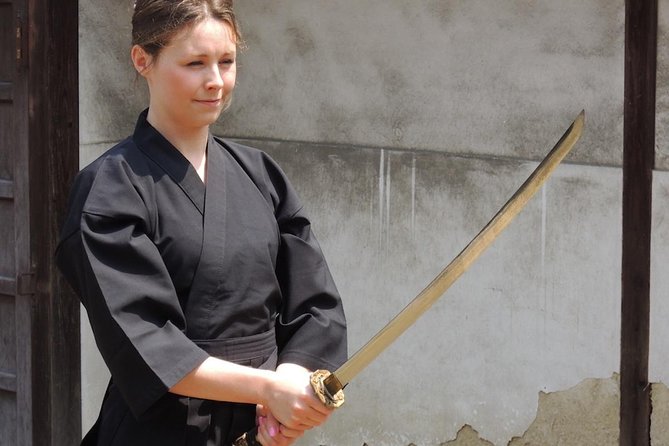
Reviewed · KYOTO TOURS
Kyoto Samurai Experience
A real samurai house, a traditional kimono, and hands-on sword practice make this more than a quick photo stop. You learn the ideas behind Bushido, the Way of the Warrior, then practice basic sword movements under an experienced instructor.
I like the thoughtful mix of physical activity and quiet reflection. The Zen meditation gives the session a welcome change of pace, while the preserved house, tea, sweets, music, and sword demonstrations can add texture to the history lesson. The main drawback is value: at $119.38 per person, it is one of Kyoto’s pricier short activities, and the location can feel out of the way.
Key points to know
- Historic setting: The session takes place inside a traditional samurai house, not a modern activity studio.
- Hands-on instruction: You change into a kimono, handle a martial arts sword, and practice basic techniques.
- More than swordplay: Bushido, house history, Zen meditation, tea, sweets, and occasional traditional music form part of the experience.
- Small-group format: The maximum is 14 people, allowing for a more personal session than a large stage show.
- Flexible timing: You can choose a morning or afternoon departure.
- Plan your route: The meeting point is near public transportation, but some people find the location less convenient than central Kyoto sights.
Inside the Kyoto samurai house
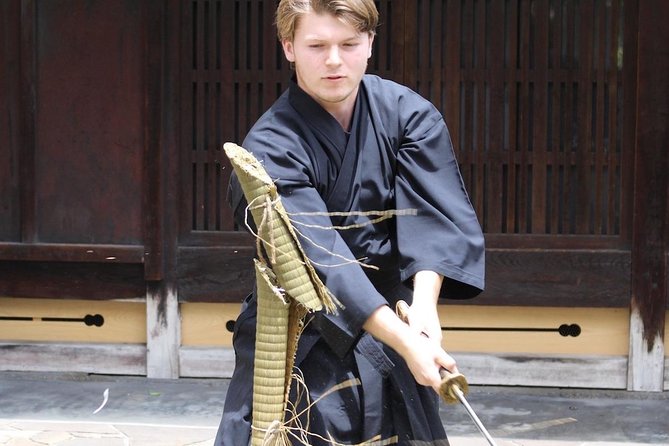
The setting does much of the early work. Instead of meeting in a hotel ballroom or a generic cultural center, you enter a traditional samurai house in Kyoto’s Nakagyo Ward. The building gives the lesson a physical connection to the subject, and details such as the rooms, clothing, swords, and old household objects help the story feel grounded.
The address is Kyoto Samurai Experience, Waraku111 Inabacho, Nakagyo Ward, Kyoto, 604-8803. The activity begins and ends at this same meeting point, which simplifies your planning. Still, do not assume it sits beside Kyoto Station or one of the city’s main temple gates. Allow time to reach the address, particularly if you have a dinner reservation or another timed visit afterward.
The session lasts about 1 hour and 45 minutes. That is long enough for several different parts of the program without taking half a day from your sightseeing schedule. You can book either a morning or afternoon session, a useful choice if you want to place it around a temple visit, a food tour, or an evening in Gion.
More Samurai and Ninja Experiences in Kyoto
- Kyoto: Kendo and Samurai Experience with Uniform and Gear
★ 4.9 · 815 reviews - Kyoto: Samurai Sword Class by Experts in Traditional Arts
★ 4.9 · 657 reviews - Skip the lines Basic Ticket at SAMURAI NINJA MUSEUM KYOTO
★ 4.5 · 632 reviews
Wearing the kimono before taking up the sword
The clothing change is not just a costume photo opportunity. It helps mark the shift from ordinary sightseeing to a short lesson in traditional practice. You put on a traditional kimono before beginning the sword work, and staff explain the structure of the session as you go.
Expect the clothing to affect how you move. You need comfortable clothes underneath and suitable footwear for an athletic activity. This is not the place for stiff formal shoes, loose items that could get in the way, or an outfit that makes movement difficult.
The kimono also adds a useful visual element to photographs. Staff have taken photos during the experience and shared them quickly, according to the information provided by the operator. That can be a nice benefit for couples and families who want pictures without asking a stranger to take them.
Keep your expectations sensible. You are not becoming a fully trained swordsman in under two hours. The value lies in learning a few controlled movements, listening to the instructor, and gaining a feel for the discipline rather than mastering a martial art.
Learning Bushido from the instructor
The teaching begins with samurai culture and the principles of Bushido. The instructor explains the Way of the Warrior and places sword use within a broader set of ideas about conduct, focus, and discipline.
This context matters. Without it, sword practice can become a shallow costume activity. With it, the sword becomes part of a wider lesson about how the samurai have been represented in Japanese history and culture.
The instructor is described as an expert sword teacher and a master swordsman, with demonstrations of Japanese sword skill included in the session. The teaching is supported by English-speaking staff and translators. That is important because the value of the activity depends on understanding the explanation, not just copying a hand position.
The exact instructor can vary, and no individual guide names are provided in the booking information. You should expect an experienced Japanese martial arts instructor, supported by staff who can help with English communication.
The strongest part of the format is the balance between demonstration and participation. You first see how a technique should look, then try it yourself with guidance. The instruction is designed for beginners, but you still need to pay attention. A sword is not a prop to swing casually.
Practicing with a martial arts sword
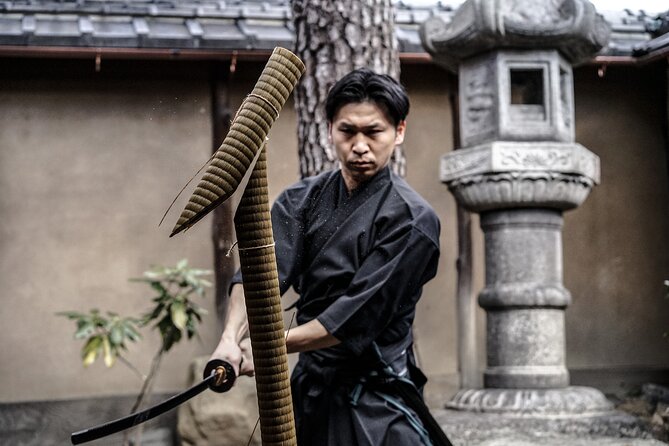
The sword practice is the heart of the experience. You handle a real martial arts training sword and learn basic swordsmanship movements under supervision. The supplied information also describes cutting practice, so the session may include the chance to make a controlled cut rather than only rehearse motions in the air.
That hands-on element gives the activity its price justification. A lecture about samurai history would cost less and could be found in a museum. Here, you receive instruction, clothing, a historic setting, demonstrations, and a physical activity in one compact visit.
The pace appears designed to keep a group involved. With a maximum of 14 people, not everyone will be moving at exactly the same time. You may spend part of the session watching the instructor or other participants. That is not necessarily wasted time, since observing a correct technique can help you understand posture and control.
The group size is still worth considering. Fourteen is small compared with a theater-style attraction, but it is not a private lesson. If you want uninterrupted one-on-one coaching, this is not the right format. If you enjoy sharing a cultural activity with family or friends, the group setting should feel more natural.
Basic fitness is required. You do not need to be an athlete, but the activity involves standing, movement, and controlled sword exercises. The operator asks participants to wear comfortable clothing and appropriate footwear. Minors must be accompanied by an adult.
More samurai and ninja sessions in Kyoto:
- Ninja 1-hour Hands-on Lesson by Japanese master in Kyoto -Entry
★ 5.0 · 489 reviews - Kyoto: Ninja Weapon Forging Experience
★ 4.8 · 478 reviews - Kyoto: Samurai Kenbu Traditional Sword Dancing Show
★ 4.5 · 426 reviews - Samurai Training with Modern day Musashi in Kyoto
★ 5.0 · 256 reviews
Zen meditation and the quieter side of samurai life
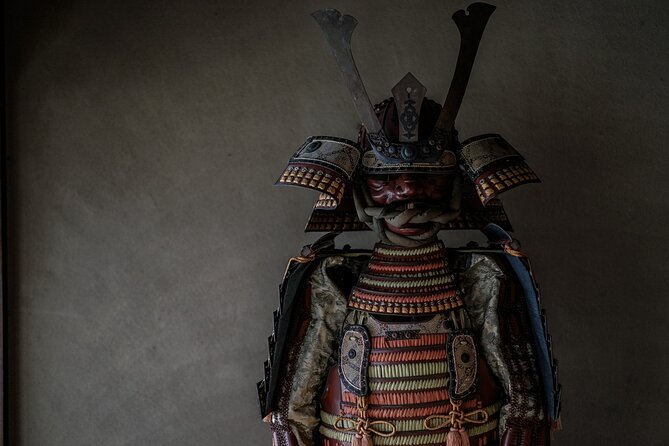
After the active sword work, Zen meditation slows the mood. This is one of the better choices in the program because it keeps the experience from becoming all action and spectacle.
Meditation also gives you a different way to think about samurai discipline. The session connects body control with stillness, attention, and calm. You may find this part especially welcome after concentrating on sword movements.
Additional elements can include tea and a sweet, an old drum, or a performance on a traditional Japanese string instrument. These details are not guaranteed as separate scheduled parts of every session, so think of them as possible additions rather than promises. They do, however, show how the activity can reach beyond sword handling.
The meditation is brief enough for beginners. You are not signing up for a long religious ceremony. Instead, it serves as a calm ending to the physical portion and rounds out the cultural lesson.
What makes the experience feel personal
The staff’s attitude is a major part of the value. The supplied feedback repeatedly highlights a warm welcome, clear explanations, patient instruction, and helpful communication. Those qualities matter in a hands-on activity, especially when participants arrive with different ages, fitness levels, and familiarity with Japanese culture.
The format suits families particularly well. Parents and children can take part together, provided minors are accompanied by an adult. Couples also have a natural reason to book it, since the program creates shared photographs and a common activity rather than another sightseeing stop where everyone simply looks and moves on.
It can also work well for a small group of friends. The sword practice gives everyone something to talk about afterward, while the meditation prevents the session from feeling like a nonstop performance.
The experience has received a 5 out of 5 rating from 1,295 reviews, with 99 percent recommending it. Those figures indicate strong overall satisfaction, but they should not erase the one important warning: at least one participant felt the session did not match the promotional material and considered it expensive for what was delivered. Group size, weather, pacing, and personal expectations can affect how much you enjoy it.
Price and the question of value
At $119.38 per person, this is not a bargain attraction. Kyoto has many inexpensive cultural experiences, and you should compare this cost with what you want from the day.
I think the price is easier to justify if you value active participation. You receive a lesson on Bushido, access to a historic house, kimono clothing, sword instruction, a meditation session, and the chance to handle a martial arts sword. You may also receive photos and encounter extra cultural touches such as tea, sweets, a drum, or traditional music.
The price is harder to justify if you mainly want a quick costume photo or a short sword demonstration. A show or museum visit would likely satisfy that goal at a lower cost. This activity is best understood as a structured cultural workshop, not a simple attraction.
The small-group limit helps. Fourteen participants is not private, but it keeps the event from becoming a crowd scene. The quality of the instructor and the amount of individual practice will matter more than the number of included extras.
Weather, comfort, and practical planning
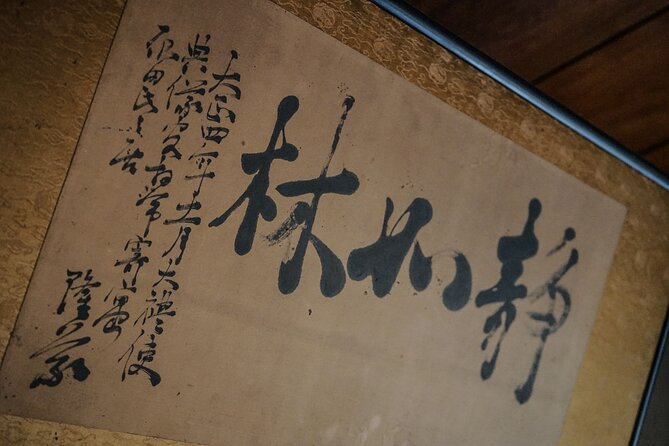
Some of the program may take place outdoors. The experience has provided hand warmers and hot tea on cold days, as well as water, wet cloths, and electrolyte sweets during very hot weather. Even so, dress for the season and be ready for temperature changes.
Wear shoes that allow safe movement. Comfortable clothes are essential beneath the kimono, and you should avoid carrying bulky items that make changing or practicing awkward.
The tour is near public transportation, but the meeting point may not be as convenient as you expect. Check the address before leaving your hotel and build in a little extra time. Since the activity returns to the starting point, you do not need to arrange a separate pickup at the end.
Mobile ticketing makes entry simple. Confirmation is received when you book. If you need to change plans, free cancellation is available up to 24 hours before the start time. Changes or cancellations inside that 24-hour window are not accepted and are not refunded. Rescheduling may be possible before that cutoff, depending on availability.
If accessibility is a concern, contact the operator before booking. The provided information asks people with accessibility questions to send a message, rather than promising a specific level of access.
Who should book this Kyoto activity
I would put this high on the list for families, couples, and friends who want a shared experience with genuine participation. It works especially well when you have already seen several temples and gardens and want to add something more active to your Kyoto schedule.
It is also a good choice for people fascinated by martial arts, Japanese history, traditional clothing, or Zen practice. You do not need prior sword experience. The instruction is intended to introduce the basics.
I would be more cautious if you dislike group activities, have difficulty standing or moving for an extended period, or want a strictly historical lecture. The program is physical, staged in part for participation and photos, and limited to a short introduction rather than a full academic treatment of samurai history.
The activity can be especially memorable for a parent and child. It gives both people a clear role, and the mixture of history, clothing, movement, and meditation keeps the pace varied.
Should you book the Kyoto Samurai Experience?
Book it if you want to do something in Kyoto rather than simply look at another historic site. The preserved house, expert sword instruction, kimono, and Zen meditation make a fuller experience than the name alone suggests.
Skip it if the $119.38 price feels too high for a 1-hour-45-minute activity, or if you want a private lesson with constant individual attention. Also check the route carefully, since the location may be less convenient than the city’s central sights.
For most people who enjoy hands-on cultural activities, I think the combination is worth considering. Go with realistic expectations: you will learn basic techniques and samurai ideas, not complete a warrior’s training. Arrive in comfortable clothing, allow time to find the house, and let the quiet meditation be part of the experience rather than rushing straight to the sword practice.
FAQ
Where does the Kyoto Samurai Experience begin?
It begins at Kyoto Samurai Experience, Waraku111 Inabacho, Nakagyo Ward, Kyoto, 604-8803, Japan.
Where does the experience end?
The activity ends back at the same meeting point where it begins.
How long does the experience last?
It lasts approximately 1 hour and 45 minutes.
How much does it cost?
The listed price is $119.38 per person.
Are morning and afternoon sessions available?
Yes. You can choose between a morning or afternoon departure.
What activities are included?
The session includes samurai history and culture, Bushido, kimono dressing, basic swordsmanship, handling a martial arts sword, and Zen meditation.
Is the group private?
No. It is a small-group activity with a maximum of 14 participants.
Do I need to be physically fit?
You should have a moderate level of physical fitness. The activity includes standing and sword practice, so comfortable clothes and suitable footwear are required.
Can children participate?
Yes, but minors must be accompanied by an adult.
Can I cancel for a refund?
You can cancel for a full refund if you do so at least 24 hours before the scheduled start time. Cancellations or changes made less than 24 hours before the start are not accepted or refunded.
Just added around Kyoto
- Kyoto: Zen Meditation at a Private Temple with a Monk★ 5.0 · 25 reviews
- Kyoto: Gion Geisha District & Sake-in-Hand Walking Tour★ 5.0 · 37 reviews
- Private Pewter Sake Cup Experience with a Kyoto Artisan★ 5.0 · 31 reviews
- Your Private Vacation Photography Session In Kyoto★ 5.0 · 110 reviews
- Private Guided Traditional Buddhist Cooking in Japan★ 5.0 · 16 reviews
- Kyoto Wagashi(Japanese sweets) Cooking Class near Fushimiinari★ 5.0 · 60 reviews
- Traditional Japanese Music show & Experience Tour in Kyoto★ 5.0 · 57 reviews
- Kyoto:Family-Friendly Kimono & Yukata Experience at WARGO★ 5.0 · 147 reviews
Kyoto Tours, compared.
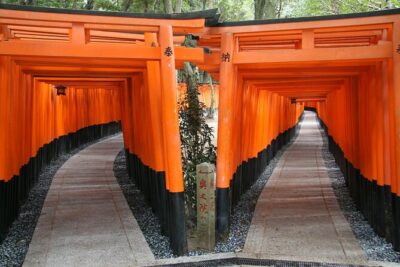
Fushimi Inari, Kinkakuji, Bamboo Grove 1 Day Bus Tour
Read our review →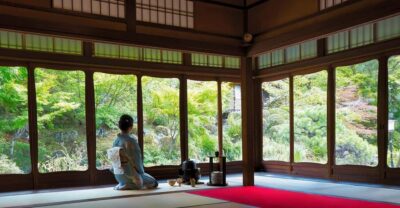
Tea Ceremony in a Traditional Tea House in Kiyomizu
Read our review →
Kyoto Geisha Walking Tour: Gion District & Hidden Gems
Read our review →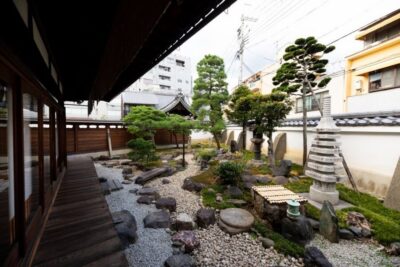

Gion Magical Night Walking Tour with Geisha Trivia
Read our review →
Gion Geisha District Walking Tour – Stories of Geisha
Read our review →Browse the lists this tour appears in