
Reviewed · KYOTO TOURS
Kyoto: Gion Geisha District & Sake-in-Hand Walking Tour
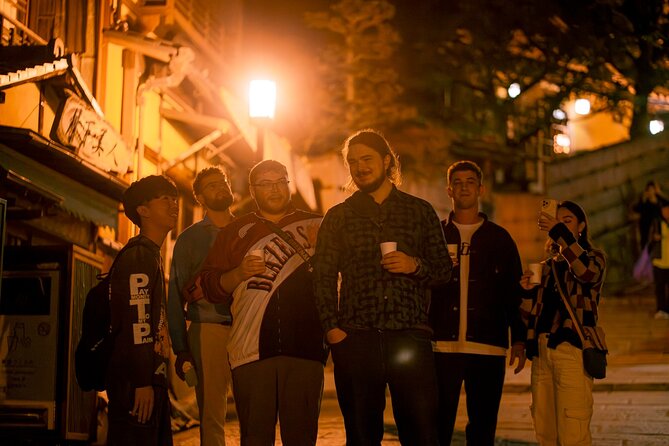
Kyoto’s Gion district changes character after dark. Lanterns soften the wooden facades, side streets grow quiet, and a short walk can reveal a far more atmospheric side of the city than a daytime visit. This tour pairs that evening stroll with sake tasting and plainspoken explanations of geisha culture, shrines, samurai traditions, and Zen.
I like the small-group limit of 10, which gives you a better chance to ask questions and keep a relaxed pace. I also like the route itself: you move from the Kamo River and Gion’s lanes to Yasaka Pagoda, Ninenzaka, and Yasaka Shrine instead of staying on one famous street.
The main consideration is the amount of walking. The tour can last from one hour to one hour and 30 minutes, and one experience ended closer to 70 minutes. Guide interaction may also vary, so this suits you best if you enjoy atmosphere and conversation rather than a tightly scripted history lecture.
Key points to know before booking

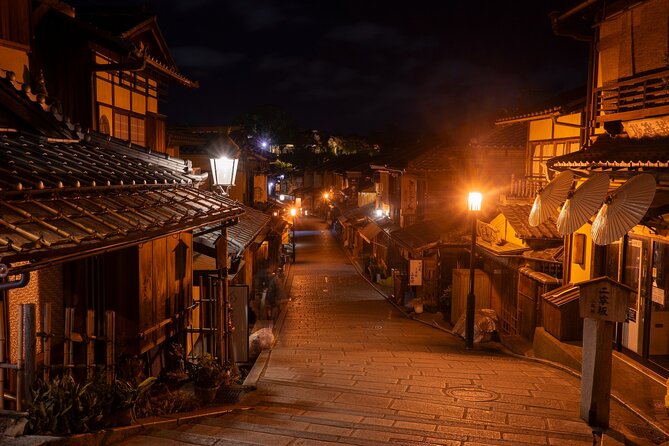
- Lantern-lit Gion after dark: The evening setting gives Hanamikoji Street, temple lanes, and old wooden houses a quieter mood.
- Sake is part of the walk: You sample local sake during the experience, with some guides bringing bottles from different regions of Japan.
- A route through several Kyoto landmarks: The walk links Gion, Yasui-Konpiragu, Yasaka Pagoda, Ninenzaka, Sannenzaka, Nene-no-Michi, and Yasaka Shrine.
- Small groups help the experience: No more than 10 people join, and the group can be much smaller on some dates.
- A cultural introduction, not a geisha performance: You learn about geisha culture and where you might spot a geiko, but sightings are never promised.
- Plan for a night walk: Comfortable shoes, quiet voices, and a moderate level of fitness are important.
Why Gion works best after sunset
Gion is Kyoto’s best-known geisha district, but it is easy to reduce it to a photo stop. The real pleasure comes from moving slowly through its network of wooden machiya houses, teahouses, narrow lanes, and small shrines while a guide explains what you are seeing.
At night, the district often feels more restrained. Lantern light picks out doorways and rooflines, while the side streets can be much quieter than the main sightseeing routes. Rain can add to the mood, although the tour requires good weather and may be canceled if conditions are poor.
You should keep expectations sensible. This is not a staged geisha show, and the guide cannot guarantee a geiko sighting. You may see one passing through the district, but the value of the walk is the setting and the context, not a promised encounter.
The tour begins near Kikunoi Roan in Saitocho, close to the Kamo River. That is a useful starting point because the river gives you a clear sense of Kyoto’s layout before you turn toward Gion. The experience then finishes at Yasaka Shrine, placing you in a central part of Higashiyama for the rest of your evening.
More geisha-district evenings:
- Kyoto Geisha Walking Tour: Gion District & Hidden Gems
★ 4.7 · 3,273 reviews - Kyoto: Gion Magical Night Walking Tour with Geisha Trivia
★ 4.9 · 2,393 reviews - Kyoto: Gion Geisha District Walking Tour – Stories of Geisha
★ 4.7 · 2,187 reviews
From the Kamo River into Gion
The Kamo River is one of Kyoto’s most pleasant natural reference points. Its banks offer open views and a calm contrast to the tight lanes ahead. The river is also tied closely to the city’s daily life and long history, so it makes a natural introduction to Kyoto before the walk becomes more focused on traditional neighborhoods.
From here, you head into Gion. The guide’s role matters most at this stage because the district can look like a maze if you do not know which lanes connect. A local guide such as Shumpei, Mune, or another member of the Otatrip Guide team can point out features you might otherwise pass without noticing.
The discussion includes geisha culture, samurai culture, and Zen meditation. Those subjects give the streets more meaning, but the quality of the conversation depends partly on the guide and the group. Some guides are especially good at answering questions about daily life in Japan and comparing Japanese customs with those of other countries.
If you are curious, ask questions early. The relaxed format works best when you treat it as a conversation instead of waiting for a long speech at every stop.
Hanamikoji Street and the etiquette of Gion
Hanamikoji Street is one of Gion’s most recognizable lanes. Traditional wooden buildings line the route, and the preserved architecture gives you a strong sense of old Kyoto. It is also one of the places where visitors most need to behave carefully.
This is a residential and working district, not an open-air theater. Keep your voice down, do not block entrances, and avoid treating people in the area as photo subjects. The tour specifically asks you to respect local residents, which is good advice for anyone exploring Gion at night.
The guide can explain the difference between the district’s public appearance and its private world. Teahouses and geisha-related spaces are not ordinary shops, and simply walking past them does not mean you can enter or take pictures. The route is about observing from public streets and learning the setting.
This section may be the highlight for photographers. Lanterns, dark timber, and narrow pavement create strong night scenes. Still, you should be ready for crowds or restrictions on photography in certain areas, since the district remains sensitive to visitor behavior.
Yasui-Konpiragu and a small shrine with a memorable purpose

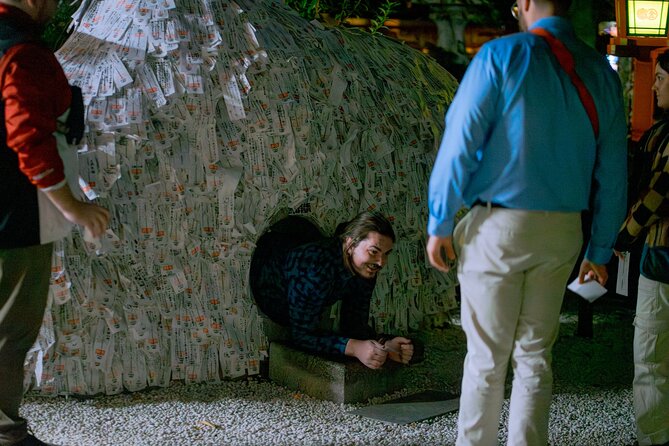
Yasui-Konpiragu adds a different kind of stop to the walk. The shrine is known for helping people sever bad relationships and form good ones. Its large Enkiri, or relationship-cutting, stone is the feature that gives the site its unusual reputation.
The stop lasts about 15 minutes, enough time for an explanation and a look around without turning the tour into a formal shrine visit. The guide can help you understand why the shrine attracts people with personal hopes and concerns, rather than presenting it as just another attractive building.
This is also a useful reminder that Kyoto’s religious sites are not all grand temple complexes. Some are small, specific, and closely tied to everyday wishes. You get more from the visit if you listen for the human reason behind the shrine’s traditions.
As with any active religious place, act with care. Follow the guide’s lead and avoid loud conversation. The nighttime setting can make this stop feel quiet and personal.
More drinks-led nights in Kyoto:
- Kyoto Night Foodie Tour in Gion (9+ dishes + 6 Sake tastings)
★ 5.0 · 1,762 reviews - 3-Hour Kyoto Insider Sake Brewery Tour with Tastings & Pairings
★ 5.0 · 917 reviews - Arashiyama Bamboo, Temple, Monkeys, or Secret Sake Brewery
★ 4.8 · 886 reviews - Kyoto: Izakaya Bars Guided Walking Tour
★ 4.9 · 815 reviews
Yasaka Pagoda and the Higashiyama streets

Hokanji Temple, better known as Yasaka Pagoda, is one of Kyoto’s most familiar sights. The five-story pagoda rises above the Higashiyama district and gives the surrounding lanes a strong visual focus. The structure dates to the sixth century, according to the tour material, and it is one of the area’s key landmarks.
You have about 15 minutes here. That is enough for photographs and background, but not a full temple visit. The tour focuses on the exterior route and the surrounding streets, so do not book it expecting extended time inside every religious site.
After the pagoda, the route reaches Ninenzaka and Sannenzaka. These gently sloping, stone-paved streets are lined with preserved wooden buildings and traditional shops. During the day, they can be crowded. At night, the mood may be calmer, with illuminated facades and fewer people depending on the date and weather.
The listed time at each slope is brief, about five minutes each. Think of these stops as scenic passages rather than long visits. You will have time to take in the architecture and hear the guide’s explanation, but you will not have time for a leisurely round of shopping.
The stone pavement and slopes also explain why shoes matter. Wear footwear with good grip and enough support for a night of walking. This is not a difficult hike, but the route is more active than a short stroll between two nearby sights.
Nene-no-Michi and the approach to Yasaka Shrine
Nene-no-Michi is a quieter stone path named after Nene, the wife of Toyotomi Hideyoshi. It connects the area around Kodaiji Temple with Maruyama Park and gives the route a welcome change of pace after the more famous streets.
The path has a gentler, less commercial feel. You can pay attention to the paving, walls, trees, and traditional buildings while the guide adds more context about Kyoto’s past. The scheduled stop is about 10 minutes, so the emphasis remains on walking and interpretation rather than a long pause.
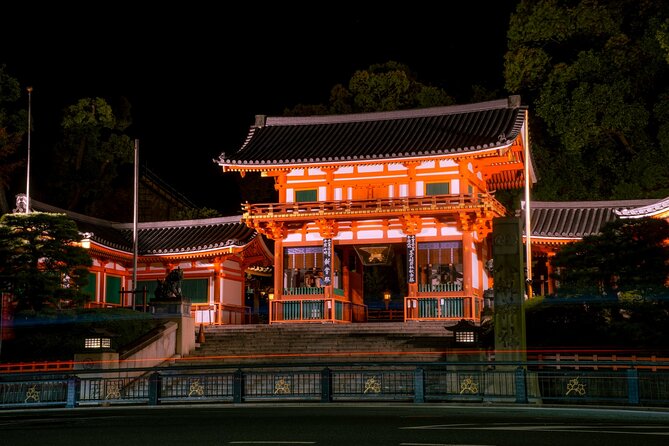
The route then reaches Yasaka Shrine, where the tour ends. Yasaka Shrine is also called Gion Shrine and dates to 656 AD. It has a close connection to the Gion district and is one of Kyoto’s major Shinto sites.
The final visit lasts about 20 minutes, making it the longest stop on the route. That gives you time to see the shrine grounds at night and ask final questions before saying goodbye. Ending here is practical because Yasaka Shrine sits near other Higashiyama sights and evening dining areas.
Most buses may have stopped running by the time the tour finishes. The provider can help you catch a taxi or return to the starting area, but you should not assume that a bus will be available. Check your route before setting out, especially if you are staying far from central Kyoto.
What the sake tasting adds
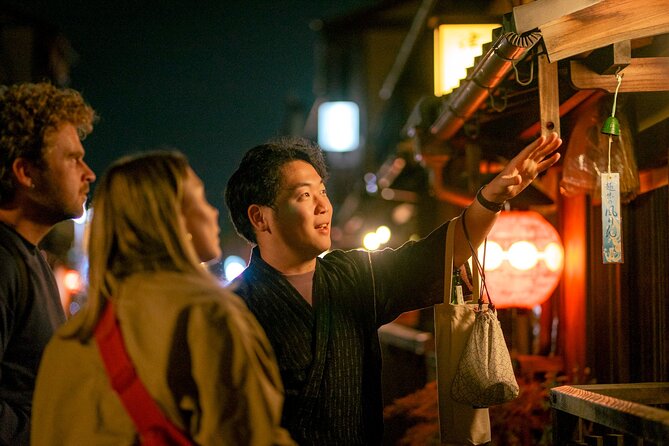
The sake element is more than a drink placed at the end of a walking tour. It gives the group an easy way to talk and makes the evening feel less formal. Some guides bring several sake varieties from different regions of Japan, allowing you to compare flavors rather than sample just one bottle.
Snacks may also be included, but the available information does not specify exactly what or how much you receive. Treat the sake as a tasting, not a meal. Have dinner plans before or after the walk.
The phrase sake in hand should not be taken too literally as permission to wander carelessly through the streets. Drink responsibly, keep your voice low, and remember that you are passing through residential areas. Alcohol is included, and participants must be at least 20 years old.
The tasting is a good fit if you want a social evening with a local drink. It is less suitable if you do not drink alcohol or want a food-focused tour. The price does not appear to include a large meal, and the central purpose remains the walking route and cultural explanation.
Price, group size, and overall value
At $27.84 per person, this is a modestly priced Kyoto experience. The value comes from combining a local guide, a small-group route, and sake tasting in about one to one and a half hours. You are also getting help with navigation in a district where the narrow lanes can be confusing.
The price makes the tour especially useful early in your Kyoto stay. A guide can help you get your bearings in Gion, show you how the main streets connect, and give you ideas for returning on your own. You may not need a second guided visit after learning the route.
The group limit is 10 people, though some departures can be smaller. A tiny group can make the guide more available for questions, but it can also place more pressure on the guide to keep conversation moving. One poor experience reported little interaction, so this format is not automatically intimate simply because the group is small.
The experience has a 4.8 rating from 37 reviews and a 95 percent recommendation rate. Those numbers point to strong satisfaction overall, while the lower scores suggest a fair warning: the tour is only as engaging as the guide’s interaction and your own interest in asking questions.
Who should book this Kyoto night walk?
I would choose this tour if you want:
- A short introduction to Gion after dark
- A guide who can explain geisha culture without turning the evening into a performance
- A route through several famous Higashiyama streets and shrines
- A casual sake tasting with local context
- A small group rather than a large bus tour
- An easy first-night activity near central Kyoto
You may want something else if you prefer long temple visits, a formal lecture, a full dinner, or a guaranteed geisha encounter. The stops are short, and several are viewed from the route rather than explored in depth.
It also may not suit you if walking on slopes and stone pavement is uncomfortable. The tour asks for moderate physical fitness, and comfortable clothing and shoes are essential.
Book with an open attitude toward the evening. The most memorable parts are likely to be the lantern-lit lanes, the quiet path through Higashiyama, and the chance to discuss Japan over small sake samples. It is not a grand production, and that is part of its appeal.
Practical details that matter
The meeting point is Kikunoi Roan, at 118 Saitocho, Shimogyo Ward. The ending point is Yasaka Shrine at 625 Gionmachi Kitagawa in Higashiyama. The tour is close to public transportation at the start, but late-night transport can be more limited at the finish.
Confirmation arrives when you book, and a mobile ticket is available. Group discounts may be offered. You can cancel for a full refund up to 24 hours before the start time. Cancellations or changes within 24 hours are not refunded or accepted.
The tour depends on good weather and a minimum number of participants. If poor weather or low enrollment causes cancellation, you can choose another date or experience, or receive a full refund.
Should you book the Gion Geisha District and Sake-in-Hand Walking Tour?
Book it if you want a reasonably priced, atmospheric introduction to Gion with a few well-chosen Higashiyama sights and a sake tasting folded into the walk. Guides such as Shumpei and Mune have been praised for friendly conversation, local explanations, and sake from different Japanese regions.
Just keep the limits in mind. This is a compact walking tour, not a full evening program. The route may finish closer to an hour than 90 minutes, the walking is steady, and the amount of guide interaction can vary.
For many visitors, the combination of lantern light, quiet lanes, shrines, and sake will make the tour worth the time and money. If that sounds like your kind of Kyoto, it is a sensible pick for an evening in Gion.
FAQ
How long does the Gion and sake walking tour last?
The tour lasts approximately one hour to one hour and 30 minutes. The exact duration can vary.
Where does the tour start?
The meeting point is Kikunoi Roan, at 118 Saitocho, Shimogyo Ward, Kyoto.
Where does the tour end?
The tour ends at Yasaka Shrine, at 625 Gionmachi Kitagawa in Kyoto’s Higashiyama Ward.
Is sake included?
Yes. A local sake tasting is included, and some guides bring sake from several regions of Japan. Snacks may also be provided.
What is the minimum age?
Participants must be at least 20 years old because alcohol is provided.
How many people can join?
The tour has a maximum of 10 participants.
Do I need to be physically fit?
You should have a moderate level of physical fitness. The tour involves substantial walking on streets that include slopes and stone pavement, so comfortable shoes are recommended.
Can I cancel for a full refund?
Yes, if you cancel at least 24 hours before the experience start time. Cancellations within 24 hours are not refunded. If poor weather or insufficient enrollment causes the provider to cancel, you can receive a full refund or choose another option.
More Walking Tours in Kyoto
- Night Walk in Gion: Kyoto’s Geisha District
★ 4.5 · 2,003 reviews - Kyoto Gion Geisha District Walking Tour – The Stories of Geisha
★ 5.0 · 1,441 reviews - Nishiki Market Brunch Walking Tour (7 Tastings + Brunch)
★ 5.0 · 1,355 reviews - Kyoto Arashiyama Walking Tour: Bamboo, Monkeys, Gardens & Secrets
★ 5.0 · 1,216 reviews
More Food Tours in Kyoto
- Kyoto: Insider Sake Brewery Tour with Sake and Food Pairing
★ 5.0 · 704 reviews - Kyoto Sake Brewery & Tasting Walking Tour
★ 5.0 · 623 reviews - Kyoto Nishiki Market Food and Culture Walking Tour
★ 5.0 · 412 reviews - Kyoto: Gion Food Tour 13 Dishes at 4 Eateries
★ 5.0 · 408 reviews
Just added around Kyoto
- Kyoto: Zen Meditation at a Private Temple with a Monk★ 5.0 · 25 reviews
- Private Pewter Sake Cup Experience with a Kyoto Artisan★ 5.0 · 31 reviews
- Your Private Vacation Photography Session In Kyoto★ 5.0 · 110 reviews
- Private Guided Traditional Buddhist Cooking in Japan★ 5.0 · 16 reviews
- Kyoto Wagashi(Japanese sweets) Cooking Class near Fushimiinari★ 5.0 · 60 reviews
- Traditional Japanese Music show & Experience Tour in Kyoto★ 5.0 · 57 reviews
- Kyoto:Family-Friendly Kimono & Yukata Experience at WARGO★ 5.0 · 147 reviews
- Private Cooking Class Udon in Kyoto Japan★ 5.0 · 23 reviews
Kyoto Tours, compared.


Fushimi Inari, Kinkakuji, Bamboo Grove 1 Day Bus Tour
Read our review →
Tea Ceremony in a Traditional Tea House in Kiyomizu
Read our review →
Kyoto Geisha Walking Tour: Gion District & Hidden Gems
Read our review →

Gion Magical Night Walking Tour with Geisha Trivia
Read our review →

Gion Geisha District Walking Tour – Stories of Geisha
Read our review →Browse the lists this tour appears in