
Reviewed · KYOTO TOURS
Kyoto: Samurai Kenbu Traditional Sword Dancing Show
Kyoto’s Samurai Kenbu show turns samurai culture into an hour of graceful movement, poetry, ceremony, and controlled sword work. The performers do not simply trade blows onstage. They use the sword, fan, posture, and rhythm to tell short tales from Japan’s feudal age.
I like the English narration, which gives each performance a clear place in samurai life. I also like the short lesson at the end, when you draw and handle a sword under instruction rather than only watching from your seat.
The main point to know is that this is sword dancing, not a full fight show. The stage is intimate, and the emphasis is on elegance, discipline, and storytelling. If you want nonstop action or a large theatrical production, this may feel quieter than expected.
Key points to know before booking
- 700 years of tradition: Kenbu connects sword movement with poems recited before battle.
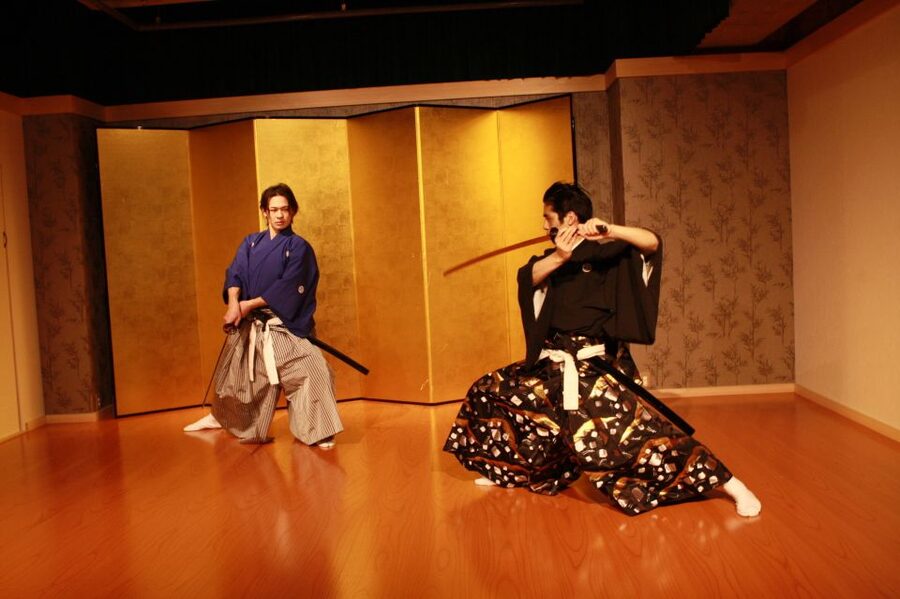
- More than swordplay: Performers use folding fans, ceremony, facial expression, and precise footwork.
- English narration: Short explanations introduce the stories, techniques, and samurai customs.
- Hands-on finale: You can practice basic movements with a sword and possibly a folding fan.
- Convenient Kyoto location: The theater is a four-minute walk from Sanjo Keihan Subway Station.
- One-hour format: The compact schedule fits neatly into a day of sightseeing, though some people may find the ending slightly long.
What Kenbu really is
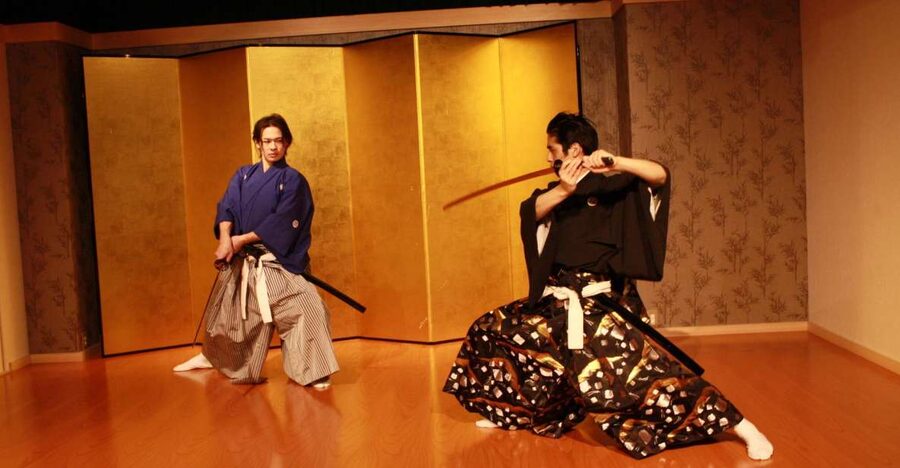
Kenbu, sometimes written Kembu, is a traditional Japanese sword dance. Its movements are linked to the poems and songs associated with samurai preparing for battle. The sword is not treated only as a weapon. It is also part of a formal performance built around control, posture, timing, and feeling.
That distinction matters. Popular images of samurai often focus on fast sword fights, but Kenbu presents a different side of the warrior ideal. You see restraint, ceremony, and the responsibility that came with carrying a sword.
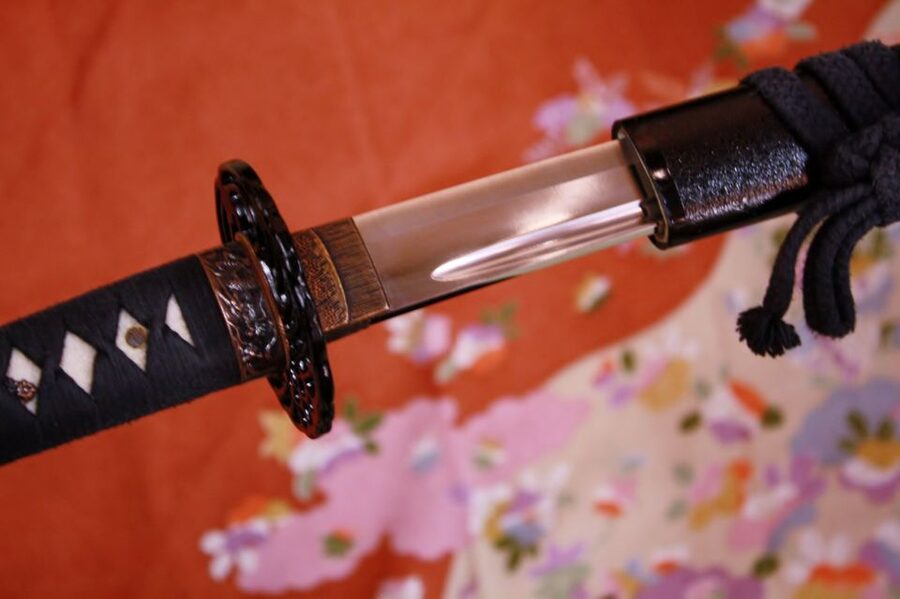
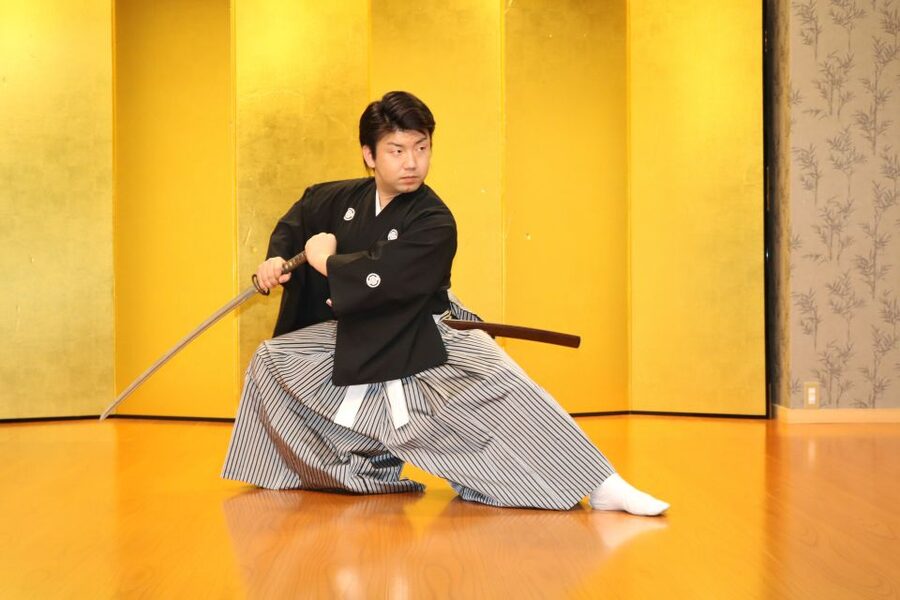
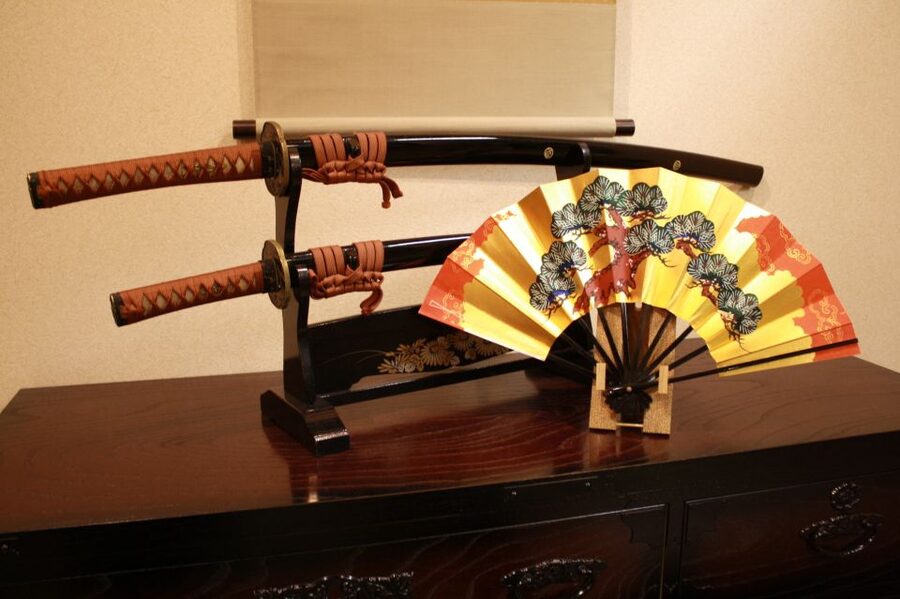
The performance looks smooth because the artists have trained to make difficult movements seem easy. A sword is drawn, held, turned, and returned to its scabbard with care. The folding fan adds another layer, taking the place of a sword in some moments and helping express a character, gesture, or scene.
I find this approach more useful than a simple staged duel. You get a glimpse of how samurai values are presented through art, not just through combat. At the same time, the show remains accessible, with humor and direct interaction keeping the tone from becoming too solemn.
More Samurai and Ninja Experiences in Kyoto
- Kyoto Samurai Experience
★ 5.0 · 1,294 reviews - Kyoto: Kendo and Samurai Experience with Uniform and Gear
★ 4.9 · 815 reviews - Kyoto: Samurai Sword Class by Experts in Traditional Arts
★ 4.9 · 657 reviews
Arriving at the Samurai Kembu Theater
You meet at the Samurai Kembu Theater in Kyoto. It is about four minutes on foot from Sanjo Keihan Station on the Kyoto City Subway and about five minutes from Sanjo Station on the Keihan Main Line.
Plan to arrive five to fifteen minutes before the start. You will remove your shoes before entering, following Japanese custom. Wear socks or otherwise be comfortable going without shoes for the performance.
The theater does not have a waiting room, so arriving far too early is not especially useful. People without appointments cannot wait inside the room. Large luggage and travel bags also have no proper storage space, so leave suitcases at your accommodation or use another luggage facility before coming.
This is a central Kyoto location, making it easy to pair with other sights around Sanjo and Gion. You do not need hotel pickup, and none is included. That keeps the price lower, but you are responsible for finding the theater and arriving on time.
The introduction: history, duty, and technique
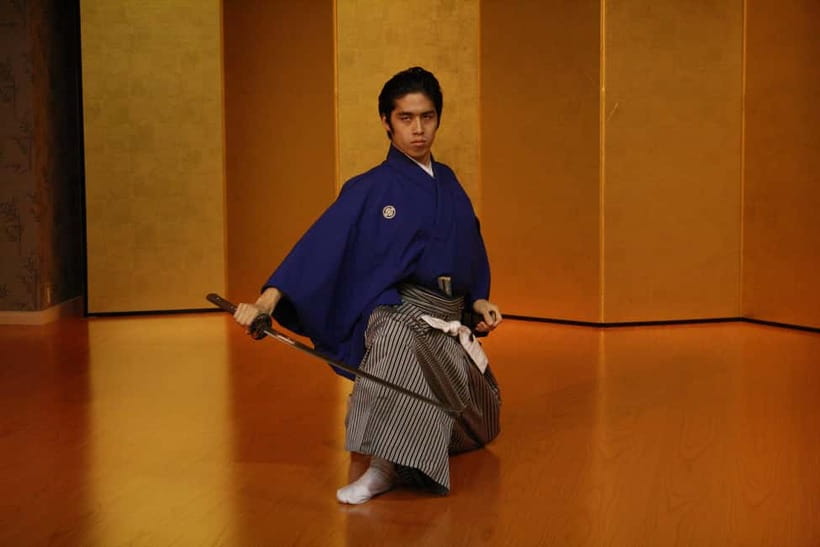
Once seated, you begin with an introduction to Kenbu and samurai culture. The instructor explains the background of the art, the meaning of its movements, and the responsibility connected with carrying a samurai sword.
The English and Japanese instruction is an important part of the experience. You are not left to guess what a movement means. Before each dance, you hear a short explanation of the tale or historical setting, which helps you follow the action even when the choreography is stylized.
The presentation covers the broad period from the 12th through the 19th centuries. That is a long span of Japanese history, so this is not a detailed history lecture. Think of it as a cultural introduction, using several short stories to show changing ideas about samurai conduct and tradition.
Some English explanations may be easier to follow than others. One part of the experience can move quickly for listeners who are not used to the subject or the speaking style. Still, the structure helps: an explanation comes first, then the performance gives you a visual example.
Pay attention to the details around the sword. The show is designed to make you think about the object’s weight and meaning, not simply its cutting ability. That makes the later practice session more interesting, since you have already seen how much care goes into basic handling.
Watching the traditional and modern Kenbu performances
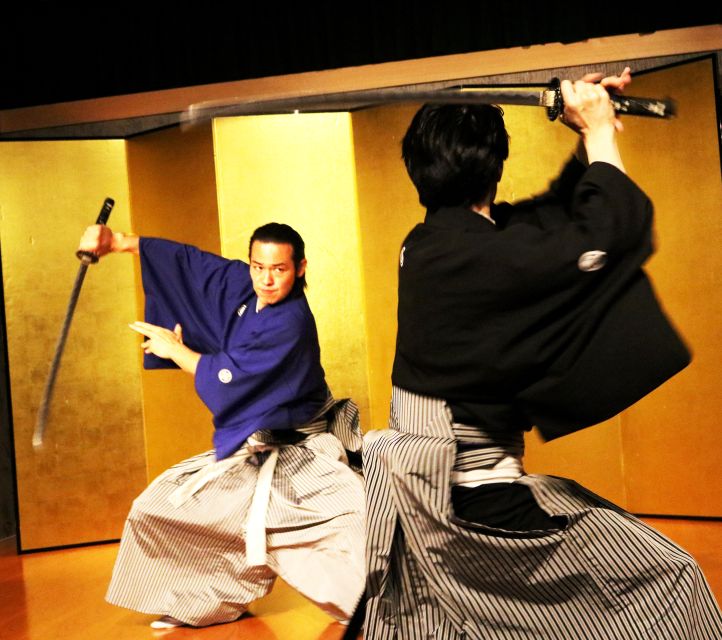
The main program is a series of Kenbu demonstrations. Each performer moves through a carefully arranged sequence of sword gestures, following the poems associated with samurai before battle.
You will see both traditional-style and new-style Kenbu. The traditional pieces lean toward formal movement and established patterns. The newer style can feel more theatrical, with stronger drama and clearer stage storytelling. Together, the two approaches show how an old art can be kept active rather than frozen in the past.
The performers use the whole body. A turn of the shoulder, a shift of the feet, or the angle of the head can change the feeling of a scene. The sword may suggest readiness, grief, courage, or farewell. At times the movement is forceful. At others, it is measured and almost quiet.
The most impressive part is often the control. A professional can make a sword swing look casual, but the lesson afterward makes clear how much balance and concentration are required. When you try even a basic motion, the performance’s polished quality becomes easier to appreciate.
The stories include heroic and tragic elements. There is also some humor in the acting, including moments when a character facing death plays the scene with a lighter touch. That humor helps younger audience members and anyone unfamiliar with Japanese theater stay engaged.
Do not expect a broad stage packed with scenery. The setting is intimate, and the focus remains on the artists. Some people prefer this close view because it lets you notice the details of posture and expression. If you imagined a large-scale action spectacle, adjust your expectations before booking.
Photography and video are not allowed during the show. This rule protects the performance and keeps the room free from glowing screens and camera noise. Afterward, you are given time to take pictures, and the performers may help create samurai-style photographs.
More samurai and ninja sessions in Kyoto:
- Skip the lines Basic Ticket at SAMURAI NINJA MUSEUM KYOTO
★ 4.5 · 632 reviews - Ninja 1-hour Hands-on Lesson by Japanese master in Kyoto -Entry
★ 5.0 · 489 reviews - Kyoto: Ninja Weapon Forging Experience
★ 4.8 · 478 reviews - Samurai Training with Modern day Musashi in Kyoto
★ 5.0 · 256 reviews
The folding fan and the language of movement
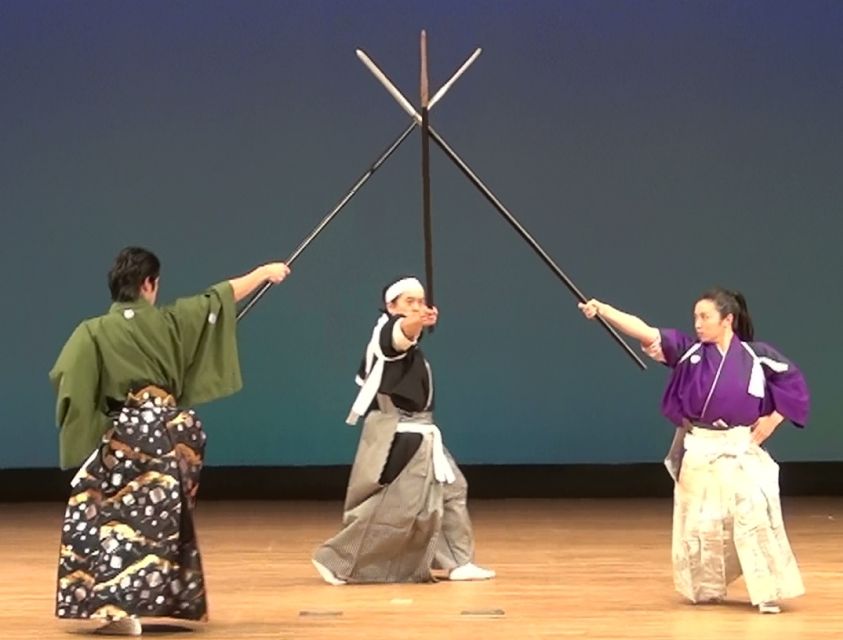
The sword receives top billing, but the folding fan is a key part of Kenbu. A fan was a practical object in samurai culture, yet in performance it can suggest movement, status, emotion, or another object in the story.
If time allows, you may learn how to use a fan during the mini-experience. This part is not guaranteed in the same way as the sword lesson, since it depends on the time available after the main program.
I like the fan demonstration because it widens the experience beyond the obvious sword theme. You see that Kenbu is a performing art with a wider vocabulary of gestures. The fan also gives the performers another way to show refinement and control.
For families, this variety helps hold attention. Children may wait for the sword handling, while adults can focus on the connection between poetry, ceremony, and stage movement. A three-year-old has attended successfully, and teenagers have found the lesson interesting, though individual attention spans will vary.
The short sword lesson after the show
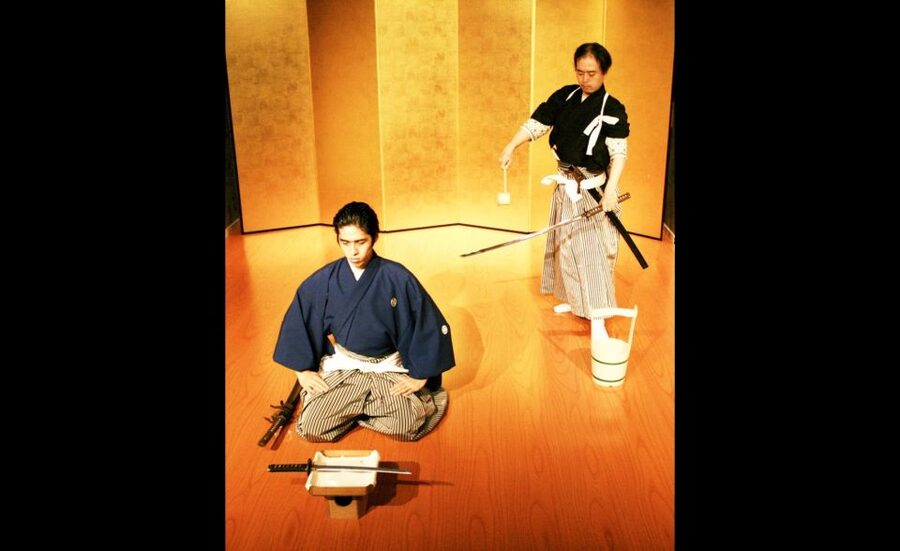
After the performance, the artists return for the interactive section. You can hold a sword, slowly draw it from the scabbard, and learn basic movements under the instructor’s command.
The lesson starts gently. You practice how to hold the sword and how to swing with control, then add a little more force as instructed. The emphasis is on safe, deliberate handling. This is not combat training, and you should not expect to learn fencing or Kendo in one short session.
The activity gives you a better feel for the discipline behind Kenbu. A sword that looks light and effortless in a performer’s hand feels more demanding when you must keep your posture, grip, and movement together.
There may also be a chance to practice a fan. The exact amount of time depends on the schedule and group. The sword lesson is the more reliable part of the mini-experience.
The instructors keep this section friendly and relaxed. Their humor helps beginners feel at ease, especially when a simple movement suddenly feels awkward. You may also learn a few shouted words or calls used during the movements.
After the lesson, you can take photos with the performers and swords. This is your opportunity to capture the dramatic poses that are off-limits during the show. The staff can take pictures for you, which is useful if you are traveling alone or want a photo of the whole group.
Remember that the sword is handled only as directed. The point is to learn respect and control, not to swing freely. The best photographs come after you have listened carefully and adopted the correct stance.
Is the one-hour schedule enough?
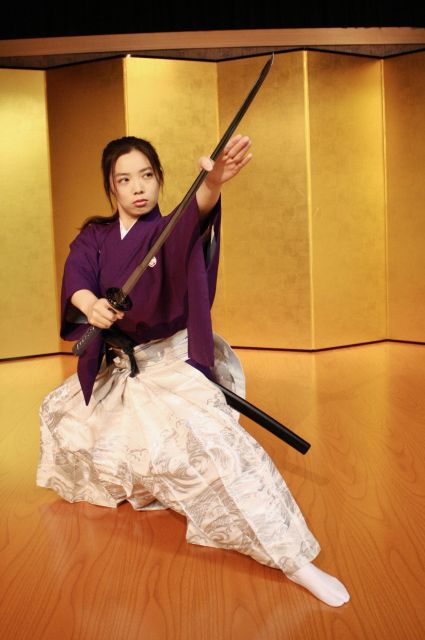
For most people, one hour is a good length. It gives you a complete performance, cultural explanations, and a short practical lesson without taking half a day from Kyoto sightseeing.
The compact format is especially useful if you are fitting the show between temple visits, shopping, or an evening meal. You can reach the theater easily by rail, and the central location makes it simple to continue exploring after the final photographs.
The trade-off is that the program can feel slightly packed. You move from explanation to performance and then to the hands-on session in a short period. If you want a long workshop or detailed instruction in sword arts, this experience will be only an introduction.
One hour also means the historical background stays at an overview level. You will hear about samurai culture and the meaning of Kenbu, but you will not receive a full course on Japan’s political or military history. I see that as a sensible choice for a stage show, as long as you book it for cultural insight rather than academic detail.
The $32 price and what you receive
At $32 per person, the cost includes theater admission, the Kenbu show, and the short sword lesson. Food, drinks, transportation, and hotel transfers are not included.
I consider the price reasonable for a central Kyoto performance that combines live theater with an interactive finale. You are paying for skilled performers, an English-supported introduction, a complete one-hour program, and the chance to handle a sword under supervision.
The value is strongest if you take part in the lesson and photos. If you only want to sit and watch sword dancing, you may find other cultural performances more satisfying, especially if you prefer music, costumes, or a larger stage.
The experience has a 4.5 rating from 426 bookings, which fits its appeal as a short, polished introduction to samurai culture. It is not the cheapest activity in Kyoto, but the hands-on portion gives it more substance than a standard spectator show.
Free cancellation is available up to 24 hours before the activity for a full refund. You can also reserve now and pay later, which helps if your Kyoto schedule is still changing.
Who should book this Kyoto samurai show?
I would recommend it most strongly to:
- First-time visitors to Japan who want a clear introduction to samurai customs.
- Families looking for an activity that combines history, performance, and participation.
- Teenagers and adults interested in swords, Japanese culture, or traditional theater.
- History fans who enjoy learning through short stories rather than a museum lecture.
- Solo visitors and couples who want a central, one-hour activity with photo opportunities.
- Visitors with limited time who need a compact cultural experience.
It is less suitable if your main goal is a realistic sword fight, a large stage, or extended martial-arts practice. The show favors grace over speed and ceremony over battle spectacle.
Wheelchair access is available, and instruction is offered in English and Japanese. The no-photo rule during the performance, lack of a waiting room, and limited luggage space are the practical points most likely to affect your plans.
My verdict: a graceful introduction with a fun finale
Book this show if you want to see samurai culture presented through movement, poetry, and ceremony, then try a few basic sword actions yourself. The strongest parts are the performers’ control, the English explanations before each tale, and the friendly hands-on session afterward.
Go in expecting Kenbu rather than Kendo, and a compact theater rather than a grand stage. With that expectation, the $32 price feels fair, especially for families and first-time visitors who want something more active than simply looking at historic sites.
FAQ
Where is the Samurai Kenbu Theater?
The theater is in Kyoto on Honshu, Japan. It is about four minutes on foot from Sanjo Keihan Subway Station and five minutes from Sanjo Station on the Keihan Main Line.
How long does the experience last?
The activity lasts one hour, including the introduction, Kenbu performances, and short sword lesson.
What is included in the ticket price?
The price includes entry to the Samurai Kenbu Theater, the Kenbu show, and a short sword lesson.
Is the performance in English?
The instructor is available in English and Japanese. Traditional tales are presented with English narration.
Can I take photos during the show?
No. Photography and video are not allowed during the performance. You can take photos after the show when the performers return for the interactive portion.
Can I hold a real samurai sword?
You can hold and practice basic movements with a sword during the short lesson, following the instructor’s directions. The experience is supervised and is not a full martial-arts class.
Will I learn to use a folding fan?
If time allows, you may also learn basic fan movements. The folding-fan portion depends on the time remaining after the main program.
Is the theater wheelchair accessible?
Yes, the activity is wheelchair accessible.
What should I bring or avoid bringing?
Arrive five to fifteen minutes early and be ready to remove your shoes. Do not bring large luggage or travel bags, since there is no room for them. The theater also asks you not to attend under the influence of alcohol.
More Shows in Kyoto
- Kyoto Gion Cultural Walk & Geisha Show with Dining Options
★ 5.0 · 518 reviews - Kyoto Gion Cultural Walk & Geisha Show with Dining Options
★ 5.0 · 483 reviews - 1 Hour Geisha Show in Kyoto
★ 5.0 · 452 reviews - Kyoto: Meet-and-Greet, Maiko Show and Experience
★ 4.8 · 286 reviews
Just added around Kyoto
- Kyoto: Zen Meditation at a Private Temple with a Monk★ 5.0 · 25 reviews
- Kyoto: Gion Geisha District & Sake-in-Hand Walking Tour★ 5.0 · 37 reviews
- Private Pewter Sake Cup Experience with a Kyoto Artisan★ 5.0 · 31 reviews
- Your Private Vacation Photography Session In Kyoto★ 5.0 · 110 reviews
- Private Guided Traditional Buddhist Cooking in Japan★ 5.0 · 16 reviews
- Kyoto Wagashi(Japanese sweets) Cooking Class near Fushimiinari★ 5.0 · 60 reviews
- Traditional Japanese Music show & Experience Tour in Kyoto★ 5.0 · 57 reviews
- Kyoto:Family-Friendly Kimono & Yukata Experience at WARGO★ 5.0 · 147 reviews
Kyoto Tours, compared.
Fushimi Inari, Kinkakuji, Bamboo Grove 1 Day Bus Tour
Read our review →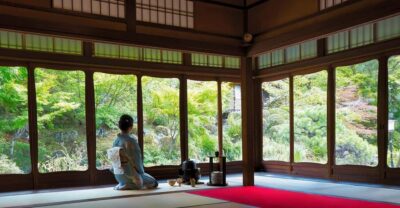
Tea Ceremony in a Traditional Tea House in Kiyomizu
Read our review →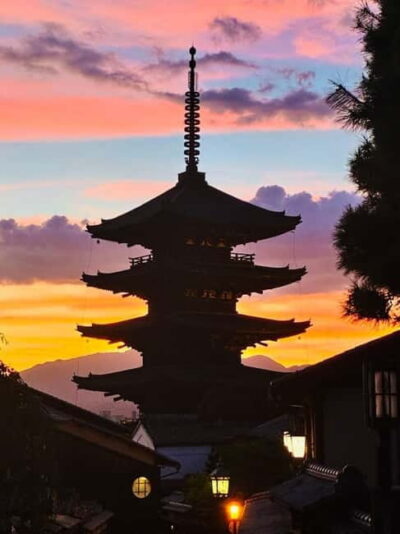
Kyoto Geisha Walking Tour: Gion District & Hidden Gems
Read our review →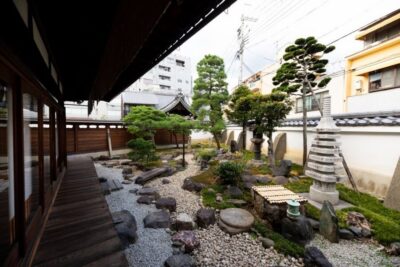

Gion Magical Night Walking Tour with Geisha Trivia
Read our review →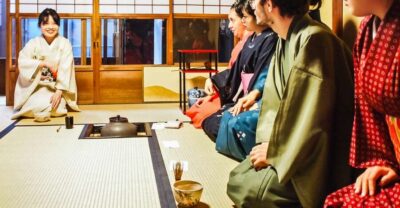

Gion Geisha District Walking Tour – Stories of Geisha
Read our review →Browse the lists this tour appears in