
Reviewed · HAKONE TOURS
Hike Japan Heritage Hakone Hachiri with certified mountain guide
Hakone Hachiri is not simply a country walk. It is an old route across the Hakone mountains, where you follow stone paving once used by Edo-period samurai, merchants, and ordinary people traveling between Edo and Kyoto. The day links Amazake Tea House, Lake Ashi, and the old cedar road with castle ruins and a riverside finish in Mishima.
I like the way this tour combines walking with local buses, so you cover a broad stretch without forcing yourself through every currently closed section. I also like the small group limit of six and the care offered by Aki, also named Akihiro, a certified guide with wilderness first-aid training. The main catch is that this is a real hike, with slopes, uneven stone, and about 8 kilometers on foot, not a gentle sightseeing stroll.
Key points to know
- Follow an Edo-era highway: Walk sections of the Old Tokaido route, including the cobbled Hakone Hachiri path and towering cedar avenue.
- See Hakone from several angles: Lake Ashi, Hakone Shrine’s Heiwa no Torii, and possible views of Mt. Fuji give the day variety.
- Use buses as part of the journey: Shared taxis and local buses connect the trail sections, including a ride past a temporarily closed portion.
- Finish in Mishima: The tour ends at Mishima Station, with onward Shinkansen trains to Odawara and Tokyo.
- Expect a full seven-hour day: Lunch, transport, walking, and sightseeing fill most of the day from the 9 a.m. start.
- Budget for extras: Lunch, local transport, snacks, and an optional Shinkansen ride are not included in the tour price.
Why Hakone Hachiri makes a better history walk
Many Hakone outings focus on Lake Ashi, the ropeway, or hot-spring towns. This one gives you the route between places. That difference matters. You are not just stopping at scenic points. You are learning how people crossed the mountain before modern roads and railways made the journey easy.
Hakone Hachiri forms part of the old Tokaido Highway. The mountain section was a hard passage, with steep grades and rough paving. Your guide can explain why the road mattered, how movement was controlled, and what travelers faced on the way between eastern and western Japan.
I like that the route has several kinds of interest. The forest and lake provide the natural setting, while the checkpoint and castle ruins explain the political side of the journey. The walk also has a clear sense of direction: you begin at Hakone Yumoto and finish at Mishima, rather than ending where you started.
The guide is a major part of the value. Aki is described as calm, kind, and well informed about both local nature and Japanese history. He also takes photographs for families during the day, a useful touch when you are busy walking and cannot easily take group pictures yourself.
More walks and treks around Hakone:
- Hike Hakone Hachiri
★ 5.0 · 48 reviews - Traverse Outer Rim of Hakone Caldera and Enjoy Onsen Hiking Tour
★ 5.0 · 30 reviews - Hakone Hachiri: Old Tokaido Highway Hiking Tour
★ 4.9 · 22 reviews
Starting at Hakone Yumoto and reaching Amazake Tea House
Meet at Hakone Yumoto Station at 9 a.m. From there, a shared taxi takes you toward the trailhead. That short ride is practical, since it avoids using your early energy on less interesting road walking.
The first walking section lasts about an hour and leads toward the Amazake Tea House area. Along the way, you reach a woodcraft village where local artisans demonstrate traditional uses of timber. This gives the morning a human touch before the route turns more strongly toward the historic road.
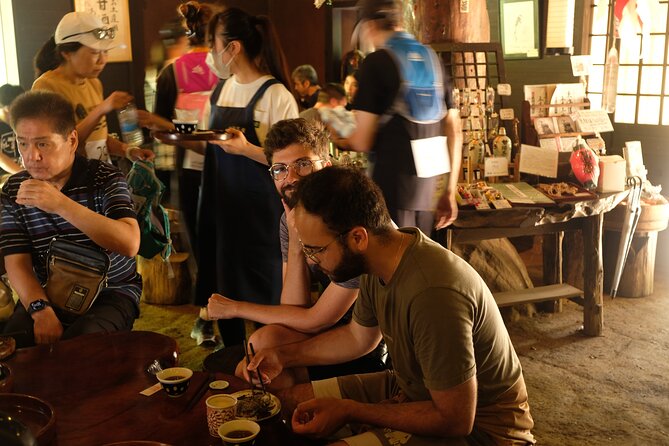
The tea house is also a natural place to pause. Amazake, a traditional sweet rice drink, and snacks can be purchased separately. They are not included, so carry some yen if you want to try them or pick up something for the trail.
This first portion sets the tone for the day. You get a mix of village life, forest, and old-road history rather than a long lecture at one fixed site. The tradeoff is that the route may feel slow if you are expecting immediate views of Lake Ashi. The most rewarding parts build gradually.
Walking the cobblestones toward Lake Ashi
From the Amazake Tea House area, the route continues over old stone paving. These cobbles are one of the most memorable parts of Hakone Hachiri, but they are also where suitable footwear matters most. Wear sturdy walking shoes with good grip, and expect your pace to be slower than on a smooth path.
The stones help you picture the original journey. This was not a polished park trail made for casual strolling. It was a working road across a difficult mountain crossing. A certified mountain guide can point out how the route fits into the wider Tokaido system and explain the people who once used it.
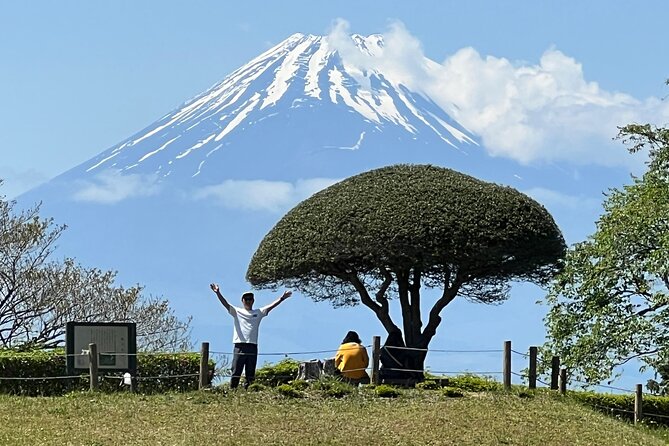
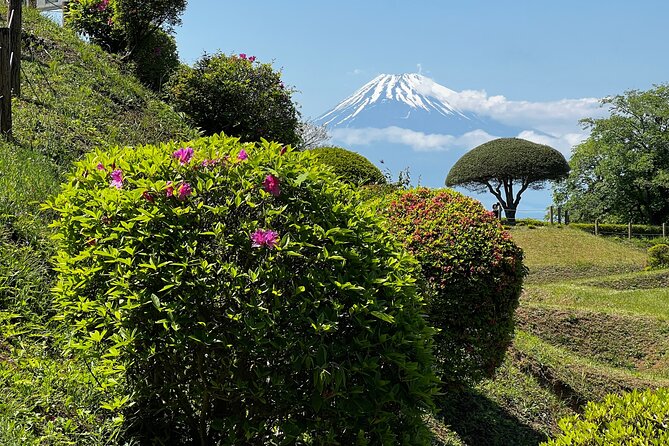
The path eventually brings you to Lake Ashi. The change is welcome: after the enclosed forest and stone road, the lake opens the view. Weather permitting, you can see Mt. Fuji from different points during the day, though clouds can easily hide it.
That weather note is important. Fuji is never guaranteed, and rain or cloud can affect the views. The walk still has value in poor conditions because the forest, paving, and historical sites remain, but you should not book this solely for a Fuji photograph.
Lake Ashi, Heiwa no Torii, and the cedar avenue
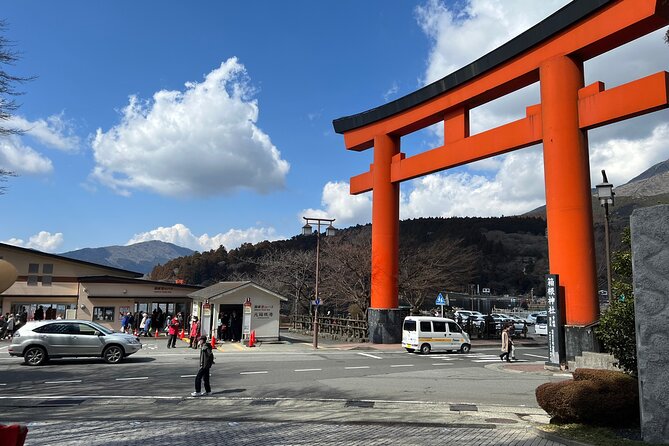
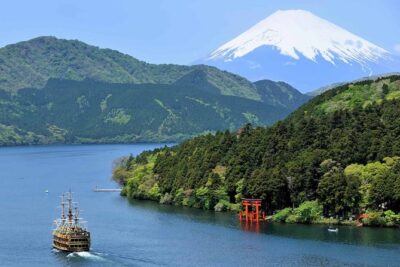
At the Motohakone area, you walk along the Lake Ashi shoreline. The famous Heiwa no Torii, the red gate associated with Hakone Shrine, sits at the water’s edge. With clear weather, Mt. Fuji may appear behind it, creating one of the classic Hakone views.
This section is less demanding than the mountain trail and gives you time to look around. The lake, shrine gate, and surrounding mountains offer a useful visual break before the next historical stop. You can also understand why this shoreline became such a well-known part of the Hakone route.
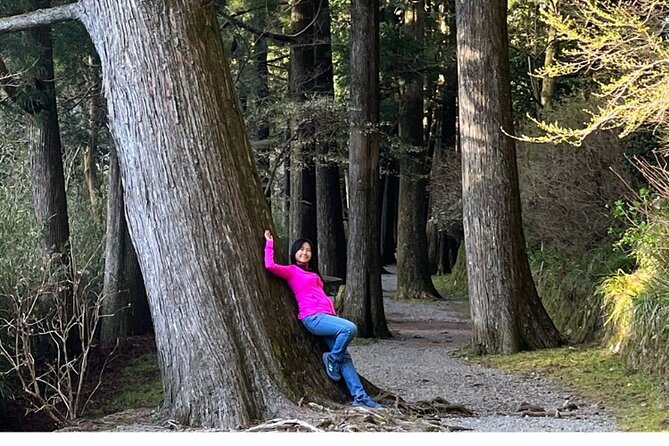
From the lake, you enter the cedar avenue of the Old Hakone Road. Huge cedar trees line the path and create a shaded corridor. The trees are not just decoration. They help you sense how the road once offered protection from sun, rain, and mountain weather.
The avenue can be busy around popular sightseeing points, but the experience remains closely tied to the old route. Your guide helps connect the physical setting to the larger story, which is useful because a cedar-lined road can otherwise look like a pleasant walk without much explanation.
More history-led days in Hakone:
- Hike Japan Heritage Hakone Hachiri (Half Day)
★ 5.0 · 18 reviews - World Heritage Shirakawa-go and Experience Tours from Kanazawa
★ 5.0 · 4,049 reviews - Tokyo: Imperial Palace and Shogun Historical Walking Tour
★ 5.0 · 2,251 reviews - World Heritage Kyoto & Nara Uji Authentic Matcha Experience
★ 5.0 · 1,573 reviews
Hakone Checkpoint and lunch near Hakone-machi
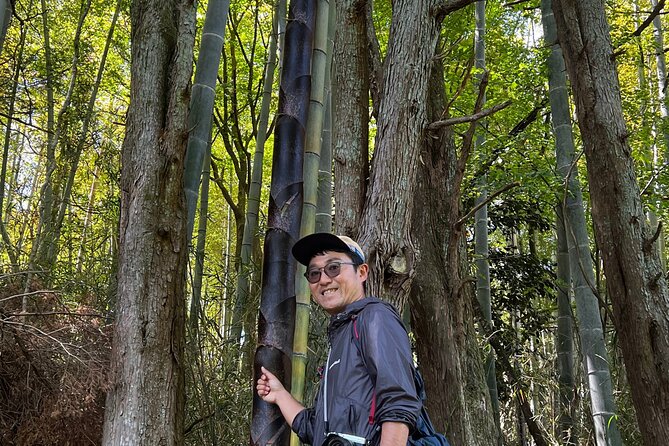
After the cedar avenue, you reach Hakone Checkpoint. During the Edo period, this checkpoint functioned much like an immigration control post. Officials monitored movement along the Tokaido and paid close attention to who was entering or leaving the region.
The stop gives the day a sharper political edge. The mountain road was not only a route for trade and travel. It was also a controlled passage. Your guide explains the checkpoint’s role and helps you see why this location mattered.
Lunch follows near Hakone-machi at a local Japanese restaurant. Lunch is not included, and the expected cost is about 2,000 yen for your group. That price is useful for planning, though your actual bill depends on what you order.
The timing works well because you have already covered the first major walking and sightseeing sections. Still, a group meal means you will have less control over the exact pace than on a self-guided walk. If you need a quick meal or have strict dietary requirements, ask for practical details before booking.
The bus across the closed section of Hachiri
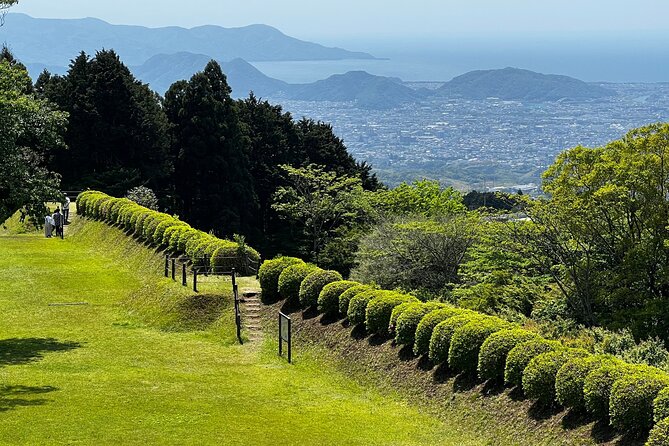
After lunch, a local bus carries you to the trailhead on the Shizuoka side of Hakone Hachiri. The bus is not a boring interruption. It is part of the route’s modern reality and lets you cover ground that would otherwise make the day longer and harder.
A temporarily closed portion is skipped by bus. This is worth understanding before you book. You will not walk every meter of the historic route from Hakone to Mishima. Instead, you walk selected sections and use public transport to connect them safely and efficiently.
The transportation between sites costs about 2,000 yen by shared taxi or bus, paid separately. Carry enough Japanese cash or confirm the preferred payment method before setting out. The included tour price does not cover these rides.
I like this arrangement for most people because it keeps the day within roughly seven hours. It also lets the guide choose a practical route around current conditions. If your main goal is a complete end-to-end through-hike, this is not the right format. If you want the best historical walking sections without turning the day into a much longer expedition, it makes good sense.
Yamanaka Castle Ruins and possible Fuji views
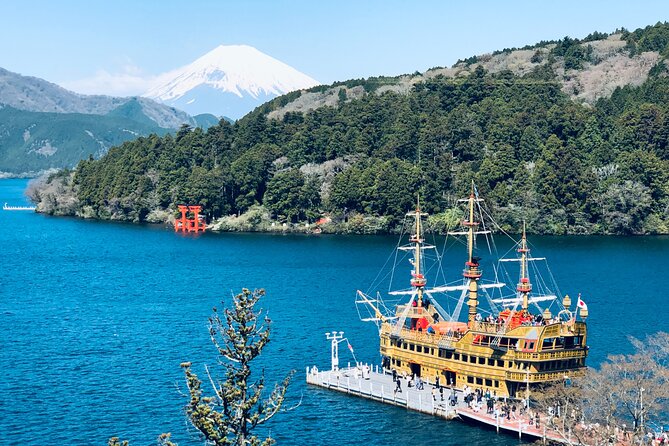
The next walking section leads toward Yamanaka Castle Ruins along the Hachiri Heritage path. The ruins add another layer to the day. You are no longer seeing only the road used by travelers. You are also visiting a defensive site connected to the strategic importance of the mountain crossing.
The remains are appreciated through their setting as much as through preserved buildings. The guide’s explanation helps you understand why a castle was placed in this part of the mountains and how it relates to the old route.
Mt. Fuji may be visible from this area when conditions are clear. The view can feel different from the lake approach because you are looking across a wider stretch of the surrounding country. Again, treat the Fuji view as a bonus, not a promise.
This section can be one of the more demanding parts of the afternoon. You have already walked in the morning, and uneven paths may feel harder after lunch. A moderate level of physical fitness is required. Take the pace seriously, especially if you are not used to slopes or cobbled surfaces.
Arriving in Mishima through shrine and river scenery
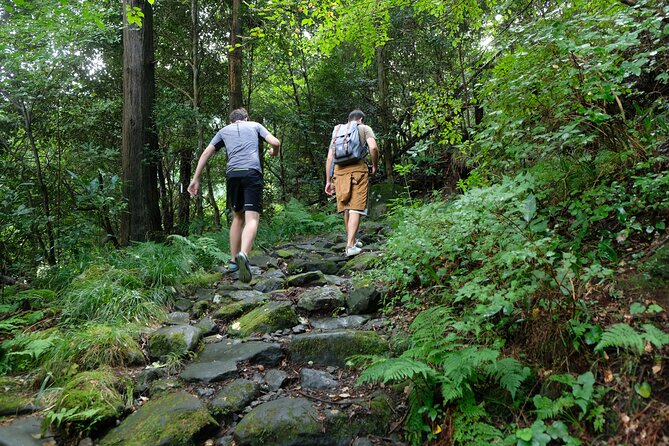
The day ends in Mishima, where you visit Mishima Taisha and Genbe River before reaching Mishima Station. Mishima Taisha is the city’s largest shrine and gives you a final cultural stop after the mountain route.
Genbe River changes the mood again. After forest paths, lake views, cedar trees, and ruins, the river offers a calmer urban finish. The route does not simply stop at a transport hub. It gives you a final look at Mishima before the guide leaves you at the station.
Mishima Station is a useful ending point if your wider trip continues. Shinkansen trains run to Odawara in about 15 minutes for around 2,500 yen, or to Tokyo in about 45 minutes for about 4,400 yen. Buses also go toward Hakone and other parts of Izu.
The optional Shinkansen cost is separate, so include it in your day’s budget if you need to return to the Odawara or Tokyo area. Ending in Mishima can be especially convenient for a one-way route, but less so if you have left luggage in Hakone and need to go back.
What the $158.52 price really covers
At $158.52 per person, this is not a bargain-priced walking tour. You are paying for a full day with a national certified professional guide who also has a wilderness first-aid certificate. The maximum group size is six, which gives the guide room to adjust explanations and walking pace more than a large coach tour could.
The price includes the guide, but not lunch, local transport, amazake, snacks, or the optional Shinkansen. A realistic extra allowance should include about 2,000 yen for lunch and about 2,000 yen for shared taxi and bus costs. Add more if you want refreshments, then budget separately for your onward train.
The value comes from the route planning and interpretation. Aki knows how to connect buses and trails so you see the main historic sections without wasting the day. That matters in Hakone, where roads, mountain paths, and public transport do not always line up in an obvious way.
Group discounts are available, but the exact saving depends on your party and booking terms. The mobile ticket is handy for meeting at Hakone Yumoto Station, though you still need to arrive ready for a prompt 9 a.m. start.
Who will enjoy this hike most
I would choose this experience if you want history attached to your walking. It suits people who enjoy old roads, shrine visits, ruins, and local transport as much as they enjoy scenery.
It is also a good match for families or small groups who want a personal guide. Aki’s calm manner and habit of taking photographs can make the day easier for a family, especially when not everyone wants to manage maps, buses, and historical notes.
You should be comfortable with a moderate hike. The route covers about 8 kilometers, but distance alone does not tell the whole story. Cobblestones, slopes, forest paths, and a full day on your feet require sensible shoes and steady energy.
Service animals are allowed, and the meeting point is near public transportation. The tour is not presented as an accessible or low-mobility outing, so anyone with concerns about uneven ground or steep sections should ask the operator before paying.
Weather, packing, and the cancellation catch
Good weather is required for this experience. If poor weather causes cancellation, you are offered another date or a full refund. That protection applies when the operator cancels, not when you simply change your mind.
The standard cancellation rule is strict: the experience is non-refundable and cannot be amended for any reason after booking. Check your schedule carefully before committing.
For the day itself, I would carry water, a light rain layer, snacks or yen for snacks, and shoes suited to rough stone. Bring a camera for the lake, Torii gate, cedar avenue, ruins, and possible Fuji views, but keep your expectations flexible if the sky turns cloudy.
The best preparation is mental as well as physical. This is a moving history lesson with several transport changes, not a single uninterrupted forest walk. That variety is a strength, but you should enjoy switching between walking and buses.
Should you book Hakone Hachiri?
Book it if you want to understand Hakone as a passage through the mountains, not just as a resort town with a lake. The combination of Edo road, Amazake Tea House, cedar avenue, checkpoint, castle ruins, shrine, and river gives you a fuller day than a quick Lake Ashi stop.
The tour earns its price through the certified guide, small group size, and careful use of local transport. Aki’s history and nature background, calm hosting, and help with family photographs add real comfort to a route that would be awkward to organize alone.
Skip it if you want a short, easy outing, a guaranteed Mt. Fuji view, or a complete unbroken walk across every part of Hachiri. For everyone else who has moderate fitness and likes authentic routes with context, this is one of the more satisfying ways to cross from Hakone to Mishima.
FAQ
Where does the tour begin?
The tour begins at Hakone-Yumoto Station in Hakone at 9 a.m.
Where does the tour end?
The tour ends at Mishima Station after visits to Mishima Taisha and Genbe River.
How far do you walk?
You walk about 8 kilometers during the day. Transportation by shared taxi and local bus connects some sections.
How long does the experience last?
The tour lasts approximately seven hours.
Is Mt. Fuji guaranteed?
No. Mt. Fuji can be seen from several points if weather permits, but cloud or rain may block the view.
Is lunch included?
No. Lunch is purchased separately at a local Japanese restaurant near Hakone-machi and costs around 2,000 yen for your group.
What other costs should I plan for?
Shared taxi and local bus transportation costs around 2,000 yen. Amazake and snacks are extra, and a Shinkansen from Mishima to Odawara costs around 2,500 yen if you choose to use it.
Just added around Hakone
- Private Hakone Half-day Car Tour with Hotel Pickup – Local Guide★ 5.0 · 48 reviews
- Traverse Outer Rim of Hakone Caldera and Enjoy Onsen Hiking Tour★ 5.0 · 30 reviews
- Hike Japan Heritage Hakone Hachiri (Half Day)★ 5.0 · 18 reviews
- Hike Hakone Hachiri★ 5.0 · 48 reviews
- Easygoing Nature Walk in Hakone Tour★ 5.0 · 15 reviews
- Odawara: Guided Ninja & Samurai Tour of Odawara Castle★ 5.0 · 25 reviews
- Odawara: Odawara Castle Tenshukaku Entrance Ticket★ 4.2 · 30 reviews
- Kowakien Yunessun Hot Springs Entry Ticket★ 4.2 · 23 reviews
Hakone Tours, compared.
Hakone 6 hour Private Tour with Government-Licensed Guide
Read our review →
Custom Private Tour in Hakone with a Certified Local Guide
Read our review →
Hakone 8 hour Private Tour with Government-Licensed Guide
Read our review →
Private Tour – Hakone Day Trip! A Tour to Explore All Must-Sees!
Read our review →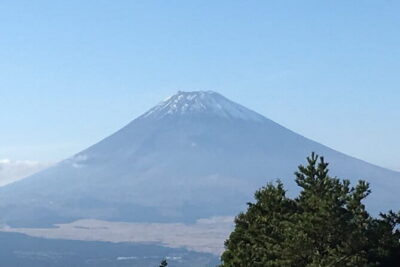

Private Hakone Half-day Car Tour with Hotel Pickup – Local Guide
Read our review →
Odawara: Odawara Castle Tenshukaku Entrance Ticket
Read our review →
Traverse Outer Rim of Hakone Caldera and Enjoy Onsen Hiking Tour
Read our review →Browse the lists this tour appears in