
Reviewed · TOKYO TOURS
Tokyo: Discover the Art of Kintsugi in Ginza
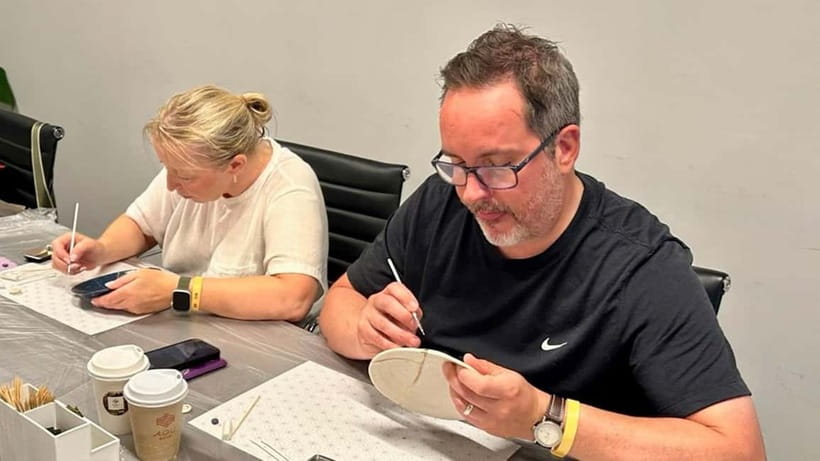
Kintsugi turns a break into the main design feature. In this 90-minute Ginza workshop, you repair a ceramic piece with synthetic lacquer and metallic powder, then pack it to take home. It is a hands-on way to meet a Japanese aesthetic idea without spending half a day in a museum.
I like the small group of up to eight, which gives the instructor room to help with tricky joins. I also like the practical setting: a private room inside Cafe AOU Ginza forest, only three minutes from Ginza Station. The main catch is that this is a fast modern version of Kintsugi, not the traditional month-long process using natural lacquer and real gold.
Key points at a glance
- Three minutes from Ginza Station: The ground-level venue is in the Daiwa Ginza Building, making this easy to fit into a day in central Tokyo.
- A finished ceramic souvenir: You repair a supplied plate or bowl and take it home in protective packaging.
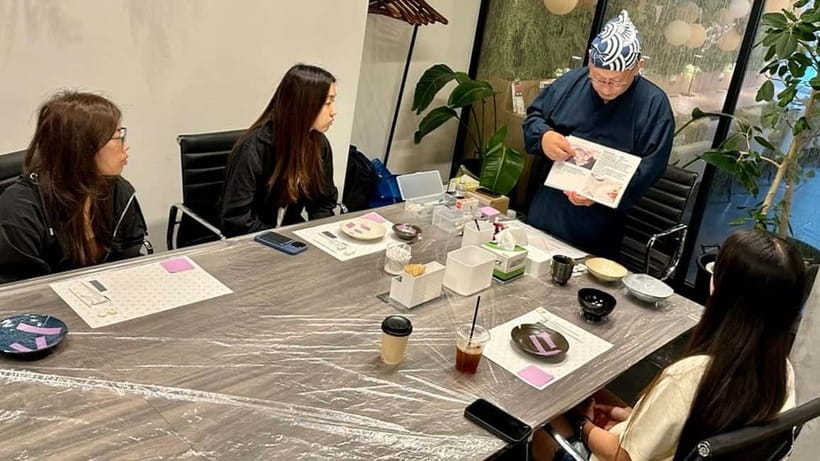
- Guidance from Tatsu or Teki: Instructors explain the process, share stories, and help when a join proves difficult.
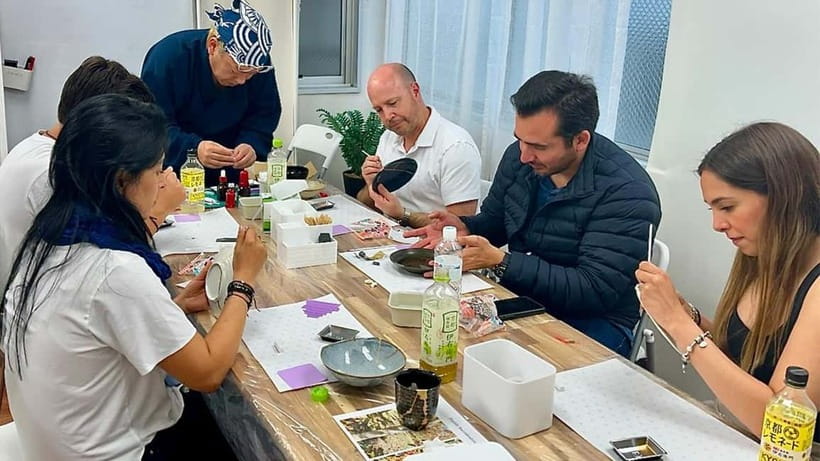
- Small groups of eight or fewer: The format is intimate, though you may wait briefly if another participant needs extra help.
- A modern, decorative form of Kintsugi: Synthetic lacquer and metallic powder let you finish within 90 minutes.
- A thoughtful activity for families with older children: Children under 10 cannot participate, but ages 10 and 14 have enjoyed the class.
Why Kintsugi works so well as a Tokyo activity
Many Tokyo activities ask you to look, listen, and move on. This one asks you to make something. You leave with a repaired ceramic object, but the more lasting part may be the change in how you look at damage and age.
Kintsugi is the Japanese practice of repairing broken ceramics so the cracks become part of the object’s appearance. Rather than hiding the break, the repair draws attention to it. That idea gives the class more weight than a simple souvenir-making session.
The workshop introduces this philosophy while keeping the task manageable for a first-timer. You do not need prior craft experience, and you do not need to bring a broken cup from home. A ceramic piece is supplied, along with the tools and materials needed for the repair.
The setting also helps. You are in a dedicated private room inside a cafe near Ginza’s department stores, luxury shops, and broad city streets. A complimentary soft drink is included, and some sessions have offered good-quality coffee while the instructor explains what will happen.
I see this as a useful pause in a busy Tokyo day. You get conversation, focused handwork, and a quiet room, then step back into Ginza with a small object that connects you to the neighborhood.
A few more Tokyo half-days to weigh up
- Mt Fuji and Hakone 1-Day Bus Tour Return by Bullet Train
★ 5.0 · 26,383 reviews - 1-Day Tokyo Bus Tour
★ 5.0 · 14,250 reviews - Tokyo: TOKYO SKYTREE® Admission ticket
★ 4.5 · 11,192 reviews
Getting to the private room near Ginza Station
The meeting point is Cafe AOU Ginza forest, on the ground floor of the Daiwa Ginza Building. The venue is about three minutes from Ginza Station, a major advantage if you are planning around train connections or a full day in the city.
The easy access matters because the class itself is short. You do not want to lose a large part of your afternoon finding an out-of-the-way studio. At the same time, read your confirmation carefully. The private room can change based on availability and the number of reservations, with notice sent by email one day before the workshop.
That last detail deserves attention. Do not rely only on the original address when the day arrives. Check your email before setting out, especially if you booked several days in advance.
The venue is on ground level, but the activity is not suitable for people with mobility impairments. The supplied information also lists people with a cold, babies under one year, and people with hearing impairments among those for whom the activity is not suitable. Children must be at least 10 years old.
Choosing your ceramic piece and meeting the instructor
The workshop begins with an explanation of the craft and its place in Japanese aesthetics. The instructor then introduces the materials and the basic sequence, so you understand the purpose of each stage before working on the ceramic.
Some sessions offer a choice between two cracked plates in different colors. Other supplied descriptions refer more generally to a ceramic piece or bowl. The exact selection may vary, but you will receive the object you need rather than being asked to bring your own.
The instructors add much of the character. Tatsu has welcomed participants outside the building, explained the lesson over a drink, helped the class along, and shared stories about Ginza. Teki has been described as friendly and clear, with a knack for helping people who fall behind without making the room feel rushed.
The instruction is available in English and Japanese. That makes the workshop a comfortable choice if you want cultural context as well as manual guidance. You can ask about the craft, the neighborhood, and the steps in front of you instead of simply copying a demonstration.
The group limit is eight people. That is small enough for personal help, but it is not a private one-to-one lesson. If one person needs extra assistance, you may pause for a short time while the instructor catches them up. One participant specifically found that the hands-on time felt briefly limited for this reason, though the instructor then helped the group move along.
The 90-minute repair process
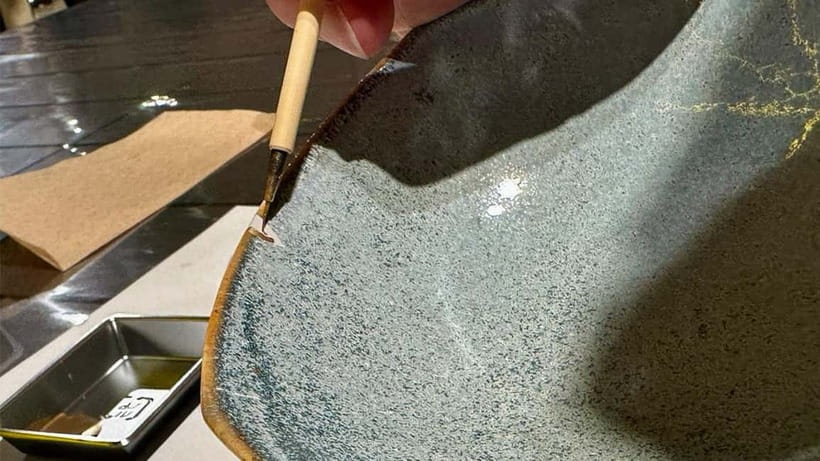
The class follows a clear, step-by-step format. You learn how the broken sections fit together, work with the supplied repair materials, and add the decorative metallic finish along the join.
The most important thing to understand is the time scale. Authentic Kintsugi traditionally uses natural lacquer and can take about a month to complete. This workshop uses synthetic lacquer and metallic powder instead, allowing you to complete the object during the session.
That shortcut is not a flaw as long as you know what you are booking. You are receiving an accessible introduction and a finished keepsake, not professional restoration training or a museum-quality conservation treatment. The modern materials make sense for a short activity aimed at visitors.
The work calls for patience more than artistic talent. You need to watch the joins, follow instructions, and accept that handmade results will vary. The appeal is in seeing the object become your own, not in producing a flawless factory finish.
The instructor steps in when needed, particularly if a piece does not fit easily or a participant needs to speed up. That support is valuable for beginners. It also means the class remains workable for a mixed group, where some people may be comfortable with detailed handwork and others may need more time.
You should expect some waiting during the process. Since everyone works on a ceramic piece at roughly the same time, the instructor may move around the room helping each person. That is normal for a small group workshop, but it means the 90 minutes will not be nonstop individual instruction.
Same base, a completely different sort of day:
- Tokyo: teamLab Planets TOKYO Digital Art Museum Entry Ticket
★ 4.6 · 9,779 reviews - Mt Fuji & Hakone Cruise, Drum Show Bullet Train 1 Day from Tokyo
★ 4.0 · 7,413 reviews - Tokyo: Sumo Show Experience with Chicken Hot Pot and a Photo
★ 4.8 · 6,678 reviews - Tokyo: Shinjuku Food Tour (13 Dishes at 4 Local Eateries)
★ 5.0 · 6,603 reviews
What you take home, and how to pack it
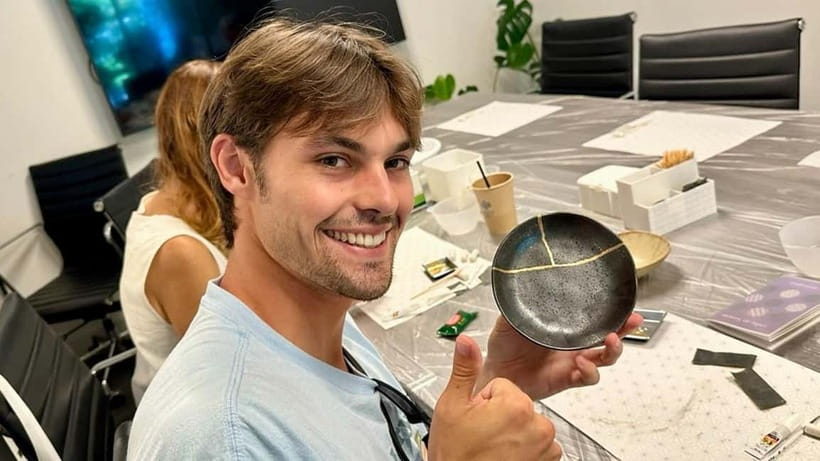
The strongest practical feature is that you keep the repaired ceramic. You are not making a temporary sample or leaving your work behind for firing. At the end, the piece is packaged for the trip home, with protective presentation that helps prevent damage in your luggage.
That packaging is more important than it may sound. A newly repaired plate or bowl is an awkward object to carry through trains, hotel rooms, and an international flight. Proper wrapping turns it into a realistic souvenir rather than something you must handle with constant worry.
The piece should be used for decoration only. It is not microwave-safe because of the risk of ignition, so do not treat it as everyday tableware. The safest use is as a display object, a small reminder of Tokyo, or a thoughtful gift.
The final look will be personal. The line of the repair, the choice of ceramic color, and the amount of metallic powder all affect the result. That variation is part of the point. You are taking home a one-of-a-kind object, not an identical item from a shop shelf.
Is $75 a fair price?
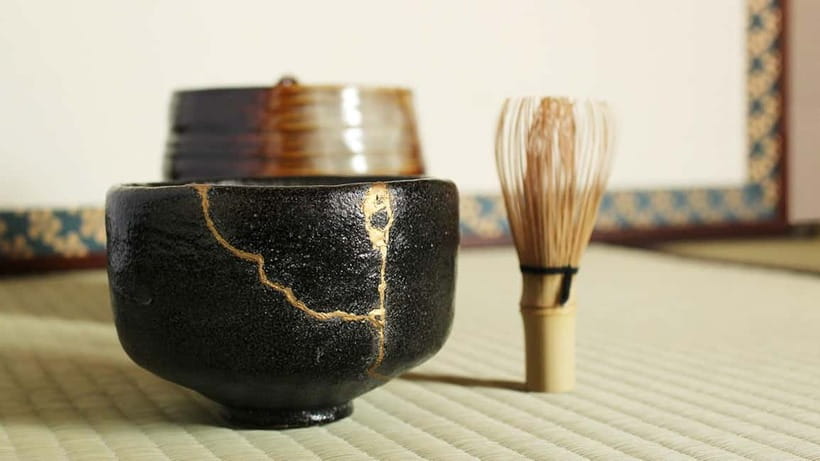
At $75 per person, this is not the cheapest creative activity in Tokyo. You are paying for a central Ginza location, a 90-minute guided class, all materials, the ceramic piece, instructor support, packaging, and a soft drink.
The value improves if you care about the finished object and the cultural explanation. A casual craft class can feel thin when you leave with only a small exercise. Here, you take home a repaired plate or bowl that has a clear connection to a Japanese tradition.
The price also covers convenience. You do not need to buy tools, find a broken ceramic, or work out how to handle lacquer. The location is easy to reach, and the small group keeps the class more personal than a large demonstration.
Still, do not book it expecting a full apprenticeship. The modern materials and short format are designed for access, not for traditional craft production. If your main goal is to study authentic natural-lacquer Kintsugi in depth, this will be too brief and simplified.
For most visitors, I think the value is strongest when you see it as a cultural activity with a useful souvenir attached. It gives you a focused experience in the middle of Ginza, rather than another purchase from a shopping district.
Who will enjoy this most
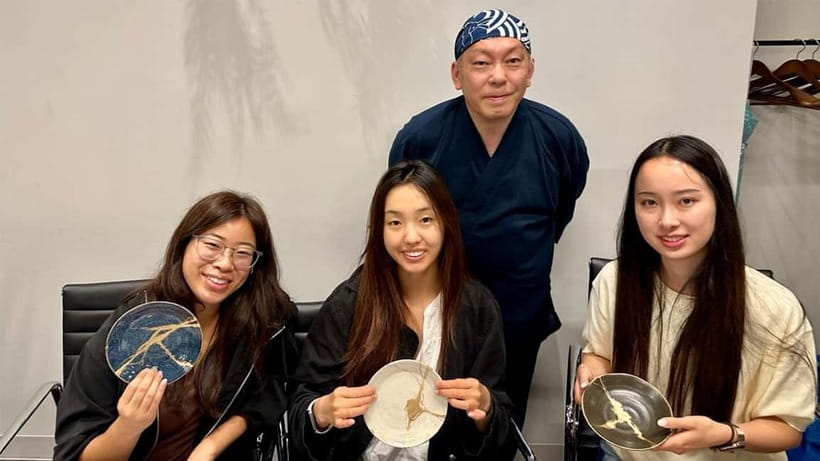
I would choose this for couples, solo visitors, friends, and families with children aged 10 or older. It gives a group something to do together without demanding advanced artistic skills.
It also suits people who like quieter activities. You are not racing through several sights or trying to photograph every detail. The appeal is sitting down, listening, and working with your hands.
Families should note the age rule. Children under 10 cannot participate, while older children have enjoyed the instructor’s help and the freedom to make their own piece. The class can work well for a parent and child, but the group format means each participant needs to follow the process independently.
This is less suitable if you have limited mobility, a cold, a baby under one year, or a hearing impairment. Those restrictions are stated for the activity, so check them before booking rather than assuming the private-room setting will solve every access concern.
Planning the rest of your Ginza day
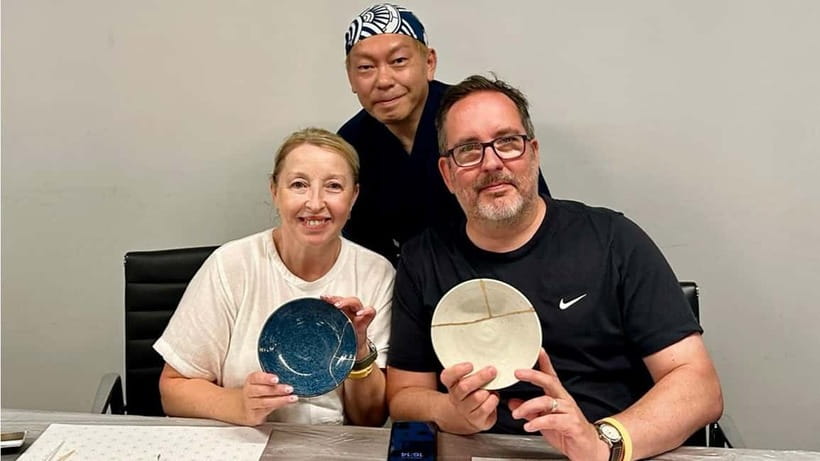
The class fits neatly into a Ginza itinerary. You can schedule it between shopping, dining, and nearby sightseeing because the activity lasts 90 minutes and begins close to the station.
If high-end shopping is not your priority, the workshop gives you a reason to visit the district anyway. Afterward, you can continue exploring Ginza on foot or use the station to reach another part of Tokyo. The class does not include hotel pickup or drop-off, so you arrange your own way there and back.
I would leave enough time before the start to find the building and check your email for any venue update. The meeting point is central, but Tokyo buildings can still take a moment to identify when you are watching the clock.
The repaired item also affects your day. Since you will carry it afterward, keep it protected rather than putting it loose in a shopping bag. The provided packaging helps, but careful handling remains sensible.
Booking flexibility and practical details
You can reserve now and pay later, which helps if your Tokyo schedule is still shifting. Free cancellation is available up to 24 hours before the activity for a full refund.
Starting times vary, so you need to check availability for your preferred date. The small group is capped at eight, and the venue may change when reservations or room availability require it.
The instructor speaks English or Japanese. All tools and materials are included, and the complimentary soft drink is part of the session. Hotel transportation is not included.
One final reminder: the finished ceramic is decorative only and cannot go in a microwave. If you want to use it as a food-serving plate, this is the wrong souvenir for that purpose.
Should you book the Ginza Kintsugi workshop?
Book it if you want a compact, hands-on cultural activity with a finished souvenir and a thoughtful idea behind it. The central location, small group, patient instructors such as Tatsu and Teki, and careful packaging make it easy to fit into a Tokyo day.
Skip it if you want traditional month-long Kintsugi using natural lacquer, or if you prefer a longer studio course with uninterrupted personal instruction. For everyone else, $75 buys more than a repaired ceramic. It buys 90 minutes of calm, a useful introduction to Japanese aesthetics, and an object whose cracks tell the story of your time in Ginza.
FAQ
Where is the Kintsugi workshop held?
The meeting point is Cafe AOU Ginza forest, located on the ground floor of the Daiwa Ginza Building near Ginza Station.
How long does the activity last?
The workshop lasts 90 minutes.
How far is the venue from Ginza Station?
The private room is about three minutes from Ginza Station.
What languages does the instructor speak?
Instruction is available in English and Japanese.
What is included in the price?
The price includes the 90-minute workshop, all tools and materials, a ceramic piece to restore, instructor guidance, and a complimentary soft drink.
Can I take my repaired ceramic home?
Yes. You take home the ceramic piece you repair, and it is packaged to help protect it during your journey.
Is this traditional Kintsugi using real gold?
No. Traditional Kintsugi can take about a month and uses natural lacquer. This workshop uses synthetic lacquer and metallic powder so you can finish the piece within 90 minutes.
Can I use the repaired ceramic in a microwave?
No. The repaired item is recommended for decorative use only and is not microwave-safe because of the risk of ignition.
Just added around Tokyo
- Private Arrival Transfer : Narita International Airport to Central Tokyo City★ 4.5 · 12 reviews
- Narita Airport(NRT): Private Transfer to Tokyo/Yokohama 1-9pax★ 5.0 · 47 reviews
- Private Transfer from Narita Airport to Yokohama Port and City★ 4.5 · 17 reviews
- [Narita Airport Terminals 1, 2] 40-60km Sawara Itako Historic Bike Tour★ 5.0 · 13 reviews
- 3 Day Japan Highlights Tour: Tokyo, Mt.Fuji, Nara, Kyoto, Osaka★ 5.0 · 22 reviews
- Small Town in the Big City: Tasting Tokyo’s Kichijoji★ 5.0 · 195 reviews
- Small Town in the Big City: Tasting Tokyo’s Kichijoji★ 5.0 · 16 reviews
- The 10 Tastings of Tokyo With Locals: Private Street Food Tour★ 5.0 · 48 reviews
Tokyo Tours, compared.

Mt Fuji and Hakone 1-Day Bus Tour Return by Bullet Train
Read our review →

teamLab Planets TOKYO Digital Art Museum Entry Ticket
Read our review →
Mt Fuji & Hakone Cruise, Drum Show Bullet Train 1 Day from Tokyo
Read our review →
Sumo Show Experience with Chicken Hot Pot and a Photo
Read our review →
Shinjuku Food Tour (13 Dishes at 4 Local Eateries)
Read our review →
Tokyo Mt Fuji 5th St & Hakone Cruise Bus Tour w/Bullet Train
Read our review →