
Reviewed · TOKYO TOURS
Tokyo: Karate Experience with Former All-Japan Champion
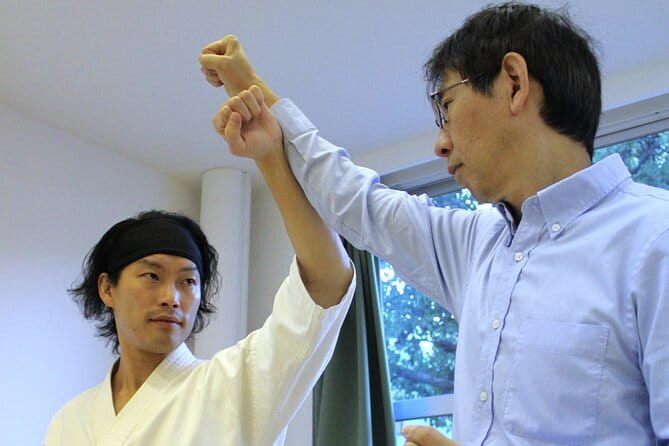
Tokyo’s karate lesson with Ryo, a former All-Japan champion, gives you more than a few staged punches for a photo. You learn how to bow, breathe, stand, block, kick, and move with purpose. I like the respectful opening ritual and the way each technique is broken into small, manageable steps.
I also like that Ryo adjusts the pace for children, beginners, and experienced martial artists. The main caution is to choose your booking option carefully: the karate uniform is included only with the private 90-minute session that specifically lists a karate gi. Other sessions require workout clothes, and the meeting point can change by option.
Key points to know before you book
- Train with a genuine Kyokushin specialist: Ryo has 20 years of experience in Kyokushin Karate, placed third at a 2013 world championship, and became an All-Japan champion.
- Start and finish with proper manners: Bowing, belly breathing, and focus are treated as part of karate, not as decoration.
- Build from simple movements: You practice punches, blocks, and kicks step by step before working on defense and movement.
- No-contact sparring keeps it approachable: You learn the idea of kumite without trading blows or taking unnecessary hits.
- Useful for mixed-ability groups: Children, first-timers, and students of other styles can all take part.
- Budget around $58 per person: The price makes the most sense if you want instruction rather than a quick cultural demonstration.
What this Tokyo karate lesson is really about
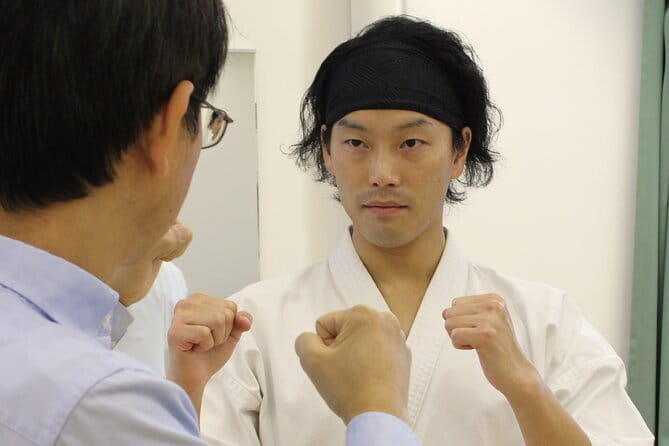
This is a short, active introduction to Japanese karate led by a serious practitioner. Ryo trains in Kyokushin Karate, a full-contact style, but this session is designed so you can learn safely without previous experience.
You will not simply copy a few dramatic moves and leave. The lesson connects karate technique with posture, breathing, courtesy, control, and timing. That makes the experience useful for someone curious about Japanese martial arts, as well as for a student who wants to compare Kyokushin with another style.
Ryo has taught since 2010 and holds a second Dan black belt, earned through a promotion exam in 2020. His competition record includes third place at the 2013 KWU Kyokushin World Union Championship in Bulgaria in the under-75-kilogram division, followed by an All-Japan title in the under-80-kilogram category. He also took first place in a kata competition in January 2026.
You do not need to know these results to enjoy the class. Their practical value is that you are learning from someone who has trained, competed, and taught for years. The lesson feels connected to a real martial arts practice rather than a costume-and-photo activity.
A few more Tokyo half-days to weigh up
- Mt Fuji and Hakone 1-Day Bus Tour Return by Bullet Train
★ 5.0 · 26,383 reviews - 1-Day Tokyo Bus Tour
★ 5.0 · 14,250 reviews - Tokyo: TOKYO SKYTREE® Admission ticket
★ 4.5 · 11,192 reviews
Bowing and breathing set the tone
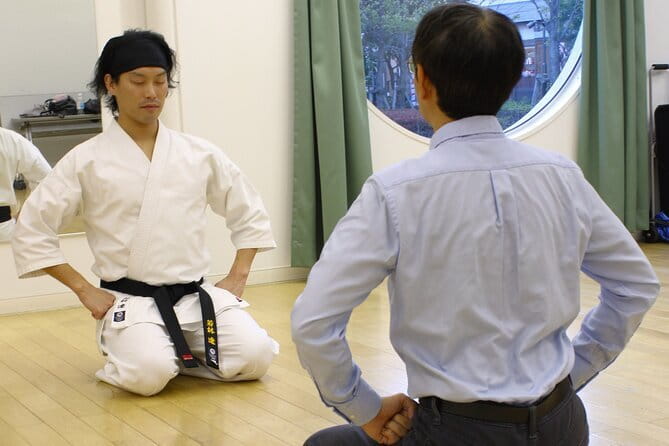
The class begins with the basic bow, known as rei. Karate uses a simple principle: start with a bow and end with a bow. This first step gives the session a clear sense of respect and structure.
For a visitor, this can be one of the most interesting parts. You are not just learning how to punch. You are learning how karate frames the entire encounter, with attention to the instructor, the training space, and the person in front of you.
Ryo also introduces breathing from the belly. This is meant to help you settle your attention and develop a calm mind. It is a small exercise, but it matters. A tense beginner often tries to perform every movement quickly, while controlled breathing helps you slow down and listen.
I especially like this beginning for families. Children may arrive excited or nervous, and the bowing and breathing provide an easy first task. They can take part immediately without needing to be strong, flexible, or athletic.
Stretching prepares your body for kicks
Before the technical work, you go through stretches for the legs, hips, shoulders, shoulder blades, and chest. This is not wasted time. Karate asks your body to move in ways that may be unfamiliar, especially when kicks and rotating blocks enter the lesson.
The warm-up helps you prepare gradually. It also gives Ryo a chance to see how the group moves and to adjust the pace. If you are stiff from a long flight or a full day of walking around Tokyo, this part should help you get ready for the more active section.
Do not treat the stretching as a competitive test. You are not expected to match an experienced martial artist. Move within your comfort level and pay attention to Ryo’s instructions. The class is meant to improve flexibility and muscle strength, but the short format does not turn it into a full fitness program.
You should still wear comfortable workout clothing unless you book the option that includes a gi. One important detail comes from the session choices: the uniform is included with the private 90-minute session with karate gi, not automatically with every 90-minute class. If wearing a traditional uniform is important to you, confirm the exact option before paying.
Punches, blocks, and kicks in small stages
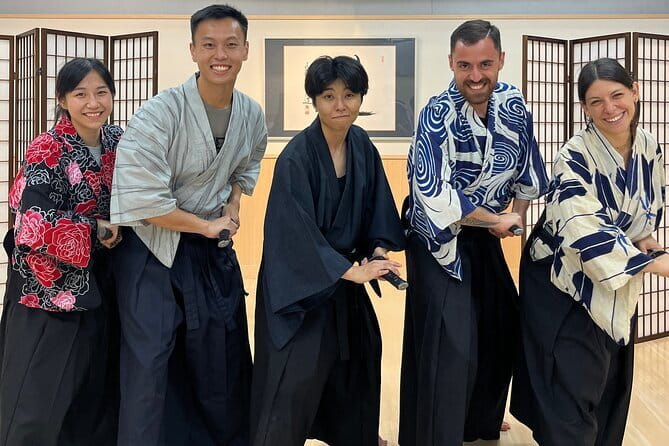
The central part of the lesson covers basic punches, blocks, and kicks. Ryo breaks each technique into several movements, then builds them together. This approach works well for beginners because you can concentrate on one part at a time instead of trying to copy a complete action at full speed.
You will work from a proper stance and learn why foot position and balance matter. A punch is not just an arm movement. A kick is not simply a matter of lifting your leg. The lesson uses stance, alignment, control, and precision to show how the pieces fit together.
Ryo demonstrates the techniques and adds corrections when needed. That personal attention is important in a small martial arts class. A large group lesson can leave you repeating a mistake, but a hands-on instructor can notice your balance, guard, or foot placement and help you fix it.
People with previous training can also get something worthwhile here. Students of Shotokan, Goju Ryu, Tae Kwon Do, Kenpo, Muay Thai, and other styles have used the lesson to compare methods. Kyokushin has its own approach, and seeing how Ryo generates movement can give an experienced student useful points to consider.
At the same time, the session does not assume that you know martial arts vocabulary. Ryo teaches in English and Japanese, and his explanations are intended for both complete beginners and returning practitioners.
Same base, a completely different sort of day:
- Tokyo: teamLab Planets TOKYO Digital Art Museum Entry Ticket
★ 4.6 · 9,779 reviews - Mt Fuji & Hakone Cruise, Drum Show Bullet Train 1 Day from Tokyo
★ 4.0 · 7,413 reviews - Tokyo: Sumo Show Experience with Chicken Hot Pot and a Photo
★ 4.8 · 6,678 reviews - Tokyo: Shinjuku Food Tour (13 Dishes at 4 Local Eateries)
★ 5.0 · 6,603 reviews
Kata adds a window into karate form
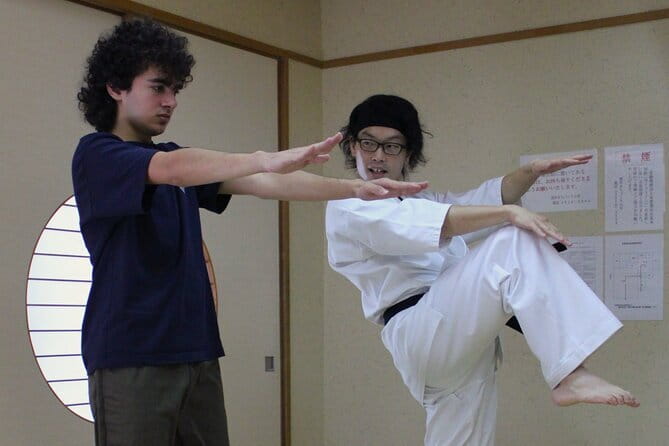
The experience includes a kata demonstration. Kata is a pattern of karate techniques performed in sequence. It can look formal to an outsider, but it is also a practical way to study movement, direction, posture, and transitions.
Watching Ryo perform a kata gives you a clearer sense of how individual punches, blocks, and steps connect. You may not master an entire pattern in one short lesson, but the demonstration helps place the basic techniques in a larger system.
For experienced karate students, this is a good chance to compare styles. A Shotokan student, for example, may recognize familiar principles while noticing differences in stance, rhythm, or application. For a first-timer, the kata offers a glimpse of the discipline and concentration behind the more active pad work.
The lesson may also discuss how kata movements can apply to self-defense. One experienced participant specifically worked on the application of kata, known as bunkai. The exact amount of kata instruction can depend on the group and the session length, so consider the 90-minute private option if you want more time for technical discussion.
Non-contact kumite teaches defense without fear
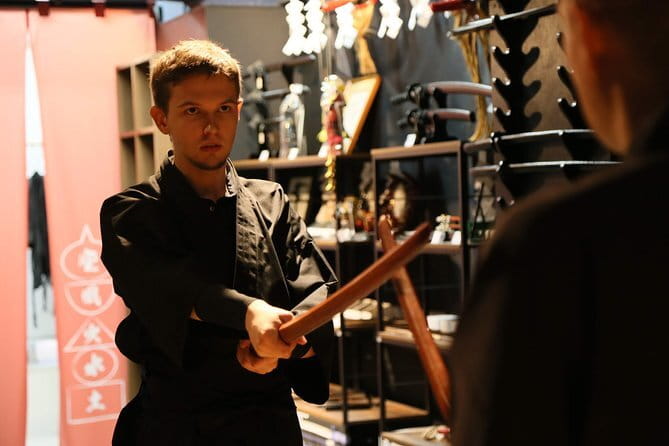
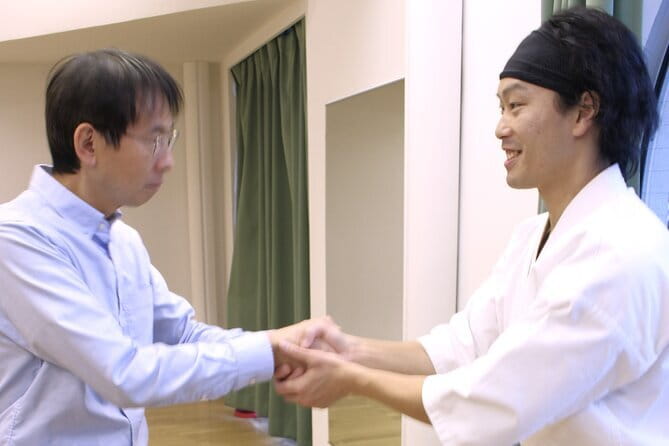
The final section introduces the essence of kumite, or sparring. You do not exchange hard blows. Instead, Ryo shows how to respond to attacks such as punches, front kicks, and low kicks through controlled movement and non-contact practice.
This is a smart format for a mixed group. A parent can take part with a child, a beginner can try defensive movement without fear, and an experienced martial artist can focus on timing and accuracy. You get the structure of a sparring drill without the pressure of a full-contact match.
The purpose is not to pretend that a single lesson turns you into a fighter. It is to show how karate techniques work in relation to another person. You learn to watch an attack, choose a response, and move with control.
Ryo also uses punching and kicking pads. Pad work adds a satisfying physical finish because you can put power behind your techniques while keeping the exercise controlled. It is more active than simply watching a demonstration, and it gives you a clear sense of how your punches and kicks feel.
A few participants have also enjoyed breaking a wooden board during the lesson. Treat that as a possible feature rather than a guaranteed part of every booking, since it is not listed among the standard inclusions. The confirmed equipment includes punching and kicking pads and a bottle of water.
Why children and families fit this class well
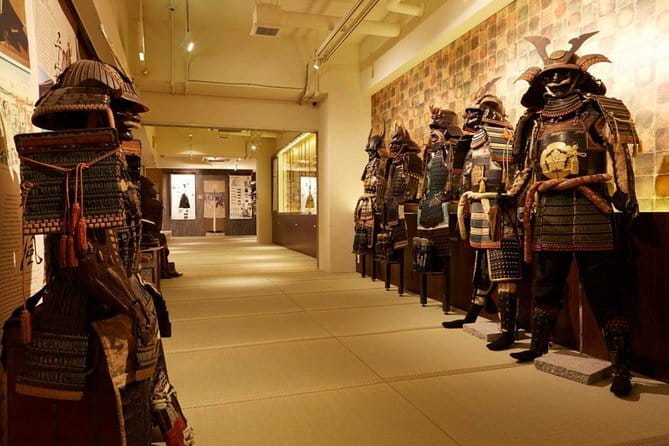
The session works particularly well for families with children who already have an interest in martial arts. Ryo has taught students from children to adults, and the lesson can be adjusted for age, confidence, and ability.
A young participant may begin nervously, especially in an unfamiliar setting or language. The gradual structure helps: bowing first, then breathing and stretching, followed by basic techniques and controlled pad work. By the time non-contact sparring begins, the child has had time to get used to the instructor and the movements.
Parents can take part alongside their children. One family with boys aged eight and ten found that Ryo explained the techniques clearly enough for the children to follow in English. That matters if you are concerned about language or about a child feeling lost during the lesson.
The class is not only for children, though. Teenagers can get a proper workout and a useful lesson, while adults can try karate without committing to a dojo or long training program. If your family has different experience levels, Ryo’s ability to adapt is one of the strongest reasons to consider this activity.
A good match for martial artists from other styles
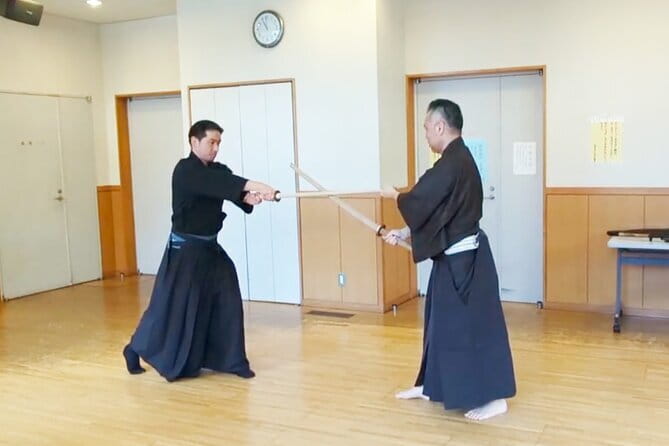
You do not have to be new to karate. In fact, students with experience in another style may find the session especially interesting.
Kyokushin is different from Shotokan, Goju Ryu, Tae Kwon Do, Muay Thai, and Kenpo. The comparison is not about declaring one style better. It is about noticing how each system handles stance, kicks, combinations, kata, and defense.
A returning karate student can use the class to refine basic movements or explore how Ryo teaches applications. A Muay Thai student may enjoy seeing how karate organizes its punches and kicks. Someone with no formal training can still follow the same progression without feeling like an outsider.
The experience also avoids a common problem with martial arts tourism: a class that is either too theatrical for serious students or too technical for beginners. Ryo’s lesson aims for a middle ground. He presents real fundamentals but explains them in a friendly, approachable way.
The setting, timing, and what to wear
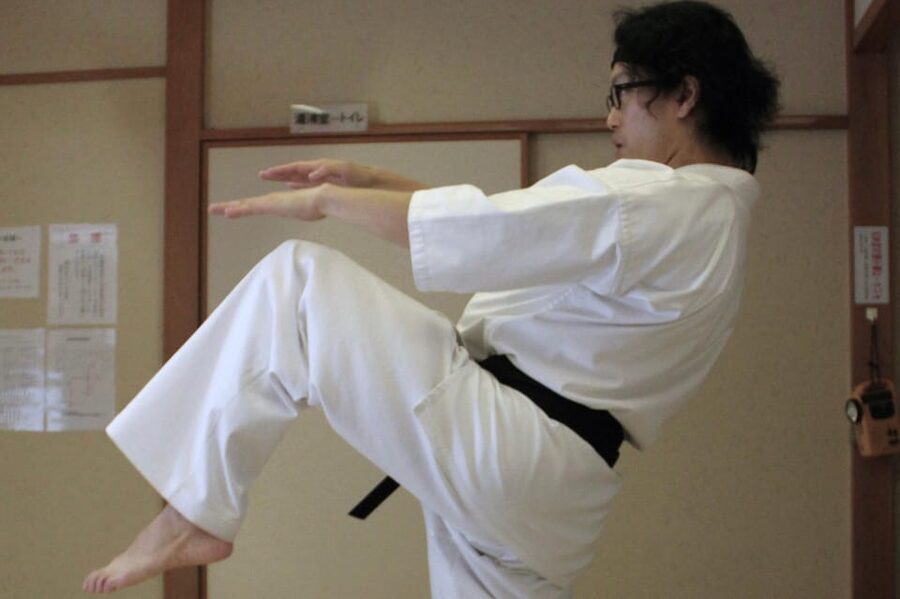
The lesson lasts from one hour to 90 minutes, depending on the booking option. The longer private session gives you more time for individual corrections, technique practice, kata, pad work, and questions. A shorter class may suit you better if your Tokyo schedule is tight or if you are traveling with young children.
The activity takes place in Tokyo, with Asakusa identified as an accessible central area for at least one session. The exact meeting point can vary by option, so check your selected booking rather than assuming every class begins in the same place.
One unusual detail is that a session may take place inside a martial arts store. That can add atmosphere, especially if you enjoy seeing equipment and the broader martial arts setting. It also means this is not necessarily a grand traditional dojo with a quiet, ceremonial feel. The surroundings may feel more practical and urban.
Wear clothes that let you stretch, kick, and move freely. If you want the full uniform experience, select the private 90-minute option with karate gi. A bottle of water is included, but you should still arrive ready for a genuine workout.
Is $58 a fair price?
At $58 per person, this is not the cheapest cultural activity in Tokyo. You can bow at a temple or watch martial arts demonstrations for less. The value here comes from direct instruction with an accomplished black belt, not from sightseeing alone.
You get a guided lesson, kata demonstration, pad equipment, water, and instruction in both technique and manners. The private or small-group format also gives you a better chance of receiving corrections. For a family or a pair of friends, that personal attention can justify the price.
The cost makes less sense if you only want a quick photo in a karate uniform. It is also worth checking the inclusions if the gi matters to you, since the uniform is tied to one specific booking option.
For someone already planning a full Tokyo itinerary, the 60 to 90 minutes fits neatly into a day in Asakusa or nearby areas. You get exercise, cultural context, and a story to take home without giving up an entire day.
The flexible booking terms help too. You can reserve now and pay later, and cancellation is available up to 24 hours in advance for a full refund. Starting times depend on availability, so check the schedule before building the rest of your day around it.
Who should book this experience?
I would recommend it most strongly to four types of people:
- You want to try karate in Japan but do not want to join a long-term dojo.
- You are traveling with a child or teenager who already enjoys martial arts.
- You practice another style and want to see how Kyokushin differs.
- You prefer active cultural activities over passive demonstrations.
It may be less suitable if you want a full-contact fight, advanced competition training, or a long seminar on Kyokushin theory. The lesson is designed for a broad range of abilities, so advanced students should expect useful corrections and comparisons rather than a specialist camp.
You should also be comfortable with physical activity. The session includes stretching, punches, kicks, defensive drills, and pad work. The sparring is non-contact, but the class is still a workout.
Should you book Ryo’s karate experience?
Yes, if you want a real beginner-friendly lesson taught by a qualified Japanese black belt. Ryo’s calm explanations, English ability, patience, and willingness to adjust the class make this a strong pick for families, first-timers, and students from other martial arts.
Book the private 90-minute gi option if you want the uniform and the most personal instruction. Choose carefully if your schedule or budget is tight, and remember that the meeting point depends on the option you select.
This is not a substitute for months of karate training. It is something better suited to a curious visitor: a focused, respectful, physically active introduction to how karate is practiced, taught, and understood in Japan.
FAQ
How long does the karate experience last?
The session lasts between one hour and 90 minutes. Starting times depend on availability and the option you book.
How much does the experience cost?
The listed price is $58 per person.
Who teaches the karate lesson?
The instructor is Ryo, a Japanese black belt who has practiced Kyokushin Karate for 20 years and has taught since 2010.
Does Ryo have competition experience?
Yes. Ryo placed third at the 2013 KWU Kyokushin World Union World Karate Championship and became an All-Japan champion in Kyokushinkan International. He also won a kata competition in January 2026.
Is the lesson suitable for complete beginners?
Yes. The class is designed for beginners as well as people who have practiced karate or other martial arts before.
Can children participate?
Yes. Ryo has taught children and adults, and the lesson can be adjusted to suit different abilities and ages.
Is the karate uniform included?
The karate gi is included only when you choose the private 90-minute session with karate gi. Check the exact option before booking. Workout clothes are needed for sessions without a provided uniform.
Is there physical-contact sparring?
No. The kumite section teaches defensive movements through non-contact sparring. Punching and kicking pads are provided for controlled pad work.
What languages are available?
The lesson is offered in English and Japanese.
Just added around Tokyo
- Private Arrival Transfer : Narita International Airport to Central Tokyo City★ 4.5 · 12 reviews
- Narita Airport(NRT): Private Transfer to Tokyo/Yokohama 1-9pax★ 5.0 · 47 reviews
- Private Transfer from Narita Airport to Yokohama Port and City★ 4.5 · 17 reviews
- [Narita Airport Terminals 1, 2] 40-60km Sawara Itako Historic Bike Tour★ 5.0 · 13 reviews
- 3 Day Japan Highlights Tour: Tokyo, Mt.Fuji, Nara, Kyoto, Osaka★ 5.0 · 22 reviews
- Small Town in the Big City: Tasting Tokyo’s Kichijoji★ 5.0 · 195 reviews
- Small Town in the Big City: Tasting Tokyo’s Kichijoji★ 5.0 · 16 reviews
- The 10 Tastings of Tokyo With Locals: Private Street Food Tour★ 5.0 · 48 reviews
Tokyo Tours, compared.

Mt Fuji and Hakone 1-Day Bus Tour Return by Bullet Train
Read our review →

teamLab Planets TOKYO Digital Art Museum Entry Ticket
Read our review →
Mt Fuji & Hakone Cruise, Drum Show Bullet Train 1 Day from Tokyo
Read our review →
Sumo Show Experience with Chicken Hot Pot and a Photo
Read our review →
Shinjuku Food Tour (13 Dishes at 4 Local Eateries)
Read our review →
Tokyo Mt Fuji 5th St & Hakone Cruise Bus Tour w/Bullet Train
Read our review →