

Reviewed · HAKONE TOURS
Hike Japan Heritage Hakone Hachiri (Half Day)
Hakone’s old Tokaido highway is the star here. You’ll walk on preserved cobbles and quiet forest paths, pass the traditional woodcraft village of Hatajuku, and finish at Lake Ashi. The steepest section is skipped by bus, so you get the best scenery without turning a half-day outing into a mountain test.
I like the small maximum of six people, which keeps the walk personal and makes it easier to ask questions. I also like the stop at the 400-year-old Amazake Tea House, where a sweet amasake drink gives you a welcome lift before the final stretch.
The main consideration is that this is more of a guided historical walk than a hard-core hike. You need moderate fitness, and the tour depends on good weather. The $114.95 price also does not include the shared taxi to the trailhead or the short bus ride to the teahouse.
Key points at a glance
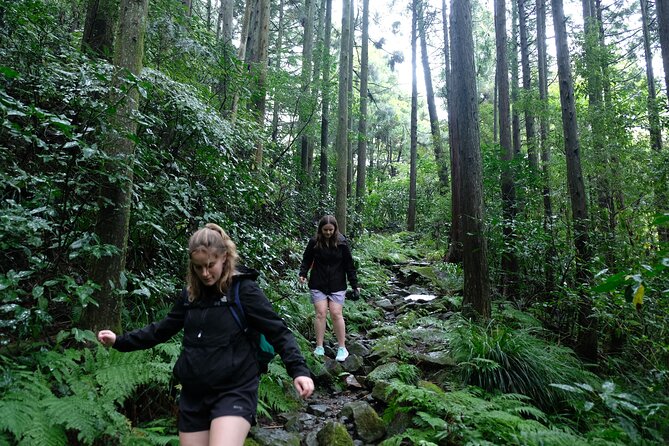
- Walk a preserved section of the old Tokaido highway: Expect cobbled sections, forest trails, and a route tied to travel between Tokyo and Kyoto during the Edo era.
- Visit Hatajuku woodcraft village: This traditional settlement is a useful stop for understanding Hakone’s famous decorative woodwork.
- Take a bus around the steepest section: You still see the character of the route without tackling its toughest climb.
- Pause at a 400-year-old teahouse: Amasake, a traditional sweet rice drink, is included at the Amazake Tea House.
- Finish beside Lake Ashi: On a clear day, Mt Fuji may appear across the water.
- Learn from a local guide: Akihiro and Aki are praised for clear English, local knowledge, and warm company.
Why the old Tokaido route matters
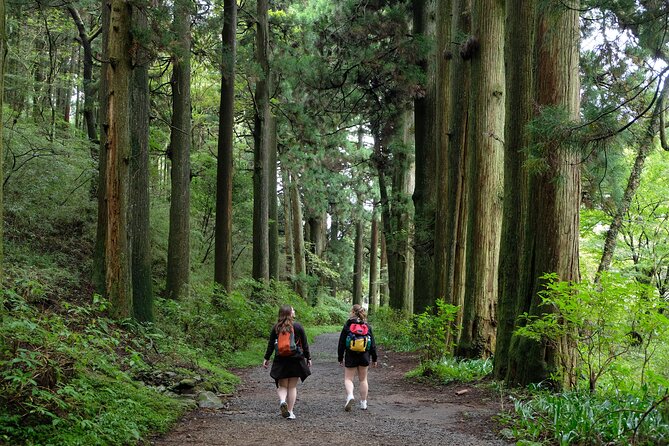
The Tokaido was one of Japan’s major historic roads, linking Tokyo and Kyoto. In Hakone, the road crossed a difficult mountain zone, making this route more than a pleasant woodland stroll. It was part of a system that shaped travel, trade, and government control during the Edo era.
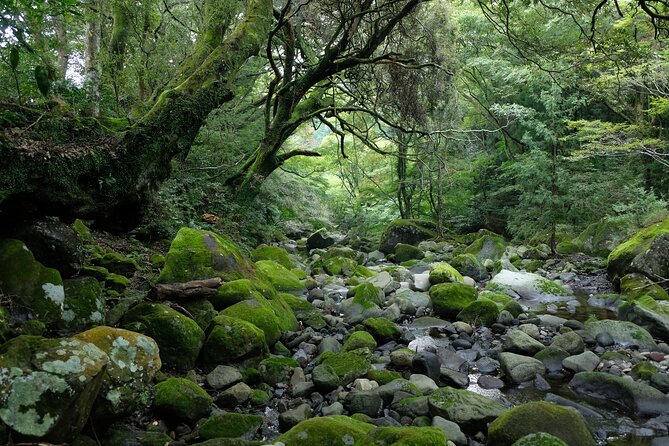
That context gives the walk its purpose. Without a guide, you might notice mossy stones, trees, and a quiet village. With someone explaining the road’s role, those details begin to connect. The trail becomes a way to understand why Hakone mattered, not just a path between two scenic points.
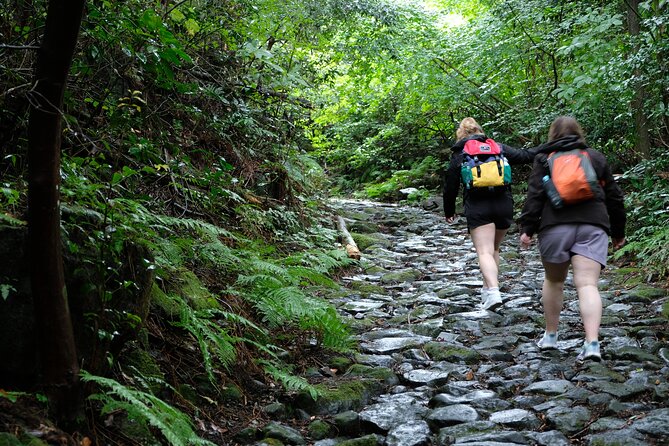
I especially like that the route uses some of the best-preserved cobbled sections of the old highway. Cobbles can be uneven, so you should watch your footing, but they also give the walk a physical link to the past. This is not a recreated attraction built for photographs. You are walking along an old route through the actual Hakone hills.
The forest portion adds a different mood. Parts of the trail are described as more remote, and the group may have the woods largely to itself. That quiet is a useful contrast to the busier sightseeing areas around Hakone-Yumoto and Lake Ashi.
More walks and treks around Hakone:
- Hike Hakone Hachiri
★ 5.0 · 48 reviews - Hike Japan Heritage Hakone Hachiri with certified mountain guide
★ 5.0 · 46 reviews - Traverse Outer Rim of Hakone Caldera and Enjoy Onsen Hiking Tour
★ 5.0 · 30 reviews
Starting at Hakone-Yumoto at 9am
The tour begins at Hakone-Yumoto Station at 9am. This is practical if you are already staying in Hakone, and the station is also close to public transportation for those arriving from elsewhere in the area.
From the start, you should expect an outing that mixes walking and transport. A shared taxi to the trailhead costs 2,000 yen to be divided among the group. That fee is separate from the tour price, so a full group of six would pay less per person than a very small group.
This arrangement is worth understanding before you book. The advertised $114.95 covers the guided experience and the certified National Mountain Guide, but not every movement needed to reach the walking route. You will also pay less than 400 yen for the bus that skips the steepest section.
Those extra costs are modest, but they affect the total value. At roughly four hours, the tour is not cheap compared with an independent walk. You are paying for a very small group, a trained mountain guide, local interpretation, and a carefully chosen route that links several Hakone sights without making you organize the transport yourself.
Hatajuku and Hakone’s woodcraft tradition
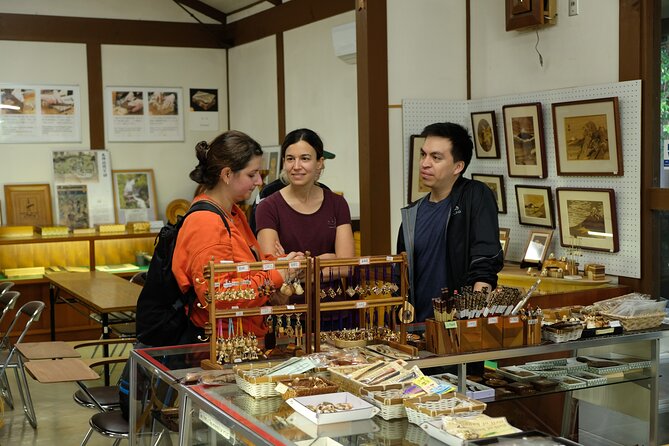
After about an hour of walking, you reach Hatajuku. This village is known for Hakone’s traditional woodcraft, especially decorative work made with carefully arranged natural wood patterns.
The stop gives the walk a human side. The old road was not only a line through the mountains. It connected settlements, workshops, rest stops, and travelers moving between major cities. Hatajuku helps show how local craft became part of Hakone’s identity.
The first section takes about two hours in the stated schedule, including the walk and time around the village. The route mixes cobbled pavement and forest trail, so you should wear sturdy walking shoes with a good grip. The information provided does not give an exact elevation gain or trail difficulty rating, but moderate physical fitness is required.
You do not need to approach this as a technical hike. Still, uneven stone paths and wooded trails can be tiring, especially if the ground is wet. Take the fitness note seriously if you have trouble with hills or uneven surfaces.
Skipping the steep climb by bus
After Hatajuku, you board a bus for the steepest part of the old route. I consider this a smart design choice for a half-day tour. You retain the more atmospheric walking sections while avoiding the climb most likely to turn a relaxed morning into an exhausting one.
The bus costs less than 400 yen and is not included. The tradeoff is simple: you do not walk every step of this section, but you gain time and energy for the forest path, the teahouse, and Lake Ashi.
Some hikers may see this as a weakness. If your main goal is to complete the entire Hachiri route on foot, this is not that experience. It is a selected section designed to show the strongest parts of the route in about four hours.
For most people comparing half-day options, the bus makes the outing more approachable. You get a historic road, a traditional village, and a scenic finish without committing to a full-day trek.
More history-led days in Hakone:
- World Heritage Shirakawa-go and Experience Tours from Kanazawa
★ 5.0 · 4,049 reviews - Tokyo: Imperial Palace and Shogun Historical Walking Tour
★ 5.0 · 2,251 reviews - World Heritage Kyoto & Nara Uji Authentic Matcha Experience
★ 5.0 · 1,573 reviews - Kyoto Gion: 2-Hour Geisha Culture & History Walking Tour
★ 5.0 · 1,186 reviews
Amasake at a 400-year-old teahouse
The next major pause is the Hakone Amazake Tea House. The building has a history of 400 years, and the stop lasts about 30 minutes.
You receive an amasake drink, a traditional sweet rice beverage. Despite its name, amasake is commonly non-alcoholic, though the supplied details do not specify the exact preparation served here. The drink works well as a break after the trail and before the final walk toward the lake.
This is one of the experience’s strongest details. A quick stop at a modern café would be pleasant, but a centuries-old teahouse gives you a clearer sense of how people once moved through Hakone. The stop also lets the guide explain the road and its travelers in a setting connected to that past.
The pace matters. Thirty minutes is enough for a drink and a rest, but not so long that the morning loses momentum. If you like tours that include a small local food or drink tradition rather than only viewpoints, this part adds real value.
Past reviews of the experience give particular attention to similar refreshment stops, including barley tea and a traditional rice dessert. The precise food served can vary, so think of the amasake as the confirmed highlight and any additional snack as a possibility rather than a promise.
Forest paths toward Lake Ashi
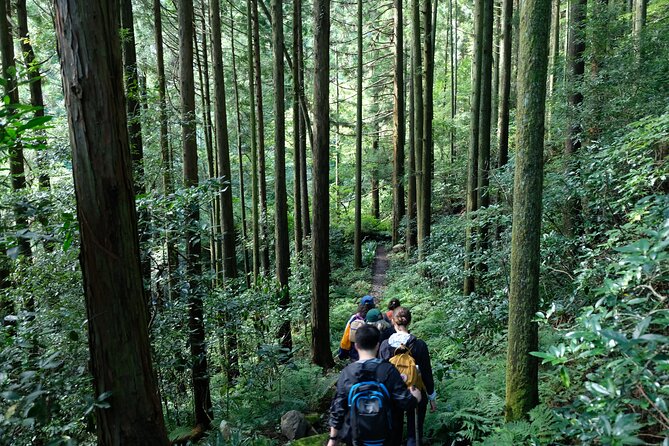
After the teahouse, the walk continues toward Lake Ashi. This is the part described as a forest-bathing hike, with more primitive woodland and quieter stretches of trail.
The phrase forest bathing can sound grand, but the idea is straightforward here: slow down, listen to the woods, and let the route provide a break from Hakone’s more developed sightseeing stops. You will still be walking, not attending a formal wellness session.
I like this section because it gives the tour a steady rhythm. You begin with transport and village life, pause for amasake, then return to the trees before reaching the open view at the lake. The change from shaded forest to water and mountain scenery makes the finish feel earned.
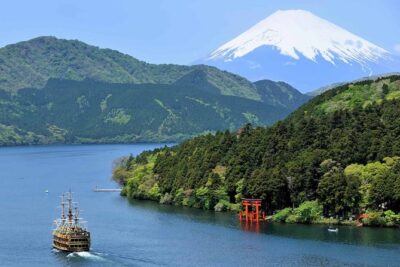
At Lake Ashi, the view depends on the weather. On a clear day, you may see Mt Fuji across the lake. You should treat this as a bonus, not the main guarantee. Hakone often has cloud and haze around the mountain, and the tour cannot control visibility.
The walking portion lasts about two to three hours overall, while the full experience takes roughly four hours. The separate one-hour listing for Lake Ashi allows time for the final viewpoint and orientation before you continue on your own.
The Hakone Checkpoint and a useful finish
The last stop is the Hakone Checkpoint. This site helps explain Hakone’s role in controlling movement along the old Tokaido highway.
The checkpoint is not just another photo stop. It shows why this mountain crossing had political importance. Your guide can connect the road, the checkpoint, and the Edo-era travel system, giving the morning a clear historical ending.
The tour finishes in Motohakone, beside Lake Ashi, at around 1pm. That timing is particularly useful. You can continue by bus toward Odawara, return to Hakone-Yumoto, or head toward a Hakone hotel. You can also take a ferry, including the well-known pirate ship service, to your next stop.
Because the tour ends at a transport hub rather than returning to Hakone-Yumoto, plan your afternoon before you set out. This is an advantage if you want to continue sightseeing around Lake Ashi, but less convenient if you need to collect luggage or return to your starting point immediately.
The guide makes the difference
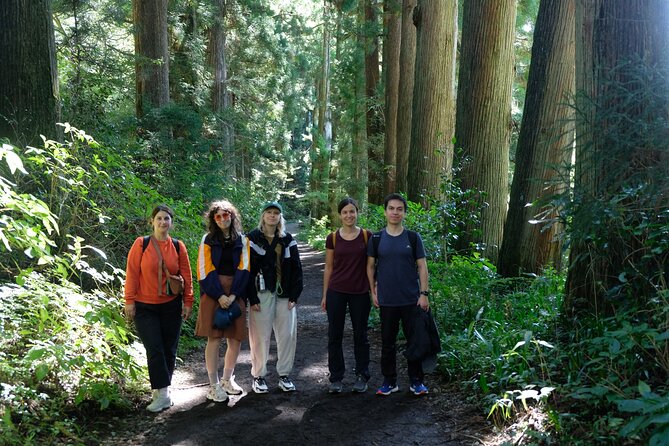
A historic trail can be rewarding on its own, but the guide shapes how much you take from it. The experience includes a certified National Mountain Guide, and the group is capped at six people.
Akihiro is from the Hakone area and has been praised for explaining the local setting and the old road in clear English. Aki has also guided the route, offering historical context, pauses for questions, and a friendly approach. One family with a teenage son found the guide especially kind and easy to understand, including a guide who had studied in Seattle.
That detail matters if you are concerned about language. The guide is not simply leading from the front and pointing toward the next turn. The strongest part of the experience is the explanation of the Edo-era road, Hatajuku’s craft tradition, and Hakone’s place in Japanese history.
A six-person limit should also help with the pace. You can ask about the trail, local traditions, or what to do after reaching the lake without needing to speak over a large crowd. The tradeoff is that small-group tours often cost more than a general sightseeing walk, which is reflected in the price.
Who should book this half-day hike?
I would choose this outing if you want to combine nature, local culture, and Japanese history in one morning. It suits people who enjoy walking but do not want a demanding full-day mountain route.
It is a good fit for couples, families with older children, and solo visitors who prefer company and explanation on a historic trail. A 16-year-old joined successfully with a parent, but the required moderate fitness level still applies.
You may prefer another activity if your priority is a long, strenuous hike, a complete end-to-end walk of the Hachiri route, or a guaranteed Mt Fuji photograph. The mountain view depends on weather, and the steepest section is covered by bus.
The tour also suits a packed Hakone schedule. Starting at 9am and ending around 1pm leaves the afternoon for Lake Ashi, the pirate ship, the checkpoint area, or a return to Odawara. Just remember that the tour is one-way, so you need to decide where you are going next.
Price, practical costs, and weather
At $114.95 per person, this is a premium half-day activity. The price makes the most sense if you value a small group and a guide who can explain the route in English rather than simply escorting you between sights.
Add the shared taxi cost of 2,000 yen per group and the bus fare of less than 400 yen per person. The taxi cost is divided among the group, so the final amount depends on how many people join.
The experience is non-refundable and cannot be changed after booking. That is important because the tour requires good weather. If the operator cancels due to poor conditions, you are offered another date or a full refund, but canceling on your own does not produce a refund.
Bring comfortable walking shoes and plan for uneven cobbles and forest trails. The provided information does not list special equipment, but sensible footwear and clothing suited to the forecast are important for a route that may be wet or slippery in poor weather.
Should you book it?
Book this tour if you want a compact, well-explained introduction to Hakone’s old Tokaido highway. The strongest reasons are the quiet forest sections, the preserved cobbles, the Hatajuku craft village, the 400-year-old teahouse, and the small group led by a certified guide.
Skip it if you want to walk every part of the route or need a low-cost sightseeing option. The extra transport fees and strict cancellation terms also deserve attention.
For the right visitor, this is a smart half-day choice. You get a real historic road, a local drink, a forest walk, and a scenic finish at Lake Ashi, with enough time left to keep exploring.
FAQ
Where does the Hakone Hachiri hike start?
The tour starts at Hakone-Yumoto Station in Hakone at 9am.
Where does the tour finish?
It finishes in Motohakone at Lake Ashi, around 1pm. From there, you can take a bus toward Odawara, Hakone-Yumoto, or a Hakone hotel, or continue by ferry.
How long does the experience last?
The full experience lasts about four hours. The walking portion takes roughly two to three hours.
Is transportation included?
Transportation to the trailhead is not included. A shared taxi costs 2,000 yen to be divided among the group. The bus to the Amazake Tea House costs less than 400 yen and is also separate.
Is Mt Fuji guaranteed to be visible?
No. You may see Mt Fuji across Lake Ashi if the weather is clear, but visibility depends on conditions.
What fitness level is required?
You should have moderate physical fitness. The route includes cobbled paths and forest trails, while the steepest section is skipped by bus.
Just added around Hakone
- Private Hakone Half-day Car Tour with Hotel Pickup – Local Guide★ 5.0 · 48 reviews
- Hike Japan Heritage Hakone Hachiri with certified mountain guide★ 5.0 · 46 reviews
- Traverse Outer Rim of Hakone Caldera and Enjoy Onsen Hiking Tour★ 5.0 · 30 reviews
- Hike Hakone Hachiri★ 5.0 · 48 reviews
- Easygoing Nature Walk in Hakone Tour★ 5.0 · 15 reviews
- Odawara: Guided Ninja & Samurai Tour of Odawara Castle★ 5.0 · 25 reviews
- Odawara: Odawara Castle Tenshukaku Entrance Ticket★ 4.2 · 30 reviews
- Kowakien Yunessun Hot Springs Entry Ticket★ 4.2 · 23 reviews
Hakone Tours, compared.
Hakone 6 hour Private Tour with Government-Licensed Guide
Read our review →
Custom Private Tour in Hakone with a Certified Local Guide
Read our review →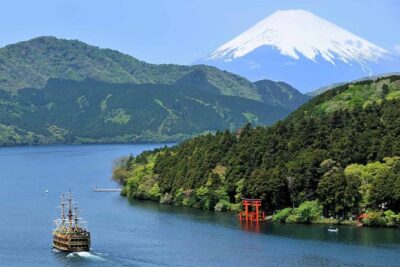
Hakone 8 hour Private Tour with Government-Licensed Guide
Read our review →
Private Tour – Hakone Day Trip! A Tour to Explore All Must-Sees!
Read our review →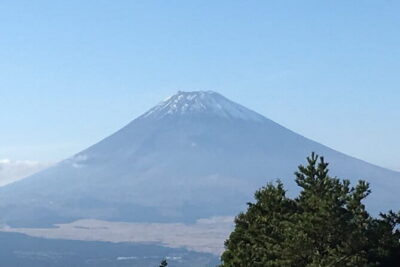

Private Hakone Half-day Car Tour with Hotel Pickup – Local Guide
Read our review →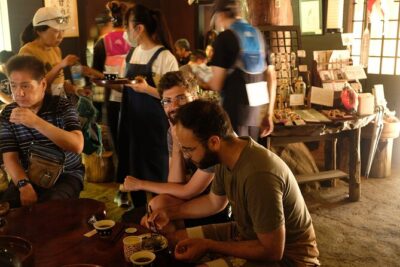
Hike Japan Heritage Hakone Hachiri with certified mountain guide
Read our review →
Odawara: Odawara Castle Tenshukaku Entrance Ticket
Read our review →Browse the lists this tour appears in