
Reviewed · TOKYO TOURS
Kamakura Temples Private Guided Tour from Tokyo
Kamakura’s 13-meter Great Buddha is the headline sight, but the real appeal of this eight-hour private tour is the way it links Buddhist temples, a Shinto shrine, and the old town in one manageable day from Tokyo. You travel by train, walk about 3 to 4 kilometers, and have a guide beside you to explain what you are seeing.
I like the private format and the chance to ask questions at your own pace. I also like the mix of Hase Temple’s gardens, Kotokuin’s famous statue, and Tsurugaoka Hachimangu’s broad shrine grounds. The catch is price: at $145 per person, you still pay for trains, admission, lunch, and drinks, so the final bill can climb.
Key points to know before booking
- The Great Buddha is only one part of the day: You also visit Hase Temple, Tsurugaoka Hachimangu, and Komachi Street.
- The tour uses public trains: The journey from Tokyo takes about 70 minutes each way, with roughly 10 more minutes between some Kamakura stops.
- Your guide walks with you: English-speaking licensed guides have included Steve, Take, Mizuma-san, and Richie, though the assigned guide can vary.
- Budget extra money: Transport is around 2,000 yen per person, temple admissions total 700 yen, and lunch is not included.
- Expect a walking day: You cover about 3 to 4 kilometers, so comfortable shoes matter.
- Private touring helps in crowds: A guide can adjust the pace and steer you through busy areas, especially around Kamakura’s major sights.
From Tokyo to Kamakura by train
The day begins with pickup from your hotel or one of the listed meeting areas, including Tokyo Station and Shinjuku Station. Pickup and drop-off are on foot, so you and the guide walk to the station rather than using a private vehicle.
The train ride to Kamakura takes about 70 minutes. That is not a quick hop, but it is a sensible way to reach the city without dealing with road traffic. I like this part because you get a look at how the day works in practical terms: Kamakura is an easy day trip, but it is not just around the corner from central Tokyo.
The guide travels with you, and the transportation cost applies to both you and the guide. The stated estimate is around 2,000 yen per person for public transportation, while one-way tickets are described as costing about 1,200 yen. Because those figures are presented slightly differently, I would confirm the expected transport total when booking and bring enough yen for same-day payment.
A private guide is especially useful here if you are not comfortable sorting out Japanese train routes. You can focus on the outing instead of working out every transfer. Still, remember that this is a public-transport tour, not a chauffeured excursion. You will walk to stations, board regular trains, and spend a good part of the day on your feet.
A few more Tokyo half-days to weigh up
- Mt Fuji and Hakone 1-Day Bus Tour Return by Bullet Train
★ 5.0 · 26,383 reviews - 1-Day Tokyo Bus Tour
★ 5.0 · 14,250 reviews - Tokyo: TOKYO SKYTREE® Admission ticket
★ 4.5 · 11,192 reviews
Hase Temple and its eleven-faced Kannon
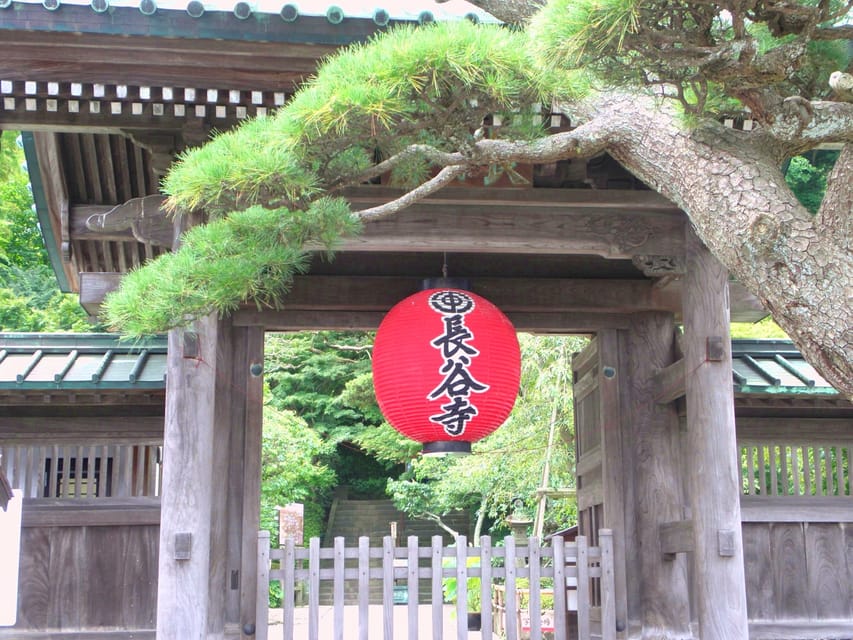
The first major stop is Hase Temple, also called the Temple of Flowers. The visit includes about 30 minutes of guided sightseeing, though the exact time can shift with crowds and the pace of your group.
Inside Hase Kannon, you see the Buddhist statue of Kannon, the Goddess of Mercy. This Kannon has eleven faces, a detail your guide can use to explain the different stages connected with the search for enlightenment. That gives the visit more weight than a quick photo stop. You are not just looking at a large religious image, but learning how Buddhist ideas are expressed through its design.
Outside, the temple gardens provide a change of mood. You can walk among the planted areas and visit Jizo-do Hall, where hundreds of small Jizo Bodhisattva statues are gathered. These small figures are one of the more distinctive sights at the temple, and they reward a slower look.
I would not expect a long temple study session here. The published schedule allows about half an hour, and the day has several major stops to fit in. If you want detailed time for every hall and garden, you may find the pace brisk. On the other hand, the short visit keeps the day moving and leaves room for Kamakura’s other landmarks.
The Hase Temple stop is a good example of why a private guide can help. A licensed English-speaking guide can explain the Kannon’s symbolism while you are standing in front of it, then point out the Jizo statues and garden details before you move on.
Walking to Kotokuin’s Great Buddha
From Hase Temple, you walk about 10 minutes to Kotokuin Temple. This is one of the easiest transitions of the day, and it avoids the need to catch another train for the short distance.
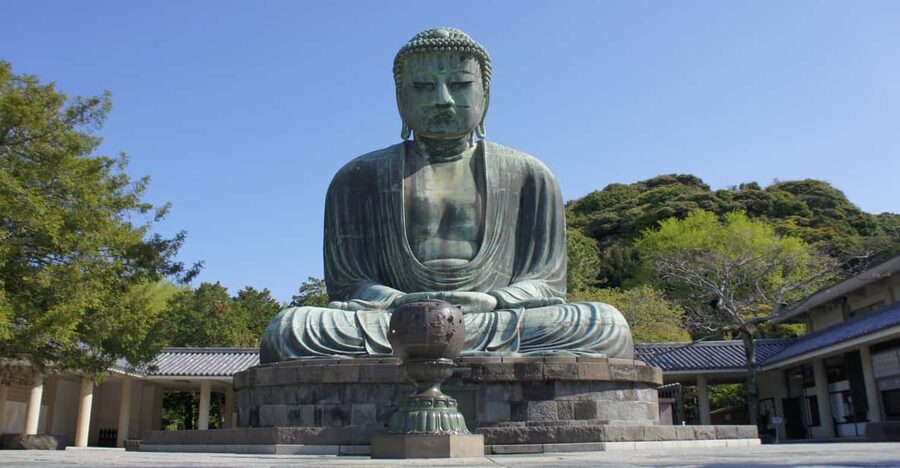
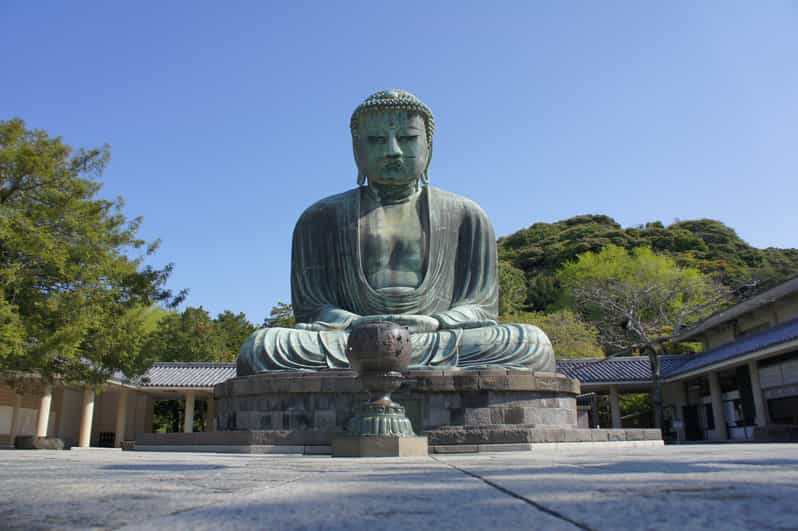
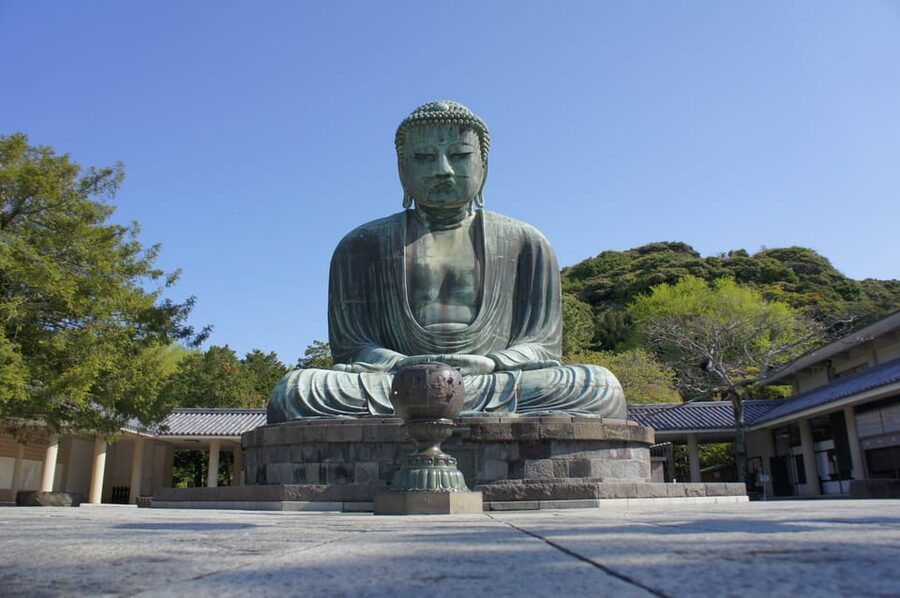
Kotokuin is home to the Great Buddha of Kamakura, a 13-meter-high bronze statue dating to 1292. Its scale is impressive, but the setting also matters. After the more detailed spaces at Hase Temple, the open presence of the Great Buddha gives you a different kind of experience.
The visit is listed at about 30 minutes, including guided sightseeing and time for photographs. Your guide explains the statue’s significance and history, which helps put its age and role in Kamakura into context.
Admission to Kotokuin is 300 yen per person. That fee is not included in the tour price. The information supplied for the tour does not list an extra charge for entering the Great Buddha itself, so I would not build that into your budget unless your guide confirms it. The important guaranteed cost is the 300-yen temple admission.
This stop is likely to be the most memorable for first-time visitors to Kamakura. It is also the place where crowd levels can affect the feel of the visit. One customer specifically described a very crowded day, with the guide managing to move the group through the busy areas and reach the main sights. That is a useful benefit of having someone who knows the route, though no guide can remove the crowds entirely.
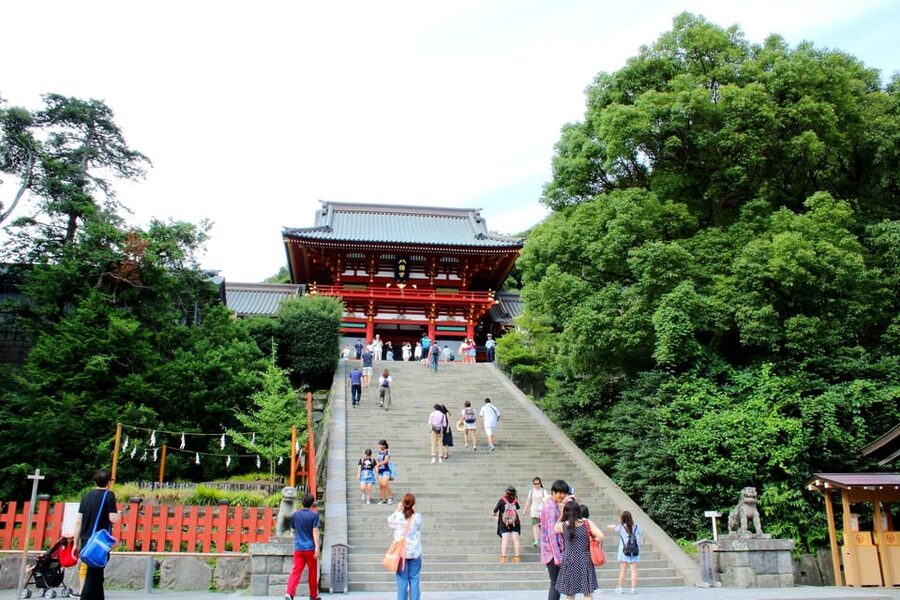
Tsurugaoka Hachimangu, Kamakura’s central shrine
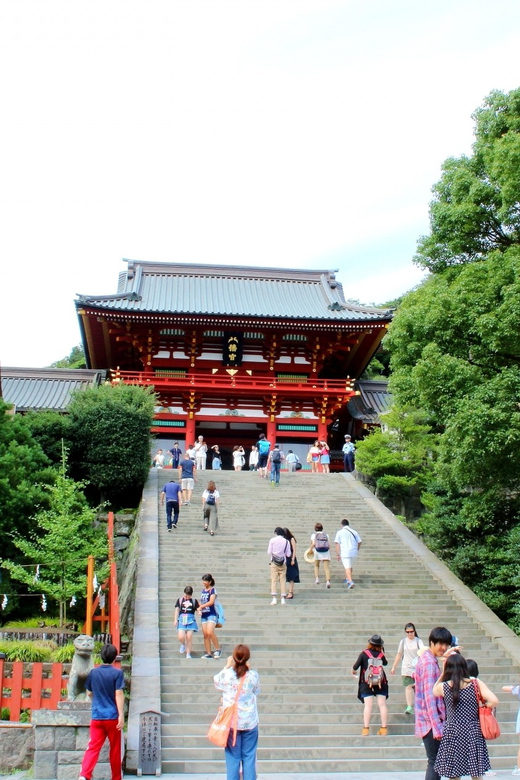
After Kotokuin, you take a train for about 10 minutes to the area of Tsurugaoka Hachimangu Shrine. The shrine receives roughly 30 minutes of guided sightseeing.
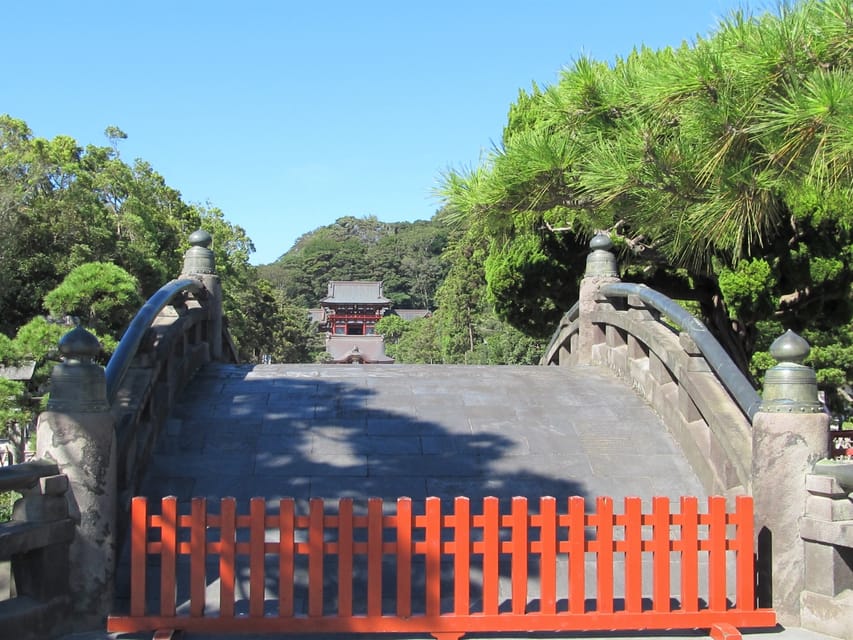
Tsurugaoka Hachimangu was built in 1063 and is dedicated to Emperor Ojin, who is also associated with the God of War. It is Kamakura’s most important Shinto shrine and sits at the city’s geographical center.
The contrast with the Buddhist sites is part of the value here. Hase Temple and Kotokuin show you Buddhist traditions, while Tsurugaoka Hachimangu introduces a major Shinto setting. You can ask your guide about the difference between the two traditions and how both became part of Japanese religious life.
The shrine is also a calmer place to pause after train rides and temple visits. The schedule is short, so you will not have unlimited time to inspect every part of the complex. I would treat this as a focused introduction rather than a full architectural study.
The site’s central position also helps you understand Kamakura as a city, not just a collection of famous monuments. The shrine connects the sightseeing day to the old town, shopping streets, and the nearby lunch stop.
Same base, a completely different sort of day:
- Tokyo: teamLab Planets TOKYO Digital Art Museum Entry Ticket
★ 4.6 · 9,779 reviews - Mt Fuji & Hakone Cruise, Drum Show Bullet Train 1 Day from Tokyo
★ 4.0 · 7,413 reviews - Tokyo: Sumo Show Experience with Chicken Hot Pot and a Photo
★ 4.8 · 6,678 reviews - Tokyo: Shinjuku Food Tour (13 Dishes at 4 Local Eateries)
★ 5.0 · 6,603 reviews
Lunch and free time on Komachi Street
The tour continues to Komachi Street for about 1.5 hours of lunch, guided time, free time, and shopping. This is the most flexible section of the day.
Lunch is not included. You pay for your own meal and drinks, and the guide also pays separately for their food. The description says lunch takes place at one of Kamakura’s fine Japanese restaurants, but it does not name a restaurant or provide a fixed menu. If you have dietary needs or a strong preference, ask the guide what choices are available before settling in.
Komachi Street gives the day a useful change of pace. Instead of moving from one religious site to the next, you have time to eat, browse, and see a more everyday side of Kamakura’s visitor center. You might find the street crowded, especially at popular times, so do not count on a quiet meal or a quick stroll.
The 90-minute block is long enough to make lunch feel like a real break. It also gives you a chance to ask your guide for help choosing what to eat or buy. One customer specifically appreciated a pleasant lunch in town and green tea drinking, so those elements may be part of the day depending on the guide and restaurant arrangements, but they should not be treated as guaranteed inclusions.
I like that this stop is not over-programmed. If the temples have filled your morning, you can use the time to sit down. If you want a little shopping, Komachi Street gives you that option. Just remember that all food, drinks, and purchases are your responsibility.
What the private guide adds
The tour includes a National Government Licensed Guide Interpreter, with English listed as the tour language. That is a meaningful credential for visitors who want cultural explanation rather than simple directions between sights.
The guide quality can shape the day. Individual guides named in customer feedback include Steve, Take, Mizuma-san, and Richie. Take used maps and pictures to explain Kamakura’s past, while Mizuma-san was praised for explaining Japanese history and culture to a family. Steve was credited with organizing a day that included the sights, lunch, and green tea.
Those examples suggest that the guiding style can vary. Some guides may use visual aids and give fuller explanations. Another customer found Richie kind and flexible but felt the sightseeing commentary was limited. I would make your expectations clear at the start: tell the guide if you want more history, more time for photographs, or help with food and shopping.
The private setup gives you more control than a large group tour. You can ask follow-up questions, slow down for a particular statue, or move on when you have seen enough. It does not guarantee a long lecture at every stop, so the best experience will come from active questions.
Is $145 per person good value?
The advertised price is $145 per person for eight hours with a private licensed guide and hotel pickup and drop-off on foot. That can be fair for a couple or small group that values personal attention and does not want to plan the day independently.
The price looks less attractive if you think of the tour as transportation plus an escort. You pay separately for train fares, temple admissions, lunch, and drinks. The known admissions total 700 yen per person, and transportation is estimated at around 2,000 yen per person. Add lunch, and your actual outlay will be notably higher than the headline price.
The value depends on what you want to avoid. You are paying for a guide who handles the route, joins you on the train, explains the sites, and manages the day’s timing. You are not paying for a private car, included meals, or included tickets.
I would choose it for a first visit, especially if you want cultural context or feel uneasy navigating Japanese trains. Independent visitors can reach Kamakura by train and visit these same places for much less. The private tour earns its keep through convenience and conversation, not through included extras.
Timing, walking, and crowd practicalities
The full day lasts eight hours, with return to Tokyo around 4 or 5 pm. That makes this a substantial outing rather than a quick side trip. You should plan for a morning departure and keep the evening fairly open in case the return takes longer than expected.
Walking totals about 3 to 4 kilometers. That is moderate, but it comes on top of station access, temple paths, shrine grounds, and standing during sightseeing. Comfortable shoes are essential.
Crowds are another factor. Kamakura’s major attractions are popular, and one particularly crowded day required the guide to work through busy areas. A private guide can help with movement and timing, but the tour cannot promise empty temples or quiet streets.
The schedule gives you 30 minutes at each of the first three principal sights, 10 minutes of walking between Hase Temple and Kotokuin, and 1.5 hours for lunch and Komachi Street. You get a clear overview of Kamakura, but not hours at any single monument. If you want a slow, photo-heavy visit, tell the guide early and accept that another stop may receive less time.
Who should book this Kamakura tour?
I think this tour suits first-time visitors to Japan who want Kamakura explained in English and prefer not to organize several trains and temple visits themselves. Families may also appreciate the private format, since the guide can respond to questions and adjust the pace more easily than a fixed group.
It is a good match for visitors who care about cultural meaning. Hase Kannon, the Jizo statues, the Great Buddha, and Tsurugaoka Hachimangu each represent something different, and a licensed guide can connect those sights.
I would hesitate if your main goal is saving money. You can reach Kamakura independently, pay the same modest admission fees, and spend less overall. I would also hesitate if you want a very slow temple day, since the schedule aims to cover four major areas within eight hours.
Free cancellation is available up to 24 hours before departure, and you can reserve now and pay later. The guide can pick you up at your hotel, but you need to provide the hotel details when booking.
Should you book it?
Book this tour if you want a private English-speaking guide, a simple route from Tokyo, and a well-shaped first look at Kamakura. The strongest parts are the mix of Buddhist and Shinto sites, the famous Great Buddha, and the guide’s help with a crowded, train-based day.
Skip it if you are comfortable using public transport and want the lowest possible cost. The extra payments matter, and the tour’s value depends heavily on how much explanation and personal help you want. Before booking, confirm the transport estimate, tell the guide what interests you most, and budget for lunch and admissions. That will give you a clearer idea of the real price.
FAQ
How long does the Kamakura tour last?
The tour lasts eight hours. You return to Tokyo at around 4 or 5 pm.
How do I travel from Tokyo to Kamakura?
You travel by public train with the guide. The journey from Tokyo to Kamakura takes about 70 minutes each way.
Where can pickup and drop-off take place?
The listed pickup and drop-off locations include Tokyo Station, Shinjuku Station, Tokyo, and Shinjuku City. Hotel pickup and drop-off are also available on foot if you provide your hotel details when booking.
Is transportation included in the tour price?
No. Public transportation for you and the guide is paid separately. The estimated transportation cost is around 2,000 yen per person, and one-way train tickets are listed at about 1,200 yen.
Are temple entrance fees included?
No. Hase Temple costs 400 yen per person, and Kotokuin Temple costs 300 yen per person.
Is lunch included?
No. You pay for your own lunch and drinks, and the guide pays separately for their meal.
How much walking does the tour involve?
The tour includes about 3 to 4 kilometers of walking. Comfortable shoes are recommended.
What language is the tour offered in?
The tour includes a live English-speaking guide. The guide is a National Government Licensed Guide Interpreter.
Can I cancel the booking?
You can cancel up to 24 hours in advance for a full refund. The tour also offers a reserve-now, pay-later option.
Just added around Tokyo
- Private Arrival Transfer : Narita International Airport to Central Tokyo City★ 4.5 · 12 reviews
- Narita Airport(NRT): Private Transfer to Tokyo/Yokohama 1-9pax★ 5.0 · 47 reviews
- Private Transfer from Narita Airport to Yokohama Port and City★ 4.5 · 17 reviews
- [Narita Airport Terminals 1, 2] 40-60km Sawara Itako Historic Bike Tour★ 5.0 · 13 reviews
- 3 Day Japan Highlights Tour: Tokyo, Mt.Fuji, Nara, Kyoto, Osaka★ 5.0 · 22 reviews
- Small Town in the Big City: Tasting Tokyo’s Kichijoji★ 5.0 · 195 reviews
- Small Town in the Big City: Tasting Tokyo’s Kichijoji★ 5.0 · 16 reviews
- The 10 Tastings of Tokyo With Locals: Private Street Food Tour★ 5.0 · 48 reviews
Tokyo Tours, compared.

Mt Fuji and Hakone 1-Day Bus Tour Return by Bullet Train
Read our review →

teamLab Planets TOKYO Digital Art Museum Entry Ticket
Read our review →
Mt Fuji & Hakone Cruise, Drum Show Bullet Train 1 Day from Tokyo
Read our review →
Sumo Show Experience with Chicken Hot Pot and a Photo
Read our review →
Shinjuku Food Tour (13 Dishes at 4 Local Eateries)
Read our review →
Tokyo Mt Fuji 5th St & Hakone Cruise Bus Tour w/Bullet Train
Read our review →