Reviewed · TOKYO TOURS
Tokyo: Open Top Panoramic Sightseeing Bus with Audio Guide
Tokyo looks different from the top deck of a bus. You get a broad view of Tokyo Tower, Ginza’s avenues, Rainbow Bridge, and the city’s tall buildings without wrestling with a subway map. At $11, this is a low-cost way to get your bearings fast, especially on your first day.
I like the two route choices and the GPS audio system, which starts commentary as the bus reaches each area. I also like the calm pace: you sit, look around, and let Tokyo come to you. The tradeoff is clear: weather and traffic matter, and the upper deck can feel hot, cold, or cramped.
Key points before you book
- Two 70-minute routes: Choose the Bay Course for Rainbow Bridge and Odaiba, or the City Course for the Imperial Palace area, Roppongi, Tokyo Tower, and Ginza.
- GPS-triggered commentary: Audio starts according to the bus’s location and is available in Japanese, English, Chinese, French, Korean, Vietnamese, and Thai.
- Tokyo Station meeting point: Check in at Tokyo VIP Lounge, about five minutes from the Yaesu North Exit.
- Open-top views with weather limits: Rain may cause the roof to close, and extreme weather such as a typhoon can cancel the ride.
- Bring suitable headphones: Headphones are optional and cost 100 yen. The jack accepts only a 3.5mm mini plug.
- Strict departure time: Arrive 20 to 40 minutes early. The bus cannot wait for late arrivals or people at the wrong meeting point.
Choosing between the Bay Course and City Course
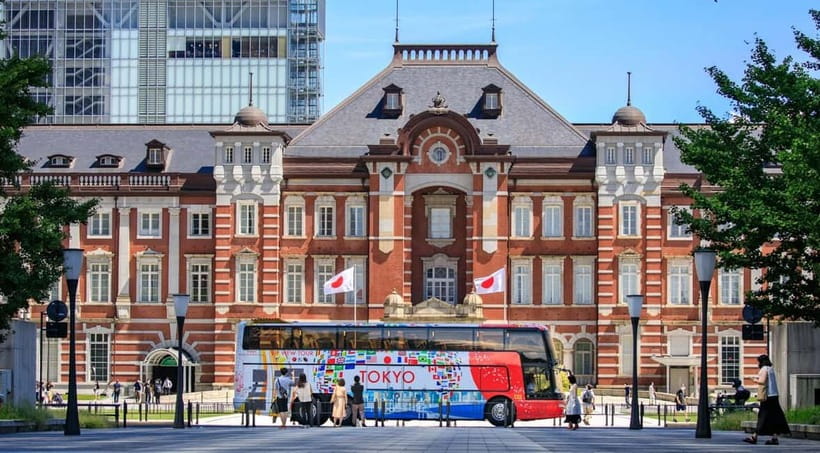
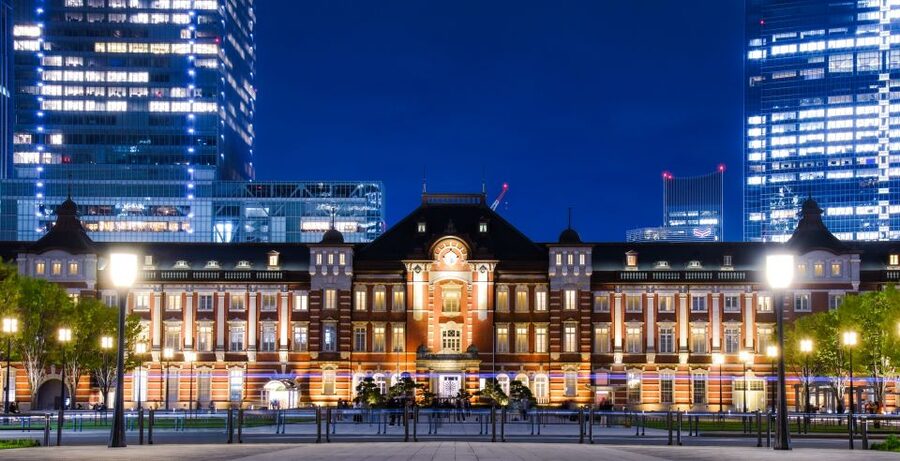
The Bay Course is the more scenic choice if you want water, bridges, and modern Tokyo. It begins at the red-brick Tokyo Station building, then passes through Marunouchi before heading toward Zojoji Temple and Tokyo Tower.
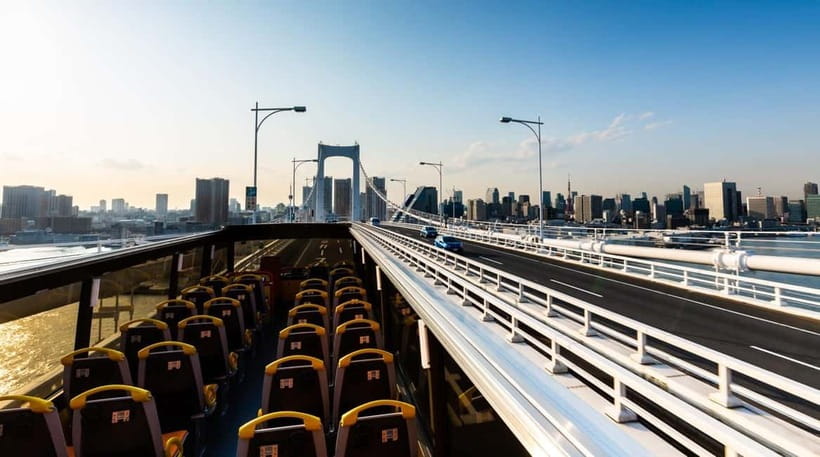
From there, the bus reaches Shibaura and crosses the first level of Rainbow Bridge. The route continues past the Fuji TV Building, the Statue of Liberty, and Odaiba Seaside Park before crossing Rainbow Bridge again on its second level. It finishes through Shiodome and Ginza.
That route gives you a useful contrast. You see Tokyo’s older religious and civic landmarks, then its waterfront developments and large-scale modern architecture. The two Rainbow Bridge crossings are the main prize. They give you an unusual view of Tokyo Bay and show how the city extends across reclaimed waterfront areas.
The City Course stays in central Tokyo. From Tokyo Station and Marunouchi, it passes Chidorigafuchi, the Akasaka State Guest House, Meiji Jingu Gaien, Tokyo Midtown, Roppongi, Tokyo Tower, Hibiya, and Ginza.
This is the better pick if your interests lean toward central districts, government buildings, city streets, and skyscrapers. You get a stronger sense of Tokyo’s formal core and its high-rise districts. It is also a sensible option if you are staying near central Tokyo and do not want to spend your short sightseeing window heading out toward Odaiba.
Both routes last 70 minutes. I would not treat one as a quick version of the other. They cover different parts of the city, so check the route carefully before booking. If your schedule allows, taking both gives you a wider look at Tokyo, and one past rider used the City Course and Bay Course on the same day.
More self-guided routes in Tokyo:
- Tokyo: 60min Panoramic Open Top Bus Tour with Audio Guide
★ 4.0 · 40 reviews
What the Tokyo Station departure is really like
The meeting point is Tokyo VIP Lounge, on the second and third floors of a building with Family Mart on the ground floor. It is about a five-minute walk from Tokyo Station’s Yaesu North Exit, at 35.681763, 139.7713517.
The name VIP Lounge may suggest a polished airport-style waiting room. In practice, the facility is a shared space used by other people, and it is fairly basic. Open-top bus passengers can use it free of charge from 40 minutes before departure. Outside that window, a facility fee may apply.
I would arrive 20 to 40 minutes early, but do not assume you can settle in for a long wait. The space is shared, and seating may not be available for every person waiting. The check-in process includes directions and, according to the experience details, a short walk from the lounge to the bus. Japanese-speaking staff are available to help, though English communication may be limited.
This is one part of the outing that rewards preparation. Save the map, check the building with Family Mart, and allow extra time inside Tokyo Station. The station is large enough to turn a simple five-minute walk into a rushed dash if you leave the platform area late.
The bus leaves on schedule. It does not wait for late arrivals, even if you contact the operator before departure. Arriving at the wrong meeting point also does not qualify for a refund, so this is not the activity to reach casually at the last minute.
Seeing Tokyo from the upper deck
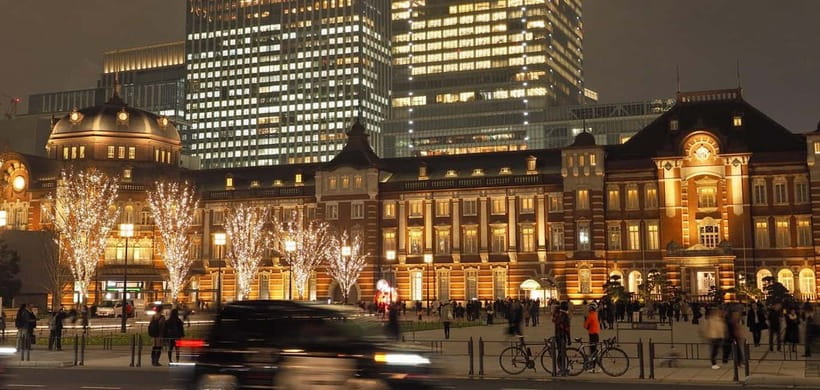
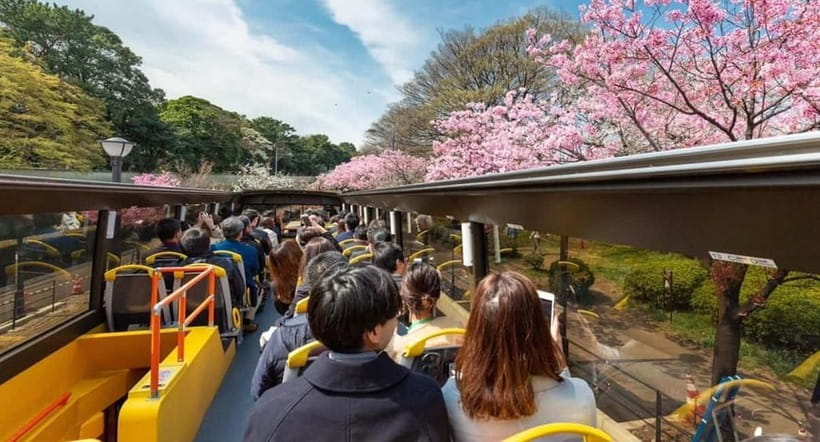
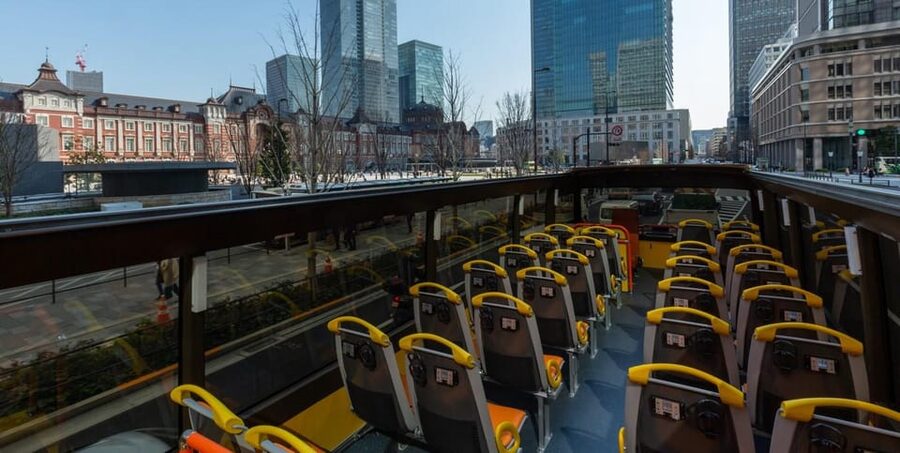
The open-top setup is the main reason to choose this ride over a standard bus tour. You get a clean view above street level, with fewer visual barriers between you and the buildings, bridges, and sky.
That view works best when the bus passes wide roads and large landmarks. Tokyo Tower, Rainbow Bridge, the waterfront, Ginza, and the high-rise districts are easier to appreciate from an open deck than from a train window. You can also watch ordinary city life from the road, including parks and public areas along the route.
The seating has a practical drawback: legroom can feel limited. If you are tall, the 70-minute duration is long enough to notice cramped knees. The bus is also exposed to the elements. A sunny afternoon may feel warm, while an evening ride or winter departure can feel cold.
The tour runs in rain unless conditions become extreme. If rain begins, the roof may be closed, which changes the experience considerably. You still get the route and commentary, but not the open-air view that makes this bus special.
Check the forecast before you go and dress for the actual conditions, not the season on the calendar. A light jacket can matter on the upper deck, while sun protection is useful in hot weather. Umbrellas are not allowed on the vehicle, and food, smoking, and selfie sticks are also prohibited.
How the GPS audio guide works
The audio system uses GPS to identify where the bus is and then plays sightseeing information for the current location. It also adjusts to traffic and road conditions, so the commentary is designed to match the bus’s progress rather than follow a rigid recorded timetable.
You can listen in Japanese, English, Chinese, French, Korean, Vietnamese, or Thai. That makes the tour useful if you want basic historical and geographical context without hiring a private guide.
Headphones are not included. You can buy a pair for 100 yen, but the audio jack accepts only a 3.5mm mini plug. If you already own compatible wired headphones, bring them. Wireless earbuds may not work with the supplied connection, and this is a small detail worth checking before you leave your hotel.
The commentary provides plenty of facts about the sights. It is more focused on landmarks than on everyday Tokyo life, so do not expect a long explanation of local neighborhoods or how residents use the city. The system is also accompanied by Japanese announcements from staff at times. This can make it harder to hear the recorded guide, especially when the live commentary is delivered over a loudspeaker.
Music between sections has also been too loud for some listeners. The simple solution is to keep the volume comfortable and expect occasional sound overlap. The audio is useful, but it is not the same as having a live guide who can answer questions or change the discussion to suit your interests.
Same base, a completely different sort of day:
- Mt Fuji and Hakone 1-Day Bus Tour Return by Bullet Train
★ 5.0 · 26,383 reviews - 1-Day Tokyo Bus Tour
★ 5.0 · 14,250 reviews - Tokyo: TOKYO SKYTREE® Admission ticket
★ 4.5 · 11,192 reviews - Tokyo: teamLab Planets TOKYO Digital Art Museum Entry Ticket
★ 4.6 · 9,779 reviews
Tokyo Tower, Zojoji, and the city center
On the Bay Course, the early section through Marunouchi, Zojoji Temple, and Tokyo Tower gives you a compact introduction to central Tokyo. Tokyo Station’s red-brick exterior is a striking starting point, while Marunouchi shows the business district around it.
Zojoji Temple adds a traditional note before the bus reaches Tokyo Tower. That contrast is one of the route’s strengths: modern office blocks, a Buddhist temple, and an instantly recognizable tower appear within the same 70-minute ride.
You do not get extended stops for visits or photographs. Think of these landmarks as moving sights, not individual attractions. If Tokyo Tower or Zojoji catches your attention, note its location and return later on foot or by train.
The City Course gives central Tokyo more room. Chidorigafuchi and the Akasaka State Guest House lead toward Meiji Jingu Gaien, Tokyo Midtown, and Roppongi. The route then returns toward Tokyo Tower, Hibiya, and Ginza.
This is a good first look at the city’s scale. You move through areas that feel quite different in character, yet they are linked by Tokyo’s wide roads and dense building clusters. The bus does not replace visiting the Imperial Palace area, Roppongi, or Ginza on foot, but it helps you decide where to spend your limited time later.
Rainbow Bridge and Odaiba are the highlight
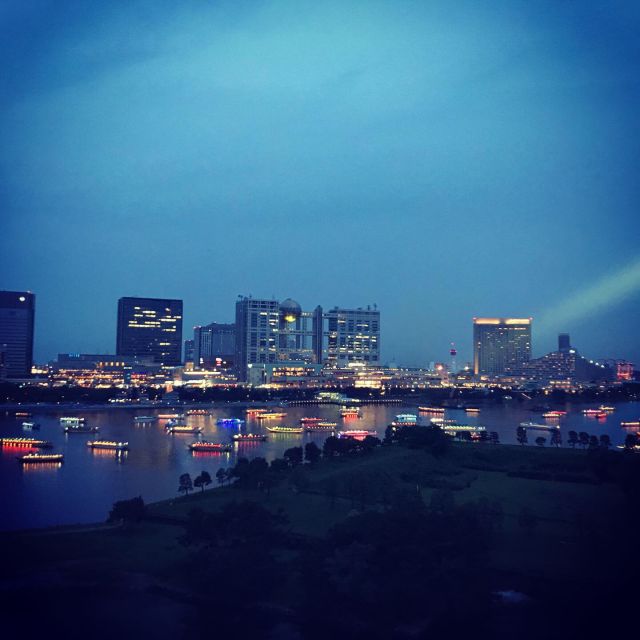
The Bay Course earns its place with the waterfront section. Crossing Rainbow Bridge provides a broad view of Tokyo Bay and the city’s shoreline. The route uses both the first and second levels, giving you two different perspectives during the ride.
The Fuji TV Building and the Statue of Liberty help mark the Odaiba section. Odaiba Seaside Park adds open space beside the water, a welcome change after the dense central districts.
This part is especially valuable at the beginning of a Tokyo stay because it shows a side of the city that can be harder to understand from underground trains. You see the relationship between the bay, bridges, reclaimed land, and large modern buildings in one continuous view.
Traffic can affect the timing, and the bus may make minor changes because of road conditions or weather. That is normal for a road-based tour, but it means the 70 minutes is an approximate sightseeing window rather than a perfectly fixed sequence.
Is $11 good value for Tokyo?
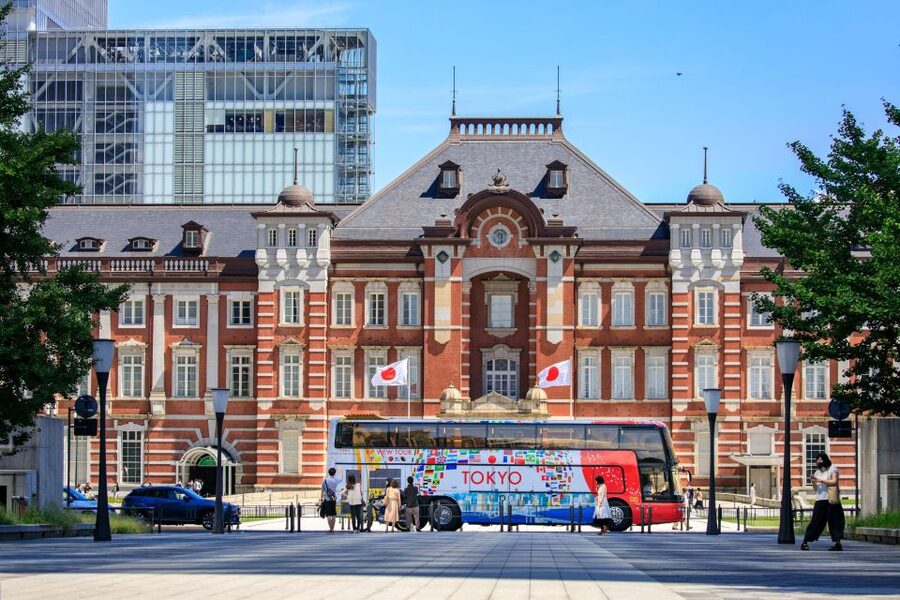
At $11 per person, the tour is priced as an orientation ride, not a full-day guided excursion. You are paying for a seat, an open-top view, a 70-minute route, and recorded commentary. You are not paying for entry to Tokyo Tower, a museum, a meal, or a live guide.
I consider that good value for a first visit or a short stop in Tokyo. Public transport is excellent, but it does not give you a continuous view of the city. A subway ride may move you faster, yet it hides much of the city behind tunnels and station corridors.
The value is strongest if you use the bus to plan the rest of your visit. Mark the areas you want to return to, then explore those places independently. It is less useful if you already know Tokyo well or want long stops at individual landmarks.
The free cancellation option up to 24 hours before departure and the ability to reserve now and pay later make planning easier. Still, the strict no-wait policy means you need to protect your departure time.
Who should book this open-top bus?
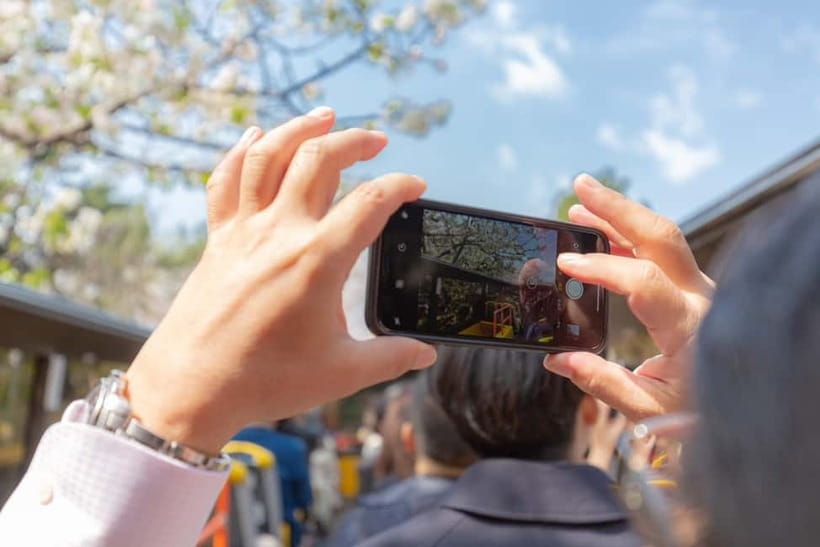
I would recommend it to first-time visitors, families wanting an easy overview, and anyone with only a short time in Tokyo. It also suits you if you enjoy watching a city from the road more than changing trains several times.
The Bay Course fits you best if Rainbow Bridge, Odaiba, and Tokyo Bay are high on your list. Pick the City Course if you want central Tokyo, Roppongi, Tokyo Tower, Ginza, and the Imperial Palace area.
I would hesitate if you dislike exposed seating, have very limited legroom, or are visiting during poor weather. I would also skip it if you need detailed personal guidance in English or another language, since the main commentary is recorded and the available staff assistance is Japanese-speaking.
Final verdict: book it for the view, not a full tour
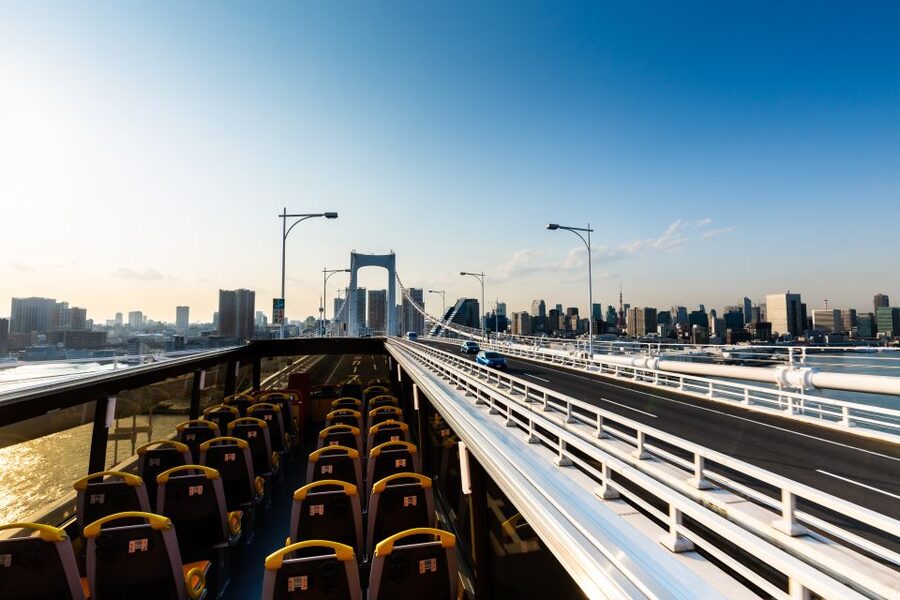
This is a simple, inexpensive way to see a lot of Tokyo in 70 minutes. The most praised features are the friendly organization, safe driving, helpful staff, clear audio information, and excellent views, especially from Rainbow Bridge.
Book it for your first day if you want to understand Tokyo’s size before choosing where to explore. Choose the route carefully, arrive early at the Yaesu-side meeting point, bring compatible headphones, and check the weather. If you accept those limits, the $11 price makes this an easy addition to a Tokyo itinerary.
FAQ
How long does the Tokyo open-top bus tour last?
Each route lasts 70 minutes.
What are the two available routes?
The Bay Course passes Tokyo Station, Marunouchi, Zojoji Temple, Tokyo Tower, Rainbow Bridge, Odaiba, Shiodome, and Ginza. The City Course passes Tokyo Station, Marunouchi, Chidorigafuchi, the Akasaka State Guest House, Meiji Jingu Gaien, Tokyo Midtown, Roppongi, Tokyo Tower, Hibiya, and Ginza.
Where is the meeting point?
Meet at Tokyo VIP Lounge on the second and third floors of the building with Family Mart on the ground floor. It is about a five-minute walk from Tokyo Station’s Yaesu North Exit.
How early should I arrive?
Arrive 20 to 40 minutes before the scheduled departure. The bus leaves promptly and cannot wait for late arrivals.
What languages are available for the audio guide?
The GPS audio guide is available in Japanese, English, Chinese, French, Korean, Vietnamese, and Thai.
Are headphones included?
No. Headphones are optional and cost 100 yen. The headphone jack accepts only 3.5mm mini plugs.
Is there a live guide?
No live guide is included. Japanese-speaking staff are available for assistance, while the sightseeing information is delivered through the GPS audio system.
What happens if it rains?
The tour operates rain or shine unless extreme weather, such as a typhoon, causes cancellation. If it rains, the open top may be closed.
Can I cancel the booking?
You can cancel up to 24 hours before departure for a full refund. You can also reserve now and pay later.
Just added around Tokyo
- Private Arrival Transfer : Narita International Airport to Central Tokyo City★ 4.5 · 12 reviews
- Narita Airport(NRT): Private Transfer to Tokyo/Yokohama 1-9pax★ 5.0 · 47 reviews
- Private Transfer from Narita Airport to Yokohama Port and City★ 4.5 · 17 reviews
- [Narita Airport Terminals 1, 2] 40-60km Sawara Itako Historic Bike Tour★ 5.0 · 13 reviews
- 3 Day Japan Highlights Tour: Tokyo, Mt.Fuji, Nara, Kyoto, Osaka★ 5.0 · 22 reviews
- Small Town in the Big City: Tasting Tokyo’s Kichijoji★ 5.0 · 195 reviews
- Small Town in the Big City: Tasting Tokyo’s Kichijoji★ 5.0 · 16 reviews
- The 10 Tastings of Tokyo With Locals: Private Street Food Tour★ 5.0 · 48 reviews
Tokyo Tours, compared.
Mt Fuji and Hakone 1-Day Bus Tour Return by Bullet Train
Read our review →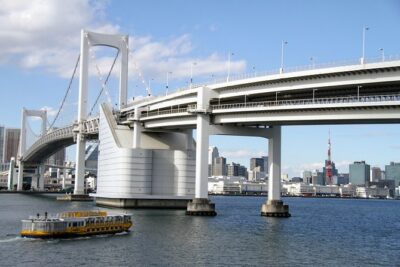
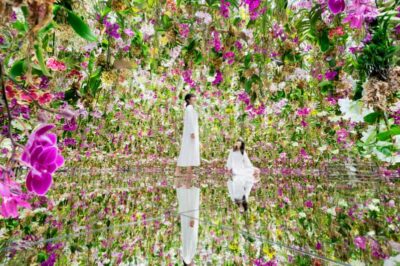
teamLab Planets TOKYO Digital Art Museum Entry Ticket
Read our review →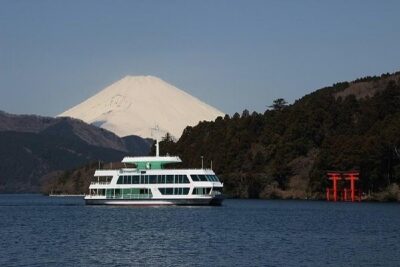
Mt Fuji & Hakone Cruise, Drum Show Bullet Train 1 Day from Tokyo
Read our review →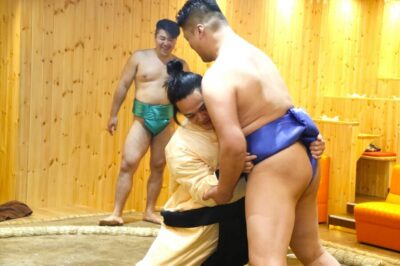
Sumo Show Experience with Chicken Hot Pot and a Photo
Read our review →
Shinjuku Food Tour (13 Dishes at 4 Local Eateries)
Read our review →
Tokyo Mt Fuji 5th St & Hakone Cruise Bus Tour w/Bullet Train
Read our review →