
Reviewed · TOKYO TOURS
Tokyo: Guided Go Kart Tour from Harajuku to Shibuya Crossing
Tokyo traffic becomes part of the show when you take a street-legal go-kart through Shibuya, Harajuku, and Shinjuku. The highlight is driving through Shibuya Crossing, with the city lights, signs, and crowds all around you. It is sightseeing with a steering wheel, not a standard city tour.
I like the small groups, limited to five drivers, and the guide-led format. I also like the costume choice and the photo service, since you can enjoy the ride instead of trying to manage a camera. The main drawback is price: at $103 per person, this is a fun splurge rather than an essential way to see Tokyo.
Key points to know before booking
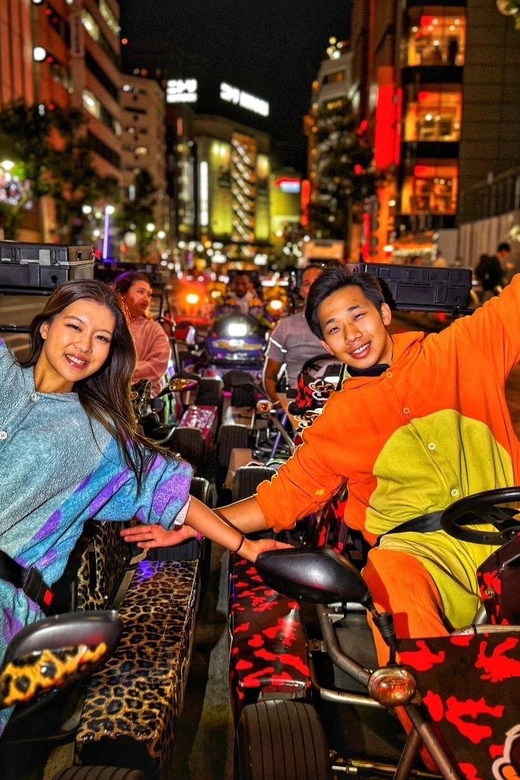
- Shibuya Crossing from the driver’s seat: You ride through one of Tokyo’s most famous intersections instead of only watching it from the pavement.
- A route through three major districts: The 75-minute outing includes Shibuya, Harajuku, Shinjuku, and nearby central Tokyo streets.
- Small groups and active supervision: Groups are limited to five, with a guide leading the formation and using signals throughout the ride.
- Costumes, photos, and camera mounts included: You can dress up, use an Action Camera or Insta360 mount, and receive digital photos plus one hard copy.
- Strict driving paperwork: Japan requires a physical 1949 Geneva Convention International Driving Permit for many drivers. Online copies and card-style permits do not count.
- Best for adults who want an unusual thrill: Drivers must be at least 18, and the tour is not suitable for pregnant women or people over 95.
What this Tokyo go-kart tour is really like
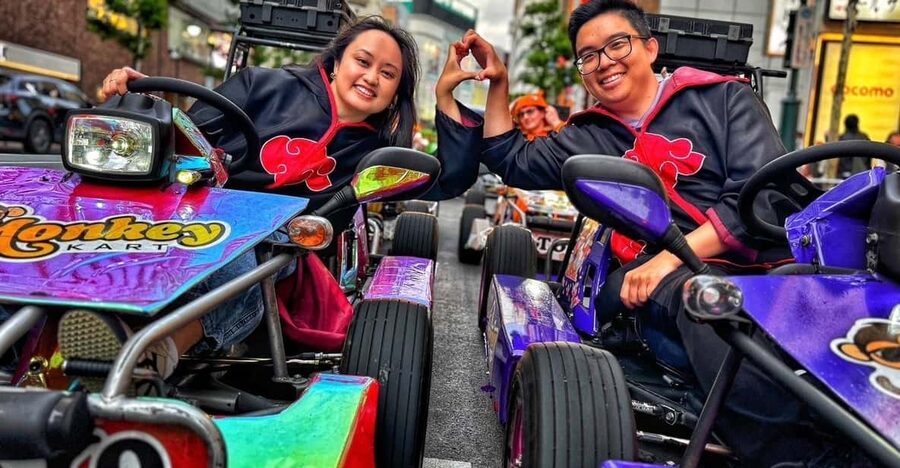
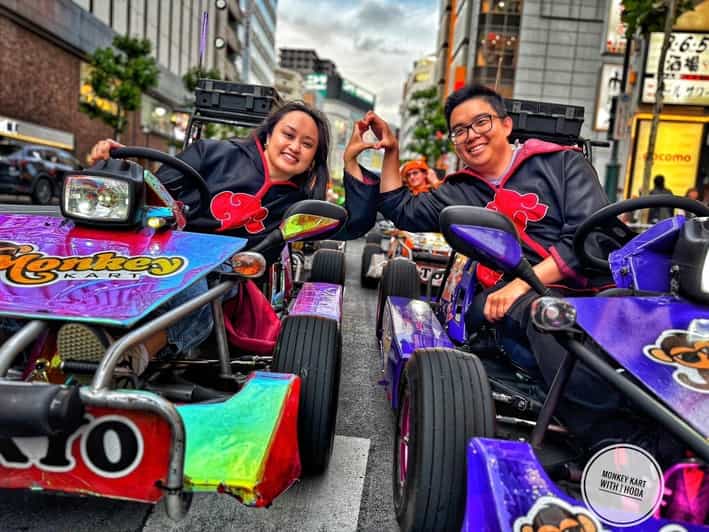
This is not a sightseeing ride in a slow electric cart. You drive your own custom-built go-kart on public roads, following an English-speaking guide through central Tokyo. The guide sets the pace, watches the group, gives signals, and stops for photographs at useful points along the way.
The tour lasts 75 minutes, though that includes the start-up process and return to the meeting point. One customer received about 57 minutes of actual driving time, so I would treat the advertised duration as the full activity rather than a promise of 75 minutes behind the wheel.
The route is the attraction. You get a quick look at several famous parts of western central Tokyo while handling the kart yourself. That makes the experience more exciting than a bus ride, but it also means you should expect traffic, road rules, and concentration rather than a relaxed commentary tour.
More karting in Tokyo:
- Flagship 2-Hours Official Street Go-Kart Tour – Tokyo Bay Shop
★ 5.0 · 4,974 reviews - Official Street Go-Kart in Shibuya
★ 5.0 · 3,435 reviews - Official Street Go-Kart Tour – Akihabara
★ 5.0 · 1,578 reviews
Meeting near Shibuya Station
The meeting point is near Family Mart at 3-chome-17-3 Shibuya, Shibuya City. From Shibuya Station, use Exit C2 and head toward the main large street. The central gate area is about a two-minute walk from that exit.
Allow time to find the shop and check in. One customer reported waiting around 30 minutes, so I would not plan a tight dinner reservation immediately after the tour. Hotel pickup and drop-off are not included, and you need to make your own way to and from the meeting point.
The location works well if you are already spending the day around Shibuya. It is less convenient if your plans center on Asakusa, Ueno, or Tokyo Station, so add train time when judging the real cost and schedule.
The safety briefing matters
Before you drive, the guide explains how to operate the kart and covers the road rules you need for Tokyo streets. This is an important part of the activity. You are not simply driving around a private track, and the guide’s signals help the group stay together in normal traffic.
Previous guides including Rakesh, Lewis, Mirko, Juani, Gas, and Kevin have been singled out for clear instructions, regular check-ins, and careful pacing. The specific guide on your date may be different, but the format is designed around close supervision.
The karts are described as well maintained and easy to use. Still, you should take the briefing seriously. The ride can feel faster than expected, especially on an open kart with little around you to block the noise and air. You need to be comfortable steering, braking, watching traffic, and responding to the guide.
Alcohol is not allowed in the vehicle. You should arrive ready to drive, not after a few drinks or with anything that could distract you.
Costumes add fun, but they are optional
You can choose a costume before setting off. The selection includes costumes, masks, and unusual glasses, and one customer described driving through downtown Tokyo in a unicorn jumpsuit. The costume option gives the photos a playful look and helps make this feel different from a normal road tour.
You do not need to dress up to enjoy the driving. If you prefer a lower-key experience, you can skip the costume and focus on the route. If you do choose one, remember that comfort and visibility matter more than the funniest possible outfit. You need to see clearly and operate the kart without restriction.
This is also where the experience’s pop-culture image needs a little care. The go-karts and costumes create a cartoon-like mood, but you are still operating a motor vehicle in Japan. Treat the costume as a photo accessory, not as permission to behave casually on the road.
A few more Tokyo half-days to weigh up
- Mt Fuji and Hakone 1-Day Bus Tour Return by Bullet Train
★ 5.0 · 26,383 reviews - 1-Day Tokyo Bus Tour
★ 5.0 · 14,250 reviews - Tokyo: TOKYO SKYTREE® Admission ticket
★ 4.5 · 11,192 reviews - Tokyo: teamLab Planets TOKYO Digital Art Museum Entry Ticket
★ 4.6 · 9,779 reviews
From Shibuya streets to the famous crossing
Shibuya is the emotional center of the ride. The route takes you through the area around the station and includes Shibuya Crossing, one of Tokyo’s most recognizable city scenes. From a kart, you see the crossing from street level while moving with the traffic, which gives the moment a different feel from viewing it at a pedestrian lookout.
The crossing is likely to be a highlight, but it is not a private photo stop or a chance to stop in the middle of the intersection. Your guide controls the group, and you follow the road as directed. The value comes from passing through the scene as part of Tokyo’s traffic flow.
Shibuya also makes the ride visually strong. Tall buildings, large signs, busy sidewalks, and constant movement surround the kart. The guide may point out local sights along the way, but the main experience is the sensation of being in the city rather than receiving a long historical lecture.
Harajuku brings a different city mood
The route also reaches Harajuku, known for its youth culture, fashion, and crowded commercial streets. From a go-kart, you get a moving view of the district instead of spending the whole visit on Takeshita Street or in nearby shops.
Harajuku is best understood here as part of the changing route. You are not booking a walking tour of its stores, shrines, or food stalls. You pass through the area and notice how its streets differ from the larger roads around Shibuya and Shinjuku.
That variety is one reason the tour works well early in a Tokyo visit. In 75 minutes, you get a first sense of several central districts. You will not see each one in detail, but you may leave with ideas about where to return on foot.
Shinjuku and the thrill of open-road driving
The ride continues into Shinjuku and nearby central neighborhoods. Shinjuku gives the tour another large-scale urban setting, with broad streets and tall buildings. Some customers have especially enjoyed driving through a tunnel, and one described a clear stretch with little traffic as an exhilarating part of the outing.
Do not count on a specific tunnel run or empty road. Road conditions change, and the guide must keep the group safe. Still, the route can include moments when the kart feels surprisingly quick. One customer said the karts went faster than expected, which is useful to know if you are imagining a gentle sightseeing pace.
The night departure has a special appeal. Tokyo’s signs and buildings light up, and the photos can capture that bright city setting. Daytime rides make it easier to see the streets and surrounding buildings. I would choose night for atmosphere and day for clearer visual detail, while remembering that the tour may be rescheduled in rain.
The guide is central to the experience
A good guide makes this activity work. You need someone who can explain the kart clearly, lead a compact group through traffic, set a sensible pace, and keep the mood light without losing focus.
The strongest guide feedback has centered on safety and communication. Rakesh has been praised for instruction and photography, Lewis for keeping the energy high, Mirko for checking on drivers, and Juani for explaining the areas along the route. Other praised guides include Gas, Rajesh, Luna, Shin, Matthias, Martinez, Chris, and Kevin.
Those names are useful examples of the service style, not a guarantee of who will lead your departure. The tour is in English, and the small group limit of five gives the guide a better chance to notice if someone is nervous or falling behind.
That small group size also affects the social side. You may ride with other people, or you could find yourself in a very small group. One customer had a morning outing with no other participants and enjoyed the extra interaction with the guide. If you prefer a private, personal feel, a lightly booked departure may be ideal, though it cannot be promised.
Photos are a real part of the value
The guide takes photos at selected points during the ride. At the end, the images are sent by AirDrop or email, and one hard copy is included. You can also use an Action Camera or Insta360 mount if you have compatible equipment.
I like this arrangement because taking pictures while driving would be unsafe and distracting. The guide handles the camera work while you concentrate on traffic and the route. The best images should show the costume, kart, and Tokyo setting together, rather than just a standard portrait.
Do not assume every minute produces a photo. The guide has to keep the group moving and choose safe places to capture images. Still, the photo service adds value at a price point that otherwise might feel high.
If you use AirDrop, make sure your phone can receive the files. Email is available too, so you have a backup method for getting the pictures after the activity.
Is $103 worth it?
At $103 per person, this is expensive compared with free city viewpoints, a train ride, or an ordinary walking route through Shibuya. It is not the most efficient choice if your main aim is to study Tokyo’s neighborhoods, visit shops, or learn detailed history.
The price makes more sense when you value the driving itself. You receive the kart, guide, safety briefing, costume access, photography, digital images, one printed photo, water, and the use of a camera mount. You are paying for an unusual activity and the work involved in organizing a small group on public roads.
I would call it good value for a special occasion, a first trip to Tokyo, or anyone who wants one memorable activity beyond temples, department stores, and observation decks. It is less compelling if you dislike traffic, do not enjoy driving, or want a calm way to take in the city.
The high rating of 4.5 from 166 recorded ratings supports the idea that the experience usually delivers its main promise. The less positive comments are also useful: one person found it costly for what it was, and another received less driving time than expected. Keep those limits in mind before paying.
The driving permit rules are the biggest booking issue
Do not leave the paperwork until you reach Japan. Many drivers need a hardcopy paper booklet of a 1949 Geneva Convention International Driving Permit issued by an official agency in their own country, such as AAA, AA, CAA, or another recognized authority.
Japan does not recognize 1968 Vienna Convention permits, IDA permits, or IAA permits. An online copy, Xerox copy, or card-style license is not valid. The activity information specifically says to obtain the permit before leaving your country.
Drivers from France, Switzerland, Taiwan, Germany, Monaco, and Belgium need a Japanese translation of their local license. The physical translation can be obtained through the Japan Automobile Federation, known as JAF.
Some nationalities, including Indonesia, Pakistan, Saudi Arabia, Mexico, Brazil, Costa Rica, Colombia, Kuwait, and Qatar, may not be allowed to drive under the required system. Check that your country issues the recognized 1949 permit before you book.
All drivers must be at least 18. Pregnant women and people over 95 should not take this activity. These are not minor details, since the correct document is required to drive.
Weather, clothing, and timing
Rain can cause the tour to be rescheduled. Tokyo weather can change, so keep some flexibility in your schedule and avoid placing this activity on the one day you cannot move.
The open kart offers little shelter, making weather a bigger factor than it would be on a bus or train. The supplied information does not specify protective clothing, so check current instructions before departure and dress for the forecast. At night, the ride may feel cooler than a normal walk.
The tour lasts 75 minutes and has set starting times based on availability. For an easier day, schedule it when you are alert and not rushing from another distant part of the city. A delayed start or a slower road section can affect your plans afterward.
Who should book this ride?
I would recommend it to adults who enjoy driving, city lights, unusual photographs, and a little controlled excitement. It suits couples, friends, and small groups who want an activity they can talk about afterward.
It is also useful on a first Tokyo visit because the route connects Shibuya, Harajuku, and Shinjuku in one outing. You will not explore them deeply, but you will see how quickly the city’s streets and moods change.
I would skip it if you are pregnant, under 18, unable to secure the correct permit, or uncomfortable driving in traffic. It is also a poor fit if you want a quiet, detailed cultural tour. The guide may share local pointers, but the kart and the road are the main event.
Free cancellation is available up to 24 hours before the activity, and you can reserve now and pay later. Those policies help if rain or a changing Tokyo schedule is a concern, but they do not remove the need to bring valid paperwork.
Should you book the Monkey Adventure Kart tour?
Book it if you want to drive Tokyo rather than simply look at it. The route through Shibuya Crossing, Harajuku, and Shinjuku is unusual, the groups are small, and the guide-led format adds a useful safety net. Costumes and photos make the $103 price easier to justify.
Skip it if you are focused on value in the narrowest sense. You can see many of these districts for far less by train and on foot, and the full 75-minute booking may include less actual driving. For the right person, though, this is one of Tokyo’s more memorable urban activities, provided you arrive with the correct permit and a flexible attitude toward traffic and weather.
FAQ
How long does the Tokyo go-kart tour last?
The advertised duration is 75 minutes. This includes the safety briefing, preparation, driving, photography, and return to the meeting point. Actual driving time may be shorter.
Where is the meeting point?
Meet near Family Mart at 3-chome-17-3 Shibuya, Shibuya City, Tokyo. The location is about a two-minute walk from Shibuya Station Exit C2, near the central gate area.
What districts does the route include?
The route includes Shibuya, Harajuku, Shinjuku, and nearby central Tokyo neighborhoods. It also includes driving through Shibuya Crossing.
Is the tour conducted in English?
Yes. The tour has a live English-speaking guide.
How many people are in each group?
The tour is limited to five participants.
What driving permit do I need?
Most drivers need a physical paper booklet of a 1949 Geneva Convention International Driving Permit issued by an official agency in their home country. Japan does not accept 1968 Vienna Convention permits, IDA or IAA permits, online copies, Xerox copies, or card-style licenses.
Do drivers from France, Switzerland, Taiwan, Germany, Monaco, and Belgium need extra paperwork?
Yes. Drivers with licenses from those places need a Japanese translation of their local license. The physical translation can be obtained from the Japan Automobile Federation.
Are costumes and photos included?
Yes. Costumes, a photoshoot, digital photos, one hard copy photo, water, and an Action Camera or Insta360 mount are included.
Can the tour be canceled or rescheduled?
You can cancel up to 24 hours in advance for a full refund. The tour may also be rescheduled because of rain, and you can reserve now and pay later.
Just added around Tokyo
- Private Arrival Transfer : Narita International Airport to Central Tokyo City★ 4.5 · 12 reviews
- Narita Airport(NRT): Private Transfer to Tokyo/Yokohama 1-9pax★ 5.0 · 47 reviews
- Private Transfer from Narita Airport to Yokohama Port and City★ 4.5 · 17 reviews
- [Narita Airport Terminals 1, 2] 40-60km Sawara Itako Historic Bike Tour★ 5.0 · 13 reviews
- 3 Day Japan Highlights Tour: Tokyo, Mt.Fuji, Nara, Kyoto, Osaka★ 5.0 · 22 reviews
- Small Town in the Big City: Tasting Tokyo’s Kichijoji★ 5.0 · 195 reviews
- Small Town in the Big City: Tasting Tokyo’s Kichijoji★ 5.0 · 16 reviews
- The 10 Tastings of Tokyo With Locals: Private Street Food Tour★ 5.0 · 48 reviews
Tokyo Tours, compared.
Mt Fuji and Hakone 1-Day Bus Tour Return by Bullet Train
Read our review →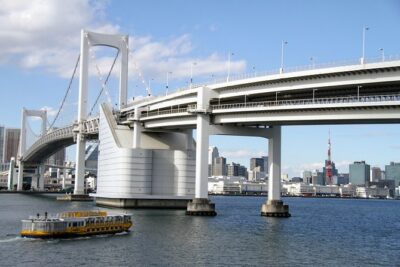
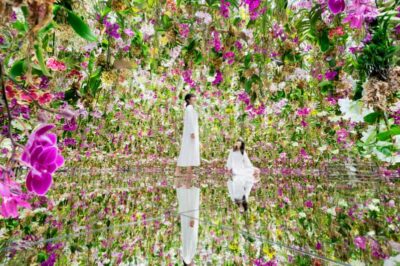
teamLab Planets TOKYO Digital Art Museum Entry Ticket
Read our review →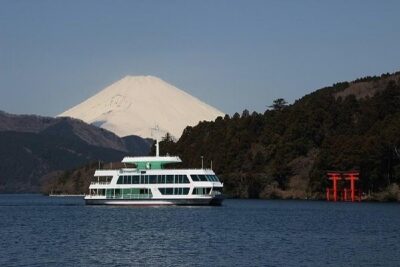
Mt Fuji & Hakone Cruise, Drum Show Bullet Train 1 Day from Tokyo
Read our review →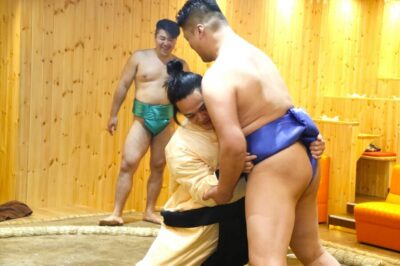
Sumo Show Experience with Chicken Hot Pot and a Photo
Read our review →
Shinjuku Food Tour (13 Dishes at 4 Local Eateries)
Read our review →
Tokyo Mt Fuji 5th St & Hakone Cruise Bus Tour w/Bullet Train
Read our review →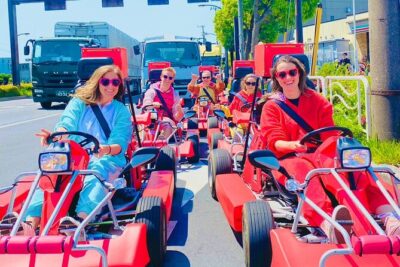
Flagship 2-Hours Official Street Go-Kart Tour – Tokyo Bay Shop
Read our review →Browse the lists this tour appears in