
Reviewed · TOKYO TOURS
Tokyo: Knife Making Workshop (Sharpening, Engraving)
A Japanese knife workshop gives you something better than a quick souvenir shop purchase: you make the souvenir yourself. At BUB Activity Center in Asakusa, you learn about Japanese knives and swords, sharpen a blade, attach its handle with a traditional hammer, and engrave your name in Japanese.
I like the practical side of learning a skill you can use at home, and I like the friendly, hands-on teaching from guides such as Lisa, Joe, Mori, and Agata. The main consideration is that sharpening takes real concentration and effort, while larger knife styles cost extra and the included handle may feel fairly basic.
Key points to know before booking
- Choose from several knife styles: The standard multi-tasking knife is included, while usuba, deba, and petit yanagiba options require a small additional payment.
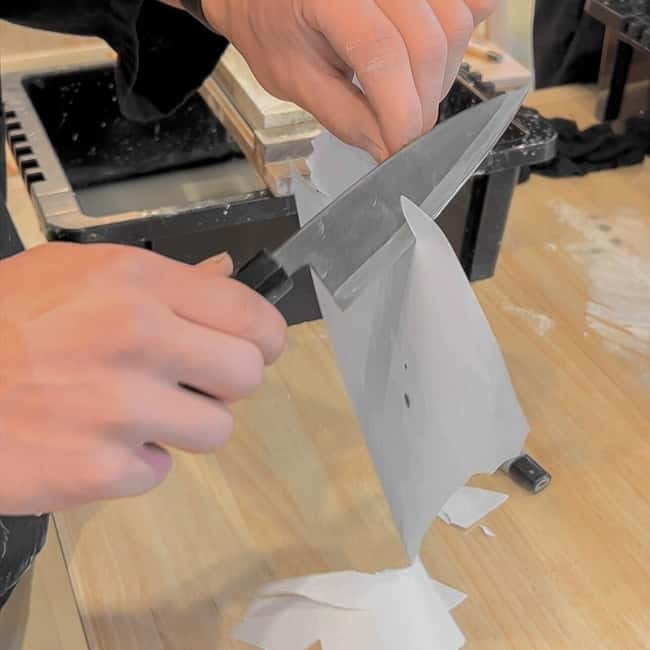
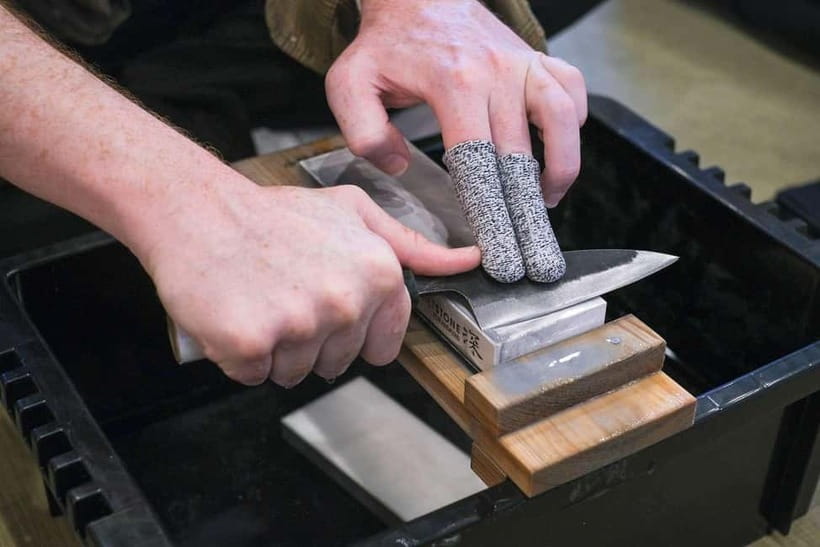
- Sharpen the blade yourself: Guides watch your technique, correct your movements, and help you finish the work properly.
- Add a personal Japanese engraving: Your name, a picture, or another design can go on the handle.
- Expect more than a craft session: The opening talk covers Japanese knives, kitchen tools, katanas, and Western swords.
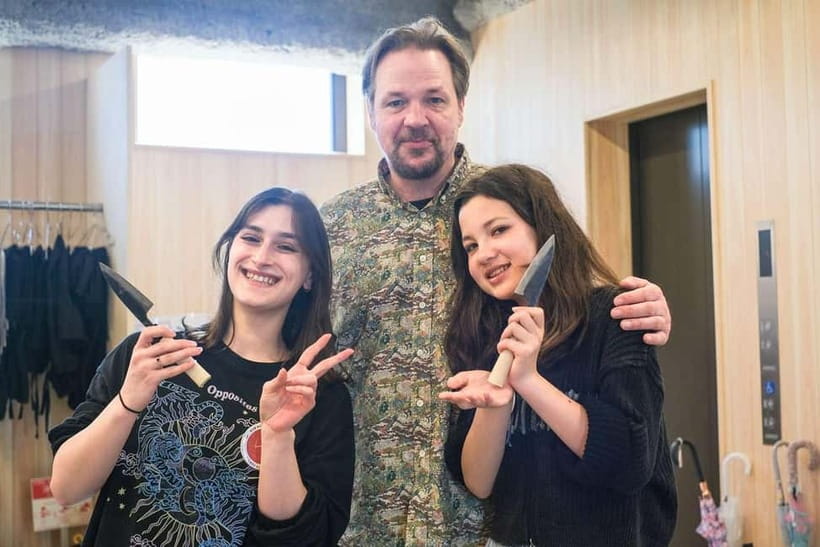
- Take home a complete gift package: Your knife comes with aesthetic packaging, Japanese snacks, drinks, and a custom key holder.
- Plan your flight luggage carefully: Put the knife box in checked luggage, or ask the staff about shipping it.
Why this Asakusa workshop is worth your time
Tokyo has plenty of shopping, but buying a knife in the kitchen district does not give you the same connection to the object. Here, the finished knife carries the marks of your own work. You may not produce a perfect blade on your first try, but you leave knowing what it takes to sharpen and care for a Japanese kitchen knife.
The activity takes place in Asakusa, a convenient part of Tokyo for a cultural outing. The BUB Activity Center is at 2 Chome 6-11 in Taito-ku, inside the Heiwa Building. Take the elevator to the fifth floor. The entrance can be easy to miss if you are moving quickly, so allow a little time to find the building and contact the provider if needed.
At $161 per person, this is not a cheap add-on. The price makes more sense if you value instruction, a finished knife, personalization, refreshments, and a cultural lesson rather than simply the lowest-cost souvenir. The knife is something you can use, display, or give as a gift, which adds practical value.
I would compare it with the price of a quality Japanese knife bought on its own. You are paying extra for the making process and the help of English-speaking instructors. That is the point of the experience, and it is also why it will not suit someone who only wants to shop.
More hands-on workshops in Tokyo:
- Sushi Making Tokyo Roll and Authentic Japanese Sushi Class
★ 5.0 · 3,971 reviews - Tokyo: Roll and Authentic Sushi Making Class in Asakusa
★ 4.9 · 1,957 reviews - Tokyo Shinjuku Chopsticks Making Class
★ 5.0 · 1,763 reviews
Arriving in a haori and getting ready to work
You begin by putting on a light haori, a Japanese kimono-style jacket supplied by the staff. It helps protect your clothing from accidental stains and sets the tone for the session without requiring you to dress up formally.
You also receive a small badge with your name written in Japanese letters. This is a simple touch, but it helps you begin learning how your name looks and sounds in Japanese before you work on the knife itself.
The session is suitable for beginners, so you do not need experience with whetstones, engraving tools, handles, or metalwork. Bilingual staff keep the instructions clear and adjust their explanations to your level of English. That matters during sharpening, when a small change in angle or pressure can affect the result.
The atmosphere is meant to be social rather than stern. You can have tea, juice, or another soft drink while listening to the introduction, and Japanese snacks and tea are also provided during the experience.
The opening lesson on Japanese knives and swords
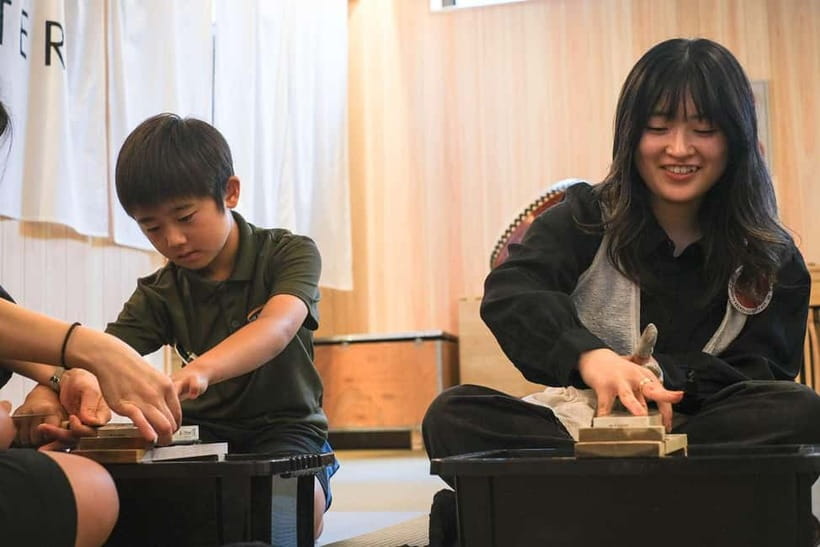
Before you choose your blade, a Japanese master explains the cultural background of knives and swords. The lesson includes the difference between Japanese katanas and Western swords, as well as the development and uses of Japanese kitchen knives.
This introduction gives the practical work some context. A kitchen knife is not just a sharp piece of metal, and the different shapes are not decoration. Their forms relate to particular cooking tasks, ingredients, and cutting methods.
You also learn about several knife types before deciding what suits you. The standard option is a multi-tasking knife, a sensible choice if you want one useful blade for general kitchen work. Other available types include usuba, deba, and petit yanagiba, but these come with an additional fee.
Ask about the choices before you commit. A deba, for example, is associated with fish preparation, while a yanagiba has a long, narrow form. The session gives you a chance to think about the purpose of the knife instead of choosing only by appearance.
The exact selection and extra prices should be confirmed when you book or at the center. The supplied information says up to five types may be available, with some options costing more.
Choosing the blade and starting the sharpening
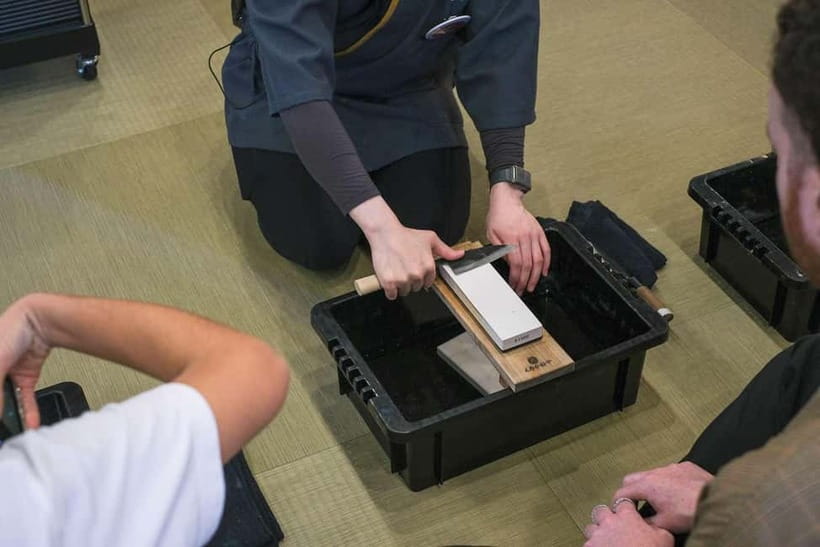
Once you select the knife type and size, the most focused part of the activity begins. You sharpen the blade under the direction of the staff, working through a process that requires steady movement and attention.
This is not a quick demonstration where you watch an expert and then receive a finished product. You do the work. The guides remain nearby to check your hand position, explain the correct movements, and offer polite corrections when your technique needs help.
Several instructors speak English, so you are not left trying to follow silent gestures. Lisa and Joe are among the guides associated with the workshop, while Mori and Agata have also been praised for their clear English and friendly teaching. Their role is important because sharpening can feel uncertain at first.
The activity has a calm, repetitive quality. You focus on the blade, the stone, and your movements. That concentration can be relaxing, but it is also physical work. If you expect a quick craft project, you may find the sharpening stage longer and harder than expected.
The good news is that beginners are not expected to get everything right. The staff keep checking your progress and can help complete the knife if time becomes tight. One useful lesson is that proper sharpening is a skill built through patience, not force.
A few more Tokyo half-days to weigh up
- Mt Fuji and Hakone 1-Day Bus Tour Return by Bullet Train
★ 5.0 · 26,383 reviews - 1-Day Tokyo Bus Tour
★ 5.0 · 14,250 reviews - Tokyo: TOKYO SKYTREE® Admission ticket
★ 4.5 · 11,192 reviews - Tokyo: teamLab Planets TOKYO Digital Art Museum Entry Ticket
★ 4.6 · 9,779 reviews
Engraving your Japanese name on the handle
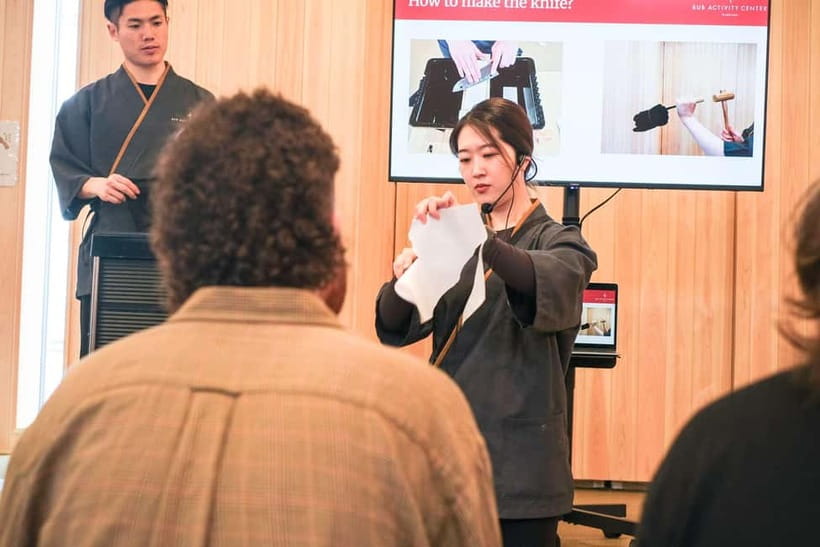
After sharpening, you move to the handle. You can engrave your name in Japanese letters, and the staff can help you with the basic Japanese if you want to understand what you are writing.
You are not limited to a name. The activity also allows a picture or another design, depending on what you want to create and what the staff can help you complete. This is where the knife becomes personal rather than simply functional.
The handle work uses a traditional hammer. You attach the handle and help finish the knife by striking the tool carefully. The sound of the hammer gives this part a satisfying sense of progress, but it also means you should work with care and follow the instructor closely.
Engraving is more difficult than it looks. A name written in Japanese has a different visual rhythm from one written in the Latin alphabet, and making clean marks on a small handle takes control. A basic design may be the sensible choice if you want a tidy result.
One point to keep in mind is the handle quality. A participant specifically felt that the handle could be improved, so do not expect a luxury knife finished to the level of a high-end specialist purchase. The personalization and the making process are the main attractions.
Packaging, snacks, and the finished souvenir
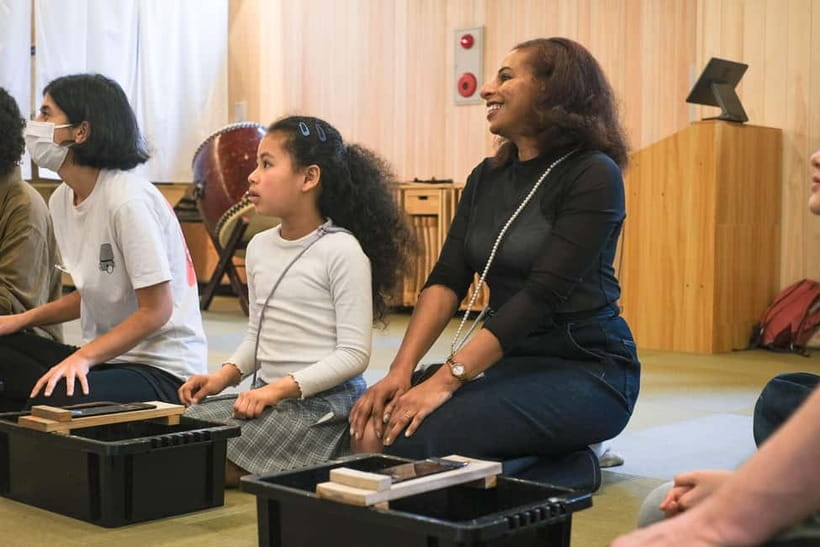
At the end, your knife is prepared in aesthetic packaging. Japanese snacks and tea add a pleasant final pause, and you receive a customized key holder with a unique design as a gift.
The packaging helps if you are giving the knife to someone else. The knife can also become a display piece. One participant planned to put the finished knife in a shadow box, which makes sense if you like souvenirs with a story rather than mass-produced items.
If you plan to use the knife at home, ask the staff about care and transport. The workshop teaches sharpening and basic knife care, so you leave with more than a decorative object. Still, the supplied information does not promise a full cooking lesson or a long-term maintenance course.
Pay attention to airport rules. Put the knife box in your checked luggage, not your carry-on bag, or ask the staff to ship it. This is an easy detail to overlook after a busy day in Tokyo.
A good activity for couples and families
The workshop works particularly well for people with different levels of interest. If two people want to attend but only one needs a knife, an observation ticket can allow the second person to watch without taking part in the full knife-making activity. An observation fee is payable on site.
That arrangement can be useful for couples, parents, or friends. One person gets the hands-on project while the other follows the lesson and takes photos or simply enjoys the atmosphere. Confirm the current observation arrangements before booking, since the observer does not receive the same included product.
The activity can also suit families. A 10-year-old participant enjoyed the session with a parent, and the guides kept the class engaging. Children should still be able to follow safety instructions and remain focused around blades and hammering tools.
For adults, the session has enough cultural material to avoid feeling like a children’s craft. The historical introduction, knife selection, sharpening, engraving, and assembly create a clear beginning, middle, and end.
Timing, access, and practical planning
The stated duration is 90 minutes, or about an hour and a half. Some sessions may take longer if the group needs extra help or if you are working carefully. If you have another appointment, leave a buffer after the class rather than scheduling a tight connection.
The center is in central Tokyo and easy to reach by public transport. The exact nearest station is not provided, so use the full address and building name when planning your route: BUB Activity Center, Heiwa Building, 5th floor, Tokyo, Taito-ku, Asakusa, 2 Chome 6-11.
The activity is wheelchair accessible, and an elevator takes you to the fifth floor. Alcohol and drugs are not allowed. Transportation to and from the center, meals beyond the supplied snacks, and larger knife upgrades are not included.
You can cancel up to 24 hours before the activity for a full refund, and reserve now while paying later. Those options are helpful if your Tokyo schedule is still shifting.
Who should book this knife-making experience
I would recommend it most to:
- Cooks who want to understand how to sharpen and care for Japanese knives
- Visitors looking for a useful, personal souvenir
- People interested in Japanese craft, tools, swords, or food culture
- Couples or families with one person who wants to participate and another who prefers to observe
- Beginners who appreciate patient, English-speaking instruction
- Anyone who enjoys tactile activities more than sightseeing from a distance
I would think twice if you dislike repetitive hand work, have very little time in Tokyo, or only want a premium chef’s knife at the lowest possible price. The included standard knife is useful, but the experience is not designed to replace shopping for a specialized or luxury blade.
The instructors are the strongest part of the session. Their job is not just to explain the process, but to keep you comfortable while you make mistakes. Guides such as Lisa, Joe, Mori, and Agata bring energy, humor, and clear English to a task that could otherwise feel intimidating.
Should you book the Tokyo knife workshop?
Book this experience if you want to carry home a souvenir with your fingerprints on it, along with a new skill and a better sense of how Japanese knives are made and used. The sharpening takes effort, and the handle may not feel perfectly luxurious, but the finished knife has a personal value that a shop-bought item cannot match.
At $161, it is best viewed as a craft lesson plus a usable gift, not simply a knife purchase. Choose the standard multi-tasking blade for the clearest value, or pay extra for a style that matches your cooking interests. Pack it in checked luggage or arrange shipping, and leave enough time after the 90-minute session.
FAQ
Where does the Tokyo knife-making workshop take place?
It takes place at BUB Activity Center in the Heiwa Building, Tokyo, Taito-ku, Asakusa, 2 Chome 6-11. Take the elevator to the fifth floor.
How long does the activity last?
The activity lasts approximately 90 minutes, or about one and a half hours.
Is the workshop suitable for beginners?
Yes. No prior experience is required, and bilingual staff provide instruction and correct your sharpening movements.
What type of knife is included?
A standard-size, multi-tasking knife is included. Up to five knife types may be available, with larger options such as usuba, deba, and petit yanagiba requiring an additional fee.
Can a friend or family member watch?
Yes, an observer option is available, but an observation fee is payable on site. The observer does not participate in the included knife-making activity.
Can I take the knife on my flight?
Put the knife box in your checked luggage, or ask the staff to ship it. Do not place it in your carry-on luggage.
Just added around Tokyo
- Private Arrival Transfer : Narita International Airport to Central Tokyo City★ 4.5 · 12 reviews
- Narita Airport(NRT): Private Transfer to Tokyo/Yokohama 1-9pax★ 5.0 · 47 reviews
- Private Transfer from Narita Airport to Yokohama Port and City★ 4.5 · 17 reviews
- [Narita Airport Terminals 1, 2] 40-60km Sawara Itako Historic Bike Tour★ 5.0 · 13 reviews
- 3 Day Japan Highlights Tour: Tokyo, Mt.Fuji, Nara, Kyoto, Osaka★ 5.0 · 22 reviews
- Small Town in the Big City: Tasting Tokyo’s Kichijoji★ 5.0 · 195 reviews
- Small Town in the Big City: Tasting Tokyo’s Kichijoji★ 5.0 · 16 reviews
- The 10 Tastings of Tokyo With Locals: Private Street Food Tour★ 5.0 · 48 reviews
Tokyo Tours, compared.

Mt Fuji and Hakone 1-Day Bus Tour Return by Bullet Train
Read our review →

teamLab Planets TOKYO Digital Art Museum Entry Ticket
Read our review →
Mt Fuji & Hakone Cruise, Drum Show Bullet Train 1 Day from Tokyo
Read our review →
Sumo Show Experience with Chicken Hot Pot and a Photo
Read our review →
Shinjuku Food Tour (13 Dishes at 4 Local Eateries)
Read our review →
Tokyo Mt Fuji 5th St & Hakone Cruise Bus Tour w/Bullet Train
Read our review →
Flagship 2-Hours Official Street Go-Kart Tour – Tokyo Bay Shop
Read our review →Browse the lists this tour appears in