
Reviewed · KYOTO TOURS
Treasures of Kyoto: Geishas & Traditions Private Tour
Kyoto’s geisha quarter makes the most sense on foot, where a small lane, theater facade, or quiet shrine can open a door into old customs. This private walk links Gion’s geiko traditions with Shinto and Buddhist sites, ending near Yasaka no To temple and a local cafe.
I like the personal pace and the way the route fits a lot into a compact area. I also like having a guide explain the difference between geisha and geiko life, banquet houses, religion, and local etiquette. The main drawback is that 2 hours 30 minutes goes quickly, and several stops receive only 10 minutes.
At a glance
- Gion without a large group: Your party has the guide to itself, so you can ask questions and adjust the pace.
- Geisha culture in context: Shinbashi Dori and the traditional banquet buildings give the subject a real setting, not just a museum explanation.
- A compact walking route: The tour connects theaters, shrines, temples, parks, and old lanes in eastern Kyoto.
- Guides with different strengths: Hosts named Ted, Guia, Maha, Kako, Shohei, and Ahmed appear in the tour’s guide pool and feedback, with praise for warmth, cultural explanations, and work with children.
- Useful for a short Kyoto stay: The route covers major sights in about two and a half hours, though it is not a full temple tour.
- Moderate fitness needed: Expect walking and steps, especially around Chion-in and the temple areas.
Why this Gion walk works for a short Kyoto visit
This is not a performance-based geisha experience. You do not get a staged meeting with a geiko or maiko, nor are meals or drinks included. Instead, you walk through the part of Kyoto where geisha traditions developed and learn how the district works.
That distinction matters. Gion is easy to photograph and easy to misunderstand. A guide can explain why some streets are protected, what the traditional banquet buildings were used for, and how to behave respectfully around working performers. The experience is at its best when you treat the neighborhood as a living community rather than a photo backdrop.
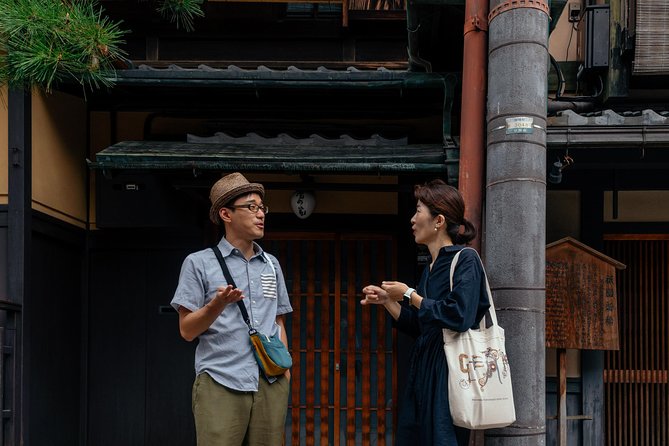
The private format is the strongest feature. A party of two can stop for a question without holding up 20 people. A family can ask for explanations suited to children. A couple interested in religion can spend more time comparing Shinto and Buddhism. Guides have adapted well to different groups, including families with children aged 10 and 14.
The walk is also practical for a first visit. Gion’s lanes can feel confusing, particularly when you move between Shijo Street, Shinbashi, temple grounds, and the roads near Yasaka Shrine. Your host handles the route while you pay attention to the details around you.
A few more Kyoto half-days to weigh up
- PERFECT KYOTO 1-Day Bus Tour
★ 5.0 · 13,518 reviews - Kyoto: Fushimi Inari, Kinkakuji, Bamboo Grove 1 Day Bus Tour
★ 4.8 · 4,316 reviews - Kyoto: Tea Ceremony in a Traditional Tea House in Kiyomizu
★ 4.9 · 3,519 reviews
From Kabuki’s founder to Minamiza Theatre
The meeting point is on Kawabatacho in Kyoto’s Higashiyama Ward. The first stop is the statue of Izumo no Okuni, the woman credited as the originator of kabuki theater. You spend about 20 minutes here, with no admission charge.
This is a smart opening because it gives you a cultural frame before you reach the geisha district. Kabuki and geisha culture are not the same thing, but both belong to Kyoto’s long tradition of theater, performance, music, and formal entertainment. The statue also puts a human face on a subject that can otherwise seem distant.
Next comes Minamiza Theatre, where the roots reach back to the early Edo period. You have about 20 minutes to learn why this theater matters and how stage entertainment became part of Kyoto’s identity.
Do not expect a long interior visit or a performance ticket. The value here is the explanation of the building and its place in Japanese theater. If you are particularly interested in kabuki, ask your guide for more detail, since this is one of the stops where a private tour can become more rewarding through conversation.
Reading Gion’s streets and protected buildings
The route then moves into Gion, including Gion Shinbashi and the area south of Shijo Street. Gion Shinbashi is designated as a traditional business preservation area, while the southern section has protection for its historic streetscape.
In plain terms, this means the setting matters as much as the individual buildings. Wooden facades, narrow lanes, and traditional businesses create the atmosphere people associate with old Kyoto. Your guide helps you notice the difference between a preserved district and a modern shopping street.
Tatsumi Daimyojin Shrine is scheduled for about 20 minutes. This is a good place to discuss Japanese religion, especially the relationship between Shinto and Buddhism. The two traditions have influenced one another for centuries, and a simple explanation here can make later shrine and temple visits easier to understand.
The tour does not ask you to master a list of religious rules. You get a practical introduction as you walk. Ask about what makes a shrine Shinto, what identifies a Buddhist temple, and how local people may relate to both.
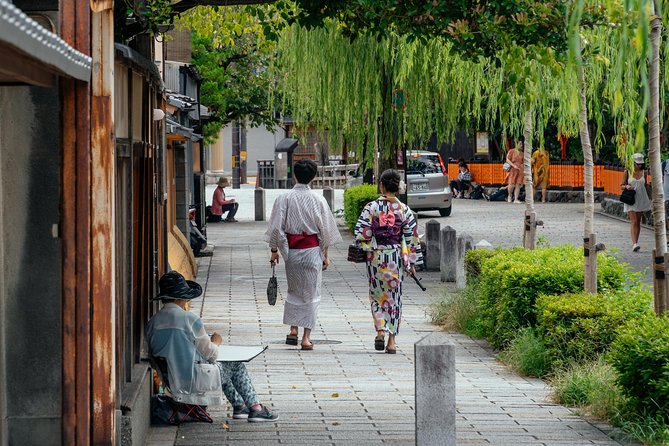
Shinbashi Dori receives about 10 minutes. Here you stand outside traditional banquet buildings where geisha entertained customers and learn more about their work, training, and social setting.
This may be the most meaningful stop for the tour’s main theme. You are looking at the streets where the tradition belongs, not simply hearing a general talk about geisha culture. At the same time, the short timing limits how much can be covered. If you want an in-depth account of training, naming, music, or the difference between geiko and maiko, use the walk to ask direct questions.
You may see women dressed in geisha-style clothing in the area, but the tour does not promise a geisha encounter. That is worth keeping clear in your mind when booking.
Chion-in and Maruyama Park add breathing room
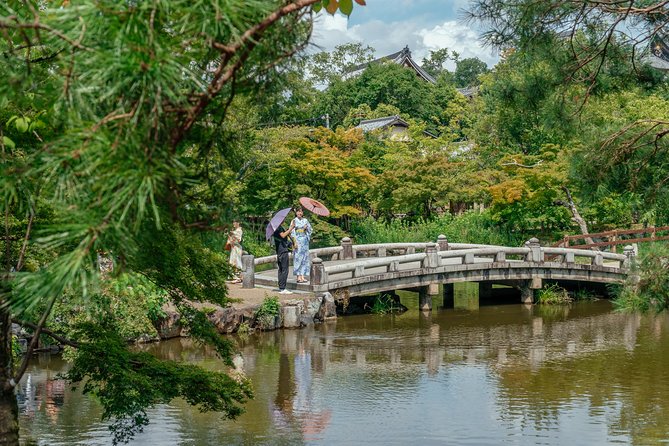
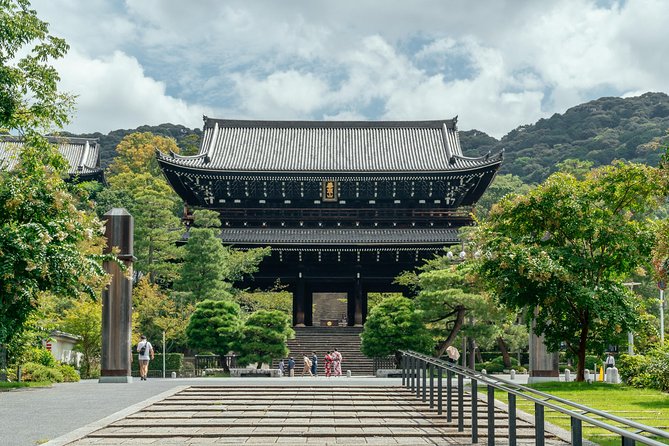
From Gion, the walk continues to Chion-in Temple. The scheduled visit is about 10 minutes, including steps for a better view of the temple and access to the garden area.
This is one of the physically more demanding parts of the route. The amount of walking is moderate, but steps can make the tour less comfortable for anyone with limited mobility. The tour information calls for a moderate fitness level, so wear shoes suited to walking and uneven surfaces.
Ten minutes is enough for an introduction and photographs, but not enough for a full temple visit. If Chion-in is high on your personal list, plan another visit on your own. Here, it functions as part of a wider story about Kyoto’s religious traditions.
Maruyama Park follows, with about 20 minutes to walk from the temple toward the park area. This longer pause gives the route a change of mood. After narrow lanes, old banquet houses, and formal religious sites, the park offers room to move and talk.
I like this part because it keeps the tour from becoming a rapid procession of facades. Your guide can connect the sites while you walk rather than stopping at every location for a formal speech. The pace has been described as relaxed, with time for photographs, questions, and general conversation.
Same base, a completely different sort of day:
- Kyoto Geisha Walking Tour: Gion District & Hidden Gems
★ 4.7 · 3,273 reviews - Kyoto: Tea Ceremony Ju-An at Jotokuji Temple
★ 4.9 · 3,207 reviews - Kyoto: Gion Magical Night Walking Tour with Geisha Trivia
★ 4.9 · 2,393 reviews - Kyoto: 45-Minute Tea Ceremony Lesson Experience
★ 4.3 · 2,378 reviews
Yasaka Shrine, Shijo Dori, and Nene-no-Michi
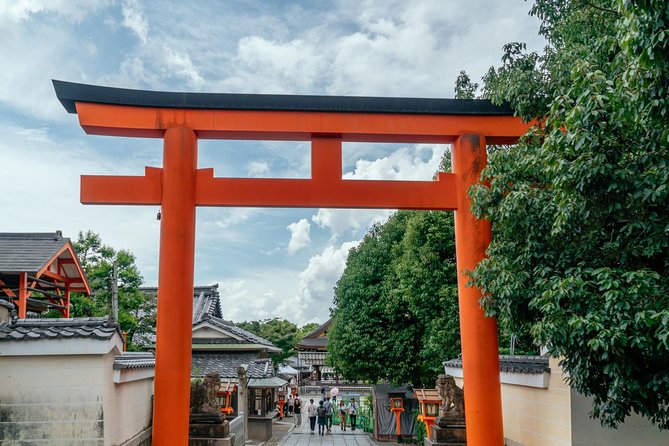
Yasaka Shrine receives about 10 minutes. Also called Gion Shrine, it has a traditional origin story that reaches back to AD 656, long before Kyoto became the Heian capital.
The stop is brief, but its location makes it useful. Yasaka Shrine links the Gion entertainment district with the religious life of the neighborhood. Ask your guide how the shrine’s festivals and local identity connect with the surrounding streets.
The tour then reaches Shijo Dori, or Fourth Avenue of Heian-kyo, the ancient capital. Today, Shijo is a major city street, so this section gives you a clear contrast with the quieter lanes of Gion. You see how modern Kyoto sits directly beside old street patterns.
Nene-no-Michi follows, with about 10 minutes. The lane takes its name from Nene, the wife of Toyotomi Hideyoshi, who helped establish Kodai-ji Temple in 1605. This section is a reminder that Kyoto’s old streets are tied to political figures, religious foundations, and personal stories, not only to geisha culture.
The route ends in the Yasaka Kamimachi area near Yasaka no To temple. The final stop is described as a picturesque five-story Buddhist pagoda with broad views from the top, followed by a finish at a nearby local cafe.
There is some inconsistency in the stop naming, since the itinerary labels this final point Yasaka Shrine while describing a pagoda and Yasaka no To temple. Check the exact end point on your confirmation, especially if you have a timed train, restaurant reservation, or another activity afterward.
What the private guide adds
A good guide is essential here. Without one, you can walk through Gion and see beautiful buildings without understanding which ones are theaters, shrines, temples, protected businesses, or former banquet houses.
The guide pool includes hosts named Ted, Guia, Maha, Kako, Shohei, and Ahmed. The exact person assigned to your booking may vary, so do not book on the assumption that one particular guide will lead your tour unless the provider confirms it.
Ted has been especially effective with explanations of geisha traditions, Kyoto’s history, and the difference between Buddhism and Shinto. He has also handled family questions well, giving children room to participate rather than delivering the same talk to every age group.
Guia has been praised for bringing history and culture to life through stories. Maha has been good at steering groups away from crowds and showing a temple and grounds they might not have found alone. Kako has kept the tour engaging in rainy weather, while Shohei has provided a warm, relaxed introduction to Gion. Ahmed has led useful conversations about Japanese customs and traditions.
These details point to the real strength of the experience: conversation. You should arrive with questions. Ask about geiko training, the role of banquet houses, shrine manners, Buddhist temples, kabuki, and how the district has changed. The private format gives you a much better chance to shape the discussion than a fixed group tour.
Price, timing, and practical value
The listed price is $135.45 per person. That is a serious cost for a 2 hour 30 minute walking tour, particularly because admission is not charged at the listed stops and food and drinks are extra.
The price makes more sense for a small party. Two people pay more per head than a larger group, but you get a guide focused only on your questions. Group discounts may improve the value for families or friends traveling together. You are paying mainly for access to a local host’s explanations and route planning, not for tickets.
For a first afternoon in Kyoto, the price can be worthwhile. You cover Gion, Shinbashi, Minamiza, several religious sites, Shijo Dori, and Nene-no-Michi without spending time sorting out the route yourself. You also gain cultural context that is hard to pick up from signs alone.
For repeat visitors who already know Gion, the value depends on your interest in geisha customs and Japanese religion. If you want lengthy temple interiors, paid attractions, or a food tasting, this is not the right product.
The meeting point is near public transportation, and the tour ends in Higashiyama rather than returning you to your hotel. Hotel pickup and drop-off are not included. Service animals are allowed, and the activity is private for your group.
Free cancellation is available up to 24 hours before the start time for a full refund. Changes or cancellations made inside that period are not accepted for a refund, and the cut-off follows local Kyoto time.
Who should book this Kyoto walk?
I would choose this tour for a first-time Kyoto visitor with limited time, a family wanting a flexible outing, or anyone curious about geisha culture but unsure how to approach Gion respectfully.
It also suits you if you prefer a walking conversation to a formal lecture. The route is compact, the stops are varied, and the guide can adjust explanations to your interests. Families have found the format workable because children can ask questions and the host can change the level of detail.
I would be more cautious if you have difficulty with steps, want a slow photographic walk, or expect to enter every temple and theater. The timetable is full, and some stops last only 10 minutes. Rain may also make the walking less comfortable, though guides have kept the experience engaging in wet weather.
Should you book Treasures of Kyoto?
Book it if you want a short, private introduction to Gion that explains the people, buildings, and beliefs behind the scenery. The best part is not checking off 11 stops. It is learning how kabuki, geisha entertainment, Shinto, Buddhism, and Kyoto’s old streets fit together.
Skip it if you want a paid performance, a meal, extensive interior visits, or a full-day temple tour. At $135.45 per person, the cost is justified by the private guide and cultural context, not by admission tickets. For a compact first look at eastern Kyoto, especially with a group that values questions and flexibility, it is a strong choice.
FAQ
How long is the Treasures of Kyoto tour?
The tour lasts approximately 2 hours and 30 minutes.
Is this a private tour?
Yes. The activity is private, and only your group participates.
What is the tour price?
The listed price is $135.45 per person. Group discounts are available.
Where does the tour start?
The meeting point is on Kawabatacho in Kyoto’s Higashiyama Ward, postal code 605-0076.
Where does the tour finish?
The tour ends in the Yasaka Kamimachi area of Higashiyama Ward, postal code 605-0827, near Yasaka no To temple.
Is hotel pickup included?
No. Hotel pickup and drop-off are not included.
Are food and drinks included?
No. Food and beverages are not included unless specifically listed as inclusions. The tour finishes at a nearby local cafe.
Does the tour include admission tickets?
The listed stops have no admission ticket included or required in the tour details. The experience is primarily a guided walking tour.
Is the tour suitable for people with limited mobility?
The tour requires a moderate level of physical fitness and includes walking and steps, especially near Chion-in. Service animals are allowed.
Can I cancel for a refund?
Yes. You can cancel at least 24 hours before the start time for a full refund. Cancellations or changes made less than 24 hours before the start time are not accepted for a refund.
Just added around Kyoto
- Kyoto: Zen Meditation at a Private Temple with a Monk★ 5.0 · 25 reviews
- Kyoto: Gion Geisha District & Sake-in-Hand Walking Tour★ 5.0 · 37 reviews
- Private Pewter Sake Cup Experience with a Kyoto Artisan★ 5.0 · 31 reviews
- Your Private Vacation Photography Session In Kyoto★ 5.0 · 110 reviews
- Private Guided Traditional Buddhist Cooking in Japan★ 5.0 · 16 reviews
- Kyoto Wagashi(Japanese sweets) Cooking Class near Fushimiinari★ 5.0 · 60 reviews
- Traditional Japanese Music show & Experience Tour in Kyoto★ 5.0 · 57 reviews
- Kyoto:Family-Friendly Kimono & Yukata Experience at WARGO★ 5.0 · 147 reviews
Kyoto Tours, compared.


Fushimi Inari, Kinkakuji, Bamboo Grove 1 Day Bus Tour
Read our review →
Tea Ceremony in a Traditional Tea House in Kiyomizu
Read our review →
Kyoto Geisha Walking Tour: Gion District & Hidden Gems
Read our review →

Gion Magical Night Walking Tour with Geisha Trivia
Read our review →
