
Reviewed · TOKYO TOURS
Chopstick Making Workshop in Ginza
The clever part of this Ginza workshop is that you do not just buy a souvenir. You start with a rough piece of wood and turn it into something you can use at home. I especially like the choice of 24 types of wood and the satisfying handwork with a real plane, followed by careful sanding and oiling.
I also like the short one-hour format and the patient English-speaking staff. It fits neatly into a day in Ginza, and name engraving gives the finished pair a personal touch. The main consideration is physical effort: planing takes real pressure, and harder woods can work your hands, shoulders, and arms.
Key points to know before you book
- Choose your wood and length: Pick from 24 wood types and two chopstick lengths, with five wood options included in the base price.
- Use traditional hand tools: You shape the chopsticks with a plane, then smooth the tips and corners by hand.
- Finish your own useful souvenir: Oil gives the wood a polished finish, and you take the finished pair home the same day.
- Add personal engraving: Names or short phrases can be engraved in Japanese or your own language for an extra ¥1,100 per pair.
- English help is available: English-speaking staff guide you through each stage, including tool use and finishing.
- Plan for a little muscle work: The process is beginner-friendly, but planing is not a push-button craft activity.
A hands-on souvenir in the middle of Ginza
Ginza is famous for department stores, polished streets, and high-end shopping. This workshop gives you a different way to spend an hour there. Instead of simply picking up a packaged souvenir, you make a pair of chopsticks from wood selected at the workbench.
That difference matters. The finished chopsticks carry the small marks of your own effort. You decide how much material to remove, how smooth to make the corners, and how polished the final surface should feel. The result is practical, personal, and easy to pack.
The meeting point is at 2-9-13 Ginza, Chuo-ku, Tokyo. The activity lasts one hour, so it can fit before lunch, between shopping stops, or during a rainy afternoon. I would still allow a little extra time to find the address and settle in, especially if you are unfamiliar with Ginza’s numbered streets.
More hands-on workshops in Tokyo:
- Sushi Making Tokyo Roll and Authentic Japanese Sushi Class
★ 5.0 · 3,971 reviews - Tokyo: Roll and Authentic Sushi Making Class in Asakusa
★ 4.9 · 1,957 reviews - Tokyo Shinjuku Chopsticks Making Class
★ 5.0 · 1,763 reviews
Choosing between 24 woods and two lengths
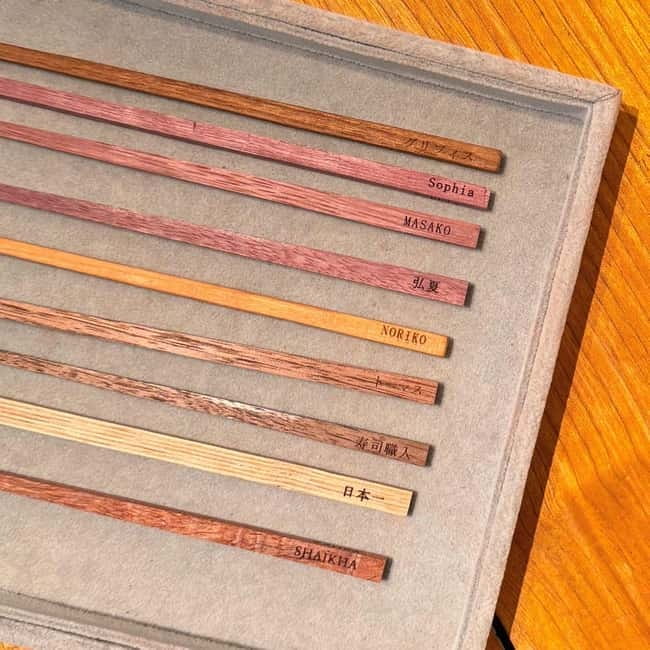
The first decision is the wood. Five of the 24 choices are included in the basic price. The other 19 are higher-grade woods and cost extra, so ask about the price of each option before you commit.
This is an important point. The base price is $25 per person, but the display of attractive specialty woods can make an upgrade tempting. Some people choose oak, beech, olive, or another premium option. Olive can be more difficult to work than softer woods, so the most expensive choice is not automatically the easiest choice for a first attempt.
You also choose between two lengths. That lets you make a pair that suits your hand size or your preference at the table. If you are making chopsticks for family members, the length choice adds a useful bit of personalization beyond color and grain.
I recommend taking a moment with this stage rather than choosing too quickly. Look closely at the grain and ask the staff how difficult each wood is to shape. The workshop is run by a woodworking company that handles the wood selection and processing in-house, and the material choices are a central part of the experience.
Planing the chopsticks takes real effort
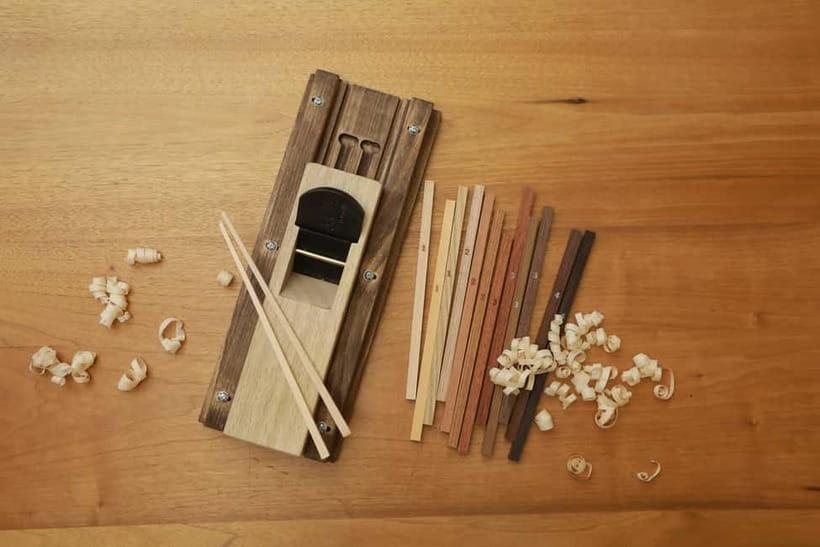
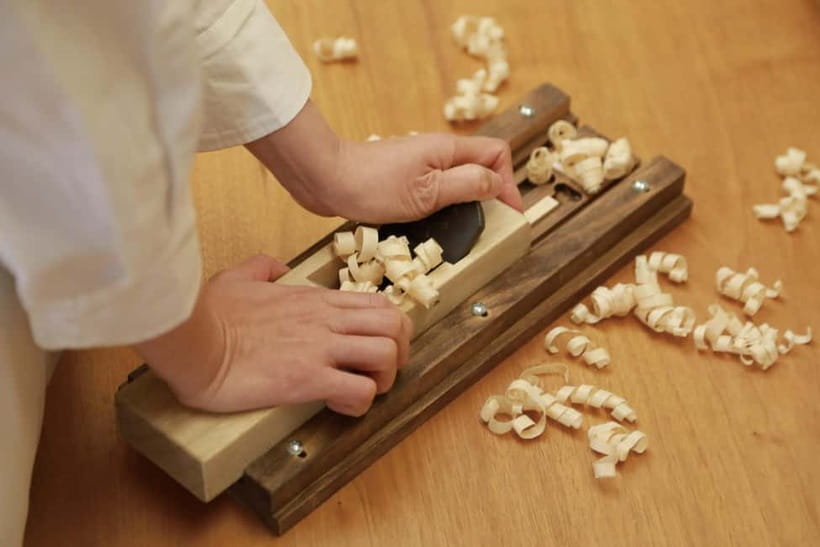
Once you choose your wood, the rough pieces go onto a stand. You use a hand plane to remove thin shavings and gradually shape the chopsticks.
This is the part that surprises some people. The tool is simple, but it needs pressure and a steady motion. You are not pressing a button or watching someone else do the skilled work. You have to pay attention to the direction of the wood, the amount you remove, and the shape of both sticks.
That effort is also what makes the activity rewarding. You can feel the wood changing under the tool. The process gives you a clear sense of progress, even though the first few passes may feel awkward.
Children and teenagers can enjoy this stage, but younger participants may need hands-on help. The formal age guidance says the activity is not suitable for children under three or people over 70. For anyone with limited arm strength or hand mobility, I would treat the planing stage as the main question when deciding to book.
The instructors explain the process step by step and help when the tool feels difficult to control. Staff members including Tina, Waka, Kotoha, Shion, and Koko have been associated with the workshop experience, and the teaching style is described as friendly, patient, and attentive. The language support is in English and Japanese.
Sanding turns rough edges into a usable pair
After planing, you use sandpaper to smooth the tips and corners. This stage looks simple, but it is where you can improve the feel of the chopsticks.
Run your fingers carefully over the wood as you work. A sharp corner that seems minor at first can become annoying during regular use. Sanding also gives you more control over the final shape. You can spend extra time refining the ends or work at a quicker pace if you are happy with a more basic finish.
The one-hour schedule is enough for the standard process, but the pace depends on how carefully you work and how difficult your wood is. Some people finish within the hour, while others take longer to refine the surface. A second pair also requires additional time and cost.
Do not worry if your first few strokes are uneven. The instructors can show you how to correct the shape and where to focus your effort. You are not expected to arrive with woodworking experience.
A few more Tokyo half-days to weigh up
- Mt Fuji and Hakone 1-Day Bus Tour Return by Bullet Train
★ 5.0 · 26,383 reviews - 1-Day Tokyo Bus Tour
★ 5.0 · 14,250 reviews - Tokyo: TOKYO SKYTREE® Admission ticket
★ 4.5 · 11,192 reviews - Tokyo: teamLab Planets TOKYO Digital Art Museum Entry Ticket
★ 4.6 · 9,779 reviews
Oil provides the final polish
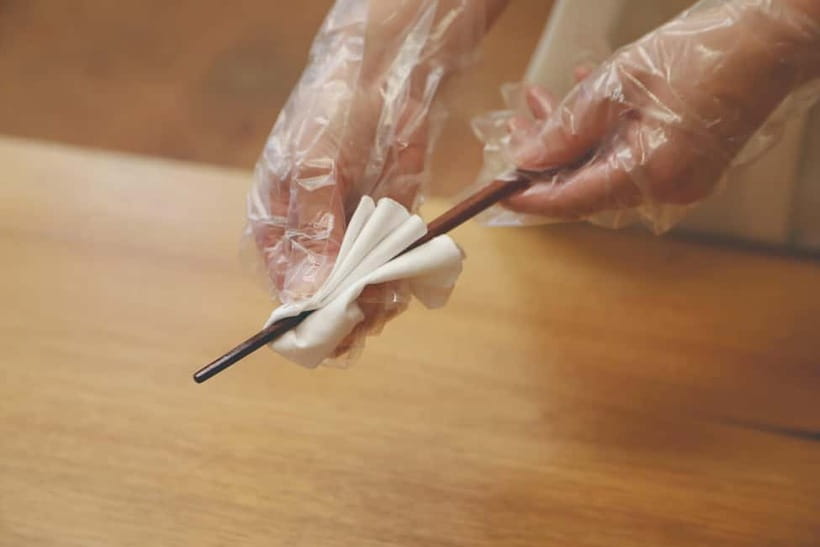
The last main step is applying oil to the chopsticks. This brings out the character of the wood and gives the pair a smoother, finished appearance.
It is a small but meaningful stage. Before the oil, the chopsticks still look like hand-shaped wood. Afterward, the grain becomes more noticeable and the pair feels closer to a finished household item.
The workshop focuses on the material and finish, not only on making a quick craft. That focus makes the $25 starting price easier to understand. You are paying for instruction, tools, materials, wood selection, and the chance to produce a pair yourself. You can certainly buy inexpensive chopsticks elsewhere, but those will not have your chosen wood, your handwork, or your personal engraving.
Engraving makes the souvenir personal
You can add your name or a favorite phrase in Japanese or your native language. The extra charge is ¥1,100 per pair.
This is one of the best add-ons if you are making a birthday gift, a couple’s keepsake, or a family souvenir. The engraving is done with a high-performance laser designed to put gentle stress on the wood, so the text becomes a neat part of the finished pair rather than a rough handwritten mark.
If you want Japanese characters, staff can help translate or prepare the wording. Keep your phrase short and decide what you want before the end of the class, since the engraving is an additional service rather than part of the basic making process.
Remember that upgrades can add up. Premium wood costs extra, and engraving costs extra. If you are watching your budget, choose one of the five included woods and skip the engraving. You will still make the chopsticks yourself and take home a useful souvenir.
What the one-hour format feels like
This is a focused activity, not a long formal woodworking course. You choose the material, learn the basic tool use, shape the sticks, sand them, and apply oil. The sequence is easy to understand and gives you a finished object within a short visit.
The format works well for couples, families with older children, and friends who want an activity between sightseeing stops. It is also a good rainy-day plan because the work takes place indoors and does not depend on the weather.
The atmosphere can become busy at full capacity. When many people need help at different stages, you may have to wait briefly for an instructor. The staff are used to moving around the room and assisting people at different points, but a crowded session may feel less calm than a smaller one.
If you want a quiet, slow woodworking lesson with long personal instruction, this may feel compact. If you want a clear introduction and a finished souvenir in about an hour, the timing is a strong point.
A useful souvenir instead of a shelf ornament
I like souvenirs that earn their space in a suitcase. A pair of chopsticks is small, light, and easy to use once you get home.
Each meal gives you a reminder of Tokyo without requiring a display case. The object also works as a gift for someone who could not join the trip. Engraving adds another reason to keep the pair rather than leaving it in a drawer.
The finished product will reflect your own work. Tiny differences between the two sticks are part of the appeal. If you want factory-perfect uniformity, buy a professionally finished pair in Ginza. If you enjoy seeing the marks of handwork, this workshop offers a better memory.
The in-house handling of the wood is another advantage. You are not simply decorating a ready-made pair. You begin with prepared wood and take responsibility for the shaping and finish.
Who will enjoy this Ginza workshop most
I would recommend it most strongly to:
- Couples who want matching or engraved chopsticks
- Families with children old enough to handle the tools with help
- Visitors looking for a practical Japanese souvenir
- Anyone curious about woodworking but short on time
- People who enjoy tactile activities more than sightseeing displays
- Repeat visitors who want something different in central Tokyo
It is less suitable if you dislike repetitive handwork, have difficulty applying pressure, or want a completely effortless activity. The planing requires patience, and harder wood can be physically demanding.
The official guidance excludes children under three and people over 70. That is worth taking seriously even though the class can work well for many families. Ask yourself if each participant can safely use the plane and sandpaper for an hour.
Timing, access, and booking details
The workshop is wheelchair accessible, and instruction is available in English and Japanese. The guide fee of ¥1,000 is included in the experience price.
You can reserve now and pay later, which helps if your Tokyo schedule is still changing. Free cancellation is available up to 24 hours in advance for a full refund. Check the available start times before booking because the one-hour duration still needs to fit around your Ginza plans.
The address is specific, so double-check 2-9-13 Ginza, Chuo-ku, Tokyo before setting out. One early arrival was able to begin promptly, but arriving at the correct location matters more than arriving far ahead of time.
A practical tip: tie back long hair and wear clothes that allow comfortable arm movement. The work is not dangerous when you follow the staff’s instructions, but planing and sanding are active tasks, not a passive demonstration.
Is the $25 price good value?
At $25 per person, the base price is reasonable for a one-hour guided craft activity in central Tokyo. The fee covers the class, tools, materials, English-speaking support, and one pair of handmade chopsticks.
The value is strongest if you care about the making process. If you only want the cheapest pair of chopsticks, you can find less expensive options elsewhere. This experience charges for the time, instruction, material choice, and personal effort.
Budget carefully around the optional extras. Five woods are included, while 19 higher-grade choices cost more. Engraving is ¥1,100 per pair. A premium wood and engraving can turn a simple $25 activity into a more expensive souvenir, but the result becomes more distinctive.
I would decide in advance how much you want to spend. Then ask the staff about the wood surcharge before selecting a premium piece. That avoids the only real value complaint attached to the experience, confusion about which woods are included and which cost more.
My recommendation for your Tokyo itinerary
I would book this if you want a short, hands-on activity that produces something useful. The combination of wood choice, hand planing, sanding, oiling, and optional engraving gives the hour a clear purpose from start to finish.
I would choose a free wood for a first attempt if you are unsure about your woodworking skills. If you already enjoy craft projects, consider a specialty wood and take your time with the sanding. Add engraving if the chopsticks are a gift or if you want a lasting reminder of your trip.
This is not simply a shopping stop, and it is not quite a full woodworking course. It sits nicely in between: enough effort to feel earned, enough instruction to suit beginners, and a finished pair you can use for years. For most visitors, that is a better souvenir than another mass-produced trinket.
FAQ
Where is the chopstick-making workshop located?
The meeting point is 2-9-13 Ginza, Chuo-ku, Tokyo, in the Ginza area of Tokyo.
How long does the activity last?
The standard workshop lasts one hour.
How much does the workshop cost?
The listed price is $25 per person.
How many types of wood can I choose from?
You can choose from 24 types of wood and two different chopstick lengths.
Are all 24 woods included in the price?
No. Five wood types are included, while the other 19 are higher-grade woods with an additional charge.
Can I have my name engraved?
Yes. You can add your name or a favorite phrase in Japanese or your native language for an extra ¥1,100 per pair.
Can I take the chopsticks home on the same day?
Yes. You can take your finished chopsticks home on the day of the workshop.
Is English instruction available?
Yes. English-speaking staff assist with the activity, and instruction is available in English and Japanese.
Is the workshop wheelchair accessible?
Yes. The activity is wheelchair accessible.
Can I cancel for a full refund?
Yes. You can cancel up to 24 hours in advance for a full refund.
Just added around Tokyo
- Private Arrival Transfer : Narita International Airport to Central Tokyo City★ 4.5 · 12 reviews
- Narita Airport(NRT): Private Transfer to Tokyo/Yokohama 1-9pax★ 5.0 · 47 reviews
- Private Transfer from Narita Airport to Yokohama Port and City★ 4.5 · 17 reviews
- [Narita Airport Terminals 1, 2] 40-60km Sawara Itako Historic Bike Tour★ 5.0 · 13 reviews
- 3 Day Japan Highlights Tour: Tokyo, Mt.Fuji, Nara, Kyoto, Osaka★ 5.0 · 22 reviews
- Small Town in the Big City: Tasting Tokyo’s Kichijoji★ 5.0 · 195 reviews
- Small Town in the Big City: Tasting Tokyo’s Kichijoji★ 5.0 · 16 reviews
- The 10 Tastings of Tokyo With Locals: Private Street Food Tour★ 5.0 · 48 reviews
Tokyo Tours, compared.

Mt Fuji and Hakone 1-Day Bus Tour Return by Bullet Train
Read our review →

teamLab Planets TOKYO Digital Art Museum Entry Ticket
Read our review →
Mt Fuji & Hakone Cruise, Drum Show Bullet Train 1 Day from Tokyo
Read our review →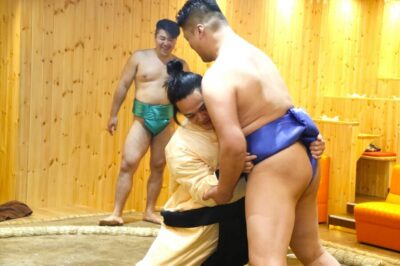
Sumo Show Experience with Chicken Hot Pot and a Photo
Read our review →
Shinjuku Food Tour (13 Dishes at 4 Local Eateries)
Read our review →
Tokyo Mt Fuji 5th St & Hakone Cruise Bus Tour w/Bullet Train
Read our review →
Flagship 2-Hours Official Street Go-Kart Tour – Tokyo Bay Shop
Read our review →Browse the lists this tour appears in