
Reviewed · KYOTO TOURS
Early Half Day to Kyoto Highlights
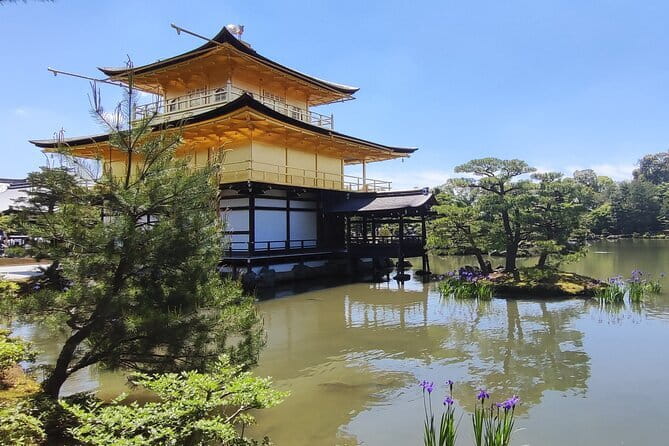
Kyoto’s biggest sights are spread across the city, yet this five-hour morning tour links three of them before the day gets crowded. You’ll visit Fushimi Inari Shrine, Arashiyama Bamboo Forest, and Kinkakuji, the Golden Pavilion, using a mix of walking and public transport.
I like the early start and the small group, capped at eight people. I also like the guide-led approach: Indra explains Shinto, Buddhism, Japanese society, and local history while keeping the group moving.
The tradeoff is a tight schedule. You have about 90 minutes at each major stop, and transport costs an extra ¥1,300 per person, with another ¥500 for Kinkakuji. This is a smart sampler, not a slow day of wandering.
Key points to know before booking
- Three major Kyoto sights in five hours: Fushimi Inari, Arashiyama Bamboo Forest, and Kinkakuji are all covered in one morning.
- An 8:00 am start helps with crowds: The early timing is one of the tour’s main advantages, especially at Fushimi Inari and Arashiyama.
- Indra is the named guide: He is praised for clear explanations, strong organization, storytelling, and a friendly manner.
- Public transport is part of the experience: You walk between sights and use Kyoto’s transport network, rather than relying on a private vehicle.
- The group stays small: The maximum is eight people, giving you more room to ask questions and keep pace with the guide.
- Your afternoon remains open: The tour ends back at Kyoto Station, leaving time for another activity or a relaxed meal.
Why this early Kyoto route works
Kyoto rewards planning, but it can punish loose plans. Fushimi Inari sits in the south, Arashiyama is in the west, and Kinkakuji is in the northwest. Seeing all three independently in one morning means checking routes, timing transport, finding the right entrances, and judging how long to stay.
This tour takes that planning burden off your shoulders. The guide leads the route, explains what you are seeing, and keeps the group on schedule. That matters most if you have only a short stay in Kyoto or want a first look at the city before exploring on your own.
The 8:00 am start is not for late risers, but it is the right choice for these famous places. Fushimi Inari’s red gates and Arashiyama’s bamboo paths are much easier to appreciate when the crowds are lighter. Kinkakuji is also a better sight when you are not trying to see the pavilion over a wall of people with phones.
You should expect a brisk morning. The route is designed to cover ground, not to linger at every shrine building, shop, garden, or side path. If you prefer a quiet, detailed visit to one or two places, book a slower tour or explore independently.
A few more Kyoto half-days to weigh up
- PERFECT KYOTO 1-Day Bus Tour
★ 5.0 · 13,518 reviews - Kyoto: Fushimi Inari, Kinkakuji, Bamboo Grove 1 Day Bus Tour
★ 4.8 · 4,316 reviews - Kyoto: Tea Ceremony in a Traditional Tea House in Kiyomizu
★ 4.9 · 3,519 reviews
Meeting at Kyoto Station and getting started
The tour begins at Starbucks Coffee in Kyoto Tower Sando, inside the Kyoto Tower building near Kyoto Station. The address provided is 7211 Higashishiokōjichō, Shimogyo Ward, Kyoto, postal code 600-8216.
This is a practical meeting point because Kyoto Station is one of the city’s main transport hubs. Still, the building is large and the meeting spot is specifically Starbucks Kyoto Tower, not simply the station entrance. Give yourself time to find the café and check the booking details for the meeting-point picture.
The opening stop lasts about 15 minutes and has no admission fee. Think of it as the place to meet Indra, confirm the group, and begin the route rather than a sightseeing stop.
Because the tour uses public transport, you should be ready for the ordinary work of moving through Kyoto: walking to stations, boarding with the group, and staying aware of the schedule. That may sound basic, but it is part of why a local guide can save you time.
Fushimi Inari’s red gates and Shinto lessons
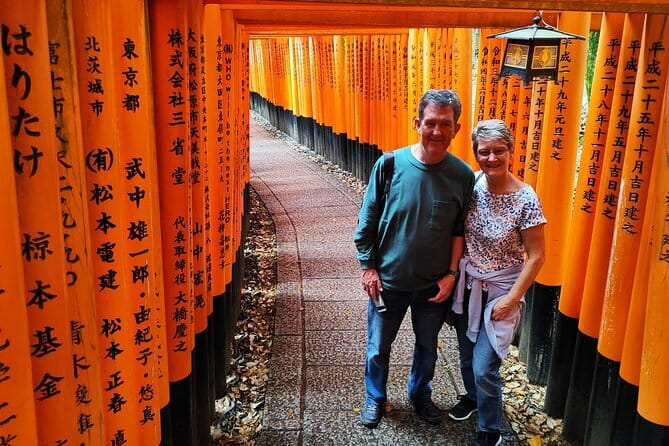
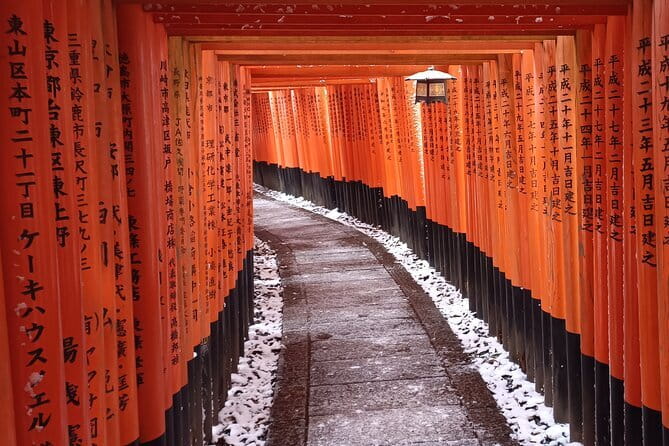
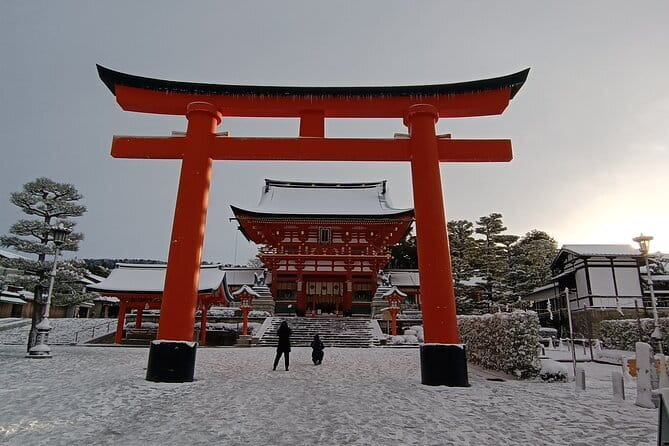
Fushimi Inari-taisha is the first major stop, with about 90 minutes set aside. The shrine is famous for its long rows of red torii gates, which create one of Kyoto’s most recognizable views.
The setting is more than a photo stop. Indra uses Fushimi Inari to introduce Shinto, one of the key parts of Japanese religious life and culture. That context gives the gates a clearer meaning than simply treating them as a striking tunnel of red and orange.
You’ll have a chance to enjoy the shrine and its views before the heaviest crowds arrive. The early timing is especially useful here because the torii gates are narrow, and the experience changes when large groups fill the path.
Ninety minutes is enough for a strong first visit, but do not expect to cover every part of the shrine grounds. Fushimi Inari is extensive, and a full walk through its wooded mountain paths would require much more time. This tour focuses on the famous section and the cultural explanation that goes with it.
Wear shoes you can walk in comfortably. The experience is not a coach ride from one photo point to the next, and the combination of shrine paths, station movement, and multiple stops makes comfort more important than style.
Arashiyama Bamboo Forest in a focused visit
The second major stop is Arashiyama Bamboo Forest, with another 90 minutes. The tall bamboo creates a memorable natural setting, and the surrounding area gives you a different side of Kyoto from the shrine architecture at Fushimi Inari.
The guide uses this stop to discuss Japanese society and the way nature fits into Japanese culture. That broadens the tour beyond a list of famous places. You are not simply being shown a bamboo path, you are being given a way to think about why natural settings matter so much in the country’s visual and cultural life.
The main path can become crowded, which makes the early schedule useful. Even so, the tour cannot guarantee an empty forest. Arashiyama is one of Kyoto’s best-known areas, and the timing improves your odds rather than removing other visitors entirely.
The 90-minute visit also gives you a practical limit. You can enjoy the bamboo, take photographs, and listen to the guide, but you may not have time for every nearby sight. If Arashiyama is the place you most want to explore, consider returning on another morning rather than trying to stretch this stop.
This is one of the tour’s strengths and its clear compromise. You get a well-planned introduction to a famous district, then move on instead of spending half the day in one area.
Same base, a completely different sort of day:
- Kyoto Geisha Walking Tour: Gion District & Hidden Gems
★ 4.7 · 3,273 reviews - Kyoto: Tea Ceremony Ju-An at Jotokuji Temple
★ 4.9 · 3,207 reviews - Kyoto: Gion Magical Night Walking Tour with Geisha Trivia
★ 4.9 · 2,393 reviews - Kyoto: 45-Minute Tea Ceremony Lesson Experience
★ 4.3 · 2,378 reviews
Kinkakuji and the Golden Pavilion
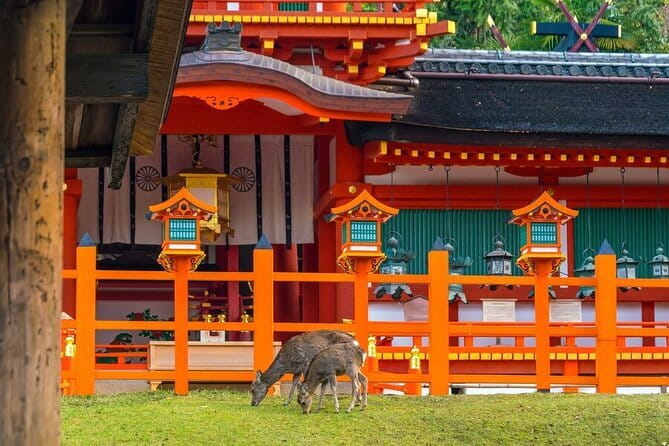
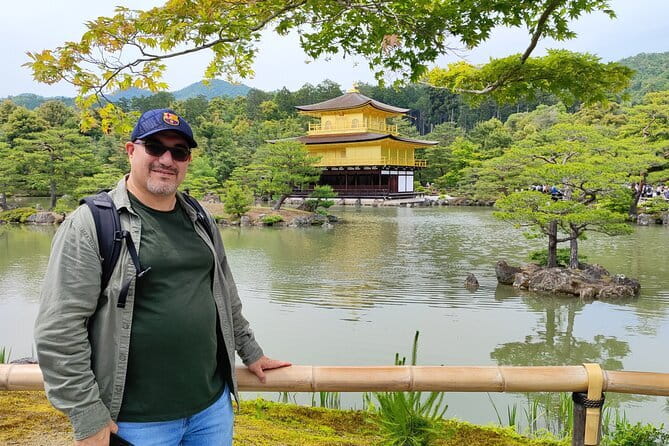
Kinkakuji Temple is the final major stop, with around 90 minutes. Known as the Golden Pavilion, it is one of Kyoto’s most visited sights and offers the tour’s most polished architectural view.
Here the focus shifts to Buddhism in Japan and the temple’s history. That progression works well: Fushimi Inari introduces Shinto, while Kinkakuji provides a chance to learn about Buddhism. You get two major strands of Japanese religious culture in one morning, without turning the visit into a classroom lecture.
The entrance fee is not included. You should budget ¥500 per person for admission. The price is modest, but it is worth knowing in advance because the advertised tour price does not cover every cost.
Kinkakuji is primarily a viewing route rather than a place where you wander freely through every building. The Golden Pavilion itself is the star, and the surrounding grounds provide the setting for the view. Your guide’s role is useful here because the history and religious meaning are easy to miss if you simply arrive, take a photograph, and leave.
The order of the stops also makes sense for a half-day plan. By placing Kinkakuji last, the tour finishes with a major sight before returning you to Kyoto Station. You are not left at an unfamiliar neighborhood with the afternoon still to plan.
What the guide adds to the morning
The strongest reason to choose this tour is not just the route. It is the guide-led structure.
Indra is the named guide, and the experience is designed around his explanations of history, culture, Shinto, Buddhism, and Japanese society. He is also described as a good storyteller who plans the timing carefully and answers questions in a small-group setting.
That combination is useful in Kyoto. The famous sights are easy to recognize, but their meaning is less obvious. A guide can point out why a shrine matters, explain the difference between religious traditions, and connect a bamboo grove or temple to broader parts of Japanese life.
The small group makes a real difference. With a maximum of eight people, you have a better chance to hear the guide and ask a question without slowing down a large crowd. It also allows the group to move through stations and entrances with less fuss.
Do keep your expectations realistic. A guide can explain the route and help with timing, but public transport still involves shared city infrastructure. You will need to stay with the group and be ready to move when the schedule calls.
The real cost and what you receive
The listed price is $94.71 per person. That covers the local English-speaking guide, but not the main transport or Kinkakuji admission.
Add ¥1,300 per person for public transportation and ¥500 for entry to Kinkakuji. Gratuity is also excluded. The final cost therefore depends on the exchange rate and whether you choose to tip, but the required additions are clear.
Is that good value? For a solo visitor or a couple, I think the value is strongest if you care about saving planning time. You are paying for a guide, a carefully timed route, cultural explanations, and help connecting three distant parts of Kyoto in one morning.
The value is less obvious if you are comfortable navigating Kyoto and already know which trains or buses to take. You can visit the sites without a tour, and the admission fees themselves are small. The tour makes more sense when your time is limited or you want someone else to manage the morning’s sequence.
The afternoon is part of the value. Returning to Kyoto Station after roughly five hours means you can still schedule another experience, visit a market, rest at your hotel, or explore a neighborhood at your own pace. Full-day sightseeing can leave you worn out; this format gives you a strong start without taking the whole day.
Who should book this tour
I would choose this experience if you are visiting Kyoto for the first time and want to see its three headline sights quickly. It also suits anyone staying near Kyoto Station, since the meeting point and return point are both there.
It is a good fit for people who like explanation with their sightseeing. If you want to understand Shinto at Fushimi Inari and Buddhism at Kinkakuji, the guide’s role adds real value.
Small groups are another reason to book. The eight-person limit gives the morning a more personal feel than a large bus tour. You can ask questions and stay connected to the guide without shouting across a crowd.
This tour may not suit you if you dislike early starts, walking, or public transport. It is also not ideal if your main goal is to spend several hours in Arashiyama or climb far into the Fushimi Inari shrine grounds. The route covers three places, so each one receives a measured visit.
The experience requires good weather. If poor weather causes cancellation, you are offered another date or a full refund. Otherwise, free cancellation is available up to 24 hours before the start time, based on Kyoto local time.
A practical morning plan
Meet at Starbucks Kyoto Tower Sando before the 8:00 am start. Since the meeting place is within the Kyoto Tower building, do not leave finding the café until the last minute.
Bring the ¥1,300 transport cost and ¥500 Kinkakuji admission fee, preferably in a form that is easy to access during the morning. Gratuity is optional and not included.
Plan for a combination of walking, shrine and temple paths, public transport, and short stops. Comfortable shoes will make the morning easier, and a small bag is more practical than bulky luggage.
Keep your afternoon flexible. The tour returns to Kyoto Station, but the exact pace can depend on transport and crowd conditions. That open afternoon is one of the best features of the format, so avoid booking another fixed activity too close to the return time.
Should you book Early Half Day to Kyoto Highlights?
Book it if you want an efficient first look at Kyoto’s most famous sights, prefer a small group, and value a guide who can connect the places to Japanese religious and social life. Indra’s organization, storytelling, and attention to questions add something that a simple route map cannot.
Skip it if you want long, unhurried visits or already feel confident planning Kyoto’s public transport. The morning is brisk, and the extra ¥1,800 in transport and admission costs comes on top of the $94.71 tour price.
For a first Kyoto morning, though, the balance is appealing: three major sights, an early start, a named local guide, and an afternoon still free. That is a practical way to get your bearings without giving up the rest of your day.
FAQ
How long does the Kyoto highlights tour last?
The tour lasts approximately five hours.
What time does the tour begin?
The tour begins at 8:00 am.
Where does the tour meet?
The meeting point is Starbucks Coffee at Kyoto Tower Sando, inside Kyoto Tower near Kyoto Station in Kyoto’s Shimogyo Ward.
Where does the tour end?
The activity ends back at the meeting point near Kyoto Station.
Which sights are included?
The tour visits Fushimi Inari-taisha Shrine, Arashiyama Bamboo Forest, and Kinkakuji Temple, also called the Golden Pavilion.
Is the Kinkakuji entrance fee included?
No. The Kinkakuji entrance fee is ¥500 per person and must be paid separately.
Is public transportation included?
No. Public transportation costs ¥1,300 per person and is not included in the tour price.
Who leads the tour?
The tour is led by an experienced local English-speaking guide. Indra is the named guide associated with the experience.
How large is the group?
The tour has a maximum of eight travelers.
Can I cancel for a full refund?
Yes. You can cancel at least 24 hours before the local start time for a full refund. Cancellations or changes made less than 24 hours before the start time are not refunded or accepted. If poor weather cancels the experience, you are offered another date or a full refund.
Just added around Kyoto
- Kyoto: Zen Meditation at a Private Temple with a Monk★ 5.0 · 25 reviews
- Kyoto: Gion Geisha District & Sake-in-Hand Walking Tour★ 5.0 · 37 reviews
- Private Pewter Sake Cup Experience with a Kyoto Artisan★ 5.0 · 31 reviews
- Your Private Vacation Photography Session In Kyoto★ 5.0 · 110 reviews
- Private Guided Traditional Buddhist Cooking in Japan★ 5.0 · 16 reviews
- Kyoto Wagashi(Japanese sweets) Cooking Class near Fushimiinari★ 5.0 · 60 reviews
- Traditional Japanese Music show & Experience Tour in Kyoto★ 5.0 · 57 reviews
- Kyoto:Family-Friendly Kimono & Yukata Experience at WARGO★ 5.0 · 147 reviews
Kyoto Tours, compared.


Fushimi Inari, Kinkakuji, Bamboo Grove 1 Day Bus Tour
Read our review →
Tea Ceremony in a Traditional Tea House in Kiyomizu
Read our review →
Kyoto Geisha Walking Tour: Gion District & Hidden Gems
Read our review →

Gion Magical Night Walking Tour with Geisha Trivia
Read our review →
