
Reviewed · KYOTO TOURS
Explore Hidden Alleyway with a Local Expert (Afternoon Tour)
Kyoto’s most memorable moments often appear between the famous sights. This three-hour afternoon bike tour takes you through wooden-house lanes, geisha districts, river paths, and quiet corners that are easy to miss on foot or from a tour bus.
I like the small group size, capped at six people per guide, and the way the route mixes famous Kyoto with ordinary neighborhood views. I also like that guide Yuichi has been praised for being funny, personable, and informative. The main drawback is that cycling on city roads requires confidence, and the afternoon schedule leaves little room for long stops.
Key points to know before you book
- Quiet lanes are the main attraction: The route gives you a close look at old wooden houses and local streets away from Kyoto’s busiest corridors.
- Five meaningful stops: You visit Miyagawacho, Gion, Tatsumi Bridge, Kyoto Imperial Palace, and the Kamo River area at Kashiwayacho.
- Small private groups: Two to six people ride with each guide, so the pace and conversation should feel more personal than on a large group tour.
- E-bikes may make the route easier: One review specifically praised the e-bike option, especially for covering more ground in limited time.
- Rain does not automatically cancel the outing: You can ride with a free poncho or switch to a walking tour using public transport.
- Basic cycling ability matters: Children must be at least 10 years old and 145 centimeters tall, and all riders must handle a bicycle safely on roads without help.
Kyoto by bicycle, from quiet lanes to familiar sights
At $102.47 per person, this is not the cheapest way to see Kyoto. It can still be good value if you want a local escort, a private group, and transportation between several districts without arranging the route yourself.
The bike matters here. Kyoto is spread out, and the tour covers places that are not best linked by a single train or subway ride. You can move from a narrow lane in Miyagawacho to Gion, then out toward the Imperial Palace and Kamo River without spending much of your three-hour window waiting for transport.
This is not a hard-charging cycling excursion. The route includes short stops of about 15 to 20 minutes, with time to look around and hear the setting explained. Still, you are riding on city streets and gravel paths, so you need to be comfortable steering, braking, and keeping with a group.
The tour begins at 2 p.m. and returns to the same meeting point at 552-13 Higashiaburanokōjichō in Shimogyo Ward. Plan extra time to reach the start, since a late arrival can cut into a fairly short outing.
A few more Kyoto half-days to weigh up
- PERFECT KYOTO 1-Day Bus Tour
★ 5.0 · 13,518 reviews - Kyoto: Fushimi Inari, Kinkakuji, Bamboo Grove 1 Day Bus Tour
★ 4.8 · 4,316 reviews - Kyoto: Tea Ceremony in a Traditional Tea House in Kiyomizu
★ 4.9 · 3,519 reviews
Miyagawacho, wooden houses and a quieter Kyoto
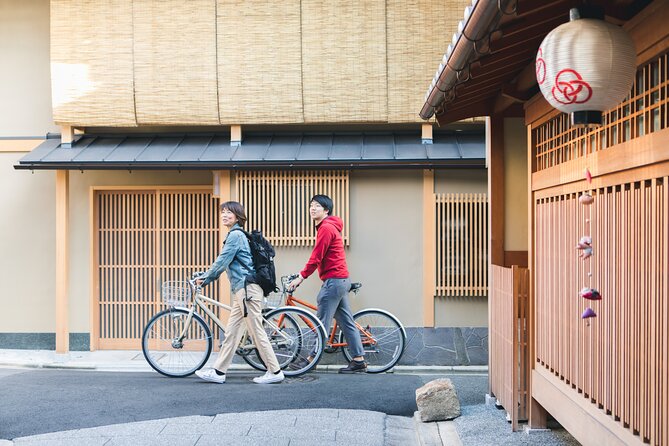
The first stop is Miyagawacho Kaburenjo, one of Kyoto’s five traditional geisha districts and the second largest among them. The area is known for its narrow lane lined with traditional wooden townhouses.
This is a good opening stop because it sets the tone for the afternoon. Instead of beginning with a grand temple or major avenue, you start with a quieter residential-feeling district where the architecture does much of the talking.
The calm atmosphere is the point. You can look closely at the scale of the buildings, the lane itself, and the way Kyoto’s old neighborhoods fit into the modern city. Your guide can also help you understand the difference between simply seeing a wooden facade and recognizing the role these streets play in Kyoto’s traditional entertainment districts.
The stop lasts about 15 minutes and has no separate admission fee. That keeps the tour moving, but it also means you should not expect a long architectural visit or an indoor performance.
Gion, Kyoto’s best-known geisha district
From Miyagawacho, the ride continues to Gion. This is the Kyoto many people picture before arriving: refined old streets, traditional buildings, and the world of maiko and geiko.
Gion developed as a major geisha district, and its old atmosphere remains one of the city’s strongest draws. Your guide’s presence is especially useful here because this is a place where local etiquette matters. The narrow streets can be busy, and respectful behavior is more important than getting a close photo.
You have roughly 15 minutes at this stop. That is enough to take in the setting and hear the basics, but not enough for a long wander through every lane. If Gion is your main reason for booking, treat this tour as an introduction rather than a complete visit.
I like the balance in the route. Gion provides the famous Kyoto image, while Miyagawacho gives you a quieter and less postcard-focused look at the same cultural world. The contrast helps you see that these districts are not just photo backdrops.
Tatsumi Bridge and the willow-lined stream
Tatsumi Bridge offers a change of pace. The route follows a small stream, with willows moving in the breeze and a gentler feeling than the main streets nearby.
This is one of the stops where the bicycle itself adds something. You arrive without the stop-and-start rhythm of a bus, and the short ride along the water lets you notice shifts in light, sound, and street character. Kyoto can feel crowded one minute and almost hushed the next.
The stop is scheduled for about 15 minutes. It is a brief pause, but it gives the afternoon some breathing room between the traditional districts and the larger Imperial Palace grounds.
Do not expect a major sightseeing site here. Tatsumi Bridge is valuable for atmosphere, not a long list of things to see. If you prefer grand buildings and formal attractions at every stop, this may feel slight. If you enjoy small urban details, it is likely to be one of the more pleasant parts of the route.
Same base, a completely different sort of day:
- Kyoto Geisha Walking Tour: Gion District & Hidden Gems
★ 4.7 · 3,273 reviews - Kyoto: Tea Ceremony Ju-An at Jotokuji Temple
★ 4.9 · 3,207 reviews - Kyoto: Gion Magical Night Walking Tour with Geisha Trivia
★ 4.9 · 2,393 reviews - Kyoto: 45-Minute Tea Ceremony Lesson Experience
★ 4.3 · 2,378 reviews
Kyoto Imperial Palace, gravel paths and open space
The Imperial Palace used to be the residence of Japan’s Imperial Family. Today, the palace grounds are open to the public as a national garden, with seasonal flowers and broad paths.
The tour cycles along gravel paths here for about 20 minutes. That gives you a welcome change from narrow city lanes, though gravel can feel less stable than pavement. Keep your speed comfortable and follow the guide’s instructions.
This stop also changes your view of Kyoto. Earlier, the route focuses on close quarters, wooden houses, streams, and old entertainment districts. The Imperial Palace area opens things up and gives you more room to look around.
The visit is free, but the schedule remains fairly tight. You will get an overview rather than a full palace tour. If you want detailed access to palace buildings or a longer garden visit, you should plan separate time on another day.
Still, this is a smart inclusion. It shows that Kyoto is not only a collection of narrow historic lanes. The city also has large public spaces where seasonal flowers and formal grounds shape the experience.
Kashiwayacho and the Kamo River
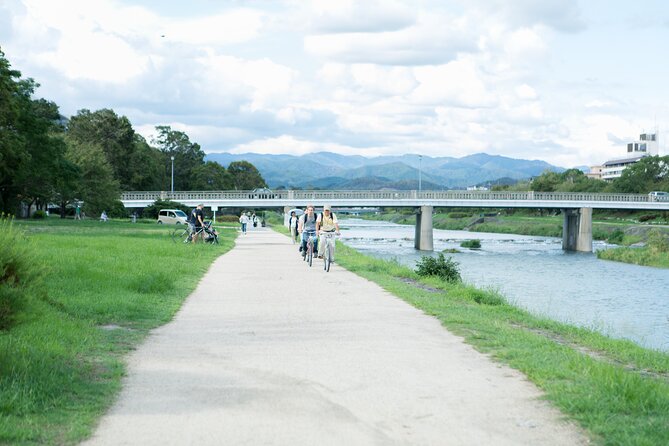
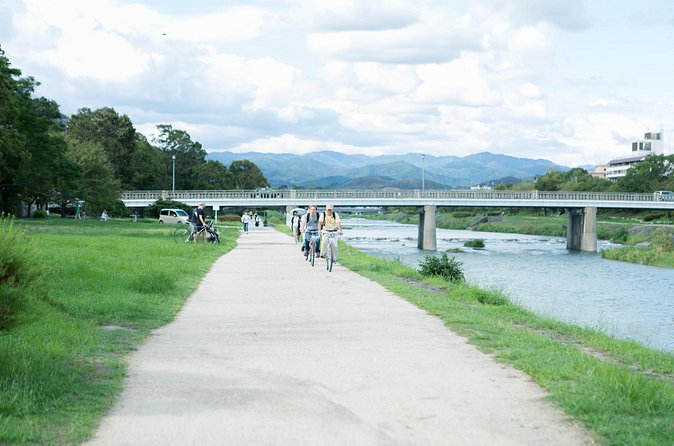
The final listed stop is Kashiwayacho, where you can relax beside the Kamo River, a favorite local waterside area. After the city streets and palace grounds, the river provides an easy final pause before the ride back to the starting point.
This part of the route is less about a single monument and more about how Kyoto residents use public space. A riverbank can tell you plenty about a city. It gives people room to sit, walk, meet, and take a break, and it offers a calmer ending than one last crowded landmark.
The scheduled stop is about 20 minutes, and admission is included. You should have enough time to enjoy the setting, but the group must keep an eye on the clock because the tour returns to its original meeting point.
The river stop also helps explain why the tour feels different from a standard sightseeing circuit. You are not simply collecting famous buildings. You are seeing how neighborhoods, waterways, public gardens, and cultural districts connect.
What the guide adds to the ride
The company trains its guides through its own program. Training covers Kyoto culture, traffic safety, group cycling, and local etiquette.
That combination matters. A guide who only knows historical facts may not be good at leading bikes through city streets. Here, the stated training places equal weight on safety and cultural behavior, which is what you want in a small cycling group.
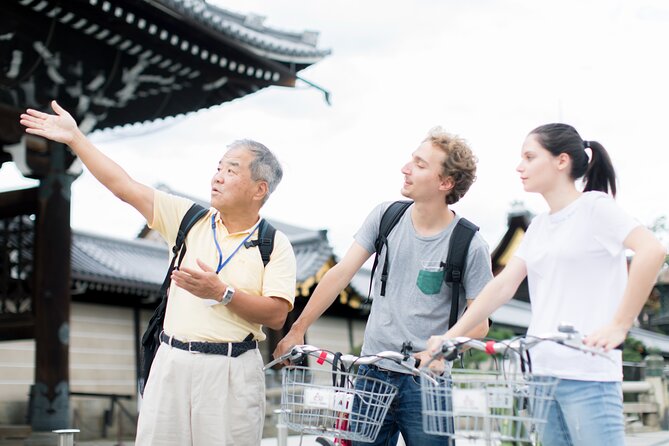
Yuichi received especially strong praise for being personable, funny, and informative. A good guide can make the difference between a pleasant ride and a tiring one, especially when the route includes several short stops and changes in traffic conditions.
You should not assume that Yuichi will lead every departure, since the tour uses a guide team. But the training program gives you a useful standard to expect: explanations should be paired with practical direction, not delivered as a long lecture while everyone stands with a bicycle.
The private format is another plus. Two to six people ride with one guide, and a group of seven to 12 can have an extra guide arranged. That is small enough for questions and easier movement through narrow streets.
E-bikes, fitness, and road comfort
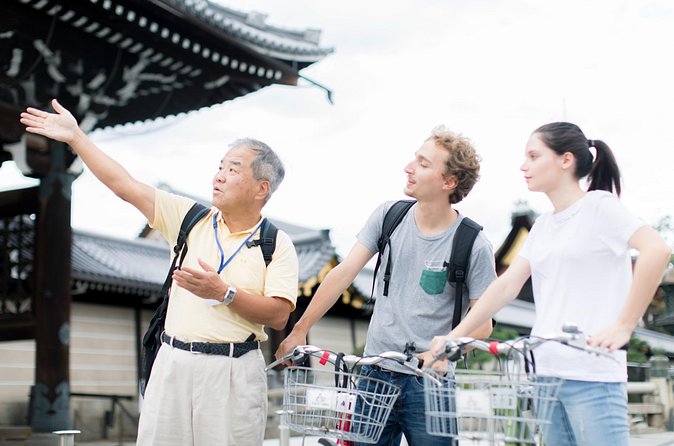
The strongest practical advantage may be the e-bike option. One rider specifically called e-bikes the way to go after using the tour to cover Kyoto’s streets and cultural sights.
The supplied information does not state that an e-bike is guaranteed for every booking, so ask before you reserve if that feature matters to you. If the bicycle is a standard model, you should be ready for ordinary pedaling over the full three hours.
You do not need to be an athlete, but you must be able to ride safely on the road without assistance. This is not suitable for a child who is still learning, or for anyone uneasy around city traffic.
Children must be at least 10 years old and at least 145 centimeters tall. They also need to control a bicycle safely on the road without help. Those rules are clear and sensible, but families should check each child’s ability rather than relying only on age.
Wear clothes that allow easy movement and shoes suitable for pedaling. The route includes gravel at the Imperial Palace, and you may spend much of the time moving between stops rather than standing in one place.
Rain planning and the afternoon timing
The tour operates in rain, which is useful in Kyoto, where weather can change your plans quickly. You can continue by bike with a free rain poncho, or choose a walking tour that uses the bus or metro, with public transport included in the tour fee.
That choice gives you flexibility, but it also changes the character of the outing. The bike is what lets you link the districts efficiently, while the walking version will likely take a slower route through the city. If rain is forecast, ask at the start which option will work best for your group.
The 2 p.m. departure has both strengths and limits. You avoid an early morning start, and the tour works well as an afternoon activity after a relaxed lunch. On the other hand, three hours passes quickly, and the final part of the ride may take place as daylight begins to soften.
The route is best for someone who wants an orientation to several parts of Kyoto in one sitting. It is less suitable if you want long, unhurried visits at each district.
Is $102.47 a fair price?
At $102.47 per person, the value depends on how much you use the guide and bicycle time. If you only want to see Gion and Tatsumi Bridge, you can visit those areas on your own for far less.
The price makes more sense if you want to connect five different places, avoid planning the route, and learn about Kyoto while riding. A private group of two to six people also gives you a more personal setting than a large coach tour.
For a family or small group with limited time, the cost can be reasonable. One four-star assessment found the outing useful for seeing several city sights quickly, especially when time was tight. That is the clearest case for booking: you trade some independence for efficient movement and local context.
The value drops if you dislike bicycles, want extensive indoor sightseeing, or prefer to spend an hour or more at each major site. This is a moving overview, not a full historical tour of the Imperial Palace or a dedicated Gion visit.
The current rating is 4.9 from 17 ratings, with 100 percent recommending it. That is a strong signal, though the sample is small. I would give the most weight to the repeated praise for the guide and the practical usefulness of covering several areas by bike.
Booking details that deserve attention
Confirmation is sent within 48 hours of booking, subject to availability. The minimum is two people, so a solo booking is not accepted. If your party has seven to 12 people, an extra guide can be arranged.
The cancellation information supplied with the tour is inconsistent. One section says you may receive a refund if you cancel at least three days before the tour date by 6 p.m. Japan time, while the formal policy says the experience is non-refundable and cannot be changed. Treat the booking as non-refundable until KCTP confirms the current rule in writing.
The same three-day, 6 p.m. Japan time deadline applies to rescheduling. After that point, changes require cancellation and a new reservation. The operator can also cancel if the minimum number is not reached, in which case you are offered another date or experience, or a full refund.
The mobile ticket is convenient, but it does not remove the need to arrive at the correct meeting point. Since the tour ends where it starts, you can plan another nearby activity afterward, provided you allow time for the ride to finish.
Who should book this Kyoto bike tour?
I would choose this tour if you have only a short stay in Kyoto and want a guided look at several districts in one afternoon. It also suits couples, families with confident young riders, and small private groups that value a flexible feel.
You will get the most from it if you enjoy streets and atmosphere as much as formal attractions. Miyagawacho, Tatsumi Bridge, and Kashiwayacho are included because of their character, not because they offer a long checklist of monuments.
I would skip it if you are uncomfortable cycling in traffic, need a slow pace, or want guaranteed e-bikes. I would also think twice if Gion or the Imperial Palace is your main goal, since each receives only a short stop.
For most capable cyclists, the route offers a useful mix: old wooden lanes, geisha districts, a willow-lined stream, open palace grounds, and the Kamo River. It gives you a feel for Kyoto’s changing rhythm without asking you to spend the whole day in a museum or on a bus.
FAQ
Where does the tour start and end?
It starts at 552-13 Higashiaburanokōjichō, Shimogyo Ward, Kyoto, 600-8235, Japan, at 2 p.m. The tour ends back at the same meeting point.
How long does the afternoon bike tour last?
The tour lasts approximately three hours.
What places does the route visit?
The route includes Miyagawacho Kaburenjo, Gion, Tatsumi Bridge, Kyoto Imperial Palace, and Kashiwayacho by the Kamo River.
How many people can join one guide?
Each guide accepts a minimum of two and a maximum of six people. For groups of seven to 12, an additional guide can be arranged.
Can children join the tour?
Children must be at least 10 years old, at least 145 centimeters tall, and able to ride a bicycle safely on the road without assistance.
What happens if it rains?
You can continue by bicycle with a free rain poncho, or switch to a walking tour using the bus or metro. Public transport is included in the tour fee.
Can I cancel or reschedule the booking?
The supplied terms conflict. One section allows a refund for cancellation at least three days before the tour by 6 p.m. Japan time, while the formal policy says the experience is non-refundable and cannot be changed. Confirm the current policy with KCTP before booking. Rescheduling requests must also be made at least three days before the tour by 6 p.m. Japan time.
Just added around Kyoto
- Kyoto: Zen Meditation at a Private Temple with a Monk★ 5.0 · 25 reviews
- Kyoto: Gion Geisha District & Sake-in-Hand Walking Tour★ 5.0 · 37 reviews
- Private Pewter Sake Cup Experience with a Kyoto Artisan★ 5.0 · 31 reviews
- Your Private Vacation Photography Session In Kyoto★ 5.0 · 110 reviews
- Private Guided Traditional Buddhist Cooking in Japan★ 5.0 · 16 reviews
- Kyoto Wagashi(Japanese sweets) Cooking Class near Fushimiinari★ 5.0 · 60 reviews
- Traditional Japanese Music show & Experience Tour in Kyoto★ 5.0 · 57 reviews
- Kyoto:Family-Friendly Kimono & Yukata Experience at WARGO★ 5.0 · 147 reviews
Kyoto Tours, compared.


Fushimi Inari, Kinkakuji, Bamboo Grove 1 Day Bus Tour
Read our review →
Tea Ceremony in a Traditional Tea House in Kiyomizu
Read our review →
Kyoto Geisha Walking Tour: Gion District & Hidden Gems
Read our review →

Gion Magical Night Walking Tour with Geisha Trivia
Read our review →
