
Reviewed · KYOTO TOURS
Kyoto 1 Day Tour from Kyoto
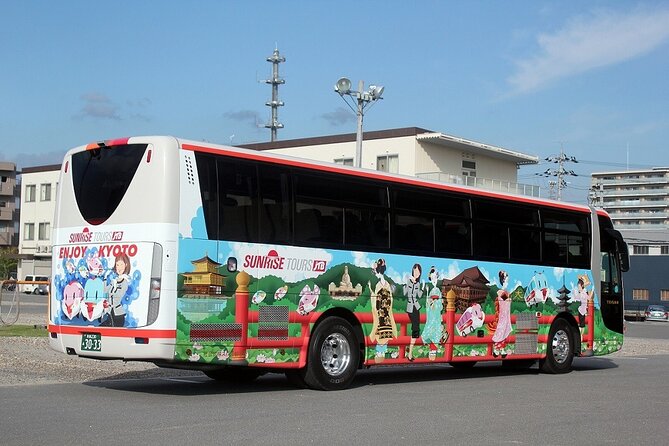
Kyoto packs centuries of Japan into a surprisingly compact day, and this tour takes you from Nijo Castle to Kiyomizu-dera with six major sights in between. I like the efficient route, the included admission fees, and the air-conditioned bus that saves you from piecing together Kyoto’s sometimes confusing public transport.
I also like that guides such as KC, Miyuki, Yuki, Michi, and Yoshitaka Harada have earned praise for clear explanations, humor, and careful group management. The catch is simple: six sites in one day means a brisk pace, and some visitors find the walking fast or the guide difficult to hear in crowded places.
Key points at a glance
- Six major Kyoto sights: Visit Nijo Castle, Kinkaku-ji, Kyoto Imperial Palace, Fushimi Inari, Sanjusangendo, and Kiyomizu-dera.
- A strong first-day introduction: You get a broad look at Kyoto’s imperial, Buddhist, and Shinto traditions without planning six separate visits.
- Comfortable transport included: The climate-controlled coach handles the long stretches between sites and avoids several local train and bus changes.
- Optional lunch: Choose no lunch, a Western-style set menu, or an Indian thali option when available.
- Expect real walking: Fushimi Inari includes about 15 minutes on foot each way from the parking area, and Kiyomizu-dera involves a sloping approach.
- Alternatives can replace stops: Closures at the Imperial Palace or Nijo Castle may mean visiting another shrine or temple instead, with no refund for the substitution.
Six Kyoto landmarks packed into 9 hours and 40 minutes
This is a classic sightseeing day, not a slow temple ramble. You start at 8:20 a.m. and finish at Kyoto Station at about 5:30 p.m., with roughly 40 people sharing the coach at maximum capacity.
That format works well if you have only a day or two in Kyoto. You will see famous places that are spread across the city, hear the basic story behind them, and avoid spending your morning figuring out which train, subway, or bus goes next.
I would not choose it for a quiet, contemplative visit. The scheduled stops range from 30 minutes to 1 hour 10 minutes, so you will have time for the main buildings, gardens, photographs, and a little independent wandering, but not for every side path or museum room.
The tour includes transportation, admission fees, and an English-speaking National Government Licensed Guide Interpreter. At $168.43 per person, the value depends on how much you value that convenience. It is not the cheapest way to see Kyoto, but adding up six admission charges, a full day of transport, and a guide makes the price reasonable for a first visit.
A few more Kyoto half-days to weigh up
- PERFECT KYOTO 1-Day Bus Tour
★ 5.0 · 13,518 reviews - Kyoto: Fushimi Inari, Kinkakuji, Bamboo Grove 1 Day Bus Tour
★ 4.8 · 4,316 reviews - 10 Must-see Spots in Kyoto One Day Private Tour (up to 7 people)
★ 5.0 · 1,108 reviews
Finding the Kyoto Station meeting point
The starting point is the JTB Sunrise Tours Desk in the basement of AVANTI, at 31 Higashikujo Nishisannocho near Kyoto Station. The tour ends at Kyoto Station, which is useful if you are continuing to Osaka or another Japanese city that evening.
Give yourself extra time to find the desk. The meeting point is inside a department store building rather than in an obvious outdoor plaza, and the basement location has caused confusion for some people. I would arrive well before 8:20 a.m., especially if you are carrying luggage or unfamiliar with the station area.
The end time is around 5:30 p.m., but traffic and crowd levels can change the order and timing. If you have a nonrefundable train reservation soon after the tour, leave a generous margin. One late group member can affect the whole coach, and the schedule is already tightly packed.
Seats may not be assigned. If you care about sitting with a companion, arrive early and ask the staff what is possible rather than assuming a seat will be held.
Nijo Castle and the Tokugawa show of power
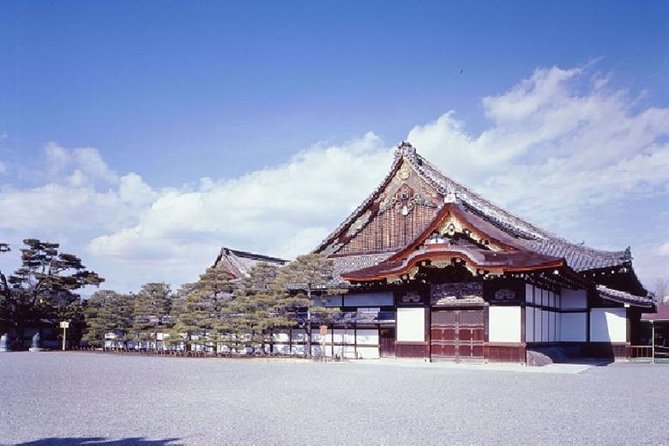
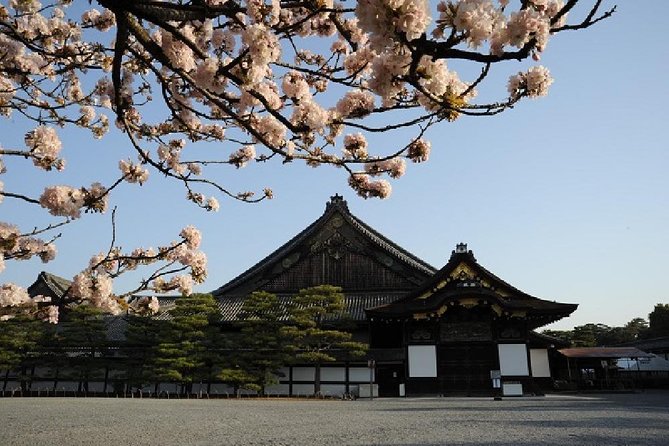
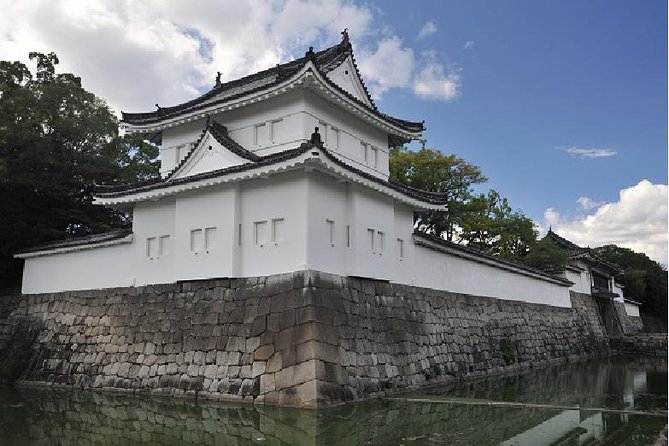
The first stop is Nijo Castle, a UNESCO World Heritage site completed in 1626. It was built to house the Tokugawa shogun during visits to Kyoto and to protect the nearby Imperial Palace.
You get about 50 minutes here, including admission. The castle is a useful opening stop because it looks restrained from the outside but becomes far more ornate inside. Expect decorated chambers, elaborate carvings, gold leaf, and rooms designed to show rank and authority.
Your guide can add meaning to details that are easy to miss when walking alone. The castle is not just an old residence. It reflects the political struggle between the shogunate and the emperor, along with the ceremonies used to manage status.
Fifty minutes is enough for a focused visit, but it will feel short if you want to inspect every room or spend time in the gardens. Stay close to the guide at the beginning, then use any remaining minutes for your own look around.
Nijo Castle is closed on Tuesdays in January, July, August, and December, with the closure shifting to the following day if Tuesday is a holiday. In that case, the tour visits Ryoan-ji Temple instead. The replacement can be worthwhile, but you should know that the itinerary is not guaranteed to include the castle on every date.
Kinkaku-ji and Kyoto’s most photographed pavilion
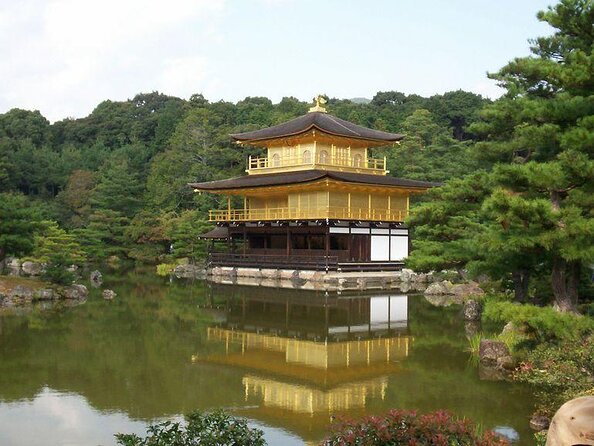
Kinkaku-ji, the Golden Pavilion, gets 45 minutes. The wooden building is covered in thin layers of gold and sits beside a pond in a carefully arranged Japanese garden.
This is one of Kyoto’s classic views. The pavilion is striking from the first angle, and the garden gives you more than a quick building photograph. You can walk the set route, pause at the pond, and take in the contrast between the gold structure, dark timber, water, and surrounding trees.
The drawback is crowding. Kinkaku-ji is among Kyoto’s most popular sights, so the path may feel crowded and the best photo spots can fill quickly. The tour helps you get there without managing local transport, but it cannot make the site private or slow the other visitors.
Forty-five minutes suits a first look. I would focus on the main view rather than trying to cover every corner. Your guide’s explanation is useful here because the pavilion’s appearance tells only part of its story.
Same base, a completely different sort of day:
- Kyoto: Tea Ceremony in a Traditional Tea House in Kiyomizu
★ 4.9 · 3,519 reviews - Kyoto Geisha Walking Tour: Gion District & Hidden Gems
★ 4.7 · 3,273 reviews - Kyoto: Tea Ceremony Ju-An at Jotokuji Temple
★ 4.9 · 3,207 reviews - Kyoto: Gion Magical Night Walking Tour with Geisha Trivia
★ 4.9 · 2,393 reviews
Kyoto Imperial Palace and the old court city
The Imperial Palace stop lasts about 40 minutes and has no separate admission charge. The palace served as the emperor’s residence until roughly 150 years ago, when the imperial capital moved away from Kyoto.
This stop adds an important layer to the day. Nijo Castle shows the shogun’s authority, while the Imperial Palace represents the court and the older ceremonial order. The buildings and grounds favor clean lines and restraint rather than the gold and elaborate decoration seen at Nijo Castle.
You will learn about ceremonies, palace life, and Kyoto’s role as Japan’s political and cultural center. Forty minutes gives you an outline rather than a full study of the grounds, so listen during the introduction and take photographs as you go.
The palace is closed on Mondays, the following day when Monday is a holiday, and on dates affected by an Imperial Household Agency event. On those days, the tour visits Kitano Tenmangu Shrine instead. If the closure falls on the 25th, the substitute is Nishi Hongan-ji Temple. There is no refund when one of these alternatives is used.
Fushimi Inari and the red torii gates
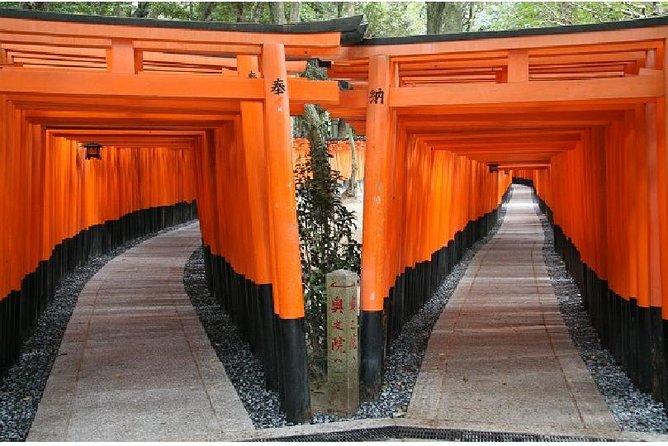
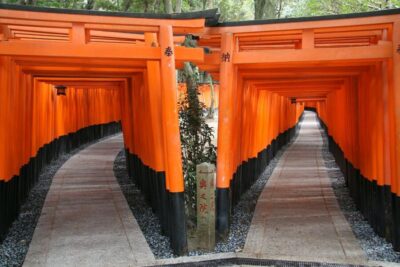
Fushimi Inari Taisha is the head shrine of about 40,000 Inari shrines across Japan. Its rows of red torii gates are among the most recognizable images in Kyoto.
You have about 30 minutes here. That is enough to enter the shrine grounds, walk beneath part of the Senbon Torii, and get a taste of the atmosphere. It is not enough to hike the full mountain route, so set your expectations accordingly.
The bus cannot simply drop you beside the main shrine entrance. You walk about 15 minutes each way from the parking area, making this one of the more important mobility notes for the day. The route may be easy for most people, but heat, rain, slippery surfaces, or crowded paths can change how it feels.
Stay aware of the return time. Fushimi Inari is the stop where it is easiest to keep walking because each gate seems to lead to another. The tour is designed for a sample of the shrine, not an extended hike.
Sanjusangendo’s long hall and 1,001 Kannon figures
Sanjusangendo Temple receives about 30 minutes. Its long wooden hall contains 1,001 life-size statues of Kannon, the Buddhist deity of compassion, dating from the 13th century.
This is one of the day’s most memorable interiors. After the open grounds of Kinkaku-ji and Fushimi Inari, you enter a space where repetition creates its own force: row after row of statues lined inside the wooden hall.
The visit is short, but the scale makes the stop worthwhile. You will not need a long explanation to understand why the hall feels different from the other sites. Listen to the guide’s comments, then use the quiet time inside to take in the arrangement.
Photography rules can apply inside religious buildings, so follow the signs and staff instructions. The tour’s schedule gives you a clear taste of Sanjusangendo without allowing the stop to consume the afternoon.
Kiyomizu-dera and the final Kyoto view
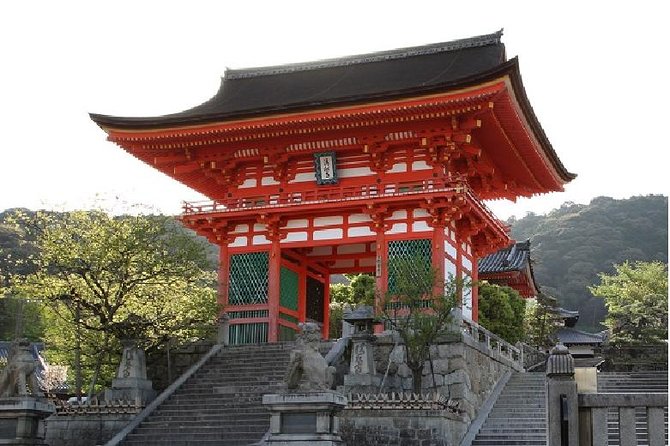
The final major stop is Kiyomizu-dera, with about 1 hour 10 minutes. The temple sits above Kyoto and is known for its broad wooden terrace and city views.
The approach is part of the experience. The historic lane leading toward the temple is lined with pottery shops and other stores, so you can browse as you walk. It is more atmospheric than arriving at a coach parking lot and stepping straight into a monument.
At the temple, the terrace gives you the broad city view promised by the tour. Depending on the weather, you might see rooftops stretching across the basin and the surrounding hills. Rain can soften the view, but the temple remains worth seeing in poor weather.
This is the longest stop, though the time still goes quickly. You need to allow for the walk up, the temple visit, photographs, and the return to the bus. If you want souvenirs from the pottery lane, shop with restraint. The group will not wait indefinitely.
Kiyomizu-dera is also where the day’s walking may catch up with you. Wear shoes that handle slopes and bring water, particularly during Kyoto’s hot summer months.
What the guide adds, and where the format can fail
A strong guide makes this tour far more useful than a self-guided checklist. Guides such as KC have been praised for humor and care in very hot weather, while Miyuki and Yoshitaka Harada have been noted for explaining Japanese customs, daily life, and historical details in clear English. Yuki and Michi have also led well-regarded departures.
The best guides do more than recite dates. They explain why a shogun needed a castle in Kyoto, how the imperial court differed from military rule, and what the torii gates at Fushimi Inari represent in Japanese religious life.
Guide quality can vary. Some departures have had trouble with sound volume or a guide walking too quickly. In a group of up to 40 people, it is easy to fall behind at a temple entrance or miss part of a talk if you are at the back.
I suggest standing close during explanations and telling the guide promptly if you cannot hear. Keep the guide’s meeting point and bus instructions in mind at every stop. The tour is well organized when communication is clear, but the tight timetable leaves little room to recover from confusion.
Lunch choices and the no-lunch option
Lunch is optional, so check the selection carefully when booking. The Western-style lunch is available only with the relevant option, and a vegetarian request must be made in advance. Same-day changes are not accepted.
An Indian thali option is also offered in its own dining area. It includes three curries, vegetable pakora, yogurt, naan or roti, rice, salad, and one nonalcoholic drink. You cannot switch between the Western lunch and Indian thali on the day.
Halal, gluten-free, and other special meal requests are not available. If you select no lunch, you have free time to eat independently in the Kyoto Station area, which can work well if you prefer to choose your own food or need more dietary control.
The included lunch adds convenience, especially on a day when every minute matters. Skipping it can give you more control, but you will need to manage food during a busy sightseeing schedule.
Walking, weather, and who will enjoy this day
Most people can take part, but this is not a sit-down sightseeing ride. You walk through castle grounds, temple compounds, shrine paths, shopping lanes, and parking areas. The Fushimi Inari transfer alone adds about 30 minutes of walking, and Kiyomizu-dera includes an uphill approach.
The coach is heated and air-conditioned, which is a real advantage in Kyoto’s hot summers and cold or rainy seasons. Still, bring practical gear. Comfortable shoes, water, and rain protection matter more here than stylish footwear.
Children up to age five may join free, but they do not receive a bus seat or lunch under that arrangement. If you need a seat or meal for a young child, book the child rate.
The tour suits first-time visitors, families, cruise or rail passengers with limited time, and anyone who wants the major sights explained in English. It is less suited to photographers, temple devotees, or repeat visitors who want long stretches at one location.
Is $168.43 good value?
At $168.43 per person, this is a convenience purchase. You are paying for a full day of transport, six admissions where applicable, an English-speaking licensed guide, and a planned route through widely separated parts of Kyoto.
You could spend less using public transit and visiting fewer sites on your own. But doing all six in one day requires careful planning, early starts, and a tolerance for transfers and queues. The coach removes much of that work.
The price is strongest when your Kyoto stay is short. If you have four or five days, I would consider exploring some sites independently and giving each one more time. If you have only one free day, the tour’s coverage makes the cost easier to justify.
Free cancellation is available if you cancel at least 24 hours before the start time. Changes or cancellations inside that window are not accepted for a refund.
Should you book this Kyoto day tour?
Book it if you want a broad, efficient first look at Kyoto and accept that each stop will be a sample rather than a full visit. The combination of Nijo Castle, the Golden Pavilion, the Imperial Palace, Fushimi Inari, Sanjusangendo, and Kiyomizu-dera gives you a useful picture of Kyoto’s court, military, Buddhist, and Shinto traditions.
I would especially choose it if you are uneasy about navigating Kyoto’s spread-out sights on your own. Arrive early at the AVANTI basement desk, stay near the guide, wear good walking shoes, and protect your train schedule after the 5:30 p.m. finish.
Skip it if your priority is quiet time, detailed photography, a full Fushimi Inari hike, or complete freedom over meals and timing. For everyone else, this is a practical way to see Kyoto’s headline sights in one demanding but rewarding day.
FAQ
How long does the Kyoto day tour last?
The tour lasts approximately 9 hours and 40 minutes. It begins at 8:20 a.m. and ends at Kyoto Station at around 5:30 p.m.
Where does the tour begin?
You meet at the JTB Sunrise Tours Desk in the basement of AVANTI, at 31 Higashikujo Nishisannocho in Kyoto’s Minami Ward.
Where does the tour end?
The tour ends at Kyoto Station, at approximately 5:30 p.m.
Is lunch included?
Lunch is included only if you select a lunch option when booking. Available choices include a Western-style set menu and an Indian thali option. You can also select no lunch and eat independently around Kyoto Station.
What happens if the Kyoto Imperial Palace is closed?
The tour visits Kitano Tenmangu Shrine when the Imperial Palace is closed, except when the closure falls on the 25th, when it visits Nishi Hongan-ji Temple instead.
What happens if Nijo Castle is closed?
If Nijo Castle is closed on one of its scheduled closure dates, the tour visits Ryoan-ji Temple instead. No refund is issued when an alternative destination is used.
How much walking is involved?
You will walk at each temple, shrine, palace, and castle. At Fushimi Inari, you walk about 15 minutes each way from the parking area to the shrine. The Kiyomizu-dera visit also includes a sloping approach.
Just added around Kyoto
- Kyoto: Zen Meditation at a Private Temple with a Monk★ 5.0 · 25 reviews
- Kyoto: Gion Geisha District & Sake-in-Hand Walking Tour★ 5.0 · 37 reviews
- Private Pewter Sake Cup Experience with a Kyoto Artisan★ 5.0 · 31 reviews
- Your Private Vacation Photography Session In Kyoto★ 5.0 · 110 reviews
- Private Guided Traditional Buddhist Cooking in Japan★ 5.0 · 16 reviews
- Kyoto Wagashi(Japanese sweets) Cooking Class near Fushimiinari★ 5.0 · 60 reviews
- Traditional Japanese Music show & Experience Tour in Kyoto★ 5.0 · 57 reviews
- Kyoto:Family-Friendly Kimono & Yukata Experience at WARGO★ 5.0 · 147 reviews
Kyoto Tours, compared.
Fushimi Inari, Kinkakuji, Bamboo Grove 1 Day Bus Tour
Read our review →
Tea Ceremony in a Traditional Tea House in Kiyomizu
Read our review →
Kyoto Geisha Walking Tour: Gion District & Hidden Gems
Read our review →
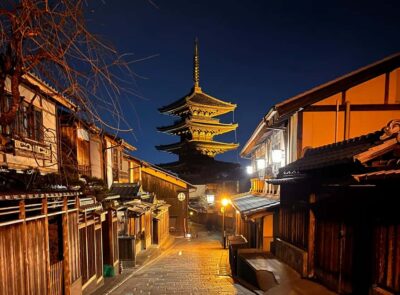
Gion Magical Night Walking Tour with Geisha Trivia
Read our review →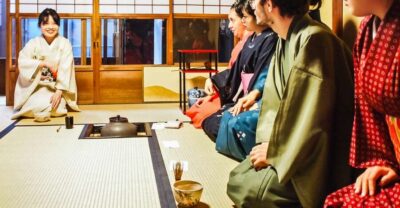
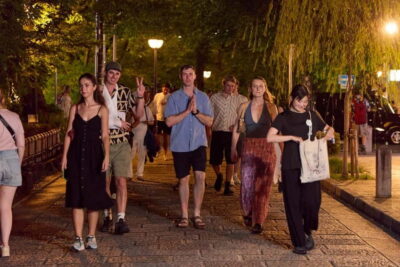
Gion Geisha District Walking Tour – Stories of Geisha
Read our review →Browse the lists this tour appears in