
Reviewed · KYOTO TOURS
Kyoto Half Day Highlights Tour
Kyoto’s best-known sights are spread across the city, but this 3.5-hour walking tour links several of them in one tidy afternoon. You move from Gion’s old streets to Kiyomizu-dera, then finish beneath the orange torii gates of Fushimi Inari.
I like the route for two clear reasons: the small maximum of 12 people keeps it personal, and the guide adds useful context about geisha, Shinto customs, Buddhism, and local history. I also like ending at Fushimi Inari, where you can continue walking or catch a train from either nearby station.
The tradeoff is simple: this is a brisk sightseeing walk, not a gentle bus tour. You’ll spend about an hour at Fushimi Inari and walk on slopes, stone lanes, and shrine paths, so comfortable shoes and reasonable fitness matter. The 3 pm start also means you should plan the rest of your day around it.
Key points about this Kyoto afternoon walk
- Gion to Fushimi Inari in one route: You see Kyoto’s old entertainment district, Higashiyama temples, and one of Japan’s most famous shrines without arranging several separate visits.
- A genuine small-group format: The tour accepts no more than 12 people, which gives you a better chance to hear the guide and ask questions.
- Mari and Marie are named guides: Guide commentary covers geisha culture, Shinto shrines, Buddhism, customs, and the meaning behind the major sights.
- Kiyomizu-dera admission is included: You do not need to buy that entrance ticket separately during the tour.
- Fushimi Inari is the finale: You finish at the shrine in front of its famous torii gates, close to Fushimi Inari JR and Keihan railway stations.
- Bring shoes for real walking: The route includes hills, stone-paved lanes, temple grounds, and shrine paths, with public transportation costing an additional ¥220 per person.
Why this route works for a short stay in Kyoto
Kyoto can be awkward to plan. Its famous places are not gathered around one central square, and the city’s narrow lanes can turn a simple sightseeing day into a string of map checks and missed turns. This tour solves part of that problem by connecting Gion, Higashiyama, Kiyomizu-dera, and Fushimi Inari in a single afternoon.
You begin at Gion-Shijo Station at 3 pm and finish at Inari Station. That point-to-point design is useful. You do not have to return to the starting area, and you end beside two railway options for your next stop.
The route is also well chosen for first-time visitors. Gion gives you Kyoto’s traditional streets and geisha associations. Kiyomizu-dera supplies the large temple setting and city views. Fushimi Inari closes the tour with its long corridors of orange torii gates. Together, the stops give you a broad first look at Kyoto rather than repeating the same kind of attraction.
The price is $50 per person. For a private guide, that would be a different calculation, but for a small group this is fair value if you want explanation and organization. You are paying not only to see the sites, but also to avoid planning the route yourself. Kiyomizu-dera admission is included, while public transportation is listed separately at ¥220 per person. Snacks are also your responsibility.
A few more Kyoto half-days to weigh up
- PERFECT KYOTO 1-Day Bus Tour
★ 5.0 · 13,518 reviews - Kyoto: Fushimi Inari, Kinkakuji, Bamboo Grove 1 Day Bus Tour
★ 4.8 · 4,316 reviews - Kyoto: Tea Ceremony in a Traditional Tea House in Kiyomizu
★ 4.9 · 3,519 reviews
Gion at 3 pm, where Kyoto sets the tone
The meeting point is outside Gion-Shijo Station, at 1 Chome Miyagawasuji in Higashiyama Ward. Arriving a little early is sensible, since the tour begins at a busy part of town and the group needs to gather before walking.
The first 30 minutes take you through Gion, Kyoto’s famous geisha district. Expect a leisurely introduction rather than a long museum visit. The value here is the guide’s explanation of the district’s customs and history, which can help you understand what you are seeing without treating the area as a stage set.
Gion is best approached with care. It is a working neighborhood, not a theme park. Stay with the group, listen to local guidance, and keep photography respectful. The tour gives you a useful orientation to the streets, but it is not designed as a detailed geisha performance or entertainment program.
This opening section also lets the guide set up themes that return later: the difference between Shinto and Buddhism, the role of shrines and temples, and how Kyoto’s old districts have changed over time. Guides Mari and Marie are specifically associated with friendly, lively explanations, local stories, and practical help with photographs.
Yasui-Konpiragu and its unusual stone passage
The group then spends about 10 minutes at Yasui-Konpiragu Shrine. This is a short stop, but it adds a different flavor to the route. The shrine is known for its power stone and the symbolic passageway through it.
You will not have time for a long, quiet visit here. Think of it as a focused introduction to a place with a distinctive ritual tradition. The guide can explain what the stone represents and why people pass through it, giving meaning to what might otherwise seem like an unusual object in a small shrine ground.
The short visit works well in a half-day schedule. It breaks up the walk from Gion toward the larger Higashiyama sights without taking time away from Kiyomizu-dera or Fushimi Inari. If you prefer slow photography or extended personal prayer at each stop, though, the fixed pace may feel quick.
Hokan-ji Temple and Kyoto’s famous Yasaka Pagoda
Next comes Hokan-ji Temple, better known as Yasaka Pagoda. You have about 10 minutes here, enough to appreciate the five-story structure and its place in the surrounding streets.
The pagoda rises 46 meters and is described as the last remaining structure from a sixth-century temple complex. That fact gives the stop weight, especially when your guide places the building within Kyoto’s long religious history.
This is mainly an exterior and neighborhood viewing stop in the stated program. Do not expect a lengthy temple visit. Its strength is visual: the pagoda provides one of Higashiyama’s clearest old-Kyoto scenes, with traditional streets leading toward the larger temple complex.
The brief timing is a fair compromise. Hokan-ji adds a strong image and useful historical context, while the tour keeps moving toward Kiyomizu-dera. If Yasaka Pagoda is your personal priority, you may want to return later on your own for more time.
Same base, a completely different sort of day:
- Kyoto Geisha Walking Tour: Gion District & Hidden Gems
★ 4.7 · 3,273 reviews - Kyoto: Tea Ceremony Ju-An at Jotokuji Temple
★ 4.9 · 3,207 reviews - Kyoto: Gion Magical Night Walking Tour with Geisha Trivia
★ 4.9 · 2,393 reviews - Kyoto: 45-Minute Tea Ceremony Lesson Experience
★ 4.3 · 2,378 reviews
Sannenzaka and Ninenzaka, the prettiest part of the walk
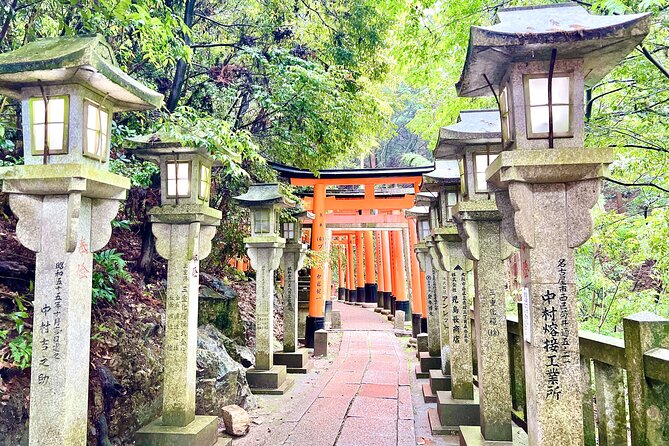
The route continues for about 20 minutes along Sannenzaka and Ninenzaka, two historic stone-paved slopes leading toward Kiyomizu-dera. These lanes are lined with traditional buildings and shops, making the walk feel more like old Kyoto than a standard city transfer.
This section is one of the tour’s most rewarding stretches because the route itself becomes part of the experience. You are not simply being delivered to a temple entrance. You approach it through narrow lanes and rising streets that show how the Higashiyama district connects homes, shops, shrines, and temples.
There is a practical catch. Stone paving and slopes can be tiring, especially in Kyoto’s humidity. Wear supportive shoes, and do not count on the walk being flat. The tour description calls for moderate physical fitness, which is an accurate warning rather than a dramatic one.
The lanes can also be crowded, and the group’s movement may be slower than your own. That is the price of seeing one of Kyoto’s most popular historic areas at street level. Your guide’s local commentary helps turn the walk into more than a pretty photo stop.
Kiyomizu-dera, the main temple visit
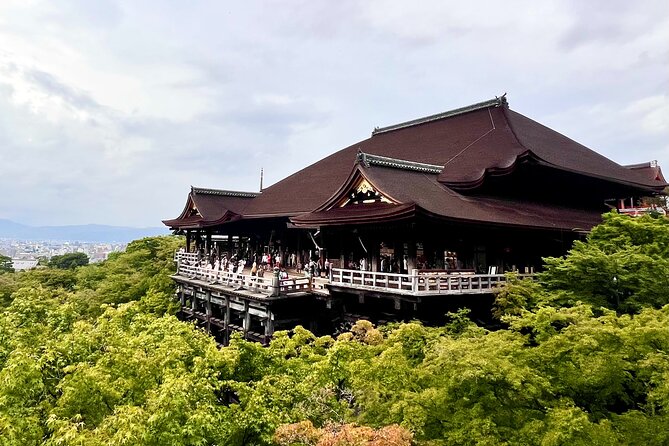
You spend about 45 minutes at Kiyomizu-dera, with admission included. This is the longest temple stop before Fushimi Inari and one of the central reasons to choose the tour.
Kiyomizu-dera is famous for its large wooden terrace and broad views over Kyoto. The grounds also include pagodas and sacred waterfalls, with traditions connected to the water. A guide is especially useful here because the complex contains several layers of religious meaning that are easy to miss when you are focused only on the terrace.
Forty-five minutes gives you time to see the key areas and take photographs, but it is not enough for every corner. You should think of this as a well-organized introduction, not a complete study of the temple grounds. If you already know Kiyomizu-dera well, the stop may feel short. If it is your first visit, the focused approach helps you see the essentials without losing the afternoon.
The included admission improves the value of the $50 price. It is one less line and one less decision during a busy day. Just remember that other costs, including the listed ¥220 transportation charge and any snacks, are not covered.
Fushimi Inari’s orange torii gates
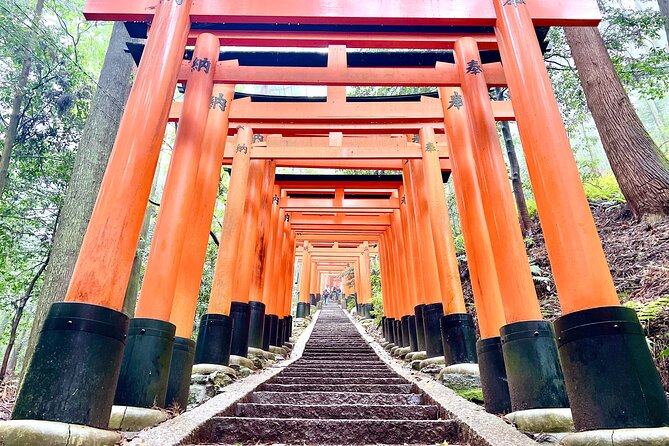
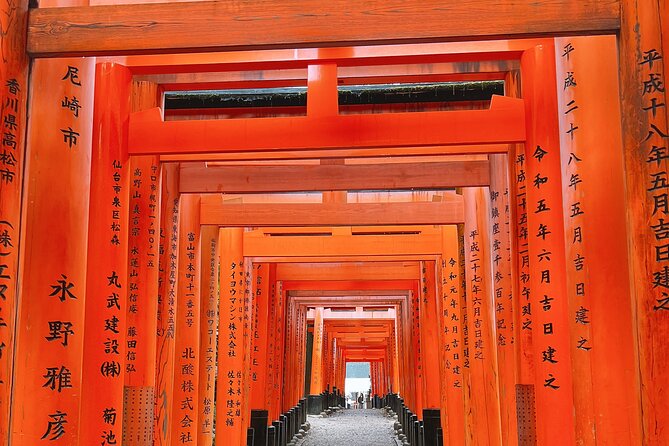
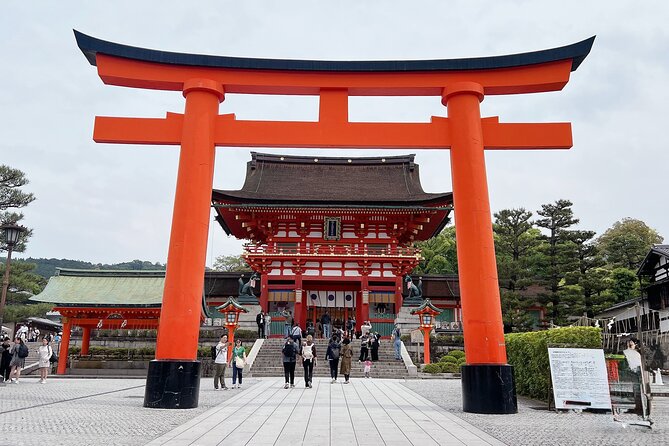
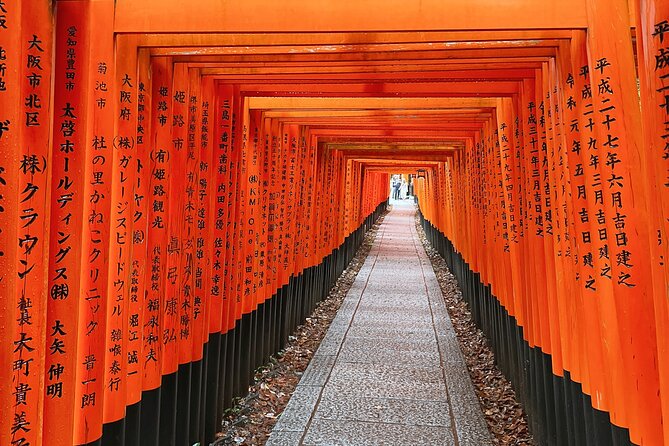
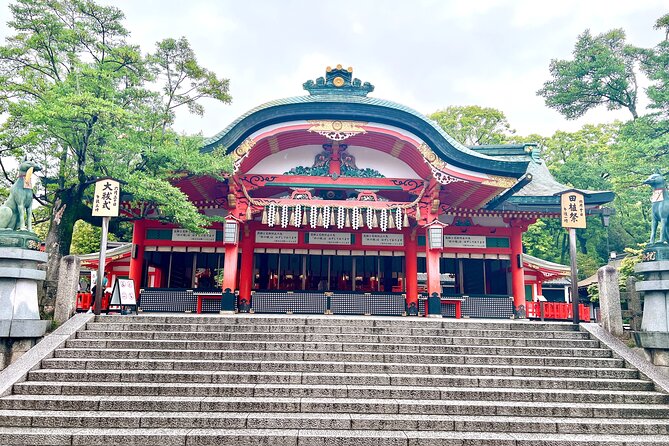
The final stop is Fushimi Inari-taisha Shrine, where the tour spends about an hour. The shrine is dedicated to the god of rice and prosperity and is known for its thousands of orange torii gates, which form long tunnels along the mountain paths.
This ending gives the tour its strongest visual moment. The gates create a winding route that changes as you climb, and the guide can explain their religious meaning and the role they play at the shrine. You get much more from the scene when you understand that the gates are not simply decorative arches.
An hour lets you enter the torii route and experience its atmosphere, but it does not mean you will walk the entire mountain trail. The paths continue upward, and you can decide how far to go within the time available. The guide’s pace and the group’s needs will shape how much you see.
Fushimi Inari is also a smart place to finish. The endpoint is in front of the shrine, near Fushimi Inari JR Station and the Keihan Line station. You can continue exploring from there or take a train onward. Unlike a tour that returns you to its starting point, this route leaves you in a useful part of southern Kyoto.
What the guide adds to the experience
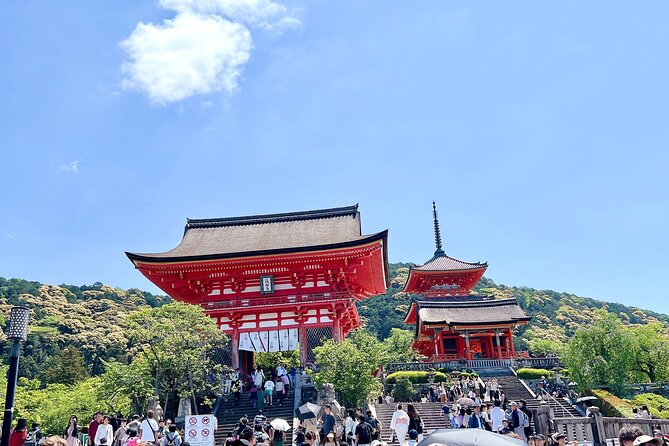
The guide is the main reason to book this instead of copying the route from a map. Mari, also referred to as Marie in the tour feedback, is credited with clear explanations, humor, local facts, and good photographs. Another guide name, Maricel, appears in the tour information connected with a longer personalized Kyoto outing, so the exact guide for your date may vary.
The strongest subject areas are geisha culture, Shinto shrine practice, Buddhism, local customs, and the meaning of the major sites. That mix matters because Kyoto often places a Buddhist temple and a Shinto shrine only a short walk apart, yet they serve different religious traditions.
A guide can also make the experience less rigid. The tour information describes adjustments to suit participants, and one account notes help after a late arrival caused by travel problems. You should not assume unlimited flexibility, but the guide’s ability to respond to the group is a useful feature.
The small-group cap of 12 is important here. At a larger size, explanations at shrine gates and temple grounds can become hard to hear. A group of 12 is still large enough to have a social feel, but small enough for questions and occasional help with photos.
Timing, weather, and the physical demands
The 3 pm start gives you a free morning and early afternoon. That works well if you want to visit another Kyoto sight first, but you need to leave enough time to reach Gion-Shijo Station. Confirmation is sent when you book, and the meeting point is close to public transportation.
The tour requires moderate fitness. You will walk through Gion, climb or descend sloped stone streets in Higashiyama, cross temple grounds, and follow paths at Fushimi Inari. Kyoto’s humidity can make the walk feel harder than the distance suggests, so carry water and wear shoes you trust.
The activity requires good weather. If poor weather cancels it, you are offered another date or a full refund. You can cancel for a full refund up to 24 hours before the 3 pm start, but cancellations or changes inside that window are not refunded or accepted.
Who should book this half-day tour
I would recommend it most strongly to first-time Kyoto visitors, people with only one or two days in the city, and solo visitors who want company without joining a huge group. It also suits anyone who prefers stories and local explanation to reading several guidebooks on the move.
It is a good fit for travelers who want the major Higashiyama sights but do not want to manage the route alone. The finish at Fushimi Inari is especially useful if you plan to continue by train afterward.
I would think twice if you dislike walking, need a very slow pace, or want long independent time at every temple. The schedule is efficient by design. You see a lot, but the short stops at Yasui-Konpiragu and Hokan-ji leave little room for lingering.
Should you book the Kyoto Half Day Highlights Tour?
Book it if you want a compact introduction to Kyoto with a real person explaining what you see. The combination of Gion, Kiyomizu-dera, and Fushimi Inari is strong, the group is capped at 12, and the included Kiyomizu-dera admission helps justify the $50 cost.
Skip it if you already know these districts or want to explore each site at your own speed. For everyone else, this is a practical first-day route: arrive at Gion, follow the old streets uphill, visit one major temple, and finish beneath Fushimi Inari’s famous torii gates.
FAQ
How long is the Kyoto Half Day Highlights Tour?
The tour lasts approximately 3 hours and 30 minutes.
What time does the tour start?
The tour starts at 3 pm local time.
Where does the tour begin?
The meeting point is Gion-Shijo Station, at 1 Chome Miyagawasuji in Kyoto’s Higashiyama Ward.
Where does the tour finish?
The tour ends in front of Fushimi Inari Shrine, near Fushimi Inari JR Station and the Keihan Line station.
Which major sights are included?
The route includes Gion, Yasui-Konpiragu Shrine, Hokan-ji Temple and Yasaka Pagoda, Sannenzaka and Ninenzaka, Kiyomizu-dera Temple, and Fushimi Inari-taisha Shrine.
Is admission included?
Admission to Kiyomizu-dera is included. The other listed stops have no admission ticket charge.
Is public transportation included?
No. Public transportation is listed separately at ¥220 per person.
How many people can join the tour?
The maximum group size is 12 people.
How much walking is involved?
The tour includes walking through Gion, along stone-paved slopes in Higashiyama, through temple grounds, and on the paths at Fushimi Inari. A moderate level of physical fitness is recommended.
What happens if the weather is poor?
The experience requires good weather. If it is canceled because of poor weather, you can choose another date or receive a full refund.
Just added around Kyoto
- Kyoto: Zen Meditation at a Private Temple with a Monk★ 5.0 · 25 reviews
- Kyoto: Gion Geisha District & Sake-in-Hand Walking Tour★ 5.0 · 37 reviews
- Private Pewter Sake Cup Experience with a Kyoto Artisan★ 5.0 · 31 reviews
- Your Private Vacation Photography Session In Kyoto★ 5.0 · 110 reviews
- Private Guided Traditional Buddhist Cooking in Japan★ 5.0 · 16 reviews
- Kyoto Wagashi(Japanese sweets) Cooking Class near Fushimiinari★ 5.0 · 60 reviews
- Traditional Japanese Music show & Experience Tour in Kyoto★ 5.0 · 57 reviews
- Kyoto:Family-Friendly Kimono & Yukata Experience at WARGO★ 5.0 · 147 reviews
Kyoto Tours, compared.


Fushimi Inari, Kinkakuji, Bamboo Grove 1 Day Bus Tour
Read our review →
Tea Ceremony in a Traditional Tea House in Kiyomizu
Read our review →
Kyoto Geisha Walking Tour: Gion District & Hidden Gems
Read our review →

Gion Magical Night Walking Tour with Geisha Trivia
Read our review →
