
Reviewed · KYOTO TOURS
Kyoto Private Tea Ceremony at a Japanese Inns
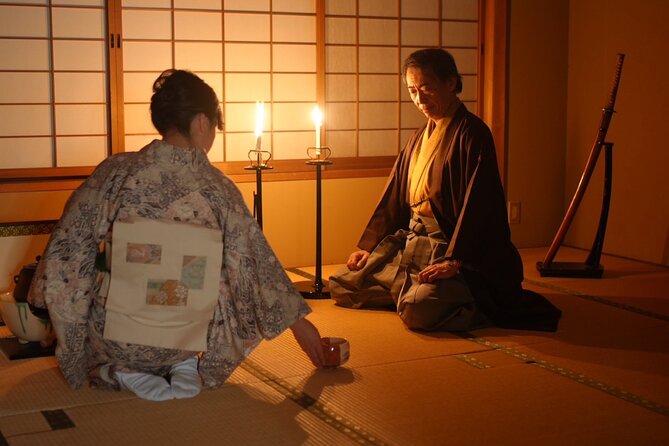
Candlelight, formal kimono, a quiet Zen pause, and a bowl of freshly whisked matcha make this more than a quick cup of tea. You enter a normally closed 20-tatami banquet room at a long-established Kyoto inn, where the darkened setting gives the ceremony a calm, almost theatrical feel.
I like the way the experience mixes participation with observation. You watch a tea ceremony, then make your own matcha. I also like the practical use of translation devices, which lets children and adults ask questions in their own language. The main consideration is time: at about 59 minutes, this is a compact introduction rather than a full study of tea culture.
Key points at a glance
- Candlelit Kyoto setting: The activity takes place after dark in a private room at a traditional inn, away from the crowds at Kyoto’s major temples.
- A complete 59-minute program: The schedule includes 15 minutes of kimono photos, 4 minutes of Zen meditation, 20 minutes of demonstration, and 20 minutes of matcha whisking.
- Matsuda and Mayumi lead the experience: Their warm, welcoming style is a major part of the evening, with licensed guide support included.
- Private groups of two to six: You share the room only with your own party, making this a good choice for couples and families.
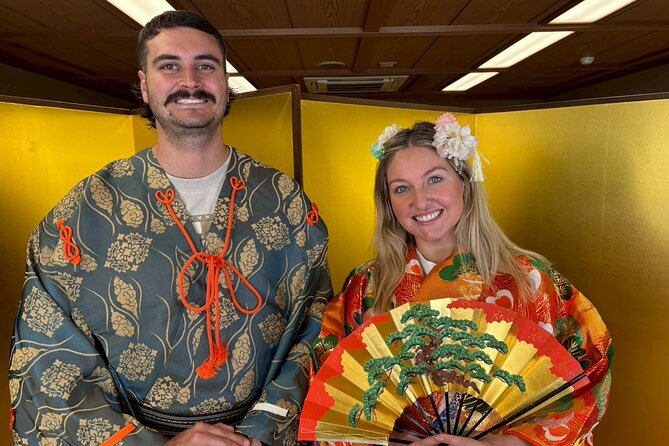
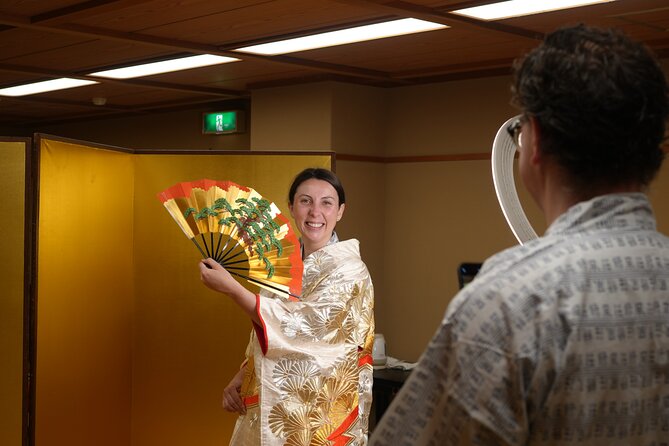
- Dress-up props add fun: You may wear a bridal uchikake or a men’s haori, with folding fans, swords, and professional lighting for photos.
- Language barriers are handled well: Translation devices are available, and no Japanese is required.
Entering a private Kyoto ryokan after dark
The meeting point is ZEN: Tea Ceremony Experience in Kyoto, at Ryofu-so, 490 Kanayacho, Shimogyo Ward, Kyoto 600-8323. The activity begins and ends there, and the location is near public transportation. You should allow a little extra time to find the building and reach the fourth floor, since this is a working inn rather than a large sightseeing attraction with a prominent street entrance.
The setting matters. Kyoto has plenty of daytime temple visits, but this experience gives you something different after the popular sights have closed. Instead of moving from one famous site to another, you spend the evening inside a room that is normally not open to the public.
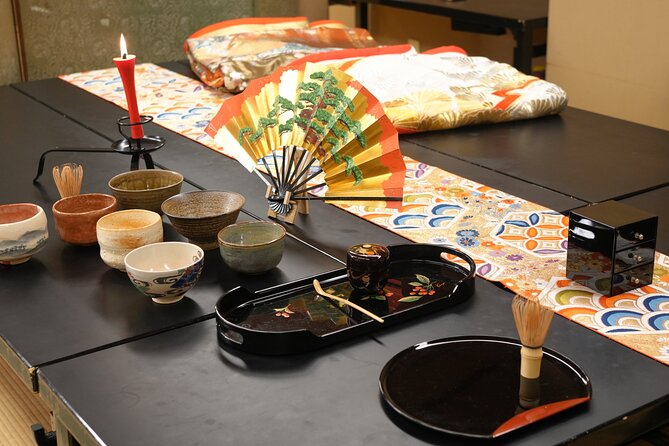
The 20-tatami room provides a traditional backdrop without asking you to commit to a long formal lesson. Tatami floors, low seating, tea utensils, and candlelight create the mood. The room is described as pitch dark apart from the candlelight, so the atmosphere is quiet and carefully staged.
That darkness may not suit everyone. If you prefer bright rooms, casual conversation, or a fast-moving activity, the tone may feel too solemn. For many people, though, the contrast with Kyoto’s busy sightseeing streets is the point.
More Tea Ceremonies in Kyoto
- Kyoto: Tea Ceremony in a Traditional Tea House in Kiyomizu
★ 4.9 · 3,519 reviews - Kyoto: Tea Ceremony Ju-An at Jotokuji Temple
★ 4.9 · 3,207 reviews - Kyoto: 45-Minute Tea Ceremony Lesson Experience
★ 4.3 · 2,378 reviews
Kimono, haori, and a 15-minute photo session
The first part lasts about 15 minutes and focuses on dressing up and taking photographs. Depending on your group, you can wear a bridal uchikake or a men’s haori. Props include folding fans and swords, and staff assist with the photography using professional lighting.
This is not simply a quick costume change before the main event. The photo session gives you a visual record of the evening and helps children take part right away. It also gives the hosts a chance to introduce the room, the clothing, and the tools used during the ceremony.
Families should pay attention to this feature. The experience is private, and the photo props offer younger participants something active to do before the quieter meditation and tea portions begin. The available feedback specifically points to children being able to ask questions through the translation device, which makes the program more workable for mixed-language families.
The clothing is also a useful way to see how formal Japanese presentation differs from ordinary sightseeing. A bridal uchikake is a particularly ornate choice, while the haori offers a simpler option for men. The information does not state that every participant receives a full traditional kimono dressing service, so you should think of this as a guided costume and photo segment rather than a full-day kimono rental.
Photos are welcome throughout the activity. Staff help with photography, which means you do not need to rely only on hurried selfies. Still, the room is candlelit, and the mood favors posed, atmospheric pictures rather than a large number of bright snapshots.
A four-minute Zen pause before the tea
The Zen meditation lasts about four minutes. That may sound brief, but the short length is practical. It gives you a moment to settle down without turning the activity into a serious meditation class.
You sit in the traditional room, quiet your attention, and prepare for the tea demonstration. The pause also helps explain the design of the program: the evening moves from playful dress-up to stillness, then from watching to making.
I would treat this as a reset rather than a lesson in Zen practice. The details of the meditation are not specified, so you should not expect an extended teaching session or a historical lecture. Its value is in the transition. After the photographs, a few silent minutes make the tea ceremony feel more focused.
This part may be easiest for adults and older children who can remain quiet for a short period. Younger children can still participate, but the experience works best when everyone understands that the room will become calm and formal for a few minutes.
Watching the 20-minute tea ceremony

The central demonstration lasts about 20 minutes. You are welcomed as a guest, watch the preparation and presentation, receive a bowl of matcha, and see how a traditional tea gathering unfolds.
For first-time visitors, this is the part that supplies cultural context through action. Tea ceremony is not only about the flavor of powdered green tea. The gestures, pacing, placement of utensils, and way a guest receives the bowl all carry meaning. A short demonstration cannot cover every school or rule, but it can show you why the ritual feels different from making tea at home.
Matsuda and Mayumi are the hosts named for this experience. Their approach is friendly and open, with translation equipment available to support questions. That combination is important because tea ceremony can seem mysterious if you cannot ask what is happening.
You do not need Japanese. The latest translation devices are used to help communication across languages, and the licensed guide is included. This will not replace every nuance of a live conversation, but it lowers the barrier for visitors who would otherwise be unsure when to bow, how to hold the bowl, or what each step means.
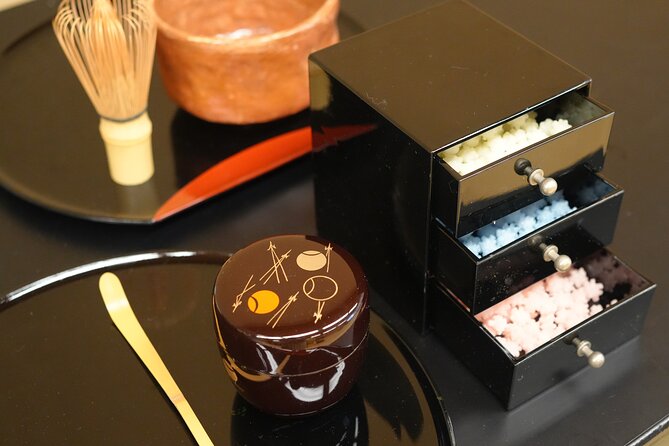
The bowl of matcha comes with sweets. The sweet is not just an extra snack. In the traditional sequence, it helps balance the tea’s bitter edge and gives you a small taste of the relationship between food, timing, and hospitality.
The demonstration is formal, but the private format should make it less intimidating than joining a large group. Your party has the room to itself, with two to six people in total. That privacy gives you more room to ask questions and take photographs without worrying about a crowded audience.
Same base, a completely different sort of day:
- PERFECT KYOTO 1-Day Bus Tour
★ 5.0 · 13,518 reviews - Kyoto: Fushimi Inari, Kinkakuji, Bamboo Grove 1 Day Bus Tour
★ 4.8 · 4,316 reviews - Kyoto Geisha Walking Tour: Gion District & Hidden Gems
★ 4.7 · 3,273 reviews - Kyoto: Gion Magical Night Walking Tour with Geisha Trivia
★ 4.9 · 2,393 reviews
Making your own matcha for 20 minutes
After watching, you get to whisk your own matcha. This portion lasts about 20 minutes, making it nearly as long as the demonstration itself.
That balance is one of the activity’s strongest features. You do not simply observe a cultural ritual from the side. You handle the utensils, whisk the powder, and see how much effort it takes to produce the fine foam associated with matcha.
The hosts can guide you through the process using the translation devices. Expect the first bowl to be more about learning than perfection. The motion, speed, and amount of water affect the result, and the process gives you a better understanding of why matcha preparation is treated with care.
This hands-on section also makes the activity more suitable for people who want a cultural experience rather than a photo opportunity alone. The photos are memorable, but making the tea gives the evening a practical center.
The information does not specify how much matcha each person receives or whether you make multiple bowls, so do not book this expecting a full tea school workshop. You are receiving an accessible introduction, with enough time to try the basic technique and enjoy the result.
What the private format changes
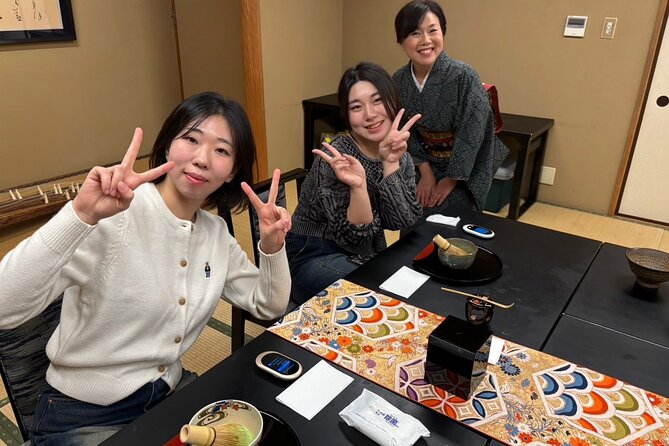
The group size is limited to two to six people, and only your own group takes part. This is a meaningful difference from a public demonstration. You can focus on the hosts, ask questions, and pose for photographs without strangers filling the room.
For couples, the quiet setting and evening schedule make this a natural special-occasion activity. For families, the costume props, sweets, and hands-on matcha session add variety. It also suits friends who want a short cultural stop between dinner and other evening plans.
The private format does come with a higher price than a simple tea tasting. The listed price is $97.98 per person, while the stated local rates are ¥15,000 for adults and ¥3,000 for children under 15. Since those figures do not match exactly, check the final amount and child pricing at booking.
For an adult, the value depends on what you want. If you only want to drink matcha, the cost is high. If you want a private room, costumes, professional lighting, a guided ceremony, translation support, sweets, and a hands-on preparation session, the price becomes easier to justify.
Children receive a much lower stated price, which can make the activity more appealing for families. Remember that the program still includes a formal four-minute meditation and a quiet ceremony, so the best fit is a child who can take part respectfully for an hour.
Why the candlelight setting matters
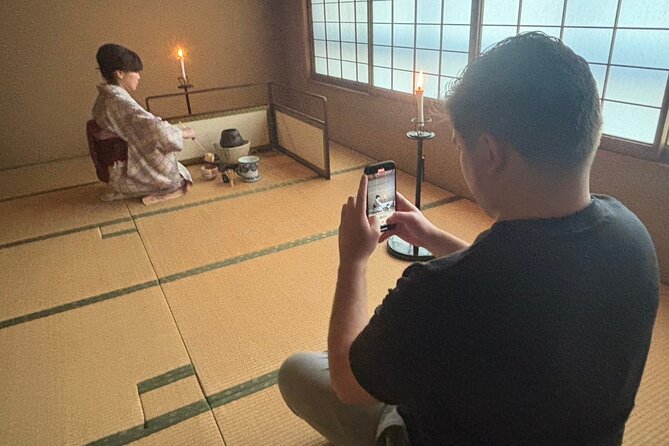
Kyoto’s best-known temples are daytime sights, and many close at night. This activity fills a different space in your schedule. You are not seeing a temple lit up or walking through a nighttime garden. You are entering a traditional room and using darkness, candlelight, and silence to change your sense of time.
The candlelight is atmospheric, but it also has practical consequences. Photos may have a softer, darker look, and the room may feel more ceremonial than a bright studio. If you want clear, evenly lit images, the professional lighting used during the photo session should help, but the overall experience remains intentionally subdued.
I like this kind of evening activity because it does not try to compete with Kyoto’s major sights. It offers a small window into Japanese hospitality, ritual, and presentation. You leave with a better idea of how a tea gathering works, rather than simply another checklist photograph outside a famous building.
Booking, timing, and cancellation details
The activity lasts approximately 59 minutes and is booked, on average, eight days in advance. That advance pattern suggests you should reserve ahead if your Kyoto schedule is tight, especially since the experience requires advance reservations and accepts only small private groups.
You receive confirmation at booking, and the ticket is mobile. The activity starts and ends at the same Kyoto address, with no separate drop-off point.
Free cancellation is available up to 24 hours before the local start time for a full refund. Cancellations or changes made within 24 hours are not accepted and are not refunded. The activity may also be canceled for poor weather or if the minimum number of participants is not reached. In those cases, you are offered another date or experience, or a full refund.
The weather rule is worth noting even though much of the activity takes place indoors. Keep your plans flexible until the cancellation period has passed.
Who should book this Kyoto tea experience?
I would recommend it to first-time visitors who want a manageable introduction to tea ceremony without spending half a day in a formal class. It is also a strong pick for couples, families, and small groups who value privacy and photographs.
The activity is especially useful if you have already spent the day at Kinkaku-ji, Ginkaku-ji, or Kiyomizu-dera and want an evening cultural experience that does not involve another crowded attraction. The contrast between busy sightseeing and a dark, quiet tatami room is part of the appeal.
You should think twice if you want a detailed history of tea ceremony, a long meditation course, or advanced instruction in matcha preparation. The 59-minute schedule moves quickly, and each section is designed as an introduction.
The hosts’ warmth is one of the strongest reasons to book. Matsuda and Mayumi are described as kind, friendly, and eager to explain the details. The translation devices also make this a practical choice for families whose children do not speak English, since questions can be asked in the participant’s own language.
Should you book it?
Book this experience if you want a private, atmospheric introduction to Kyoto culture with equal parts watching, dressing up, and participation. The candlelit ryokan room, kimono photographs, Zen pause, sweets, and matcha whisking offer much more than a basic tea tasting.
Skip it if your main goal is an in-depth tea ceremony course or the lowest possible price. At $97.98 per person, the value comes from the full package and the private setting. For a memorable evening with friendly hosts, language support, and a hands-on finish, it is a well-rounded choice.
FAQ
Where does the tea ceremony take place?
It takes place at ZEN: Tea Ceremony Experience in Kyoto, located at Ryofu-so, 490 Kanayacho, Shimogyo Ward, Kyoto 600-8323. The activity uses a private 20-tatami room on the fourth floor.
How long does the experience last?
The experience lasts approximately 59 minutes. The schedule includes 15 minutes for kimono dressing and photos, 4 minutes of Zen meditation, 20 minutes of tea ceremony demonstration, and 20 minutes of matcha whisking.
Do I need to speak Japanese?
No. Translation devices are available, and no Japanese is required. The activity also includes a licensed guide.
How many people can join a private group?
The private activity is available for groups of two to six people. Only your own group participates.
Is matcha included?
Yes. The experience includes matcha green tea and sweets. You also make your own matcha during the 20-minute whisking session.
Can I cancel for a full refund?
Yes. You can cancel at least 24 hours before the local start time for a full refund. Cancellations or changes within 24 hours are not accepted and are not refunded.
Just added around Kyoto
- Kyoto: Zen Meditation at a Private Temple with a Monk★ 5.0 · 25 reviews
- Kyoto: Gion Geisha District & Sake-in-Hand Walking Tour★ 5.0 · 37 reviews
- Private Pewter Sake Cup Experience with a Kyoto Artisan★ 5.0 · 31 reviews
- Your Private Vacation Photography Session In Kyoto★ 5.0 · 110 reviews
- Private Guided Traditional Buddhist Cooking in Japan★ 5.0 · 16 reviews
- Kyoto Wagashi(Japanese sweets) Cooking Class near Fushimiinari★ 5.0 · 60 reviews
- Traditional Japanese Music show & Experience Tour in Kyoto★ 5.0 · 57 reviews
- Kyoto:Family-Friendly Kimono & Yukata Experience at WARGO★ 5.0 · 147 reviews
Kyoto Tours, compared.


Fushimi Inari, Kinkakuji, Bamboo Grove 1 Day Bus Tour
Read our review →
Tea Ceremony in a Traditional Tea House in Kiyomizu
Read our review →
Kyoto Geisha Walking Tour: Gion District & Hidden Gems
Read our review →

Gion Magical Night Walking Tour with Geisha Trivia
Read our review →

Gion Geisha District Walking Tour – Stories of Geisha
Read our review →Browse the lists this tour appears in