
Reviewed · TOKYO TOURS
Tokyo: Asakusa Walking Tour with Japanese Comedian
Asakusa is more than Tokyo’s famous red gate and giant temple. On this small-group walk with Ryo, you get the local story behind the sights, plus the unusual perspective of a Japanese standup comedian who spent six years driving rickshaws in the district. His route also includes a free view of Asakusa from a nearby building before you reach Senso-ji.
I like two things here. First, Ryo explains how Buddhist and Shinto traditions exist side by side, a useful key to understanding Japanese religious life. Second, he points out statues, side temples, and cultural details that are easy to pass without a guide. The main consideration is pace: at 90 minutes, this is a focused introduction, not a slow temple study or a food-and-shopping tour.
At a glance: what makes this walk useful
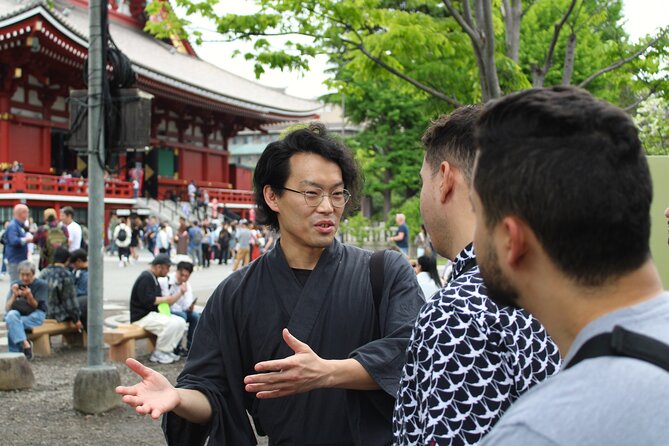
- Ryo’s double perspective: You get a guide with six years of experience working in Asakusa as a rickshaw driver, along with his experience as an English-speaking comedian.
- A free high view before the temple: The route includes a view of Asakusa from the top of a nearby building, with Tokyo Skytree and the Asahi Beer Company among the early landmarks.
- Buddhism beside Shinto: Asakusa Shrine and Senso-ji sit close together, giving Ryo a practical setting for explaining how the two traditions differ and overlap in Japan.
- More than the headline sights: The walk includes smaller temples, shrines, and Buddhist statues that you could easily overlook on your own.
- A compact group: Numbers are limited to eight people, so you have a better chance to ask questions than on a large coach-style tour.
- A clear finish at Senso-ji: The walk ends at the temple’s main hall, leaving you in a good position to continue exploring on your own.
Meeting Ryo beside the Sumida River
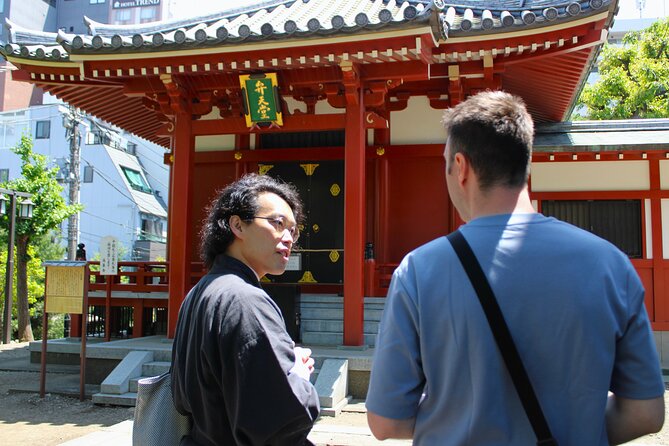
The walk begins in front of Tokyo Cruise, the water-bus station near Asakusa Station on the Tokyo Metro Ginza Line. The meeting point is only a one- or two-minute walk from the station, but you should still arrive five minutes early. The tour starts on time and does not wait for late arrivals.
This location puts you near the Sumida River and Sumida Park, a sensible starting point for a district shaped by both water and commerce. Ryo first helps you get oriented, pointing out major sights such as Tokyo Skytree and the Asahi Beer Company. These early landmarks matter because Asakusa can feel like a cluster of unrelated streets when you first arrive. A guide who gives you a visual map at the start can make the rest of the walk easier to follow.
The nearby elevated view is one of the more useful touches. You can see Asakusa from above without paying an observation-deck fee, then head down into the temple district. The information does not identify the building, so do not expect a named attraction or a full skyline visit. Think of it as a quick orientation stop and photo opportunity.
More walking tours in Tokyo:
- Tokyo Tsukiji Fish Market Food and Culture Walking Tour
★ 5.0 · 3,184 reviews - Tokyo: Imperial Palace and Shogun Historical Walking Tour
★ 5.0 · 2,251 reviews - Tokyo: Shinjuku Local Bar and Izakaya Guided Walking Tour
★ 4.9 · 1,794 reviews
Sumida Park and the first look at Asakusa
Sumida Park offers a gentler opening than starting directly under Kaminarimon Gate. Ryo uses this part of the route to connect the modern city around you with the older temple quarter ahead.
You may already recognize Tokyo Skytree from photographs, but seeing it in relation to the low-rise streets and temple roofs of Asakusa gives the district more shape. The Asahi Beer Company building provides another easy landmark. These references are especially helpful if this is your first time in Tokyo and you are still learning how the city’s neighborhoods fit together.
The park stop is guided sightseeing rather than a long nature visit. The tour is only 90 minutes, so expect a short introduction, not a relaxed park stroll. If you want extensive photography time, you will need to return later.
Kaminarimon Gate and the symbols of Senso-ji
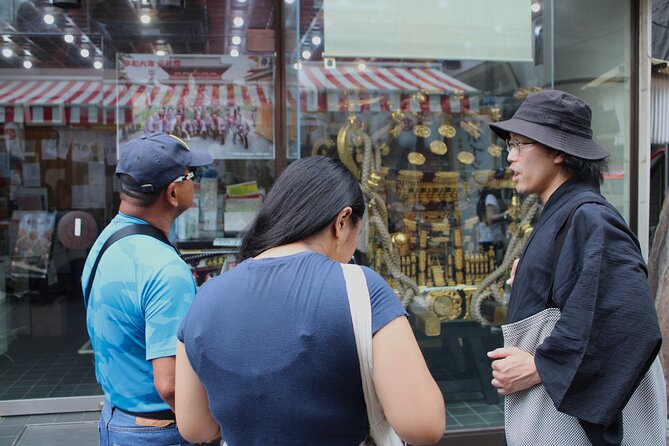
The route then reaches Kaminarimon, the Thunder Gate and one of Asakusa’s most recognizable sights. Its huge lantern makes an obvious photo stop, but Ryo’s explanation gives the gate more meaning than a quick picture can provide.
This is where a local guide earns the fee. You can walk through Kaminarimon alone, yet still miss why the entrance matters, how it relates to Senso-ji, and how the approach leads toward Nakamise Shopping Street. Ryo also uses illustrations later in the walk to explain the temple’s origin, so the experience is not limited to pointing at buildings.
Expect other people around the gate. It is a major Asakusa meeting point, and the tour does not promise a quiet visit. The benefit of joining a small group is that Ryo can keep the explanation personal and move you along without the delays of a large group.
Nakamise Shopping Street, with context before spending
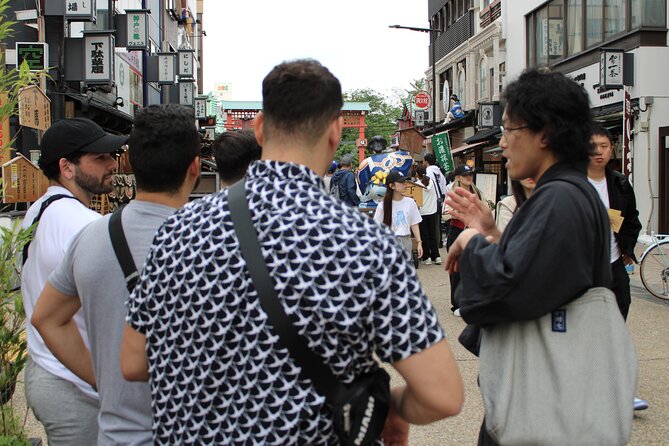
Nakamise Shopping Street runs toward Senso-ji and is lined with shops selling souvenirs, snacks, and traditional goods. The walk includes the street as a cultural stop, but it does not stop for food or shopping.
That detail is important. If you want to buy a melon pan, browse souvenirs, or linger over shop displays, plan to do it after the guided portion. Ryo can recommend places, and one participant particularly valued his suggestion for melon pan, but shopping is not built into the tour time.
I like this arrangement for visitors who want history first. Nakamise is more meaningful when you know that it is part of the approach to one of Tokyo’s oldest and best-loved temple sites, rather than simply a retail lane leading to a photo stop. Ryo explains the origin of Senso-ji with illustrations and describes how the temple received support from ordinary local people as well as powerful generals from different periods.
That social angle is useful. It shows that Senso-ji was not only a religious building protected by rulers. It was also tied to everyday life in Asakusa and to the people who kept returning to it.
A few more Tokyo half-days to weigh up
- Mt Fuji and Hakone 1-Day Bus Tour Return by Bullet Train
★ 5.0 · 26,383 reviews - 1-Day Tokyo Bus Tour
★ 5.0 · 14,250 reviews - Tokyo: TOKYO SKYTREE® Admission ticket
★ 4.5 · 11,192 reviews - Tokyo: teamLab Planets TOKYO Digital Art Museum Entry Ticket
★ 4.6 · 9,779 reviews
Asakusa Shrine beside Senso-ji
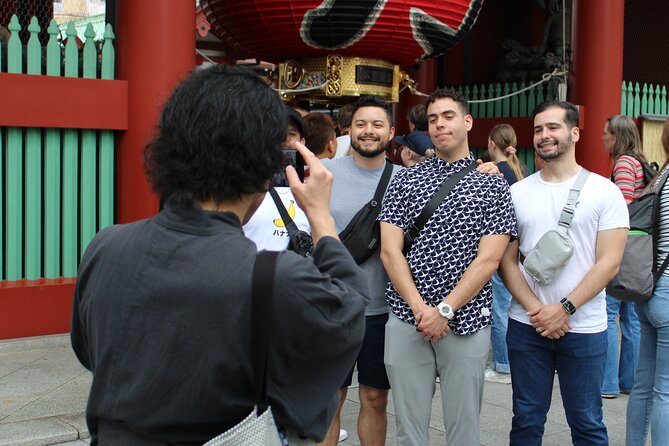
The most valuable cultural lesson comes from the close relationship between Asakusa Shrine and Senso-ji. Here you see a Shinto shrine beside a Buddhist temple, an arrangement that gives Ryo a natural way to explain Japanese religious practice.
You will not get a dry lecture about labels alone. The point is to understand that many Japanese people have lived with Buddhist and Shinto customs together, rather than treating them as completely separate parts of daily life. Seeing the two sites next to each other makes that idea easier to grasp.
Asakusa Shrine is also quieter in character than the massive Senso-ji approach. Ryo guides you through the site and adds cultural context, so you can notice the difference between the shrine and temple without trying to work it out from signs.
This stop suits you if you want more than a list of names. It gives the district a human scale and helps explain why Asakusa remains such an important place for local identity.
Buddhist statues and the smaller sacred sites
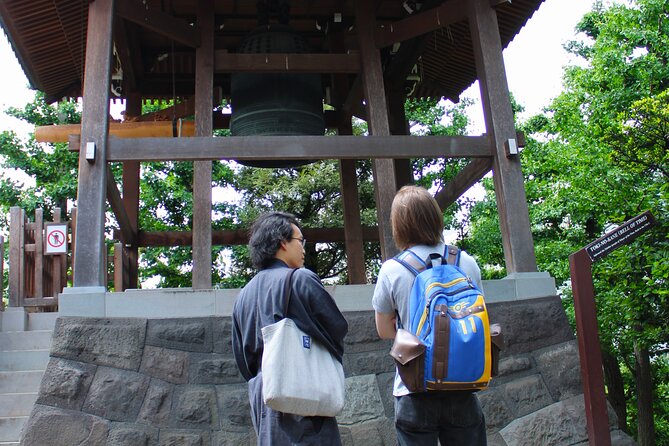
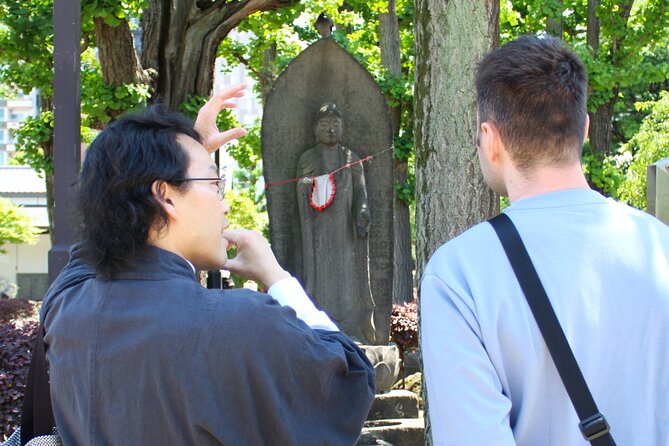
The tour does not rush only between Kaminarimon and the main hall. Ryo also takes you to smaller temples, shrines, and groups of Buddhist statues around the area.
These stops are valuable because they reward attention. The major gates are easy to find on any map, but the meaning of a statue or a modest side temple is harder to understand without someone explaining what you are seeing. Ryo introduces the significance of different Buddhist deities, giving you a way to read the religious details you will meet elsewhere in Japan.
This is also where his local work experience matters. Six years as an Asakusa rickshaw driver gave him time to observe the district and its visitors from street level. He is not presenting only a textbook version of the neighborhood. He can add the perspective of someone who has worked among its lanes and landmarks for years.
The tour’s strongest praise centers on this kind of explanation. People who want history and culture, rather than only photographs, are likely to get the most from the walk. Ryo has also been described as humble, friendly, and willing to answer questions, although one lower rating found him pleasant but not especially energetic as a guide. That is a fair warning if you want a highly theatrical performance from the comedian angle.
Senso-ji and the main hall finish
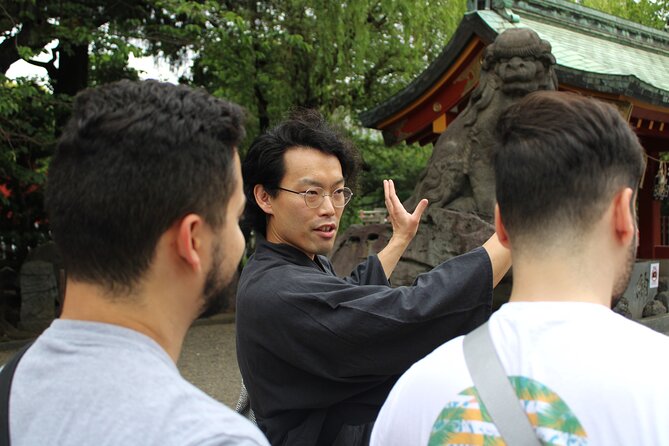
The final stop is Senso-ji, with the walk ending at the main hall. This gives you the right place to continue independently after the guide says goodbye.
Ryo’s explanation of the temple’s origin helps you see Senso-ji as more than Tokyo’s most famous Buddhist photo backdrop. He connects the building to the people and leaders who supported it through different periods, which adds useful depth to the visit.
You should remember that a 90-minute walk cannot cover every corner of the temple grounds. It gives you a framework: the gate, the shopping approach, the shrine, the surrounding sacred sites, and the main hall. You can then return to the places that caught your attention, shop along Nakamise, or explore nearby streets at your own pace.
One participant reported that the experience lasted about two hours, but the stated duration is 90 minutes. Treat 90 minutes as the planning figure, especially if you have a train reservation or another timed activity afterward.
How the comedian angle works
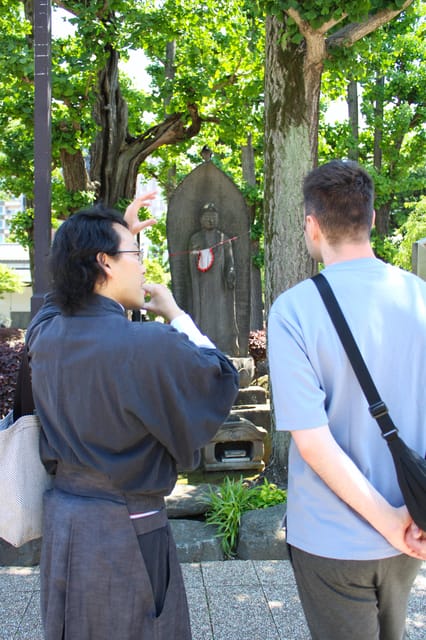
Ryo’s comedy background is not a promise of a nonstop standup show. The experience is primarily a cultural walking tour, with humor drawn from his career and his viewpoint as a local Japanese comedian.
That mix can make historical information easier to remember. A joke or personal observation may break up the sequence of gates, statues, and religious terms. It also gives you a chance to ask about Japanese culture in a less formal setting.
Still, comedy is subjective. Some people will enjoy the light touch, while others may prefer a guide who delivers a more polished performance. The strongest reason to book is Ryo’s local context and cultural explanation. Consider the humor a bonus rather than the central product.
Group size, access, and what to plan
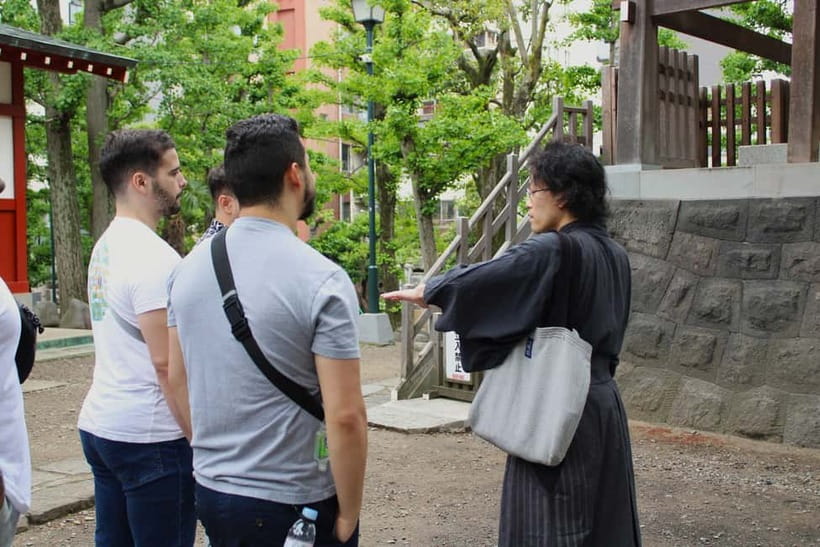
The group is limited to eight people. That is small enough to keep the walk manageable and should make it easier to hear Ryo and ask questions. It also means the tone can feel more like a conversation than a fixed speech.
The tour is wheelchair accessible, which is useful information for anyone checking route suitability. The walk includes public streets, temple grounds, shopping areas, and several stops, so you should still allow enough time to move comfortably between points.
English and Japanese are available. If you do not speak Japanese, the English option lets you ask about religious customs, local history, and practical recommendations without relying only on signs or written explanations.
The tour does not include hotel pickup. You meet at Tokyo Cruise and part ways at the main hall, so you are responsible for getting to the start and arranging your next stop. This is not a problem for most people because the meeting point is close to Asakusa Station, but it is worth building into your morning plan.
You can cancel up to 24 hours ahead for a full refund, and you can reserve now and pay later. Those terms are helpful if your Tokyo schedule is still shifting.
Is $31 a fair price for 90 minutes?
At $31 per person, this is not the cheapest way to see Kaminarimon and Senso-ji. You can walk through the main temple grounds for free. The question is what you want to buy with the extra money.
You are paying for structure, explanation, and access to a local point of view. Ryo adds historical background, explains the Buddhist and Shinto connection, identifies Buddhist deities, provides an elevated view, and offers recommendations for your later shopping. In a group of eight or fewer, that can be good value if you would otherwise spend time piecing the story together from signs and guidebooks.
The value is weaker if you already have a detailed plan for Asakusa and mainly want to photograph the same headline sights. One lower-rated experience made exactly that point: much of the route overlapped with places already planned, even though the guide did add information that would have been difficult to find alone.
I would see this as an orientation purchase. Book it early in your Tokyo stay, and you can use Ryo’s explanations and shop suggestions during the rest of your time in Asakusa. If you only have a short visit and want an independent walk, save the $31 and explore at your own speed.
Who should book this Asakusa walk?
I would recommend it most strongly to first-time visitors who want cultural context without committing to a long half-day tour. The route is compact, the meeting point is easy to reach, and the small group keeps the experience personal.
It also suits you if you enjoy asking questions. Ryo’s value comes through when he explains why a site matters, compares Buddhist and Shinto customs, or points out details you might otherwise pass. Families and mixed-age groups may appreciate the humor and short format, though the tour is still centered on walking and listening.
You may want another option if food tasting is your main goal. There is no scheduled food stop. The same goes for serious shoppers: Nakamise is included, but you are not given time to browse during the guided route.
Should you book it?
Book this tour if you want a clear introduction to Asakusa, a local guide with unusual experience, and more cultural explanation than you will get from simply following a map. Ryo’s strongest qualities are his local background, his ability to explain the temple and shrine relationship, and his attention to smaller religious details.
Skip it if you have already studied Asakusa, dislike fixed routes, or want a food-focused walk. Also keep your expectations realistic about the comedian element. You are booking a cultural tour led by a comedian, not a full comedy show.
For most first visits, $31 is a reasonable price for a compact orientation, especially when you use the rest of your day to return to the shops, temples, and views that interest you most.
FAQ
How long is the Asakusa walking tour?
The stated duration is 90 minutes. One experience lasted about two hours, but you should plan around the official 90-minute schedule.
Where does the tour begin?
Meet in front of Tokyo Cruise, the water-bus station near Asakusa Station on the Tokyo Metro Ginza Line. The meeting point is about a one- or two-minute walk from the station.
Where does the tour finish?
The walk finishes at the main hall of Senso-ji Temple.
Who leads the tour?
Ryo leads the tour. He has six years of experience working in Asakusa as a rickshaw driver and also works as a Japanese comedian performing in English.
Is the tour offered in English?
Yes. The available languages are English and Japanese.
Does the tour include shopping or food stops?
No. The route includes Nakamise Shopping Street for explanation and sightseeing, but the tour does not stop for food or souvenirs. Ryo can provide shopping recommendations for after the walk.
Just added around Tokyo
- Private Arrival Transfer : Narita International Airport to Central Tokyo City★ 4.5 · 12 reviews
- Narita Airport(NRT): Private Transfer to Tokyo/Yokohama 1-9pax★ 5.0 · 47 reviews
- Private Transfer from Narita Airport to Yokohama Port and City★ 4.5 · 17 reviews
- [Narita Airport Terminals 1, 2] 40-60km Sawara Itako Historic Bike Tour★ 5.0 · 13 reviews
- 3 Day Japan Highlights Tour: Tokyo, Mt.Fuji, Nara, Kyoto, Osaka★ 5.0 · 22 reviews
- The 10 Tastings of Tokyo With Locals: Private Street Food Tour★ 5.0 · 48 reviews
- Small Town in the Big City: Tasting Tokyo’s Kichijoji★ 5.0 · 195 reviews
- Small Town in the Big City: Tasting Tokyo’s Kichijoji★ 5.0 · 16 reviews
Tokyo Tours, compared.

Mt Fuji and Hakone 1-Day Bus Tour Return by Bullet Train
Read our review →

teamLab Planets TOKYO Digital Art Museum Entry Ticket
Read our review →
Mt Fuji & Hakone Cruise, Drum Show Bullet Train 1 Day from Tokyo
Read our review →
Sumo Show Experience with Chicken Hot Pot and a Photo
Read our review →
Shinjuku Food Tour (13 Dishes at 4 Local Eateries)
Read our review →
Tokyo Mt Fuji 5th St & Hakone Cruise Bus Tour w/Bullet Train
Read our review →
Flagship 2-Hours Official Street Go-Kart Tour – Tokyo Bay Shop
Read our review →Browse the lists this tour appears in