

Reviewed · TOKYO TOURS
Tokyo: Edo Kiriko Traditional Glass Carving Class
Edo Kiriko is not a paint-and-take-home craft. You use a cutting wheel to etch a real glass, learning a Japanese technique with more than 180 years of history. The result may not be perfect, but it will be yours.
I like the practice time before the final glass and the patient, clear instruction, especially from Ze, whose English explanations and gentle corrections have helped many beginners. I also like the compact location: you can pair the class with Senso-ji and reach it on foot from Asakusa Station.
The main consideration is simple: accurate glass cutting takes a steady hand. You choose the design, but the final result depends on your control of the tool, so perfectionists should expect a handmade souvenir rather than a shop-quality piece.
Key points to know before you book

- Choose from more than 20 glass shapes and dozens of patterns: You have real control over the look of your finished piece.
- Practice before touching your final glass: The class begins with trial cuts, including simple star shapes.
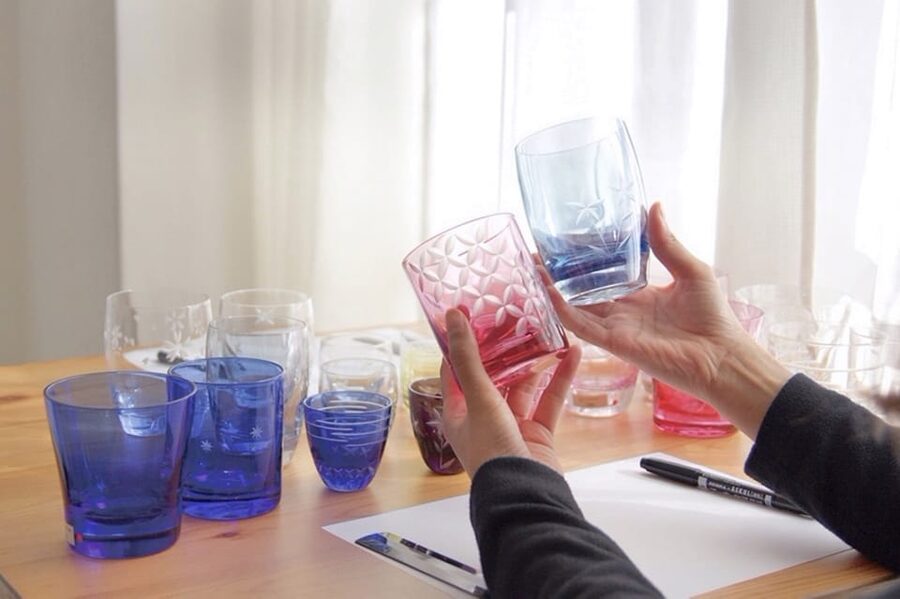
- Pick from six clear and colored glass types: Blue, pink, and yellow options add a personal touch.
- Get patient help in English or Japanese: Instructor Ze is specifically noted for clear, supportive guidance.
- Finish near Asakusa’s major sights: Sokichi is about 30 seconds from Asakusa Station, five minutes from Senso-ji, and roughly 15 minutes from Tokyo Skytree.
- Take home a useful handmade souvenir: The class costs $30 and lasts 90 minutes, making it a strong value for a hands-on Tokyo activity.
What Edo Kiriko lets you make in 90 minutes
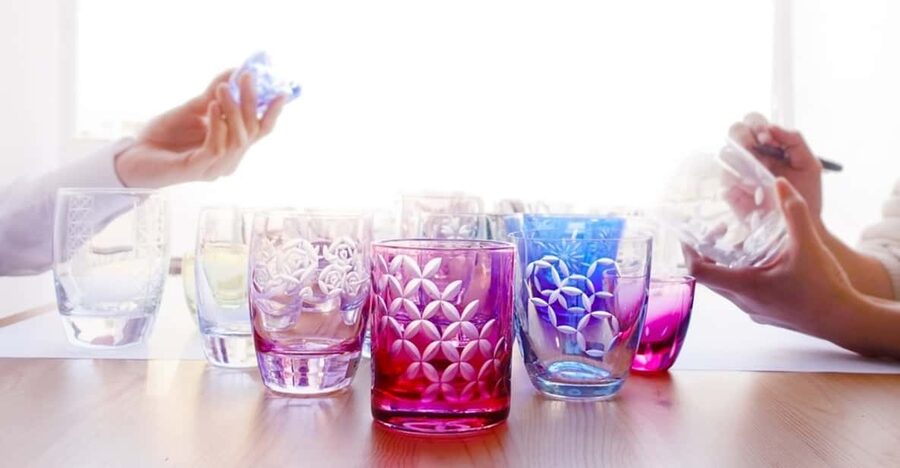
This class introduces you to Edo Kiriko, the traditional Japanese art of cutting patterns into glass. The name refers to a style associated with Tokyo, and the craft has been practiced for more than 180 years.
You do not simply watch a craftsperson work. You select your own glass, choose a pattern, practice the technique, and then make the cuts yourself. That difference matters. A purchased glass may be more polished, but a piece you create carries a clear memory of your time in Tokyo.
The class lasts 90 minutes, which is enough time to learn the basic motion without taking over your whole afternoon. You will not become a master in one session. The instructors make the class beginner-friendly, but the work still demands care. Cutting a straight line is much easier than cutting a straight line in the exact place you intended.
That small challenge is part of the appeal. You get a craft activity with a genuine skill element, not a quick souvenir assembly line.
More hands-on workshops in Tokyo:
- Sushi Making Tokyo Roll and Authentic Japanese Sushi Class
★ 5.0 · 3,971 reviews - Tokyo: Roll and Authentic Sushi Making Class in Asakusa
★ 4.9 · 1,957 reviews - Tokyo Shinjuku Chopsticks Making Class
★ 5.0 · 1,763 reviews
Starting at Sokichi near Asakusa Station
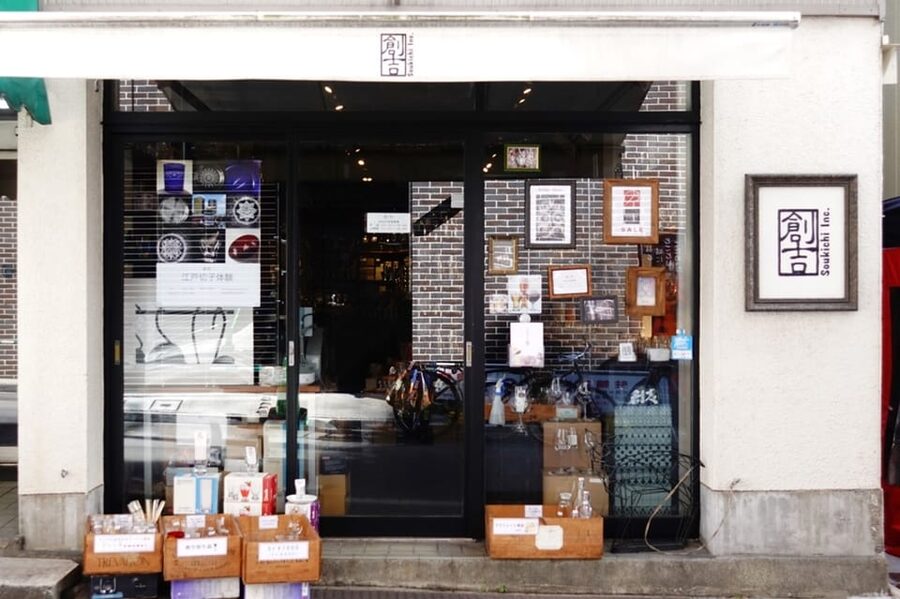
Your meeting point is Sokichi, a glassware shop about 30 seconds from Asakusa Station. Speak with a staff member inside, and you will be shown to the classroom.
The location is one of the class’s strongest practical features. You do not need a long ride across Tokyo or a complicated transfer to reach it. The room is on a small side street above the shop, giving you a short break from the crowds around Asakusa.
You should still allow a few extra minutes to find the entrance. The classroom is easy to reach, but it is not necessarily the sort of place you will spot from a major street. The useful landmark is the glassware shop below. One instructor or staff member may meet you near the door, but you should not rely on arriving at the exact second of your booking.
Once inside, the setting is quiet and compact. A small group of four has been reported, which is a useful size for this kind of practical lesson. You want enough room to work and enough instructor attention to correct your hand position or cutting angle.
The class fits neatly into a day in eastern Tokyo. Senso-ji is about five minutes away, and Tokyo Skytree is roughly 15 minutes away. You can visit the temple before class, make a glass in the middle of your sightseeing day, then continue toward the tower.
Choosing your glass and pattern
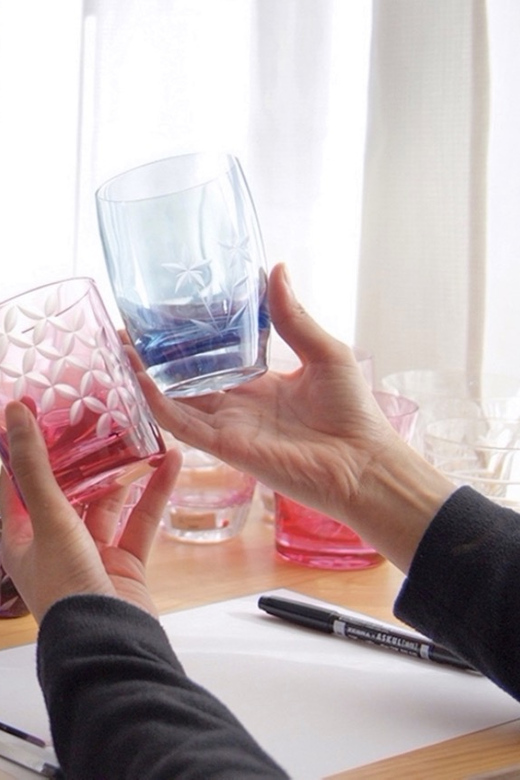
The selection stage gives you more freedom than the $30 price might suggest. You can choose from more than 20 kinds of glasses and dozens of pattern samples.
The course includes six types of clear and colored glass. The colored choices include blue, pink, and yellow. A colored surface can make the cut pattern easier to notice, while clear glass gives you a more restrained look. Your choice of shape and color affects how the finished design will appear, so listen carefully when the instructor explains which patterns work best on different glasses.
This is also where the class becomes personal. You are not handed an identical object and asked to decorate it in one approved way. You select the combination that suits you, then work within the limits of your own cutting ability.
The pattern samples help if you arrive without an artistic plan. You can choose a simple design for a cleaner result or attempt something more detailed. The class offers beginner and expert-level options, but all are described as suitable for beginners. I would treat that as encouragement to choose within your comfort zone, not as a promise that every complicated design will be easy.
If you are visiting Japan with a partner or family member, selecting different colors and patterns also gives each person a distinct souvenir. You can create matching pieces, or make deliberately different ones.
Practicing before the real cuts
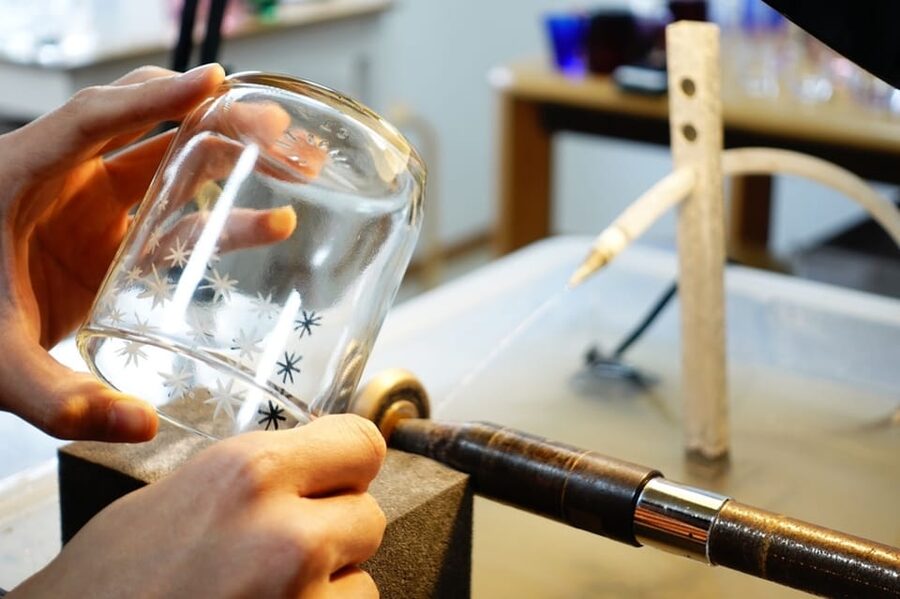
The practice stage is one of the best parts of the experience. Before working on the glass you take home, you can try the cutting technique on a practice surface.
Simple practice stars have been used to help beginners get started. This gives you a chance to learn how much pressure to use and how the cutting wheel responds. You can also see how difficult it is to keep a line steady before committing to your chosen design.
That preparation takes away some of the fear. Glass carving feels precise, and it is natural to worry about ruining the finished piece. Practice lets you make early mistakes where they do not matter.
The instructors also use this time to explain the technique. English and Japanese are available, and the English instruction has been described as clear and fully proficient. Ze, one of the named instructors, is especially associated with calm corrections and supportive advice.
I like that the teaching is not limited to a quick demonstration. You have a chance to try, ask questions, and adjust your approach. If your first attempts are crooked, the class does not treat that as a failure. The goal is to give you enough control to make a satisfying piece during the session.
Bring a hair tie if you have long hair. It is the only specific item listed for the class, but it is a sensible precaution when you are working close to equipment.
A few more Tokyo half-days to weigh up
- Mt Fuji and Hakone 1-Day Bus Tour Return by Bullet Train
★ 5.0 · 26,383 reviews - 1-Day Tokyo Bus Tour
★ 5.0 · 14,250 reviews - Tokyo: TOKYO SKYTREE® Admission ticket
★ 4.5 · 11,192 reviews - Tokyo: teamLab Planets TOKYO Digital Art Museum Entry Ticket
★ 4.6 · 9,779 reviews
Cutting your own Edo Kiriko design
After practice, you select your final glass and begin cutting the pattern. The lecturer stays nearby and guides you through the traditional technique.
This is the most absorbing part of the class, though I would use that word in a practical sense. You need to watch the glass, the tool, and the line you are following. Conversation and sightseeing plans fade into the background because small movements matter.
The work is straightforward to begin but difficult to master. That distinction comes up again and again in the experience. You can understand the motion quickly, yet keeping the cuts even and accurately placed takes practice.
The instructor may point out where to adjust your technique or refine a rough section. Ze has been praised for correcting mistakes without taking over the process. That balance is important. You want help, but you also want to know that the finished piece reflects your own work.
Some finished glasses may receive a little refining from the instructor. That does not turn the class into a demonstration. It simply helps protect the result when an early cut goes off course. You should expect a handmade look, including small variations that show how the piece was made.
The full 90 minutes is used for the class, but the time can pass quickly once you start. A small group means you may receive individual help while still having stretches of quiet time to work independently.
What makes the finished glass worthwhile
At the end, you take your Edo Kiriko glass home. The strongest value is not the raw price of the item. It is the combination of instruction, materials, and a personal souvenir made during your Tokyo visit.
At $30 per person, the class is inexpensive compared with many guided cultural activities in Tokyo. You receive the glass, colored glass options, access to the equipment, and a lecturer for 90 minutes. You also avoid paying for transportation to a distant workshop because the meeting point is near Asakusa Station.
The final result may show a crooked line or an uneven cut. That is not a flaw in the concept. It is proof that you made the piece yourself. Still, if you want a flawless collector’s object, buy one from a professional glass shop instead. This class is about learning the craft and leaving with a meaningful keepsake.
Several people have completed two glasses during the session, though you should not assume that outcome. Your speed, pattern choice, and level of help will affect how much you finish. A simpler pattern gives you a better chance of completing a clean design within the allotted time.
The souvenir is also easy to connect with a specific day. Every time you use it at home, you can remember the side street near Asakusa, the practice stars, and the concentration needed to guide the cuts.
The instruction and language support
The class is offered in English and Japanese. That makes it practical for international visitors who want more than a silent demonstration.
The most useful teaching quality here is patience. Beginners need corrections stated plainly, without making them feel clumsy. The instruction is described as calm, supportive, and clear, and the named instructor Ze has received particular praise for helping people through uncertain first attempts.
Another instructor has explained how patterns look on different glasses. That advice is worth paying attention to because the same design can appear very different depending on color, shape, and placement.
You should ask questions if you want more background about Edo Kiriko. A pamphlet may be available, but the historical explanation is not necessarily delivered in full unless you ask. The class gives you an introduction to the craft, yet it is still primarily a making activity rather than a long museum-style talk.
That arrangement suits most people. You spend more time using the tools than listening to a lecture. If Japanese craft traditions interest you, ask the instructor about the technique and the history while you work.
Who will enjoy this Asakusa class
I would recommend this experience to you if you want a hands-on cultural activity that fits into a busy Tokyo schedule. The 90-minute length works well between visits to Senso-ji, Tokyo Skytree, and other Asakusa sights.
It is also a good choice if you prefer souvenirs with a personal story. You are not just buying something made in Japan. You are making an original glass under guidance, then carrying it home.
Families, couples, friends, and solo visitors can all fit the format. The small-group setup gives you a social setting without turning the activity into a loud group performance. Two people can choose coordinating colors, while a solo participant can focus on a personal design.
You should have reasonable patience for detailed handwork. The class is beginner-friendly, but it is not effortless. If you dislike slow, precise tasks or become frustrated by imperfect lines, you may prefer a more passive sightseeing stop.
The class can also suit repeat visitors to Tokyo. It offers a different kind of local experience from temples, department stores, and observation decks. You leave with a physical object and a better sense of how much control traditional glass cutting requires.
Price, timing, and practical details
The price is $30 per person. For a 90-minute lesson with materials, a choice of glass, instructor support, and a take-home piece, I consider that good value.
Transportation is not included, but that matters little because the meeting point is about 30 seconds from Asakusa Station. You are responsible for getting to Sokichi, and there is no separate ride to a second location.
Starting times vary, so check availability for your chosen date. You can cancel up to 24 hours in advance for a full refund, and a reserve-now, pay-later option is available. Those policies are useful if your Tokyo schedule is still shifting.
The only listed item to bring is a hair tie. Wear something that lets you work comfortably and keep your attention on the glass, though no special equipment is required from you.
Best ways to fit it into your Tokyo day
The most natural plan is to combine the class with Asakusa. Visit Senso-ji first, then walk toward Sokichi for your scheduled start. After the lesson, you can continue through the neighborhood or head toward Tokyo Skytree, about 15 minutes away.
Do not plan a tight connection immediately afterward. The class is scheduled for 90 minutes, and you will want a little time to leave the room and collect yourself. The cutting itself can feel quick once you begin, but rushing would work against the careful pace the craft requires.
If you are traveling with someone who is not interested in making glass, the nearby sights give that person a useful alternative. The class is close enough to major attractions that you do not need to build an entire day around it.
The activity also makes sense on a rainy day. Much of your time is spent indoors at a work station, and the short walk from the station reduces exposure to bad weather. The experience data does not promise a heated or climate-controlled room, so treat that as a practical possibility rather than a guarantee.
Should you book the Edo Kiriko glass class?
Book it if you want to make your own Tokyo souvenir, enjoy careful handwork, and have 90 minutes to spare in Asakusa. The location is convenient, the price is fair, and the English instruction makes the class accessible to international visitors.
I would especially choose it over a standard souvenir purchase if you value the story behind an object. The finished glass may carry a few uneven lines, but you will understand the work behind the pattern and remember making it.
Skip it if your schedule is packed or you need a perfectly finished piece. Edo Kiriko rewards patience, and the class cannot remove the basic challenge of guiding a cutting tool accurately.
For most people, though, this is a smart small-scale Tokyo activity. You learn a traditional craft, receive practical help, and leave Asakusa with something you made yourself.
FAQ
How long does the Edo Kiriko glass class last?
The class lasts 90 minutes. Check the available starting times when choosing your date.
Where does the class meet?
You begin at Sokichi, a glassware shop about 30 seconds from Asakusa Station. Speak with a staff member, and they will escort you to the classroom.
Is the class available in English?
Yes. The instructors provide guidance in English and Japanese. English instruction has been described as clear, and instructor Ze is specifically noted for patient, supportive help.
Can beginners join the class?
Yes. Beginner and expert-level options are available, and all are suitable for beginners. You practice before working on your final glass.
What glass colors can I choose?
The class includes six types of clear and colored glass. The named colored options are blue, pink, and yellow.
How many designs and glasses can I choose from?
You can choose from more than 20 kinds of glasses and dozens of pattern samples.
What should I bring?
Bring a hair tie, especially if you have long hair. Transportation is not included, so you must make your own way to Sokichi.
Just added around Tokyo
- Private Arrival Transfer : Narita International Airport to Central Tokyo City★ 4.5 · 12 reviews
- Narita Airport(NRT): Private Transfer to Tokyo/Yokohama 1-9pax★ 5.0 · 47 reviews
- Private Transfer from Narita Airport to Yokohama Port and City★ 4.5 · 17 reviews
- [Narita Airport Terminals 1, 2] 40-60km Sawara Itako Historic Bike Tour★ 5.0 · 13 reviews
- 3 Day Japan Highlights Tour: Tokyo, Mt.Fuji, Nara, Kyoto, Osaka★ 5.0 · 22 reviews
- Small Town in the Big City: Tasting Tokyo’s Kichijoji★ 5.0 · 195 reviews
- Small Town in the Big City: Tasting Tokyo’s Kichijoji★ 5.0 · 16 reviews
- The 10 Tastings of Tokyo With Locals: Private Street Food Tour★ 5.0 · 48 reviews
Tokyo Tours, compared.

Mt Fuji and Hakone 1-Day Bus Tour Return by Bullet Train
Read our review →

teamLab Planets TOKYO Digital Art Museum Entry Ticket
Read our review →
Mt Fuji & Hakone Cruise, Drum Show Bullet Train 1 Day from Tokyo
Read our review →
Sumo Show Experience with Chicken Hot Pot and a Photo
Read our review →
Shinjuku Food Tour (13 Dishes at 4 Local Eateries)
Read our review →
Tokyo Mt Fuji 5th St & Hakone Cruise Bus Tour w/Bullet Train
Read our review →
Flagship 2-Hours Official Street Go-Kart Tour – Tokyo Bay Shop
Read our review →Browse the lists this tour appears in