
Reviewed · TOKYO TOURS
Tokyo Sumo Morning Practice: Viewing & Exclusive Interaction
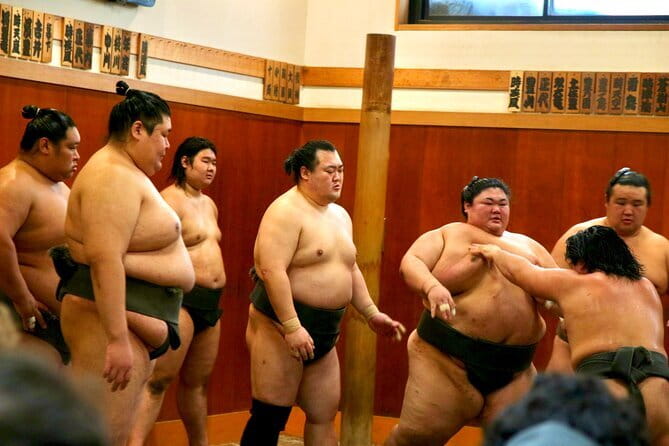
A sumo morning practice is not a staged show. In a quiet Sumida neighborhood, you enter a working stable and watch current wrestlers warm up, train, and spar at close range. The low room, heavy footwork, and sudden crashes make this one of Tokyo’s most direct encounters with a traditional sport.
I like two things especially: the front-row zabuton seating gives you a close look, while stools at the back help if floor sitting is hard. I also like the time set aside to speak with the wrestlers, rather than simply snapping a few photos and being hurried away.
The main consideration is the early start and strict etiquette. You must stay quiet during practice, and food, drinks, recording, and flash photography are not allowed. During a grand tournament period, the schedule changes and viewing lasts only about an hour.
Key points at a glance
- Watch working wrestlers, not performers: See warmups, practice bouts, and sparring at an active sumo stable.
- Choose your seat: Sit on a traditional zabuton near the action or use a stool toward the back.
- Meet the athletes afterward: Ask about training and daily life, then take commemorative photos.
- Learn before you enter: The guide explains sumo rules, customs, and stable etiquette at Narihira Park.
- Take home a banzuke: You receive an official ranking sheet in a specially designed folder.
- End with open questions: A final session with the guide gives you time to ask about sumo or Tokyo.
Why a morning at a sumo stable feels different
Tokyo offers plenty of polished cultural shows. This experience takes you somewhere less polished and more revealing: a real training stable where professional wrestlers prepare for competition.
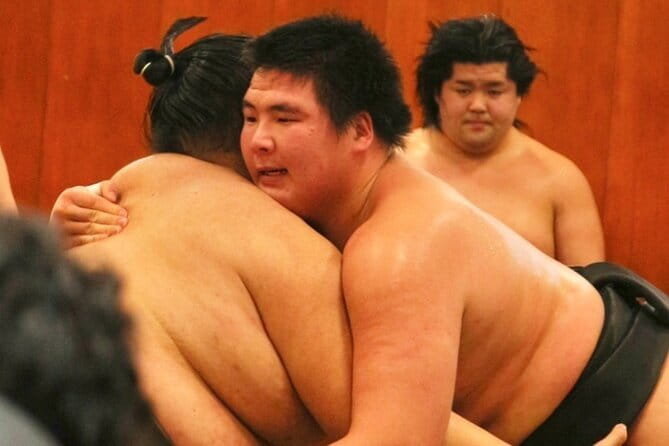
You are not watching a contest with a cheering crowd and formal announcements. You are watching athletes work. The rhythm can shift from quiet concentration to a thunderous collision in a second. That contrast helps you understand the physical cost of sumo better than a short explanation in a museum ever could.
The tour lasts about three hours, but the practice itself is only one part of the morning. Your guide gives you the basic tools first, then helps you read what is happening in the room. That preparation matters because sumo has its own rules, gestures, ranks, and manners. Without it, you might see a series of shoves and stomps. With it, you begin to notice the discipline behind every movement.
This is also a useful choice for someone who wants contact with present-day Japanese culture. The wrestlers are active athletes, not historical interpreters. Their training, daily routines, and mindset are part of the conversation after practice.
More Sumo Experiences in Tokyo
- Tokyo: Sumo Show Experience with Chicken Hot Pot and a Photo
★ 4.8 · 6,678 reviews - Tokyo: Sumo Show and Dining Experience
★ 4.8 · 2,742 reviews - the SUMO show
★ 5.0 · 1,960 reviews
Meeting at Narihira Park before the stable visit
Your morning starts near the multipurpose restroom at Narihira Park in Sumida. This is not just a place to gather. The guide checks your name, provides sumo-related materials, and explains the behavior expected inside the stable.
The short introduction covers sumo history, rules, and etiquette. You will also learn practical points such as staying quiet during training, respecting seating instructions, and using your camera without flash. Listen closely here. Once you enter the stable, the guide may not be able to give long explanations without disturbing the wrestlers.
The meeting point also gives you a calmer start than arriving directly at the training room. You have time to find your guide and understand the plan before entering a private working space. English and Japanese guidance are available.
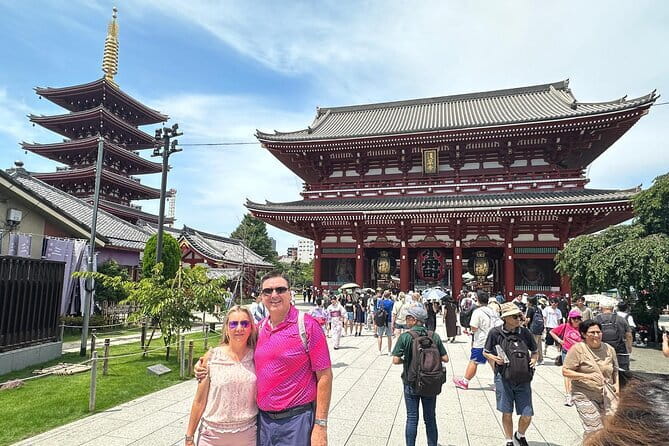
Transportation to the meeting point is not included, so you need to plan your route in advance. The activity finishes around 11:00 AM, putting you in a handy position for Tokyo Skytree or Asakusa afterward.
Watching warmups, practice, and sparring up close
After the park briefing, you walk to an active sumo stable. The stable visit is the heart of the morning, and it is important to set the right expectation: this is training, not a performance arranged for an audience.
You might see warmup exercises, repetitive drills, and practice bouts. The supplied experience details specifically describe the raw force of bodies clashing, while participants have also described seeing warmups, training, and sparring. The pace and exact sequence can vary because the wrestlers are following their own practice schedule.
The setting is close enough to make the physical work impossible to ignore. Sumo is often reduced to the final push at the edge of the ring, but practice shows the preparation behind it. You see concentration, repetition, balance, and controlled force. The room can feel intense even when nobody is speaking.
This is where the guide’s opening explanation pays off. You can connect what you see with the rules and rituals introduced in the park. A guide such as Haru, Momo, Sana, or Ryoko can help turn unfamiliar movements into something you understand.
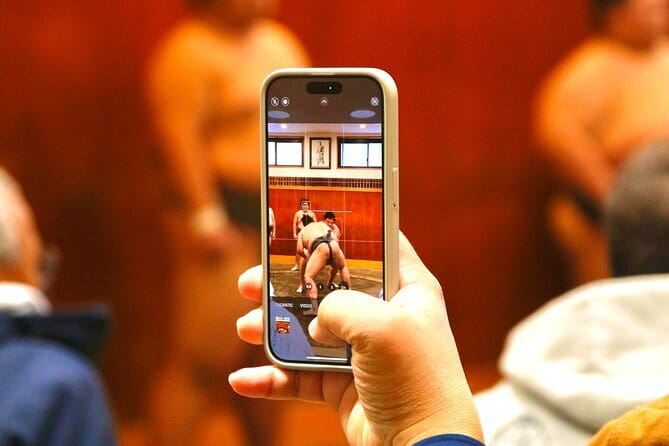
You must remain quiet during practice. Flash photography is forbidden, and video and audio recording are not allowed. Photography is permitted within the stable’s rules, but you need to follow instructions about timing, flash, and where you sit. If you are looking for a relaxed photo opportunity every few minutes, this may feel restrictive. If you want to respect the training, the rules are a fair trade.
Zabuton or stool seating, depending on your comfort
The seating choice is a practical strength. Traditional floor cushions, called zabuton, are available near the front. This gives you a close view and a more traditional feel, but sitting on the floor for an extended period is not comfortable for everyone.
Stools are available at the back. You give up some closeness, yet you gain a more forgiving seat and a different view of the room. I would choose the zabuton if you can sit comfortably on the floor and want to feel close to the practice. I would choose the stool if your knees, hips, or back make floor seating difficult.
The seating arrangement is still subject to the stable’s instructions. You cannot treat the room like a theater where you move around whenever you want. Arrive ready to settle in and observe.
Children under six are not permitted. Older children may still find the quiet rules and intense physical contact demanding, so think about your child’s ability to sit calmly before booking.
More sumo mornings and shows:
- Tokyo Shinjuku Sumo Show & Experience with Photo
★ 5.0 · 1,750 reviews - Tokyo: Sumo Show and Experience in Shinjuku
★ 4.8 · 1,001 reviews - Tokyo: Sumo Tournament Tour with Chair Seat Tickets
★ 4.6 · 753 reviews - Tokyo:Luxury Sumo Show Experience & Japanese cuisine & Drink
★ 4.7 · 577 reviews
Meeting the wrestlers after practice
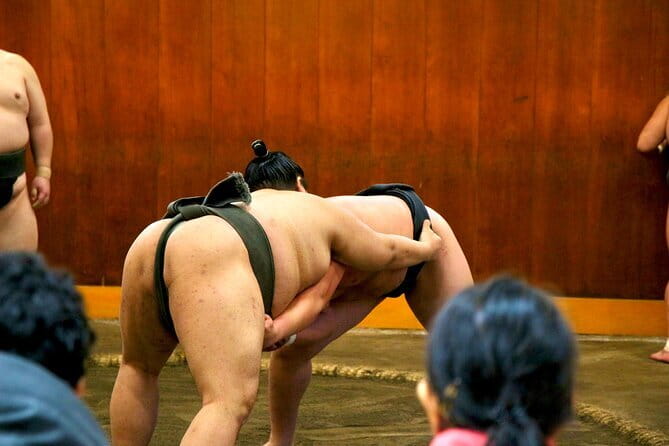
The tour becomes more personal once practice ends. You have an opportunity to speak directly with active wrestlers through the guide, ask questions, and take commemorative photos together.
This interaction gives the morning a useful second half. During practice, you observe from a respectful distance. Afterward, you can ask about training, daily life, and the mental side of the sport. The guide helps with communication and keeps the exchange moving.
The wrestlers’ willingness to answer questions is a major part of the experience. You can ask about the work you have just watched, rather than relying only on prepared facts. That makes the session feel like a cultural exchange instead of a one-way talk.
Some participants have also described being invited to try a short bout with a professional in the training space. This is not presented as a guaranteed part of every departure, so do not book expecting to wrestle. If an invitation happens, follow the staff’s instructions and treat it as an optional bit of fun, not a test of strength.
The photo session comes after practice, when the atmosphere is less restrictive. You still need to follow the stable’s directions, but this is the time to capture a personal souvenir. The combination of questions and photos helps you remember the people behind the sport, not just the spectacle of the collision.
The banzuke and the final park conversation
After leaving the stable, you return to Narihira Park for the closing part of the tour. You receive an official banzuke, the ranking sheet used in the sumo world, inside a specially designed souvenir folder.
This is a better memento than a generic postcard because it connects directly to the structure of sumo. Rankings are central to how the sport is organized, and the sheet gives you a physical reminder of that system. Keep the folder flat if you can, since it is intended as a souvenir rather than a disposable handout.
The final session is a guide-led Q&A at the park. Instead of adding a rushed meal, the tour leaves time for questions about sumo customs, training, and anything you did not understand inside the stable. You can also ask for personal suggestions for the rest of your Tokyo day.
I like this ending because the questions often come after you have seen the practice. Before entering, you may ask general questions about rules. After watching, you can ask why a certain drill mattered or how wrestlers prepare for a bout. The conversation becomes more useful because you have something specific to discuss.
The tour wraps up around 11:00 AM. From there, you can continue toward Tokyo Skytree or Asakusa, making this an easy morning addition to a full day in eastern Tokyo.
What the $93 price really covers
At $93 per person, this is not a cheap sightseeing stop. The price includes the stable visit fee, an English-speaking guide, and the banzuke souvenir. It also covers access to an activity that is normally closed to ordinary public viewing.
The value depends on what you want from Tokyo. If you only want to see sumo once from a distance, the price may feel high. If you want an actual training session, interpretation of the rules, direct conversation with wrestlers, a photo opportunity, and a useful keepsake, the cost becomes easier to justify.
The guide is important to that calculation. Sumo has enough unfamiliar customs that you could miss much of the meaning without help. Guides including Sarah, Sana, Haru, Momo, and Ryoko have been singled out for clear explanations, kindness, and professional support. Since guide assignments can change, you should not book solely for one named person, but the range of positive guide comments points to a consistent focus on communication.
You also avoid the uncertainty of trying to arrange access to a stable yourself. The stable fee, group coordination, etiquette briefing, and language support are bundled together. That convenience has real value, especially during a short Tokyo visit.
Timing, tournament periods, and practical restrictions
The early morning timing is part of the appeal. Sumida is quieter, the stable is focused on training, and you finish with most of the day still available.
It is also the main drawback for late risers. You need to reach Narihira Park at the assigned starting time, and you should allow room for finding the meeting point. Check the available departure time when booking because the exact start time is not fixed in the activity details.
During the Grand Sumo Tournament periods, which occur for about two weeks in January, May, and September, practice starts 30 minutes earlier. Viewing time is also reduced to about one hour. This is a significant change, so check the schedule carefully if your visit falls near one of those periods.
The stable does not allow food, alcohol, drugs, flash photography, video recording, or audio recording. Photography itself is allowed under the stable’s rules. You should also expect quiet observation rather than constant narration.
Free cancellation is available up to 24 hours before the activity for a full refund, and you can reserve now and pay later. Those terms help if your Tokyo schedule is still shifting, though they do not remove the need to check the exact meeting time.
Who will get the most from this experience
I would recommend this morning to anyone who wants an authentic look at a Japanese sport and is willing to follow the rules of a working stable.
It is especially suitable for:
- First-time visitors who want more than a standard city attraction
- Sports fans interested in training, discipline, and athletic routines
- People curious about Japanese customs but unsure how to approach them
- Photographers who can work without flash or video
- Couples and solo visitors who value a personal cultural encounter
- Anyone planning to visit Asakusa or Tokyo Skytree later that day
It may be less suitable if you need a flexible drop-in activity, dislike sitting quietly, cannot sit on the floor or use a stool comfortably, or expect a guaranteed wrestling demonstration. The optional bout described by some participants should be treated as a pleasant possibility, not part of the promised itinerary.
The under-six age limit also rules out very young children. Older children may enjoy the spectacle, but the quiet setting and no-recording policy require patience.
How this compares with a sumo dinner show
A dinner show gives you entertainment built around sumo themes. This morning visit gives you the working routine of current wrestlers instead.
That difference matters. You see practice rather than a performance designed for applause. You do not receive a meal, and you must accept stricter behavior rules. In return, you get closer to the actual training environment and have time to ask the athletes questions afterward.
The experience is not polished in the same way as a theatrical production. That is its point. The appeal lies in seeing a serious daily practice and trying to understand it with help from the guide.
Should you book the Tokyo sumo morning practice?
Book it if you want an intimate look at real sumo, can manage an early morning, and are comfortable with quiet observation. The strongest reasons to go are the active stable visit, the direct Q&A with wrestlers, the choice of seating, and the guide’s help in making the sport understandable.
I would skip it if your schedule is too tight for the assigned start, you want video footage, or you are mainly seeking a relaxed spectator show. Also check the tournament-period schedule before paying, since both the start time and viewing length change.
For the right visitor, $93 buys more than three hours on a timetable. It buys access, context, and a rare chance to ask current wrestlers what their demanding work is really like. That is a solid use of a Tokyo morning, especially when you finish close to two of the city’s best next stops.
FAQ
Where does the sumo morning practice tour meet?
The meeting point is near the multipurpose restroom at Narihira Park in Sumida, Tokyo.
How long does the experience last?
The full activity lasts about three hours and normally finishes around 11:00 AM.
What languages are available?
Guidance is available in English and Japanese.
Is transportation to the meeting point included?
No. Transportation to Narihira Park is not included in the activity.
Can I sit on the floor during the practice?
Yes. Traditional floor cushions, called zabuton, are available near the front.
Are stools available for people who do not want to sit on the floor?
Yes. Stools are available toward the back of the stable.
Can I take photographs inside the stable?
Photography is allowed, but you must remain quiet and follow the stable’s instructions about flash and seating. Flash photography is not allowed.
Can I record video or audio?
No. Video recording and audio recording are not allowed.
Are children allowed to join?
Children under six are not permitted to participate.
What happens during the Grand Sumo Tournament periods?
During the tournament periods in approximately January, May, and September, practice starts 30 minutes earlier and the viewing time is about one hour.
What is included in the price?
The price includes the sumo stable visit fee, an English-speaking guide, and a special souvenir consisting of an official banzuke in a souvenir folder.
Can I cancel for a refund?
Yes. You can cancel up to 24 hours in advance for a full refund.
Can I reserve without paying immediately?
Yes. Reserve now and pay later is available, allowing you to hold a place without paying on the day of booking.
More Morning in Tokyo
- Tokyo: Sumo Morning Practice Viewing Tour
★ 4.8 · 570 reviews - Tokyo: Sumo Morning Training Visit
★ 4.4 · 370 reviews - Tokyo: Sumo Morning Practice Tour at Sumida City
★ 4.8 · 308 reviews - Tokyo Sumo Morning Practice Tour at Stable
★ 5.0 · 298 reviews
Just added around Tokyo
- Private Arrival Transfer : Narita International Airport to Central Tokyo City★ 4.5 · 12 reviews
- Narita Airport(NRT): Private Transfer to Tokyo/Yokohama 1-9pax★ 5.0 · 47 reviews
- Private Transfer from Narita Airport to Yokohama Port and City★ 4.5 · 17 reviews
- [Narita Airport Terminals 1, 2] 40-60km Sawara Itako Historic Bike Tour★ 5.0 · 13 reviews
- 3 Day Japan Highlights Tour: Tokyo, Mt.Fuji, Nara, Kyoto, Osaka★ 5.0 · 22 reviews
- Small Town in the Big City: Tasting Tokyo’s Kichijoji★ 5.0 · 195 reviews
- Small Town in the Big City: Tasting Tokyo’s Kichijoji★ 5.0 · 16 reviews
- The 10 Tastings of Tokyo With Locals: Private Street Food Tour★ 5.0 · 48 reviews
Tokyo Tours, compared.

Mt Fuji and Hakone 1-Day Bus Tour Return by Bullet Train
Read our review →

teamLab Planets TOKYO Digital Art Museum Entry Ticket
Read our review →
Mt Fuji & Hakone Cruise, Drum Show Bullet Train 1 Day from Tokyo
Read our review →
Sumo Show Experience with Chicken Hot Pot and a Photo
Read our review →
Shinjuku Food Tour (13 Dishes at 4 Local Eateries)
Read our review →
Tokyo Mt Fuji 5th St & Hakone Cruise Bus Tour w/Bullet Train
Read our review →
Flagship 2-Hours Official Street Go-Kart Tour – Tokyo Bay Shop
Read our review →Browse the lists this tour appears in