
Reviewed · TOKYO TOURS
Tokyo: Sumo Morning Training Visit
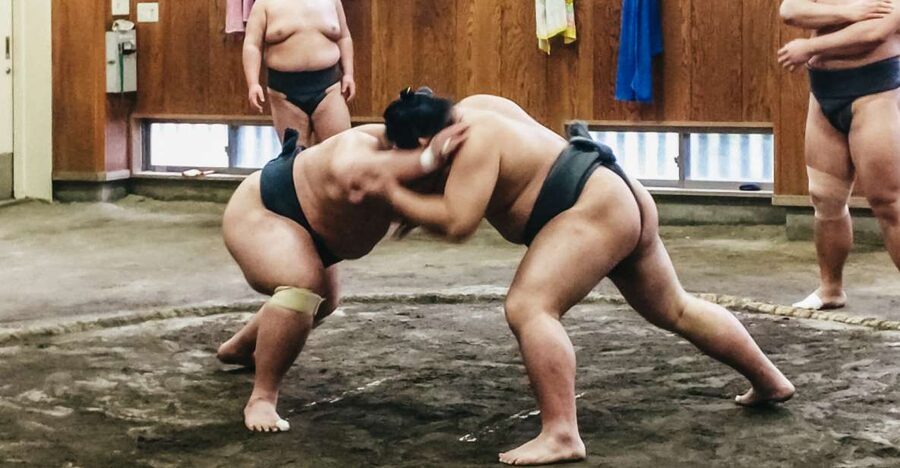
The best part of this Tokyo experience is the distance between you and the action. Inside a real sumo stable, you watch professional wrestlers warm up, practice their footwork, push across the clay, and sometimes spar hard enough to make the room feel it. This is training, not a staged show, which gives the visit its value.
I like two things here: the rare chance to see sumo at close range, and the group photo with the wrestlers at the end. The main drawback is that you may sit on the floor in silence for 60 to 120 minutes, with no food, drinks, or casual movement. During Tokyo tournament months, the session can last only about 30 minutes.
Key points to know before you book
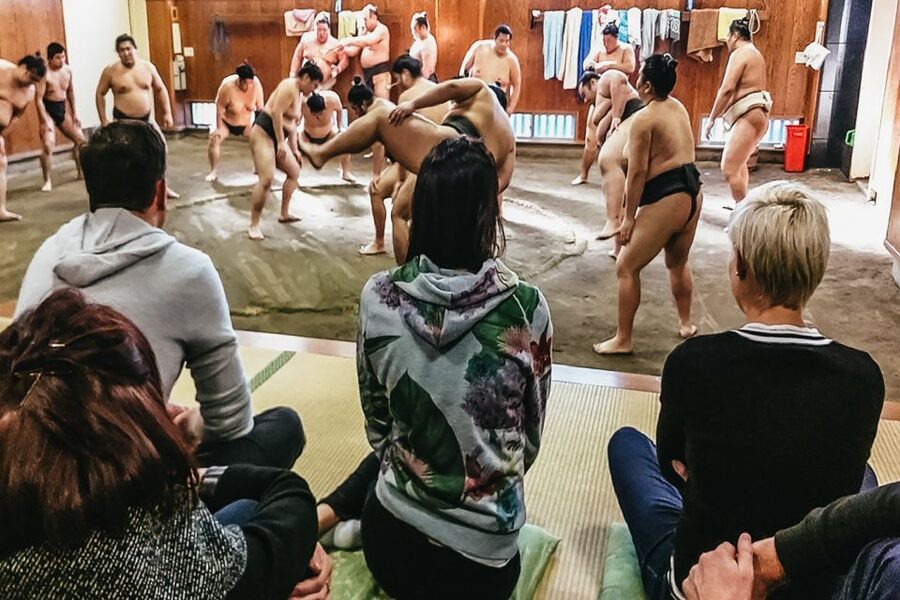
- You enter a working sumo stable: This is an active training space, not a theater built for tourists.
- The meeting place arrives late: Your exact stable and route are normally sent by email about three days before the visit.
- Training can be longer than advertised: The listed duration is one hour, but sessions have lasted 90 minutes or two hours.
- January, May, and September change the timing: During Tokyo Grand Sumo Tournament months, training may be limited to about 30 minutes.
- Silence matters: Phones must be silent, flash photography is forbidden, and video requires advance permission.
- Arrive early for a better view: Seating is free choice, and a back-row spot can make the action harder to see.
Inside a real Tokyo sumo stable
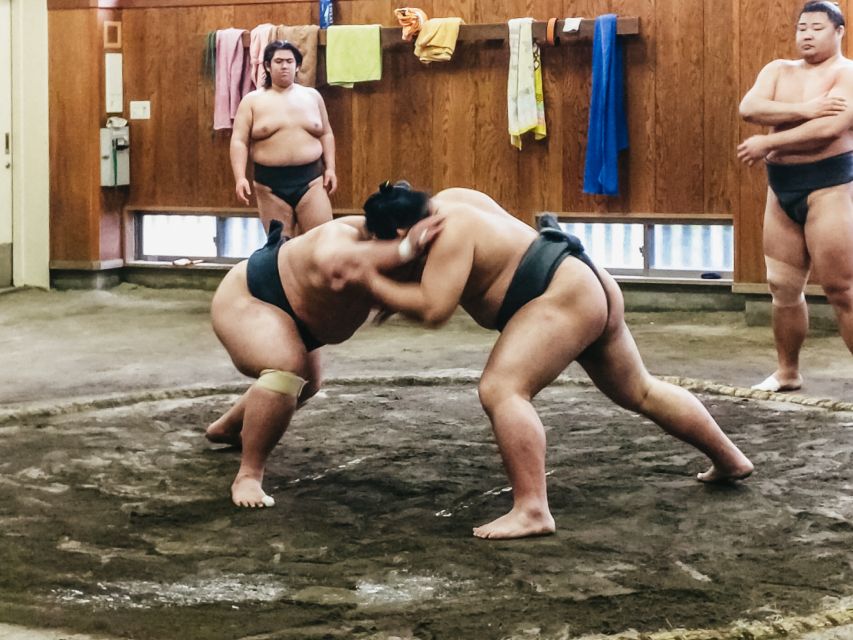
Sumo is easiest to understand when you see the work behind the bouts. A tournament gives you the polished version: wrestlers enter the ring, perform their rituals, and compete before a crowd. This visit shows the less glamorous part, the repeated drills, conditioning, balance work, and physical contact that prepare them for competition.
You are not entering a museum or a cultural center. You are being admitted to a place where wrestlers train, and the stable’s own rules take priority. That is why the atmosphere can feel more serious than a typical sightseeing activity. You are expected to watch quietly and avoid anything that distracts from the practice.
The action may begin with warm-up exercises and basic movements. You can expect to see wrestlers work on balance, stance, pushing strength, and the controlled techniques that make sumo more than two large men charging at each other. When sparring begins, the contact is sudden and forceful. You may hear the impact before you fully process the movement.
Several people found the wrestlers’ speed, balance, and technique more surprising than their size. That is an important reason to choose this visit over a simple photo opportunity. Close up, sumo looks less like a novelty and more like a demanding discipline.
More Sumo Experiences in Tokyo
- Tokyo: Sumo Show Experience with Chicken Hot Pot and a Photo
★ 4.8 · 6,678 reviews - Tokyo: Sumo Show and Dining Experience
★ 4.8 · 2,742 reviews - the SUMO show
★ 5.0 · 1,960 reviews
Why the training feels authentic
The strongest feature is its lack of polish. The wrestlers are not performing a neatly packaged routine for a theater audience. The schedule can change with their condition, and the session may not include every type of exercise or a full match.
That uncertainty is part of the deal. One day may offer energetic sparring. Another may focus more on warm-ups, drills, or pushing practice. You should book this if you value access to a real setting more than a guaranteed sequence of entertainment.
Some sessions have felt fairly relaxed, while others have included intense bouts. You may see only a few wrestlers working during part of the visit, and your view can depend on where you sit. The experience is best understood as a window into daily training, not as a substitute for a tournament ticket.
What happens during the one-hour visit
The advertised duration is one hour, but it needs a footnote. Normal training is often around 60 minutes, though some sessions have continued for 90 minutes or up to two hours. If you are planning a tightly packed morning, leave room for the longer version.
The basic flow is straightforward:
- You meet the host or greeter at the assigned location.
- You enter the stable with the guide.
- You take an available seat and watch the training.
- The wrestlers continue through warm-ups, drills, and possible sparring.
- At the end, you take a group picture with them.
The guide’s role can be light. The English host or greeter may check names, explain the rules, and help you enter, but several participants received little or no commentary during the training. If you want the rituals, gestures, rankings, nutrition, or history explained, read a little about sumo before you arrive.
That lack of narration is the clearest weakness. A short introduction would help you understand why wrestlers perform certain movements and how practice differs from a tournament bout. You can still learn by watching body language and repeated drills, but the activity is more visual than educational.
The strict rules inside the stable
The stable is a quiet place during practice. You must keep your phone on silent, avoid loud conversation, and remain still. Flash photography is not allowed, and video recording requires prior permission. Do not assume that a quick clip is acceptable.
Food and drinks are not allowed. Large bags and luggage are also prohibited, and smoking indoors is forbidden. Hats and sunglasses must be removed.
The seating rules deserve serious attention. You may sit on the floor and need to keep your feet from pointing toward the training area. Leaning against walls or shifting around can be viewed badly. One participant described the need to sit quietly and still for two hours as a real physical challenge.
This is especially important if you have knee, hip, or back problems. Chairs are not automatically available, and a seat may need to be arranged in advance. Contact the provider before the visit if floor sitting could be difficult. Do not wait until you arrive and expect the stable to solve the problem.
A cushion would make the experience easier, but it is not listed as included. Bringing one is not necessarily permitted, so ask ahead rather than arriving with a large item. The safest plan is to wear comfortable clothing and treat the seating as part of the cultural etiquette.
More sumo mornings and shows:
- Tokyo Shinjuku Sumo Show & Experience with Photo
★ 5.0 · 1,750 reviews - Tokyo: Sumo Show and Experience in Shinjuku
★ 4.8 · 1,001 reviews - Tokyo: Sumo Tournament Tour with Chair Seat Tickets
★ 4.6 · 753 reviews - Tokyo:Luxury Sumo Show Experience & Japanese cuisine & Drink
★ 4.7 · 577 reviews
Getting the meeting details right
The meeting information requires more care than usual. The Google Maps location may not be the actual meeting place, and the automatic voucher or account page may show only a sample location. The real stable and route are normally confirmed by email about three days before the scheduled date.
Read both the voucher and the separate confirmation email. Use the stable shown on the voucher and follow the later instructions. Specific stable requests cannot be accepted because the location depends on the day, though all assigned stables are in Tokyo.
Check-in begins at the stated meeting time. If you arrive early, do not ring the doorbell or enter on your own. Entry is allowed only with the guide. This is a working facility, so turning up too soon or wandering in is not appropriate.
The location can be difficult to find, especially if you walk from a train station. Build in extra time and make sure your phone works in Japan. If you get lost, call the number in the confirmation email. Prompt help has been available when participants had trouble locating the meeting point.
Do not take the original address as the final word. The late confirmation is inconvenient, but it is also designed to direct you to the stable actually being used that day.
A morning transfer option, with limits
You can add a one-way hotel transfer for an extra charge. It is available only from hotels within Tokyo’s 23 wards, and the vehicle can carry no more than four passengers.
The driver speaks Japanese, not English. Your hotel must have a front desk, and you need to send the hotel name, check-in date, reservation name, and a Japanese mobile number after booking. The pickup time is sent by email at least one day before the visit.
This option may help if you are worried about finding an unfamiliar stable before sunrise. It is less useful if you need English assistance during the ride. If you are more than 10 minutes late for pickup, the booking is treated as a no-show.
The transfer does not include a return ride. Plan your onward trip from the stable separately.
Timing around the Tokyo Grand Sumo Tournament
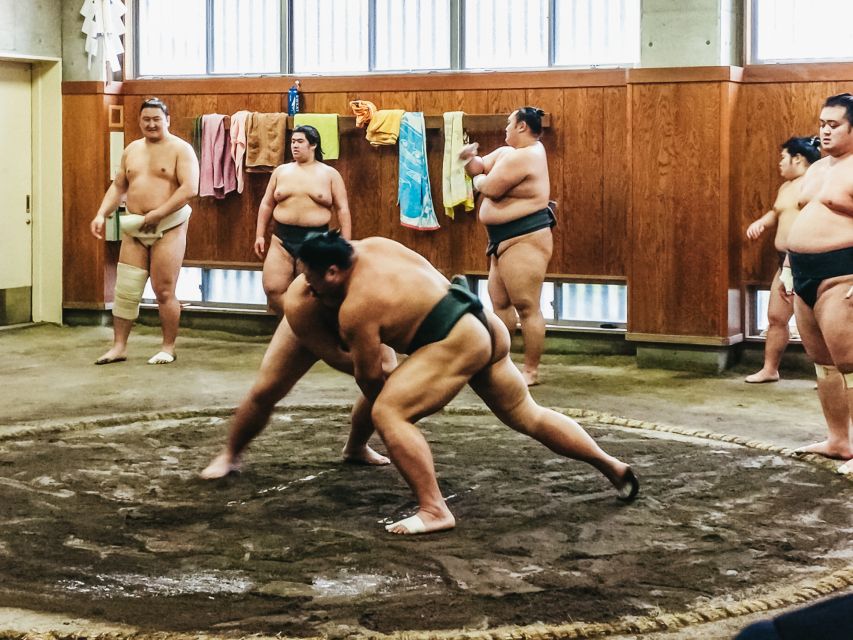
The calendar matters more than the basic one-hour description suggests. Tokyo hosts Grand Sumo Tournaments in January, May, and September. During those months, stable training may be reduced to about 30 minutes because the wrestlers are preparing for or taking part in competition.
You still get close access and the group photo, but you may see only a shorter warm-up or limited practice. The price does not drop for the shorter session, and no refund is given on that basis.
If your main goal is to watch extended training, avoid those months if your schedule allows. If your main goal is proximity and a look inside a stable, the shorter visit can still be worthwhile. If you want actual competition, use the $77 as part of your tournament budget instead. One participant who attended during a September tournament found an actual tournament ticket gave better value for seeing bouts.
The choice comes down to access versus duration. This activity gives you the stable. A tournament gives you the formal matches, crowd, ceremony, and full competition setting.
The group picture at the end
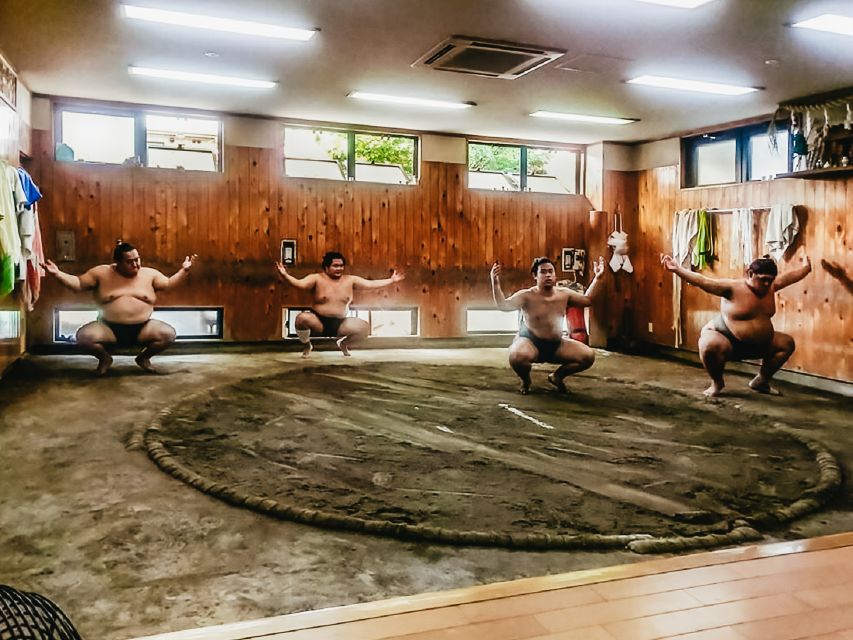
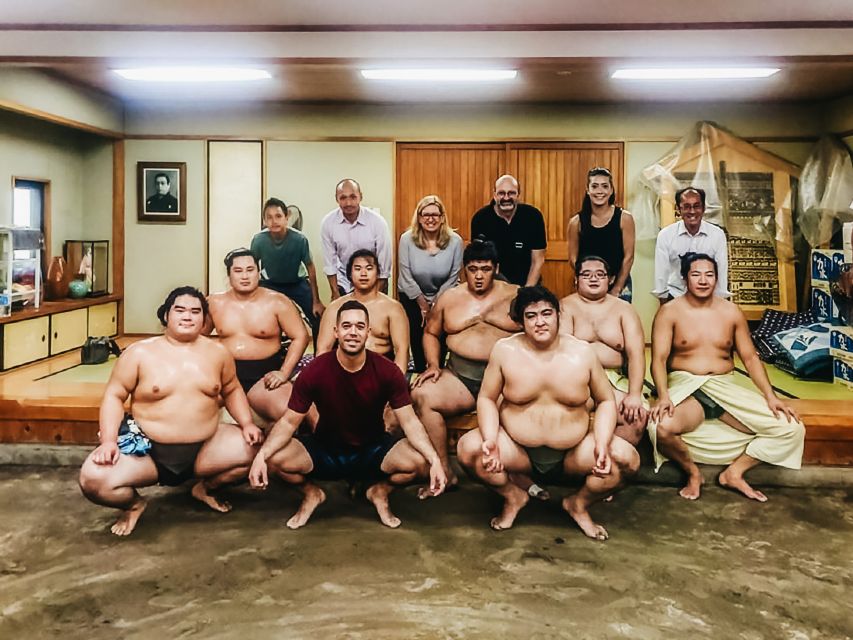
The photo is included, and it gives the visit a clear finish. After training, you have the chance to pose as a group with the wrestlers. This is one reason you should stay through the end if you can.
If you leave early, you will not receive the group picture. That rule matters because the training may feel long, especially if you are uncomfortable on the floor. Decide before you arrive that the photo is part of the experience, not an optional extra.
Photography during practice remains controlled. Flash is forbidden, and video needs prior permission. Follow the guide’s instructions rather than trying to capture every moment. The wrestlers are working, not posing for a private photo session.
Is $77 a fair price?
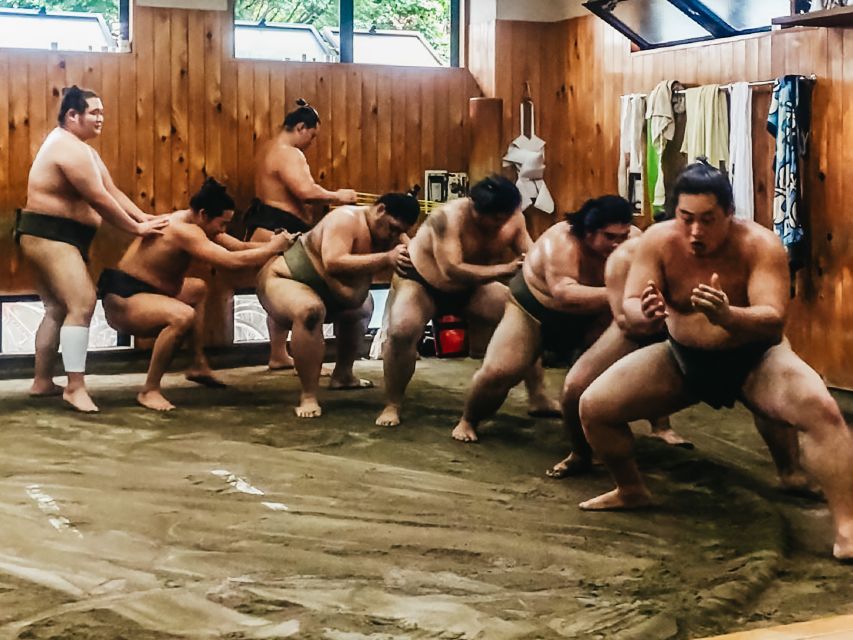
At $77 per person, this is not the cheapest way to encounter sumo. You are paying for access to a working stable, advance coordination, a host or greeter, and the group photograph. You are not paying for a full show, a meal, hotel return transfer, or a long educational talk.
I see the value as strong for someone who wants an authentic setting and close views. A tournament ticket may offer more total entertainment, but it will not necessarily give you the same feeling of watching the preparation from a few feet away. A sumo-themed performance may be easier and more polished, but it will not be the same as seeing active professionals train.
The value drops if you expect a guaranteed two-hour session, detailed English interpretation, chairs, or a full set of bouts. It also drops during January, May, and September, when the training may last only 30 minutes.
For a first visit to Japan, I would consider this a specialty experience rather than a general sightseeing essential. If sumo interests you, the price is reasonable for the access. If you are only mildly curious, a tournament viewing or a museum-style introduction may give you more context.
Who should book this experience?
You are a good match for this visit if you:
- Want to see professional sumo wrestlers at close range
- Prefer real training to a staged cultural show
- Can sit quietly on the floor for at least an hour
- Are happy to observe without constant English explanation
- Can adapt if the session changes or ends early
- Have a strong interest in Japanese sport and tradition
Families can enjoy it, but think about the sitting rules. Even children as young as three have been captivated by the action, while older children may appreciate the physical intensity. The no-talking rule and lack of movement can still be hard for restless children.
This is not ideal if you need frequent toilet breaks, cannot sit on the floor, want to take video, or need a fixed address well in advance. It is also a poor fit if you expect a guide to narrate every movement.
Practical ways to make the visit better
Arrive early, but wait outside until check-in time. Early arrival helps you get a better seat once entry begins, yet entering or ringing the bell before the stated time is not allowed.
Wear clothing that lets you sit comfortably. Do not bring luggage or a large bag, and keep your phone ready for directions but silent once inside.
Read basic sumo terms before the morning. Learn the difference between warm-up movements, pushing drills, and sparring. A little preparation turns a silent hour into a lesson in technique.
If you have mobility concerns, request seating help before the date. Do not count on chairs being available. Also, keep your morning schedule open in case training continues beyond the listed 60 minutes.
Finally, check your email repeatedly in the days before the visit. The meeting point is not fixed at booking, and missing the updated location can mean missing part of the training.
Should you book the Tokyo sumo morning visit?
Book it if you want the real thing: a quiet room, heavy impacts, repetitive drills, and a close view of athletes working without a tourist-friendly script. The group photo is a nice reward, but the training itself is the reason to go.
Skip it if you want a polished presentation or a guaranteed full-length session. For the best value, schedule it outside January, May, and September, arrive early for seating, and prepare for floor sitting. At $77, it is a fair buy for sumo fans and culture-minded visitors, but a less certain choice for anyone expecting a conventional guided tour.
FAQ
Where does the sumo morning training visit meet?
The exact meeting place is decided about three days before the scheduled date. It may differ from the location shown on Google Maps or the automatic voucher, so follow the separate confirmation email and the stable listed on the voucher.
How long does the experience last?
The listed duration is one hour. Normal training can last about 60 minutes, but some sessions continue for 90 minutes or up to two hours.
Is the training shorter during a Tokyo sumo tournament?
Yes. During the Tokyo Grand Sumo Tournaments in January, May, and September, training may last only about 30 minutes. No refund is provided for the shorter session.
Can I take photos inside the stable?
You may take photos without flash, but flash photography is forbidden. Video recording is allowed only with prior permission.
Can I take a video of the wrestlers training?
Only if permission is granted in advance. Do not record video automatically.
Is hotel pickup included?
No. One-way hotel pickup is an optional extra. It is limited to hotels within Tokyo’s 23 wards, with a maximum of four passengers.
Does the pickup driver speak English?
No. The pickup drivers speak Japanese. Hotels without a front desk cannot be used for pickup.
What should I bring?
Bring a face mask or protective covering. Do not bring food, drinks, luggage, or large bags. Hats and sunglasses are not allowed inside.
Can I leave before training ends?
Yes, you may leave early, but you will not receive the group picture. You are also expected to remain quiet and avoid disturbing the training while inside.
More Morning in Tokyo
- Tokyo: Sumo Morning Practice Viewing Tour
★ 4.8 · 570 reviews - Tokyo: Sumo Morning Practice Tour at Sumida City
★ 4.8 · 308 reviews - Tokyo Sumo Morning Practice Tour at Stable
★ 5.0 · 298 reviews - Tokyo Ryogoku Sumo Morning Practice + Photo Shoot with Wrestlers
★ 4.5 · 277 reviews
Just added around Tokyo
- Private Arrival Transfer : Narita International Airport to Central Tokyo City★ 4.5 · 12 reviews
- Narita Airport(NRT): Private Transfer to Tokyo/Yokohama 1-9pax★ 5.0 · 47 reviews
- Private Transfer from Narita Airport to Yokohama Port and City★ 4.5 · 17 reviews
- [Narita Airport Terminals 1, 2] 40-60km Sawara Itako Historic Bike Tour★ 5.0 · 13 reviews
- 3 Day Japan Highlights Tour: Tokyo, Mt.Fuji, Nara, Kyoto, Osaka★ 5.0 · 22 reviews
- Small Town in the Big City: Tasting Tokyo’s Kichijoji★ 5.0 · 195 reviews
- Small Town in the Big City: Tasting Tokyo’s Kichijoji★ 5.0 · 16 reviews
- The 10 Tastings of Tokyo With Locals: Private Street Food Tour★ 5.0 · 48 reviews
Tokyo Tours, compared.

Mt Fuji and Hakone 1-Day Bus Tour Return by Bullet Train
Read our review →
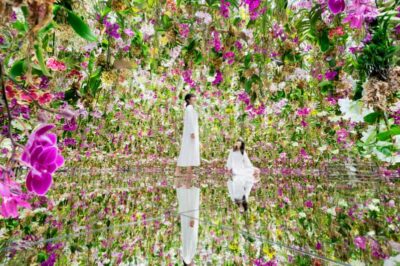
teamLab Planets TOKYO Digital Art Museum Entry Ticket
Read our review →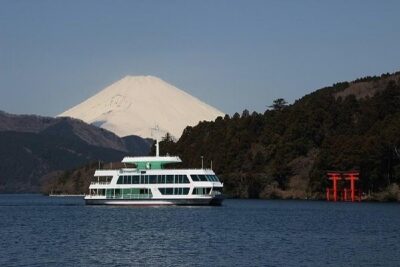
Mt Fuji & Hakone Cruise, Drum Show Bullet Train 1 Day from Tokyo
Read our review →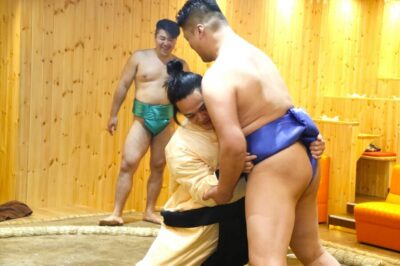
Sumo Show Experience with Chicken Hot Pot and a Photo
Read our review →
Shinjuku Food Tour (13 Dishes at 4 Local Eateries)
Read our review →
Tokyo Mt Fuji 5th St & Hakone Cruise Bus Tour w/Bullet Train
Read our review →
Flagship 2-Hours Official Street Go-Kart Tour – Tokyo Bay Shop
Read our review →Browse the lists this tour appears in