
Reviewed · TOKYO TOURS
Tokyo: Calligraphy Experience with yukata or Samue
Japanese calligraphy is much more than writing pretty characters. In this 90-minute Tokyo class, you learn how pressure, balance, and brush movement give each stroke its shape and feeling. The lesson also explains the spiritual ideas and history behind the characters, so your finished artwork carries more meaning than a quick souvenir-shop purchase.
I like two things right away: you make the artwork yourself, and you leave with the finished piece. I also like the warm extras, including tea, snacks, and the chance to wear a yukata or Samue. The main consideration is practical: clothing can get dirty, and the class is not suitable for children under four or people over 70.
Key points at a glance
- A real brush lesson, not a quick photo stop: You practice lines, brush handling, and kanji before creating a final work.
- Wear traditional clothing: The experience offers a yukata or Samue, adding a visual and cultural element to the class.
- English and French instruction: You can learn with an English-speaking or French-speaking instructor.
- Your name can become part of the souvenir: The instructor may write your name, adding a personal touch to the finished artwork.
- Small-group attention: Numbers are limited to 10 people, which matters when you need help with brush pressure and stroke order.
- Tea creates a calm pause: Japanese tea and snacks are included, giving the class an unhurried feel.
Why calligraphy makes a better souvenir than a shop purchase
Tokyo gives you no shortage of souvenirs, but a tube of sweets or a character keychain rarely brings the trip back to life. Calligraphy works differently. You spend time learning how to form a character, then take home the result of your own effort.
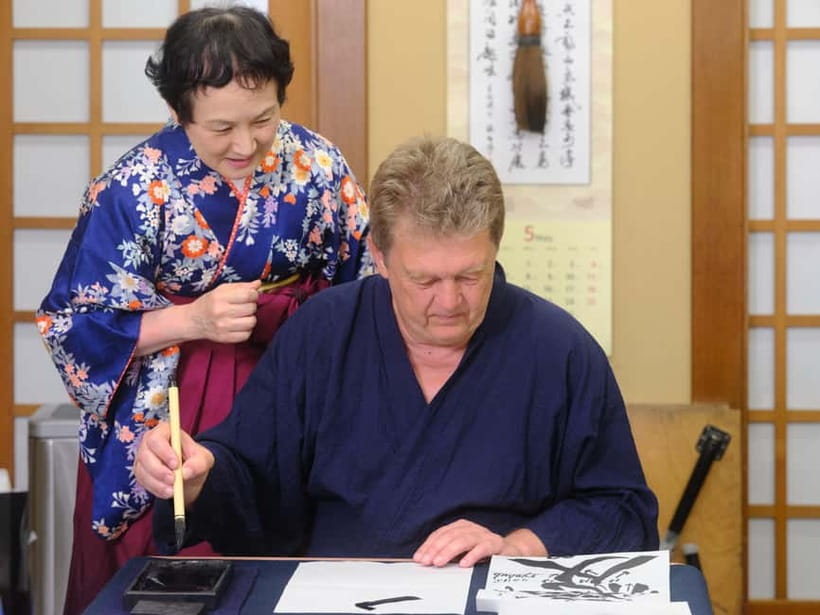
That effort is important. Beginners often discover that a brush does not behave like a pencil. Too much pressure makes a stroke heavy. Too little leaves it weak. The instructor helps you find the right movement, then gives you time to practice before asking you to make the final piece.
You also learn that Japanese characters are not just shapes to copy. The class covers their history, spirituality, and meaning. That context gives you a better sense of why calligraphy remains an important art in Japan, rather than treating it as a decorative activity.
The final work is made on a piece of card, according to the class format described by participants. It is easier to pack than a large framed artwork, though you should still protect it carefully in your luggage.
More Kimono Experiences in Tokyo
- Let’s make kimono !(Kimono is a gift for you
★ 5.0 · 252 reviews - Tokyo: Matcha and Kimono Experience
★ 4.7 · 219 reviews - Tokyo: Asakusa Kimono Dressing and Matcha Experience
★ 4.9 · 173 reviews
Arriving beside the nursery and temple
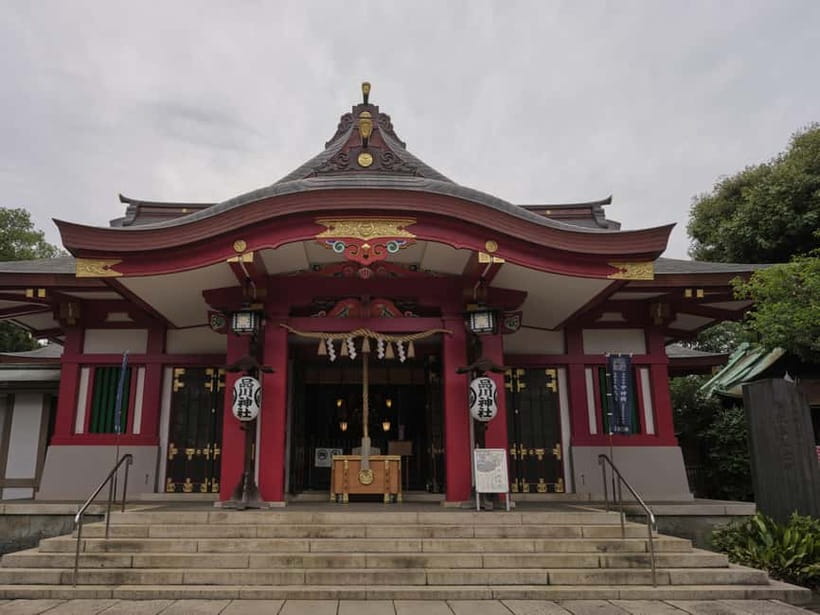
The meeting point is described as being next to a nursery, with Kaideiji beside it. The location information is brief and includes Japanese text, so I would copy the exact meeting details into your phone before leaving your hotel. If you are using a taxi, showing the Japanese address or meeting instructions should be easier than trying to explain the location in English.
Transportation to the meeting point is not included. Plan that part yourself, and allow a little extra time if you are unfamiliar with the area. This is a class with a fixed starting time, not a hop-on experience where you can stroll in whenever convenient.
The setting appears to support the tone of the lesson. You are not simply meeting at a large tourist attraction, taking a photograph, and moving on. The nearby nursery and temple reference help identify a more local meeting point, though the supplied details do not promise a temple tour or sightseeing stop. Come for the calligraphy itself.
The first minutes: tea, clothing, and introductions
The class begins with a welcome from the instructor. Tea and snacks are included, and this small pause helps you settle before the more careful work begins.
You can also put on a yukata or Samue. The clothing adds fun, especially if you are marking a birthday or celebrating a special day in Tokyo. Some people have described wearing kimono-style clothing during the early part of the activity, while the advertised options are yukata or Samue. Ask the instructor what is available when you arrive.
This is also the right moment to mention your preferred language. Instruction is offered in English and French. The provider is 日本書鏡院, and named teachers connected with the class include Hana, Koushi, and Tomo. The exact instructor may vary, so do not book based on one particular teacher unless the reservation page confirms that person.
Wear clothes that can get dirty. Ink and brushwork are not ideal companions for your finest dinner outfit, and traditional clothing does not remove that risk. A simple outfit underneath is the sensible choice.
Learning the brush one stroke at a time
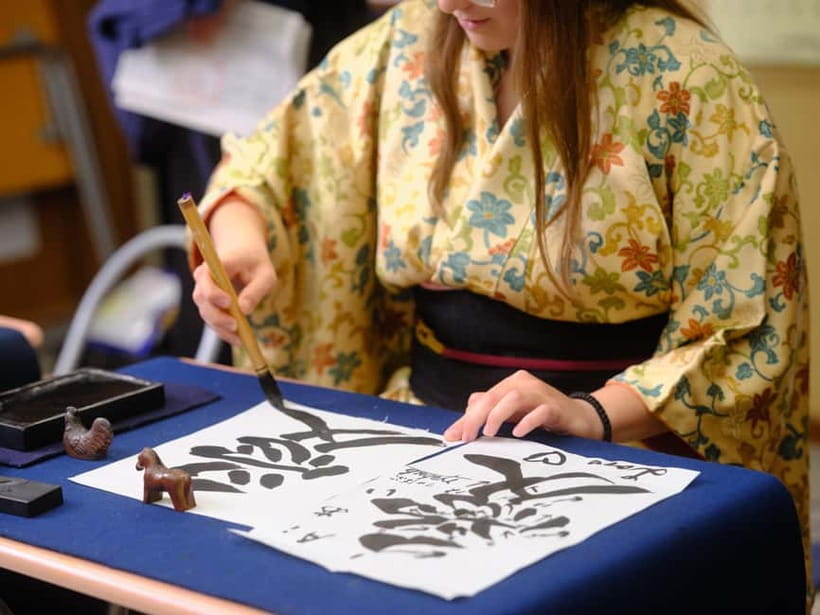
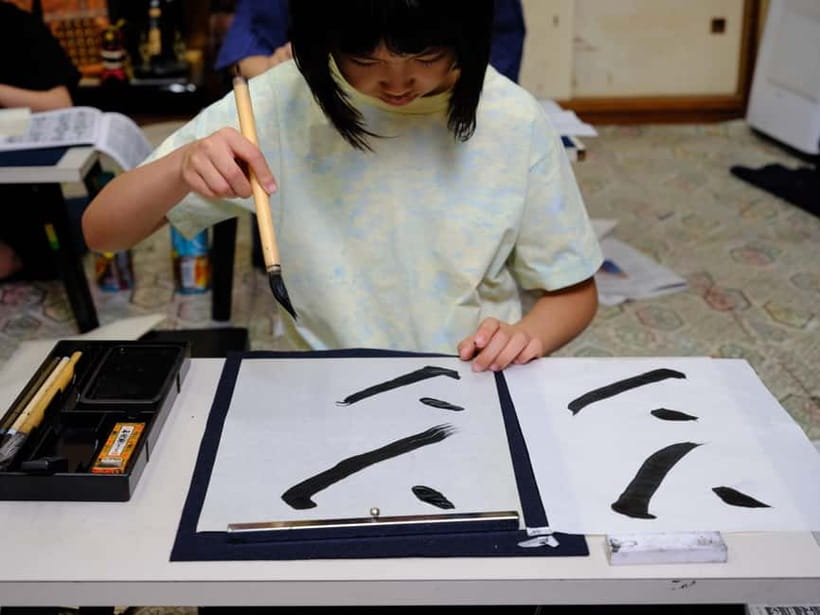
The teaching begins with basics. You learn how to hold and use the brush, then work on lines and controlled movements. This sounds simple until you try it. A brush can spread, taper, or wobble depending on the angle and pressure of your hand.
The instructor demonstrates the movement and guides you as you practice. That step-by-step approach is useful because Japanese calligraphy depends on order and motion, not only on the final shape. You are learning how a character is built, rather than tracing a finished example.
You should expect a hands-on lesson, not a long lecture. The class includes explanations of the characters’ spiritual and historical meaning, but the main activity remains practical. You hold the tools, make mistakes, adjust your technique, and try again.
This is where the small group matters. With up to 10 participants, the instructor has a reasonable chance to look at your work and correct your brush position. It is not the same as a private lesson, and the experience may feel busier if the group reaches its limit, but the format is still far more personal than a large demonstration.
More kimono rentals in Tokyo:
- Asakusa: Kimono Tea Ceremony with Matcha and Sweet
★ 4.9 · 153 reviews - Tokyo Asakusa: Traditional Kimono Rental Experience at Wargo
★ 4.7 · 87 reviews - Tokyo Asakusa: Miu Kimono Rental and Optional Photoshoot
★ 4.9 · 54 reviews - Tokyo: Kimono Rental inside Shinjuku Gyoen National Garden
★ 4.9 · 39 reviews
Choosing and writing your kanji
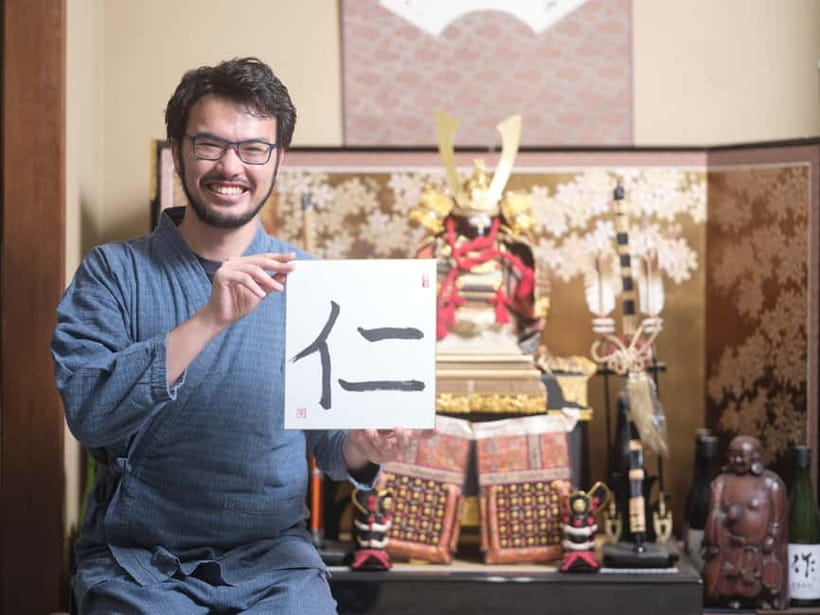
Once you have practiced the basic movements, you work toward a kanji of your own. The available information does not specify a fixed list of characters, so the choice may depend on the instructor and the class format. You will learn the meaning and structure of the character as you prepare to write it.
Take your time here. You do not need to chase the most complicated character. A simple kanji that connects with your trip, family, or personal interests may make a more satisfying souvenir than an elaborate symbol you cannot remember.
The teacher continues to guide you as you work. One especially personal touch is having your name written by the instructor. That gives you two keepsakes: your own practice and final work, plus a professionally written version of your name.
The class is not designed to turn you into a professional calligrapher in one sitting. It gives you a beginner’s understanding and a finished result you can feel proud of. If your final lines are not perfectly balanced, that is part of the point. You are taking home a record of learning an art, not buying a factory-made print.
Creating the final artwork
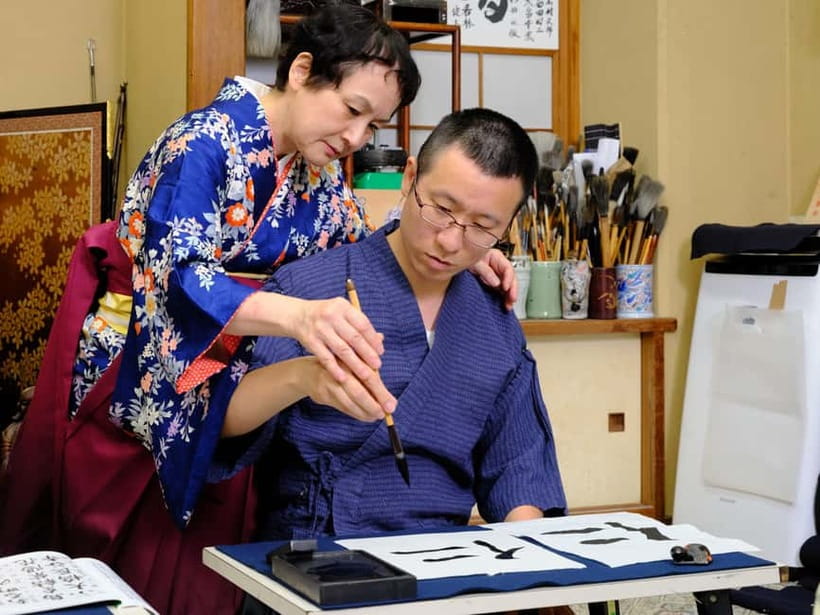
The last writing stage is the part most people anticipate. You move from practice paper to the final card or artwork, where each stroke suddenly feels more important.
This is when the instructor’s earlier advice becomes useful. Keep your arm relaxed. Watch the brush tip. Do not rush the beginning or ending of a stroke. You may get one chance to place a line exactly where you want it, so concentration becomes part of the experience.
The activity has a quiet, focused quality. Calligraphy asks you to slow down, even in a city as energetic as Tokyo. For families and friends, it also creates a shared project. Each person makes a different piece, and the results become easy to compare without turning the class into a competition.
A birthday booking could work especially well here. One family celebrated a daughter’s birthday with the class, and the instructor’s family helped with explanations and practical support. That does not mean every booking includes a birthday arrangement, but the format suits a small celebration.
Tea, conversation, and the cultural side of the class
The tea break is not just a drink added to the price. It gives the class a natural pause between instruction and final work. You can look at the tools, collect your thoughts, and talk with the teacher before returning to the brush.
The cultural explanation is one of the strongest reasons to choose this class over a basic craft workshop. You learn about the spirituality and history connected to Japanese characters, which helps explain why the writing is treated with such care.
The French option is useful for more than translation. A good explanation of stroke order and brush pressure needs precision, and several French-speaking participants found the instruction clear and comfortable. English instruction is also available, with an English-speaking guide included.
The atmosphere is intended to be welcoming and attentive. Teachers have been described as kind, patient, and artistically skilled. That does not guarantee that every instructor will teach in exactly the same style, but the class is built around personal guidance rather than a self-led worksheet.
Is $64 a fair price?
At $64 per person, this is not the cheapest cultural activity in Tokyo. You are paying more than the cost of buying a calligraphy brush and trying a few strokes at home.
The value comes from what is bundled into the 90 minutes. Your fee covers professional instruction, all calligraphy tools, the instructor, an English or French guide, tea, and your finished artwork. Traditional clothing is also part of the experience, with yukata or Samue available.
I consider the price reasonable if you want an organized cultural activity with a teacher and a physical souvenir. It is less compelling if you only want a quick photograph in traditional clothing or a ready-made piece of Japanese art.
The small-group limit of 10 helps justify the cost. You are not paying for a seat in a large hall where the instructor cannot see your work. You are paying for repeated practice, corrections, and help with the final piece.
There can be extra value for families and groups. One participant received help buying a calligraphy set afterward, and another received additional souvenirs. Those extras should not be treated as guaranteed inclusions, but you can ask the instructor about calligraphy supplies if you want to continue practicing at home.
Who should book this Tokyo calligraphy class?
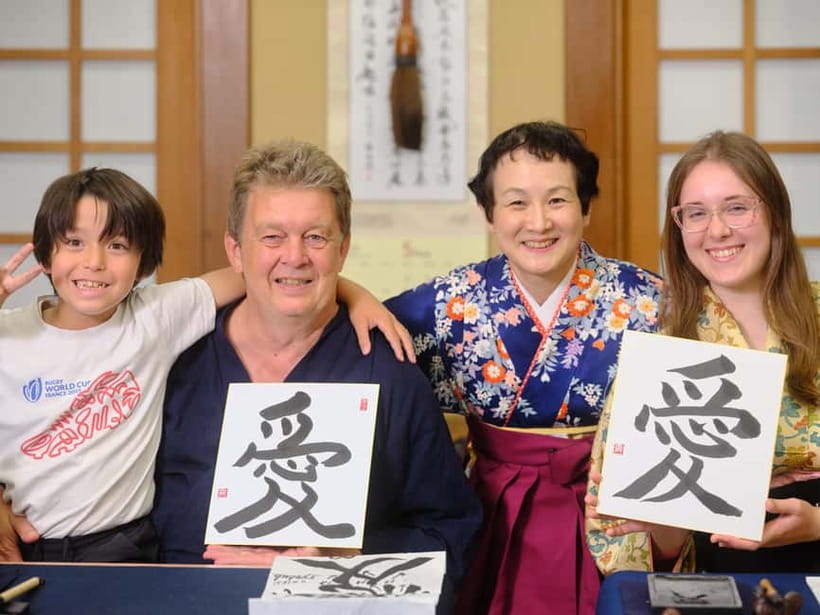
This class suits you if you want to do something with your hands and learn a little cultural background at the same time. It works especially well for:
- Couples looking for a quiet shared activity
- Families with children aged four and older
- Birthday groups and small celebrations
- First-time visitors who want a personal souvenir
- People interested in Japanese art, language, or spirituality
- French-speaking participants who prefer to learn in French
- Anyone who wants a break from Tokyo’s crowded sightseeing schedule
The experience may not suit you if you dislike focused, careful activities. Calligraphy demands patience. You will not spend the full 90 minutes posing for photos, and the finished work will reflect your beginner skill.
Age limits also matter. Children under four are not accepted, and the activity is not suitable for people over 70. The supplied information does not explain the reason for the upper age limit, so contact the provider if your group includes someone near that threshold or with a mobility concern.
Practical details that affect your choice
The class lasts 90 minutes. That is long enough for an introduction, practice, final work, and tea, but short enough to fit into a Tokyo sightseeing day.
You should check the available starting times before planning lunch, dinner, or another reservation. The activity has a set meeting point, and transportation is not included.
Cancellation is flexible: you can cancel up to 24 hours in advance for a full refund. You can also reserve now and pay later, which helps if your Tokyo schedule is still changing.
Bring clothes that can get dirty. Calligraphy tools are supplied, so you do not need to carry brushes, ink, or paper. Your finished work is included to take home.
The class is offered in English and French, and the group is limited to 10 people. Those details are particularly useful if your party includes children, several family members, or people who do not speak Japanese.
Should you book it?
I would book this class if you want a souvenir with a story behind it. The strongest features are the patient, step-by-step instruction, the chance to wear traditional clothing, the cultural explanation, and the fact that you create the final work yourself.
The $64 price makes sense for a guided small-group lesson with tea, tools, clothing, and an artwork to take home. I would skip it only if your schedule is too tight for a fixed 90-minute class, if you want a purely sightseeing-focused day, or if someone in your party falls outside the stated age range.
For most visitors, this is a thoughtful way to slow down in Tokyo. You leave with ink on paper, a better grasp of how Japanese characters are formed, and a souvenir that came from your own hand.
FAQ
How long does the Tokyo calligraphy experience last?
The activity lasts 90 minutes.
What languages are available?
Instruction is available in English and French.
Is traditional clothing included?
The experience offers a yukata or Samue for participants to wear. Some class sessions may describe the clothing as kimono-style.
Are calligraphy supplies provided?
Yes. All necessary calligraphy tools are included.
Can I take my artwork home?
Yes. Your finished calligraphy work is included as a souvenir.
What should I wear?
Wear clothes that can get dirty, since the activity uses ink and calligraphy tools.
Just added around Tokyo
- Private Arrival Transfer : Narita International Airport to Central Tokyo City★ 4.5 · 12 reviews
- Narita Airport(NRT): Private Transfer to Tokyo/Yokohama 1-9pax★ 5.0 · 47 reviews
- Private Transfer from Narita Airport to Yokohama Port and City★ 4.5 · 17 reviews
- [Narita Airport Terminals 1, 2] 40-60km Sawara Itako Historic Bike Tour★ 5.0 · 13 reviews
- 3 Day Japan Highlights Tour: Tokyo, Mt.Fuji, Nara, Kyoto, Osaka★ 5.0 · 22 reviews
- Small Town in the Big City: Tasting Tokyo’s Kichijoji★ 5.0 · 195 reviews
- Small Town in the Big City: Tasting Tokyo’s Kichijoji★ 5.0 · 16 reviews
- The 10 Tastings of Tokyo With Locals: Private Street Food Tour★ 5.0 · 48 reviews
Tokyo Tours, compared.

Mt Fuji and Hakone 1-Day Bus Tour Return by Bullet Train
Read our review →

teamLab Planets TOKYO Digital Art Museum Entry Ticket
Read our review →
Mt Fuji & Hakone Cruise, Drum Show Bullet Train 1 Day from Tokyo
Read our review →
Sumo Show Experience with Chicken Hot Pot and a Photo
Read our review →
Shinjuku Food Tour (13 Dishes at 4 Local Eateries)
Read our review →
Tokyo Mt Fuji 5th St & Hakone Cruise Bus Tour w/Bullet Train
Read our review →
Flagship 2-Hours Official Street Go-Kart Tour – Tokyo Bay Shop
Read our review →Browse the lists this tour appears in