
Reviewed · TOKYO TOURS
Tokyo: Sumo Morning Practice with Photo Banzuke and Guide
Sumo is most powerful when you see it at close range, before the polished tournament spectacle. At this morning practice, you sit in chairs inside a traditional stable and watch wrestlers train, clash, and repeat the same hard movements with serious focus. I like the small group of nine, which gives the guide room to explain what you are seeing. I also like the chance to learn the basics after practice, rather than simply taking photos and leaving.
The main drawback is time. The experience is listed as seven hours, and one part can feel slow if the group is delayed by late arrivals. You need to reach Exit B1 at Kiyosumi-Shirakawa Station on time, find the FamilyMart nearby, and accept that this is a structured group outing rather than a quick one-hour look at sumo.
Key points to know before booking
- Watch practice inside a real sumo stable, one of the few stables that permits outside observers.
- Sit in chairs, a useful detail for a long morning of watching training.
- See wrestlers of different sizes compete without weight classes, an unusual feature of sumo.
- Learn the rules and customs from an English-speaking local guide after the practice.
- Keep the group intimate, with no more than nine participants.
- Plan extra care around the meeting point, since late arrivals can hold up the start.
Why a morning stable visit feels different from a tournament
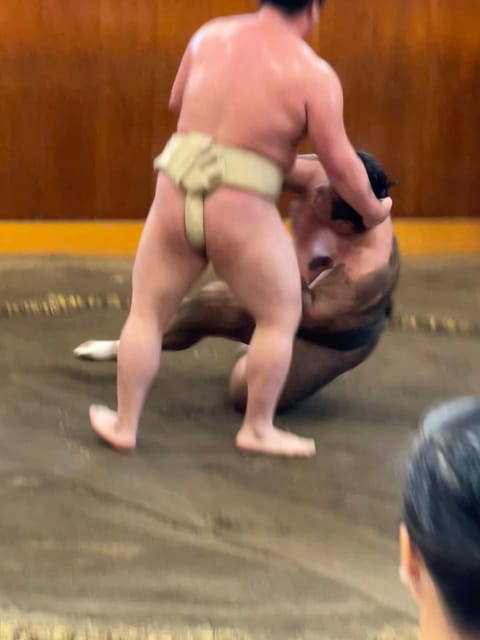
Tokyo’s major sumo tournaments run for only 90 days each year. A morning practice gives you another way to see the sport when no tournament is taking place, and it may offer a closer look at the work behind the public matches.
The setting matters. You are not sitting in a large arena with thousands of people around you. You enter a sumo stable, where wrestlers train as part of their daily routine. The activity is built around observation, so the best part is the chance to watch the wrestlers concentrate on technique and repetition.
Sumo has no weight classes. That fact becomes more meaningful when you see the athletes facing one another at close range. Size is part of the sport, but balance, timing, footwork, grip, and force all matter too. The guide helps put those moments into context, which is especially useful if you know sumo mainly from quick television clips.
You should also keep your expectations in check. This is practice, not a championship bout. The action may include drills, warm-ups, and training matches rather than a full tournament atmosphere. That is precisely why the visit can feel more genuine, but it also means the pace and intensity may vary.
More Sumo Experiences in Tokyo
- Tokyo: Sumo Show Experience with Chicken Hot Pot and a Photo
★ 4.8 · 6,678 reviews - Tokyo: Sumo Show and Dining Experience
★ 4.8 · 2,742 reviews - the SUMO show
★ 5.0 · 1,960 reviews
Meeting at Kiyosumi-Shirakawa Station
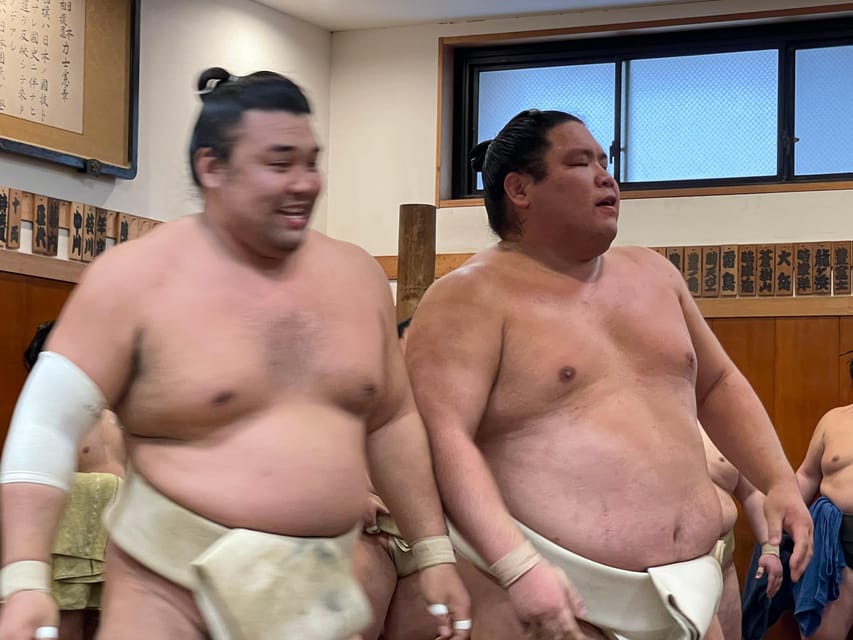
Your day begins at Exit B1 of Kiyosumi-Shirakawa Station, near a FamilyMart convenience store. The meeting instructions emphasize the station exit because it is easier for the guide to spot the group there, including people arriving by taxi.
I would treat this as a point where you want to be early, not merely on time. The group is small, but it still has to move together to the stable. A late arrival can affect everyone, and the guide may try to help if you are delayed, but the group takes priority.
The directions are fairly simple, yet one useful detail is worth remembering: wait at the front of the FamilyMart near Exit B1 rather than wandering around the station. That removes the most likely source of confusion. Save the provider’s contact details before leaving your hotel in case transport problems slow you down.
Kiyosumi-Shirakawa is also a practical starting point for this experience. The stable is described as being only 14 minutes from Otemachi and Tokyo Station, making the activity reasonably convenient if you are staying near central Tokyo. The meeting point itself is not at Tokyo Station, so allow enough time to reach Kiyosumi-Shirakawa.
The walk and the first 15 minutes with your guide
After meeting, you begin with a guided portion of roughly 15 minutes. This is likely when the guide explains the plan, checks the group, and leads you toward the stable.
The walk is short enough that comfortable shoes should be sufficient, but you should still wear footwear you can use for a full day out. The total experience lasts seven hours, and the itinerary also includes two walking sections of about 10 minutes each. This is not a demanding walking tour, but it is longer than the stable visit alone.
The guide’s role is important from the start. Sumo has its own vocabulary, manners, rankings, rituals, and training customs. Without some background, you may see bodies colliding without understanding why one wrestler wins a bout or why a particular movement matters.
The English-language guide provides that bridge. The information supplied does not name the individual guides, so you should not expect a specific person by name. What you can expect is a live English presentation from a local guide, with a focus on the basics rather than a long academic lecture.
Sitting close to the training action
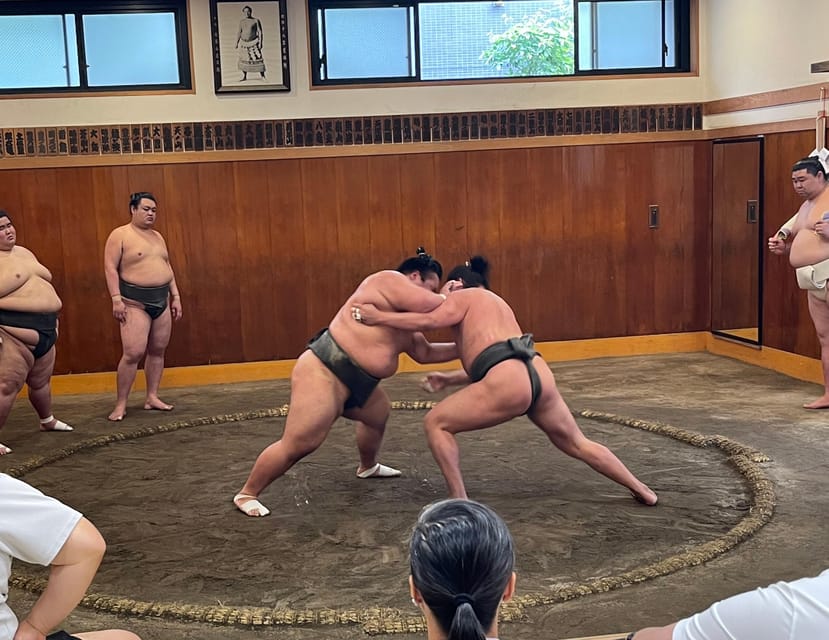
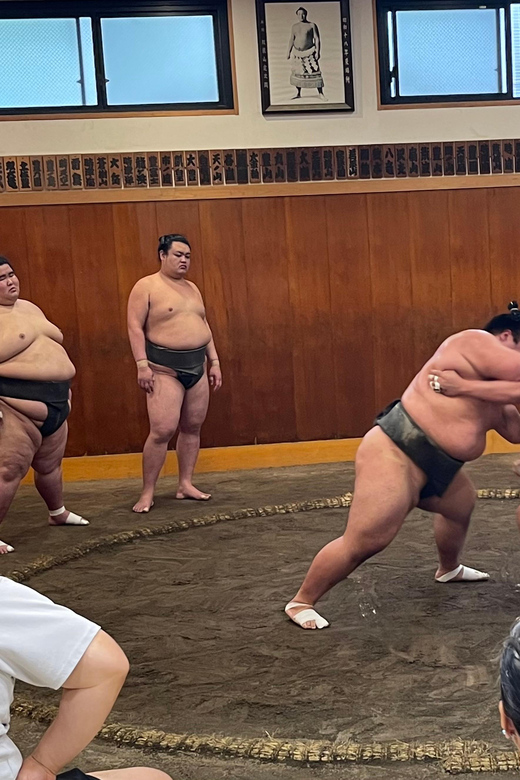
The central part of the outing lasts about two and a half hours. You sit in chairs and watch the wrestlers train inside the stable. That seating detail is easy to overlook, but it makes a real difference. Sumo practice requires patience, and standing for the entire session would make it harder to pay attention.
At close range, the sport’s physical force should be clear. Sumo is not just about two large men pushing forward. Wrestlers work on balance, positioning, grips, movement, and the ability to remain upright under pressure. Repeated practice is part of the point.
The stable also gives you a look at the sport away from its tournament presentation. There are no claims here that you will see a famous champion or a particular training routine, so you should not book this expecting a guaranteed star sighting. The appeal is the setting and the access to an active practice session.
You will need to observe respectfully. The activity is built around watching, not joining in, and the stable is a working place. The supplied information does not list detailed etiquette rules, so follow the guide’s instructions closely once inside. Keep your camera ready, but do not let photography distract you from the practice itself.
The morning timing is another advantage. Training provides a look at the wrestlers before their next major match, and the session has a more workmanlike feel than a staged demonstration. If you enjoy seeing how a traditional sport is prepared and maintained, this is likely the strongest part of the day.
More sumo mornings and shows:
- Tokyo Shinjuku Sumo Show & Experience with Photo
★ 5.0 · 1,750 reviews - Tokyo: Sumo Show and Experience in Shinjuku
★ 4.8 · 1,001 reviews - Tokyo: Sumo Tournament Tour with Chair Seat Tickets
★ 4.6 · 753 reviews - Tokyo:Luxury Sumo Show Experience & Japanese cuisine & Drink
★ 4.7 · 577 reviews
What the guide adds after practice
After the practice, the guide gives a short presentation on the basics of sumo. This is not an optional extra tacked onto the end. It helps you understand what you have just watched.
You can expect an introduction to the fundamentals of the sport, including the broad idea of how wrestlers win and how matches work. The exact lesson plan is not specified, so I would not book this for a detailed course in ranking systems or stable management. Think of it as a clear orientation that lets you carry more understanding into the rest of your time in Japan.
That explanation is valuable because sumo can look simple from a distance. Two wrestlers enter the ring, push or throw one another, and one leaves first. In practice, small shifts in balance and foot placement can decide the result. A guide who explains those details gives you a better way to watch.
The guide also helps connect the practice to sumo’s place in Japan. It is the country’s national sport, with traditions that reach well beyond the contest itself. You get more from the stable visit if you pay attention to those customs instead of treating the morning as a photo opportunity alone.
The Photo Banzuke stop
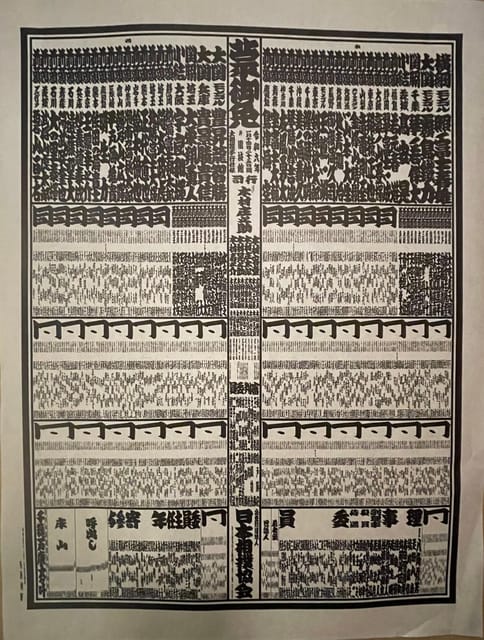
The experience includes a 15-minute photo stop and is sold as a sumo morning practice with Photo Banzuke. This gives you a short, defined moment for photographs after the main observation period.
A banzuke is associated with sumo rankings, and the Photo Banzuke element adds a visual keepsake to the day. The supplied details do not explain exactly what the photo setup includes, so I would see it as a modest photo portion rather than a long portrait session.
Bring a camera, as suggested. A phone is likely useful for ordinary pictures, but the stable’s rules and the guide’s instructions should determine when you can take photographs. You may find that the most meaningful images are not posed ones, but the quiet moments of training, the ring, and the wrestlers preparing for another bout.
The 15-minute limit keeps the photo stop from taking over the day. If you want a large collection of carefully arranged portraits, this may not meet that goal. If you want a few reminders of a rare cultural experience, it should be enough.
Walking back and the seven-hour schedule
The itinerary includes two additional walking sections of about 10 minutes each before returning to Kiyosumi-Shirakawa Station. The full activity is listed as seven hours, even though the main practice itself lasts about two and a half hours.
That longer schedule is the key practical issue. Some of the time includes meeting, walking, explanations, the photo stop, and group movement. The precise order of every segment is not fully spelled out, so you should keep the morning and much of the afternoon open.
One person specifically found the experience longer than expected and wanted to leave early to make better use of a sunny day in Tokyo. That is useful advice. If you have a packed sightseeing schedule, this outing may take more time than you want, even though the stable visit itself is the main attraction.
Leaving early may also be awkward because this is a group activity. If you already know you cannot stay for the entire period, tell the guide at the start. You should not assume that the group can simply wait while you depart or change plans.
Is $115 good value?
At $115 per person, this is not a cheap way to fill an hour in Tokyo. The price needs to be judged against access, not just duration.
Only a select number of Japan’s 44 operating sumo stables allow outside observers at morning practice. That limited access is the main reason the cost can make sense. You are paying for entry to a working sumo environment, a local English-speaking guide, the post-practice explanation, and a small group capped at nine people.
The group size is especially helpful here. In a large tour, the guide would have less room to answer questions and the stable could feel more crowded. With nine people or fewer, you have a better chance of hearing the explanation and staying organized during the walk.
The value is strongest if sumo is a major interest for you, or if you want a cultural experience that is not simply a museum visit. It is weaker if you are mainly looking for a quick Tokyo activity, a guaranteed famous wrestler, or a full competition in an arena.
You can also reduce the financial risk by booking with the stated flexible terms. You may cancel up to 24 hours ahead for a full refund, and the reserve-now, pay-later option lets you hold a place without paying immediately. Those policies are useful when your Tokyo schedule is still moving, but they do not change the need to attend on time.
Who should book this sumo experience?
I would recommend it most strongly to adults and older children who already have some curiosity about sumo. Children under nine are not accepted, so families with younger children should choose another activity.
It also suits you if you prefer small-group experiences and want a guide to explain what you are seeing. The practice may be quiet and repetitive at times, which is part of its authenticity. If you need constant action, you may find the two-and-a-half-hour observation period long.
The experience is wheelchair accessible according to the supplied details. You should still confirm any personal mobility requirements when booking, since the day includes walking sections and movement between the station, stable, and other stops.
It is a good match for a first visit to Tokyo if you want one activity tied closely to Japanese tradition. It may be less suitable on a day when you plan to cover several distant sights, since the seven-hour duration leaves limited room for other plans.
My practical verdict
I like this experience because it gives you access to a side of sumo that most short city tours cannot provide. Sitting in a stable and watching wrestlers train is more revealing than seeing only a polished tournament match. The guide’s explanation also helps you understand the sport instead of leaving with nothing but photographs.
The schedule is the catch. Seven hours is a serious block of time, and late arrivals can slow the group. Meet early at Exit B1 by the FamilyMart, wear comfortable shoes, bring a camera, and keep the rest of your day flexible.
Book it if you value close cultural access, a small group, and a real training setting. Skip it if you want a fast stop, a guaranteed tournament, or a tightly packed sightseeing day. At $115, it earns its price through access and context, not through speed.
FAQ
Where does the sumo experience begin?
It begins at Exit B1 of Kiyosumi-Shirakawa Station, near a FamilyMart convenience store.
How long does the activity last?
The stated duration is seven hours. The schedule also includes a 15-minute guided section, about two and a half hours of guided activity, a 15-minute photo stop, and walking sections of about 10 minutes each.
How long is the sumo practice observation?
The main guided practice portion is listed as approximately two and a half hours.
Can I sit during the practice?
Yes. Chairs are provided so you can sit while watching the wrestlers train.
Is the guide available in English?
Yes. The activity includes a live English-speaking local guide.
How many people are in the group?
The group is limited to nine participants.
Are children allowed to join?
Children under nine years old are not permitted to take part.
Can I cancel for a refund?
You can cancel up to 24 hours in advance for a full refund. The reserve-now, pay-later option is also available.
More Morning in Tokyo
- Tokyo: Sumo Morning Practice Viewing Tour
★ 4.8 · 570 reviews - Tokyo: Sumo Morning Training Visit
★ 4.4 · 370 reviews - Tokyo: Sumo Morning Practice Tour at Sumida City
★ 4.8 · 308 reviews - Tokyo Sumo Morning Practice Tour at Stable
★ 5.0 · 298 reviews
Just added around Tokyo
- Private Arrival Transfer : Narita International Airport to Central Tokyo City★ 4.5 · 12 reviews
- Narita Airport(NRT): Private Transfer to Tokyo/Yokohama 1-9pax★ 5.0 · 47 reviews
- Private Transfer from Narita Airport to Yokohama Port and City★ 4.5 · 17 reviews
- [Narita Airport Terminals 1, 2] 40-60km Sawara Itako Historic Bike Tour★ 5.0 · 13 reviews
- 3 Day Japan Highlights Tour: Tokyo, Mt.Fuji, Nara, Kyoto, Osaka★ 5.0 · 22 reviews
- Small Town in the Big City: Tasting Tokyo’s Kichijoji★ 5.0 · 195 reviews
- Small Town in the Big City: Tasting Tokyo’s Kichijoji★ 5.0 · 16 reviews
- The 10 Tastings of Tokyo With Locals: Private Street Food Tour★ 5.0 · 48 reviews
Tokyo Tours, compared.

Mt Fuji and Hakone 1-Day Bus Tour Return by Bullet Train
Read our review →

teamLab Planets TOKYO Digital Art Museum Entry Ticket
Read our review →
Mt Fuji & Hakone Cruise, Drum Show Bullet Train 1 Day from Tokyo
Read our review →
Sumo Show Experience with Chicken Hot Pot and a Photo
Read our review →
Shinjuku Food Tour (13 Dishes at 4 Local Eateries)
Read our review →
Tokyo Mt Fuji 5th St & Hakone Cruise Bus Tour w/Bullet Train
Read our review →
Flagship 2-Hours Official Street Go-Kart Tour – Tokyo Bay Shop
Read our review →Browse the lists this tour appears in