
Reviewed · KYOTO TOURS
Kyoto: Japanese Calligraphy Workshop
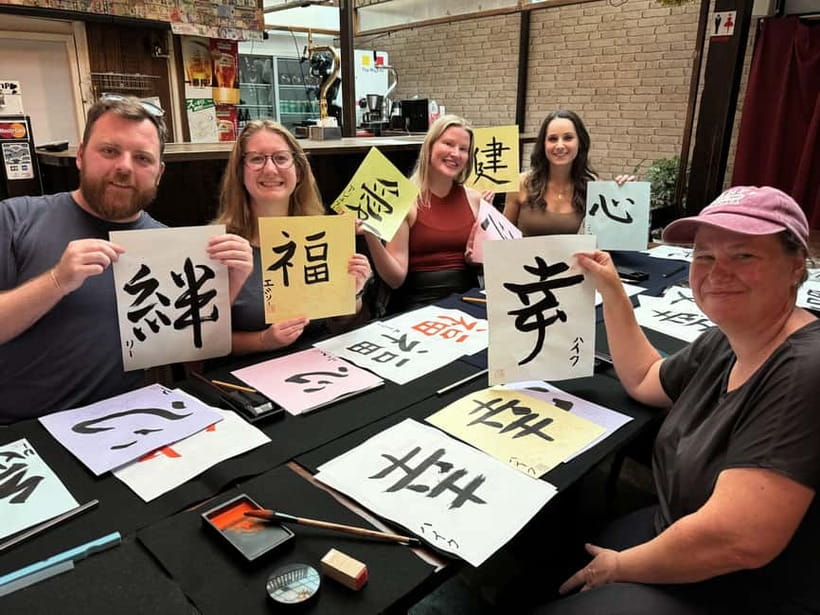
Japanese calligraphy here is not a quick souvenir stamp. You sit down with brush, ink, and rice paper, then learn how a few controlled strokes become a kanji character. Instructor Takako leads beginners step by step, and you finish with your own signed work.
I like the small group of up to 10, which gives the teacher and her helpers time to correct your hand position and stroke order. I also like the personal keepsake: you can write a character and your name in kanji, then take home a finished piece signed and stamped by the instructor.
The main consideration is the short format. One to two hours is enough for a satisfying introduction, not a full course in shodo. Children under 10 cannot join, and you need to reserve at least one day ahead.
Key points at a glance
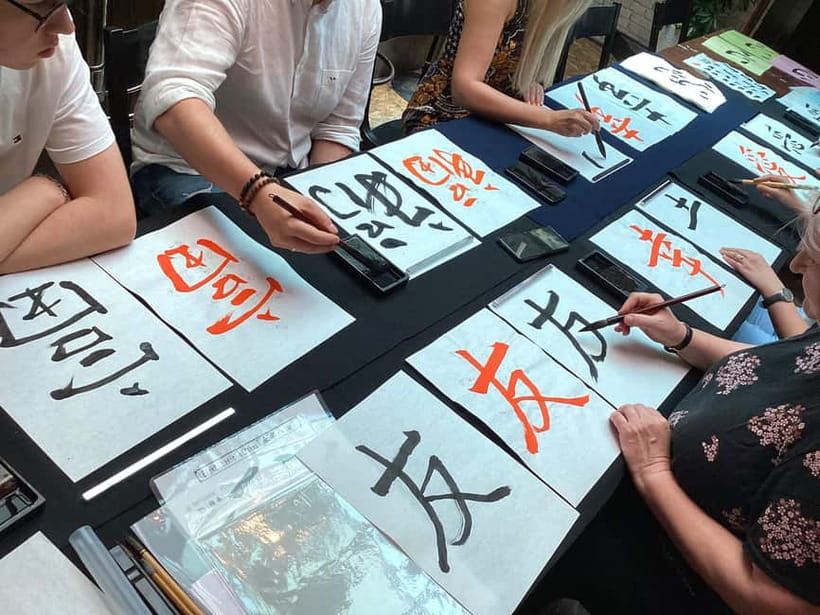
- Practice comes before the final artwork: You work through basic brush strokes before attempting kanji.
- Takako teaches with patience: English and Japanese instruction is available, with individual help during the exercises.
- Your name can become part of the lesson: The workshop includes guidance on writing names in kanji.
- You leave with more than practice sheets: Your finished calligraphy can be signed, stamped, and taken home.
- Gojo Paradiso is easy to reach: The venue sits by the Takase River on Kiyamachi Street, close to Keihan stations.
- $32 buys a compact cultural activity: Supplies, instruction, and a small group are included.
What this Kyoto calligraphy workshop feels like
The appeal of this class is its scale. You are not watching a performer demonstrate calligraphy from across a room. You are holding the brush yourself, making mistakes on practice paper, and slowly learning why each stroke needs a particular direction and pressure.
That hands-on work makes Japanese calligraphy easier to understand. A kanji character can look simple when finished, but its shape depends on rhythm, balance, and stroke order. The teacher breaks that process into manageable pieces so you can focus on one mark at a time.
The mood is also quieter than many sightseeing activities. The class takes place at Gojo Paradiso, a venue along the Takase River on Kiyamachi Street. The setting gives the workshop a calm change of pace after Kyoto’s temples, shopping streets, and busy transport hubs.
You should think of this as a cultural lesson with an art project at the end. You will not become a calligraphy master in one sitting. You will, however, gain a practical feel for the brush and leave with something far more personal than a standard shop-bought souvenir.
More hands-on workshops in Kyoto:
- Kyoto: 45-Minute Tea Ceremony Lesson Experience
★ 4.3 · 2,378 reviews - Ramen Cooking Class at Ramen Factory in Kyoto
★ 5.0 · 1,937 reviews - Kyoto : Chopsticks Making Workshop in Gion with Engraving Option
★ 5.0 · 958 reviews
Arriving at Gojo Paradiso by the Takase River
Gojo Paradiso is about a five-minute walk from Keihan Kiyomizu Gojo Station and about ten minutes from Keihan Shichijo Station. The stated distance from Kiyomizu Gojo Station is 386 meters, so this is a convenient stop to add to a day in central Kyoto.
The address is along the Takase River on Kiyamachi Street. Allow a little extra time to find the exact entrance, especially if you are walking from another part of central Kyoto. The meeting point is not described as a major transport terminal, so checking your route before leaving is sensible.
This location works well in a Kyoto itinerary because the activity does not take up a whole day. A session lasts from one to two hours, depending on the starting time and class flow. You can place it between sightseeing stops instead of giving up an entire morning or afternoon.
The venue is wheelchair accessible, which is useful for visitors who need step-free access. The supplied details do not specify every feature of the route or restroom facilities, so anyone with particular access needs should confirm those points before booking.
The opening lesson: brush, ink, and the meaning of shodo
The class begins with an introduction to shodo, the Japanese art of calligraphy. You learn about its background and the meaning behind the practice before moving into the physical work.
That opening matters. Without it, calligraphy can feel like copying attractive symbols. With a little context, you begin to see the character as a combination of form, movement, and meaning. The teacher also helps you understand what you are writing, rather than asking you to reproduce marks with no explanation.
All necessary supplies are provided. The materials have been described as high quality, and the session includes the paper, brush, ink, and other items needed for the exercises. You do not need to arrive with art supplies or previous knowledge.
The teaching languages are English and Japanese. Takako has been praised for clear English explanations, patience, and encouragement. Two helpers have also assisted during some sessions, giving the instructor more time to work with people individually.
That individual attention is important for first-timers. Brush pressure is not easy to judge by watching alone. A teacher can show you how to change the angle, slow down a stroke, or leave the right amount of white space. Small corrections make the activity much less frustrating.
Learning the basic strokes before writing kanji
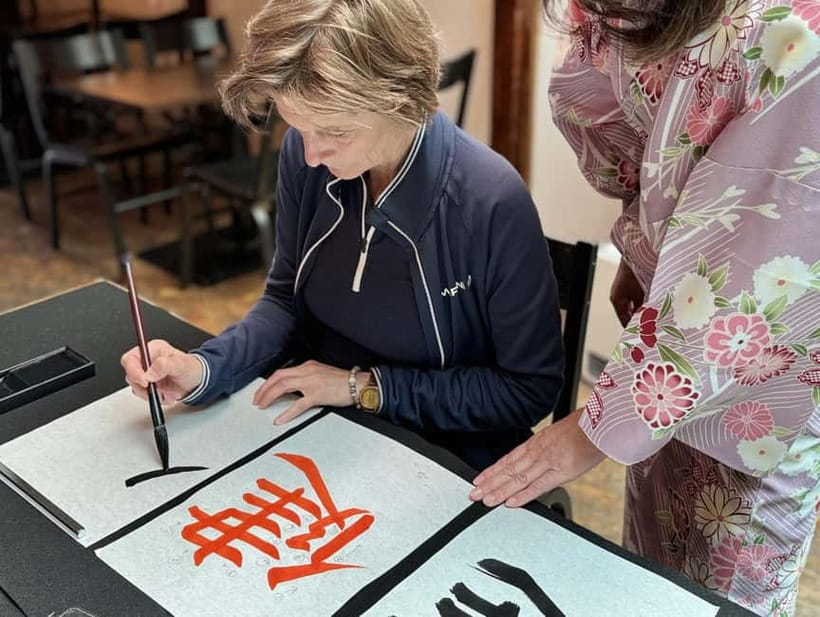
The first practical stage focuses on basic brush strokes. You practice lines and shapes before moving on to complete characters.
This is the part where you should resist the urge to rush. A brush does not behave like a pencil. The movement needs control, but it also needs a steady flow. Your early attempts may look uneven, and that is normal for a first class. The point is to learn how the brush responds.
The exercises give the class a clear rhythm. You watch a demonstration, try it yourself, and receive guidance before moving on. The format suits beginners who may feel nervous about producing a finished character in front of an instructor.
I like this step because it makes the final piece feel earned. You are not simply handed a template and told to fill it in. You build toward the artwork through practice, and the teacher can adapt her help to your progress.
The class is suitable for people with some prior calligraphy experience too, but the information provided is aimed strongly at beginners. If you already study shodo, you should expect an introduction rather than an advanced technical session.
A few more Kyoto half-days to weigh up
- PERFECT KYOTO 1-Day Bus Tour
★ 5.0 · 13,518 reviews - Kyoto: Fushimi Inari, Kinkakuji, Bamboo Grove 1 Day Bus Tour
★ 4.8 · 4,316 reviews - Kyoto: Tea Ceremony in a Traditional Tea House in Kiyomizu
★ 4.9 · 3,519 reviews - Kyoto Geisha Walking Tour: Gion District & Hidden Gems
★ 4.7 · 3,273 reviews
Choosing a kanji character and writing your name
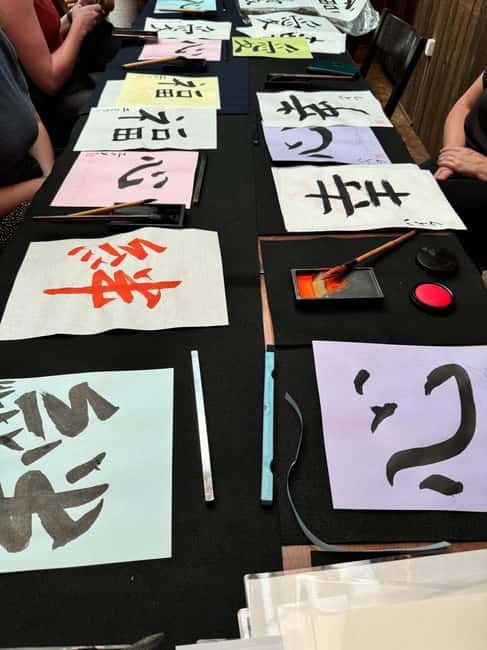
After the basic strokes, you move on to writing kanji characters. The teacher guides you through the structure and movement needed to create a complete piece.
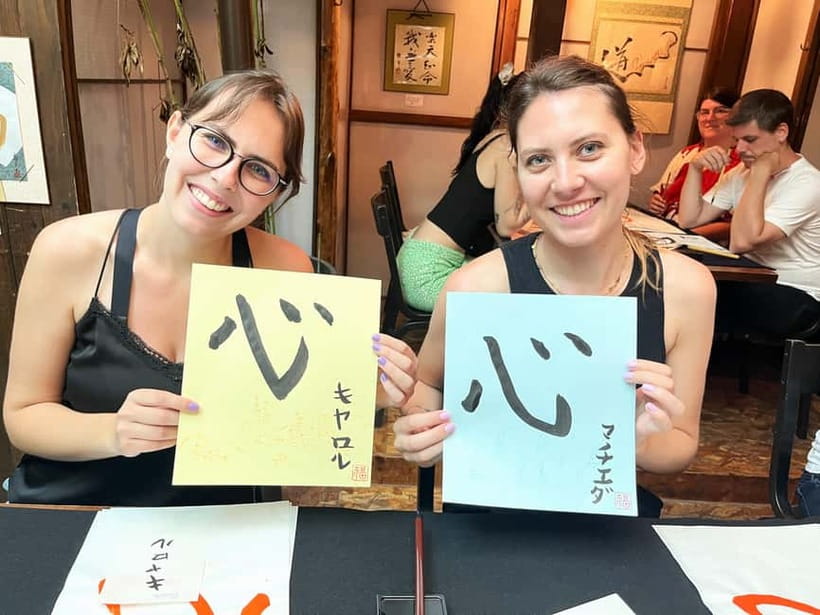
A particularly nice touch is the chance to write your name in Japanese. The activity information does not promise a particular translation or character choice, so the precise result depends on the class and your name. Still, this part gives the souvenir a clear connection to you rather than to Kyoto in general.
You may also work with a character that has personal meaning. The supplied details do not list a fixed menu of characters, so you should not assume that every possible word is available. The useful point is that the lesson moves beyond random practice marks and toward a finished, meaningful design.
The teacher’s role is central here. Takako has been described as encouraging and willing to spend time with each person during the exercises. That matters when you are trying to balance the character on the page. One heavy stroke can change the whole look, and a calm instructor helps you keep going instead of abandoning the brush.
Finishing the artwork on rice paper
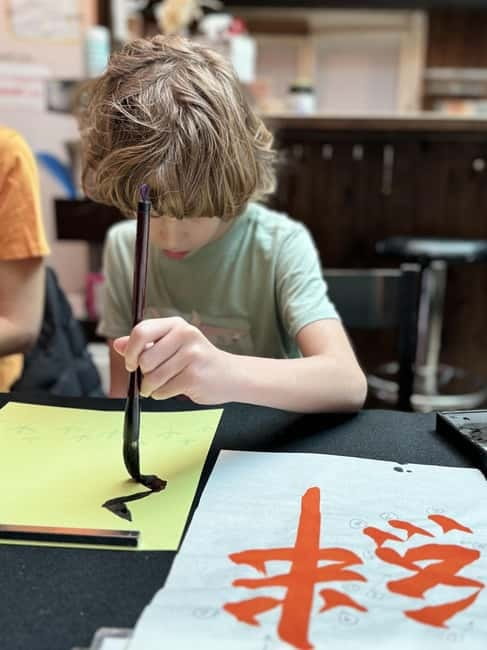
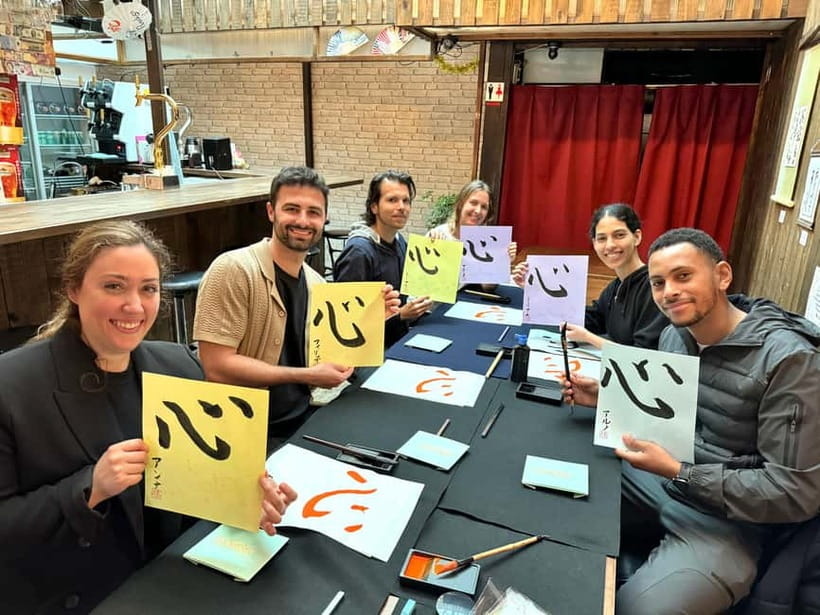
The final stage turns your practice into a keepsake. You create a calligraphy piece on rice paper, sign your name in kanji, and have the teacher add her stamp.
The stamp is a small detail, but it gives the work a traditional finished look. Your paper will still be the work of a beginner, and that is part of its charm. The value comes from the process and the memory attached to it, not from pretending you produced museum-quality calligraphy.
One especially generous detail has been the inclusion of a handmade calligraphy gift from the teacher, accented in gold. This is not a point I would treat as guaranteed unless it is confirmed at booking, since extras can change. The main promised keepsake is your own calligraphy creation.
The class also includes a chance to take photos at the end. You can look around the gallery and place special orders during this closing portion. That gives you a little time to enjoy the setting rather than packing up the instant your brushwork is finished.
If you plan to carry the piece around Kyoto afterward, bring a folder or another way to protect flat paper. The activity details do not state how the artwork is packaged, so it is wise to avoid folding or crushing it in a crowded day bag.
Why the small group matters
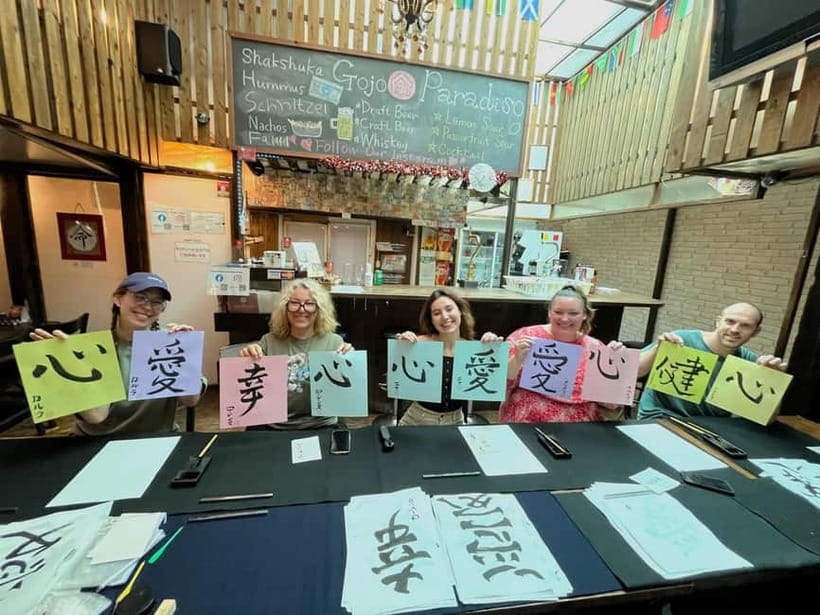
The limit of 10 participants is one of the strongest features for a practical reason: calligraphy requires close observation.
In a large class, you might spend much of the session watching from a distance or waiting for help. Here, the teacher and helpers can look at each person’s strokes and offer corrections. That is especially helpful when several people in the group are complete beginners.
A small class can also make the activity feel less formal. You are learning alongside a few other people, trying something unfamiliar together, and seeing that imperfect strokes are part of the process. The atmosphere is interactive rather than lecture-based.
The tradeoff is that small groups have limited places. Reservation is required at least one day in advance, so this is not the activity to leave until the morning of a rainy day. Starting times vary, and you need to check availability for your date.
The class is not suitable for children under 10. Older children can join only if they meet the activity requirements and are comfortable with a focused art lesson. The supplied information does not describe a separate children’s program.
Is $32 a good value in Kyoto?
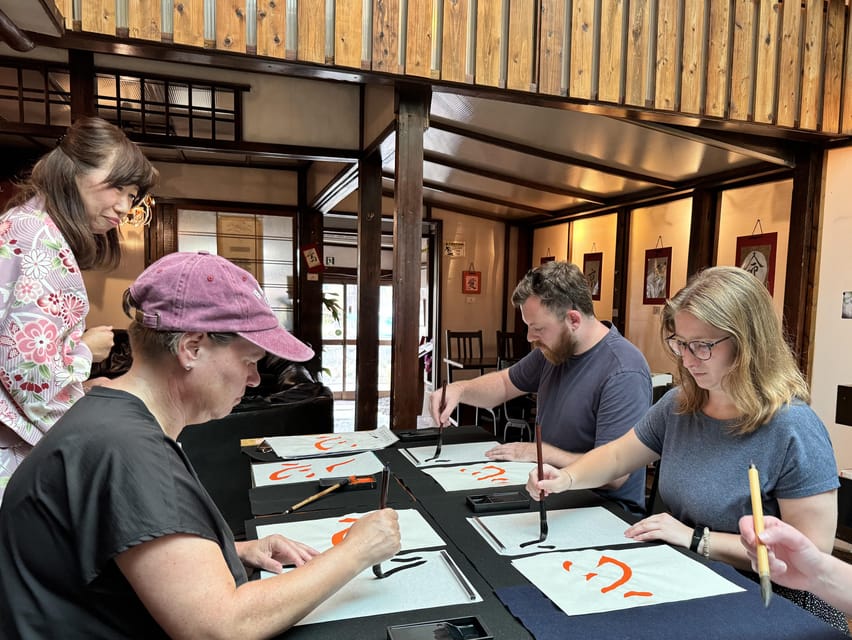
At $32 per person, the workshop offers solid value for a short cultural activity. The fee includes an expert instructor, all necessary supplies, and your finished calligraphy. You are paying for instruction and materials, not just admission to a venue.
The value is strongest if you want a personal souvenir. Kyoto has no shortage of attractive objects to buy, but a piece you create yourself carries a different memory. The kanji, your name, the rice paper, and the teacher’s stamp make it specific to your visit.
The price is also reasonable for a one to two-hour session in a central location. You do not need to arrange transport outside the city, and the short duration leaves room for temples, meals, or an evening walk.
There are limits. If you want a long, technical study of Japanese calligraphy, $32 will not buy that. This is a beginner-friendly introduction, not a multi-day apprenticeship. You should book it for the guided activity and finished keepsake, not the promise of professional-level skill.
Free cancellation up to 24 hours before the start time and the option to reserve now and pay later add useful flexibility. The reservation still needs to be made at least one day in advance, so flexible payment does not mean last-minute access.
Who will enjoy this activity most?
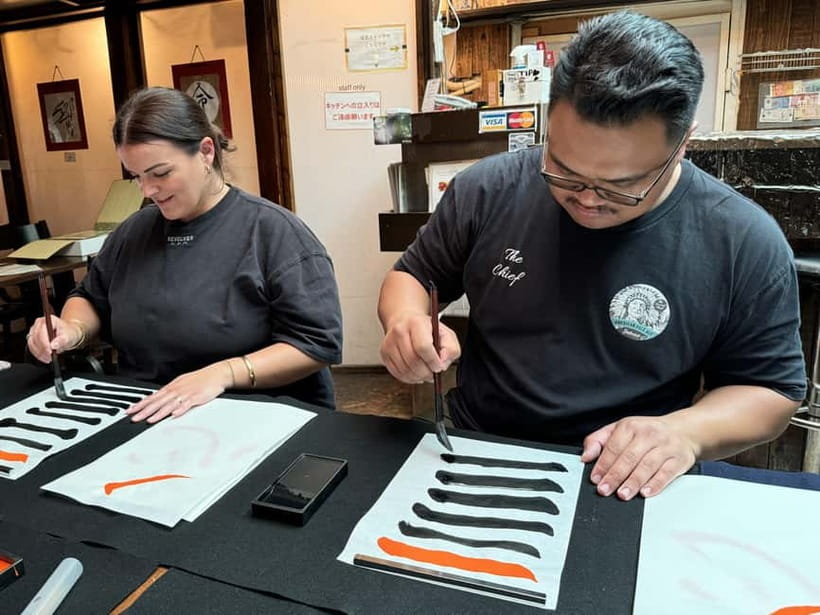
I would recommend this workshop to first-time visitors who want a cultural activity with something tangible at the end. It suits couples, friends, solo visitors, and families with children aged 10 or older.
It is also a good choice for anyone who prefers a quiet, focused experience. You do not need to be artistic, and the instruction is designed to lead you through the process. If you enjoy crafts, lettering, or trying local traditions with your hands, you will get more from it.
The workshop works well for people who are curious about Japanese writing but cannot read kanji. You learn by doing, and the teacher explains the meaning and structure rather than expecting you to arrive prepared.
I would be more cautious about booking it for a person who dislikes repetitive practice or wants a fast-moving sightseeing tour. The basic strokes are necessary, and the class asks you to pay attention to small movements. It is relaxing for some people, but it may feel slow if you want constant action.
Calligraphy enthusiasts should also set their expectations properly. The class can give you a pleasant foundation, but the supplied information does not indicate advanced instruction, specialist historical study, or a longer practice course.
Practical details before you reserve
The class is held in English and Japanese, with English guidance available. This removes a major barrier for visitors who do not speak Japanese, though calligraphy still includes visual instruction and hands-on demonstration.
The group size is limited to 10 people. Reserve at least one day ahead, then check the available starting times for your date. The activity lasts one to two hours, so look at the full schedule rather than assuming every session takes the same amount of time.
Gojo Paradiso is approximately five minutes from Keihan Kiyomizu Gojo Station and 10 minutes from Keihan Shichijo Station. It is wheelchair accessible. The meeting point is on Kiyamachi Street beside the Takase River.
Wear something comfortable and be ready to work with ink. The supplied information does not state whether protective clothing is provided, so sensible clothing is a good idea. Plan how you will carry your rice paper after class, too.
Cancellation is free up to 24 hours before the activity for a full refund. You can also reserve without paying immediately, which helps if your Kyoto schedule is still taking shape.
Should you book the Gojo Paradiso calligraphy workshop?
Book it if you want a reasonably priced, beginner-friendly cultural activity in central Kyoto and like the idea of making your own souvenir. The strongest reasons are the patient instruction from Takako, the small group, the individual help, and the chance to finish with signed and stamped calligraphy on rice paper.
Skip it if you are looking for an advanced shodo course or a long, detailed study of calligraphic technique. One to two hours gives you a useful introduction, not mastery.
For most visitors, the balance is right. You learn a little about shodo, practice the brush yourself, write kanji and possibly your name, and leave with a piece that recalls your time in Kyoto. At $32, that is a fair exchange for an hour or two spent doing something rather than simply looking.
FAQ
Where is the Japanese calligraphy workshop held?
The workshop is held at Gojo Paradiso along the Takase River on Kiyamachi Street in central Kyoto.
How far is Gojo Paradiso from Kiyomizu Gojo Station?
Gojo Paradiso is about a five-minute walk from Keihan Kiyomizu Gojo Station, or approximately 386 meters.
How far is the venue from Keihan Shichijo Station?
The venue is about a 10-minute walk from Keihan Shichijo Station.
How long does the workshop last?
The activity lasts between one and two hours. Starting times vary, so check availability for your chosen date.
What languages does the instructor speak?
Instruction is available in English and Japanese.
Is the workshop suitable for complete beginners?
Yes. The class begins with an introduction to calligraphy and basic brush strokes before moving on to kanji characters.
Can I take my calligraphy home?
Yes. You create your own calligraphy piece and take it home as a keepsake.
Are calligraphy supplies included?
Yes. All necessary supplies are included in the activity price.
Is the workshop wheelchair accessible?
Yes, the activity is listed as wheelchair accessible.
Can children join the workshop?
Children under 10 are not permitted to participate.
How many people can join the class?
The workshop is a small-group activity limited to 10 participants.
How far in advance must I reserve?
A reservation is required at least one day in advance.
Can I cancel for a full refund?
Yes. You can cancel up to 24 hours in advance for a full refund.
Do I have to pay when I reserve?
No. The activity offers a reserve-now, pay-later option, so you can book your place without paying immediately.
Just added around Kyoto
- Kyoto: Zen Meditation at a Private Temple with a Monk★ 5.0 · 25 reviews
- Kyoto: Gion Geisha District & Sake-in-Hand Walking Tour★ 5.0 · 37 reviews
- Private Pewter Sake Cup Experience with a Kyoto Artisan★ 5.0 · 31 reviews
- Your Private Vacation Photography Session In Kyoto★ 5.0 · 110 reviews
- Private Guided Traditional Buddhist Cooking in Japan★ 5.0 · 16 reviews
- Kyoto Wagashi(Japanese sweets) Cooking Class near Fushimiinari★ 5.0 · 60 reviews
- Traditional Japanese Music show & Experience Tour in Kyoto★ 5.0 · 57 reviews
- Kyoto:Family-Friendly Kimono & Yukata Experience at WARGO★ 5.0 · 147 reviews
Kyoto Tours, compared.


Fushimi Inari, Kinkakuji, Bamboo Grove 1 Day Bus Tour
Read our review →
Tea Ceremony in a Traditional Tea House in Kiyomizu
Read our review →
Kyoto Geisha Walking Tour: Gion District & Hidden Gems
Read our review →

Gion Magical Night Walking Tour with Geisha Trivia
Read our review →

Gion Geisha District Walking Tour – Stories of Geisha
Read our review →Browse the lists this tour appears in