
Reviewed · KYOTO TOURS
Kyoto: Local Home Visit and Japanese Calligraphy Class
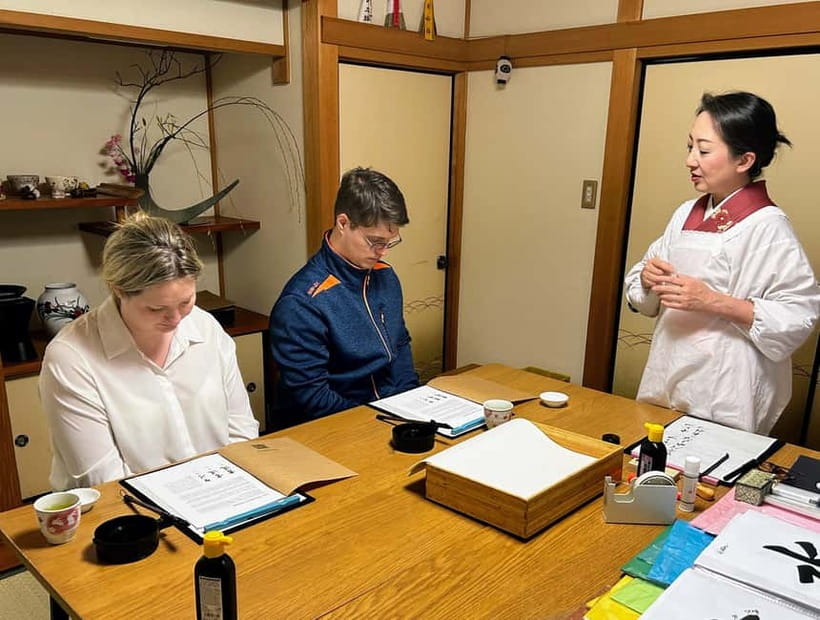
Japanese calligraphy is not a quick souvenir factory. It is a quiet lesson in control, rhythm, and patience, held in a local home about 200 meters west of Nijo Castle. Aya and her team show you how each brush movement shapes a kanji, then help you create a finished piece on Japanese washi paper.
I like two things here: the private setting, which gives the class a personal feel, and the useful souvenir, since you make the artwork yourself rather than simply buying it. The hour also feels well judged for a first taste of calligraphy.
The main limitation is simple: one hour is enough to learn the basics, not to master the art. You also need to arrive on time, bring socks, and be comfortable removing your shoes indoors.
Key points to know before booking
- A local home near Nijo Castle: The meeting place is just west of Nishinotoin Street, on the north side of Ebisugawa Street.
- Guidance from Aya and her team: You learn the history of calligraphy as well as the correct brush movements.
- A personal kanji choice: Select a character connected with an idea such as love, peace, strength, or wisdom.
- Your own Japanese artwork: Practice first, then create a final piece on washi paper to take home.
- A private one-hour class: The format suits couples, families with older teenagers, and small groups seeking a calm cultural activity.
- Strict arrival rules: Arrive five minutes early. A delay shortens your lesson, and arriving more than 15 minutes late means the class cannot be offered.
A calm Kyoto activity beside Nijo Castle
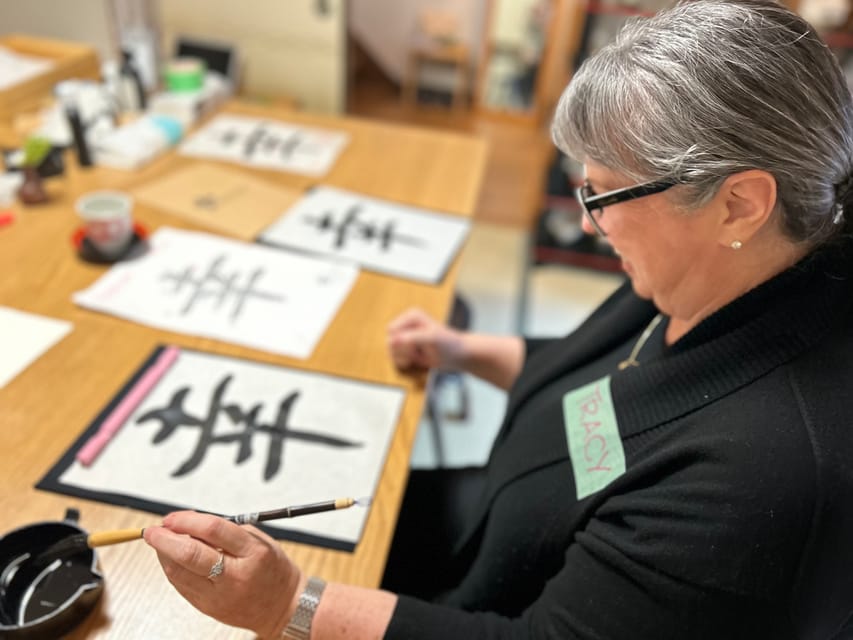
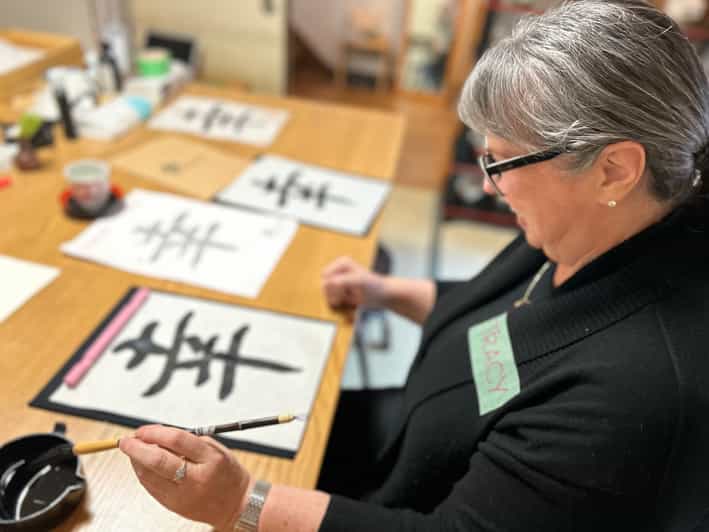
Many Kyoto activities ask you to look, listen, and move on. This one asks you to slow down. You sit with a brush, a small pool of ink, and a sheet of Japanese paper, then pay attention to the order and shape of each stroke.
That change of pace is the point. Calligraphy is not simply handwriting in Japanese. The brush angle, pressure, speed, and stopping point all affect the character. A line that looks simple may require careful control.
The visit takes place in a local home near Nijo Castle, rather than in a large commercial studio. That gives the experience a more intimate setting. You are not just attending a demonstration. You are entering a working domestic space, removing your shoes, and meeting people who live in Kyoto.
The setting has practical limits. There is no waiting area if you arrive too early, so do not turn up 20 or 30 minutes ahead of time expecting somewhere to sit. Five minutes early is the useful target.
More hands-on workshops in Kyoto:
- Kyoto: 45-Minute Tea Ceremony Lesson Experience
★ 4.3 · 2,378 reviews - Ramen Cooking Class at Ramen Factory in Kyoto
★ 5.0 · 1,937 reviews - Kyoto : Chopsticks Making Workshop in Gion with Engraving Option
★ 5.0 · 958 reviews
What happens during the one-hour lesson
The class begins with explanations about Japanese calligraphy and its place in Japanese culture. Aya has spoken about the subject’s history and about how she learned the art herself, giving the lesson a personal thread rather than treating it as a set of craft instructions.
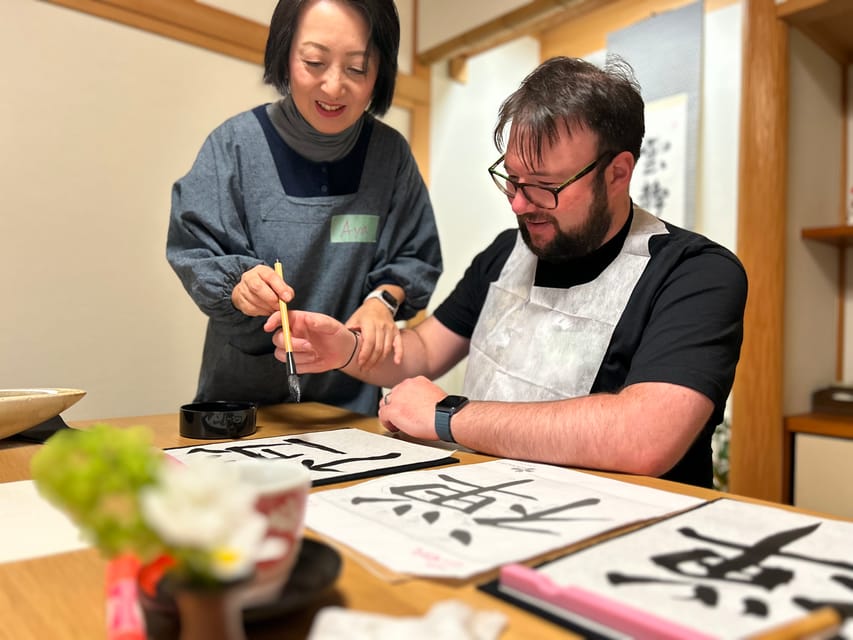
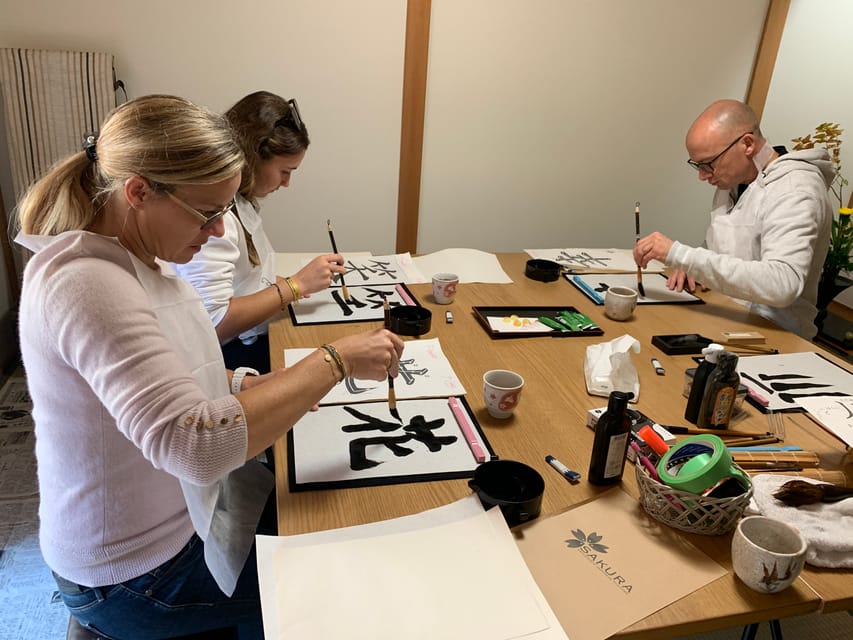
You then learn the basic brush movements. Expect practice rather than instant perfection. The teacher shows you how to guide the brush, and you repeat the strokes with help from Aya or an assistant.
Several people who took the class found the instruction patient and encouraging. That matters because beginners often make the same mistake: they grip the brush too tightly and try to force the line. The lesson helps you understand that the brush needs movement and restraint, not brute strength.
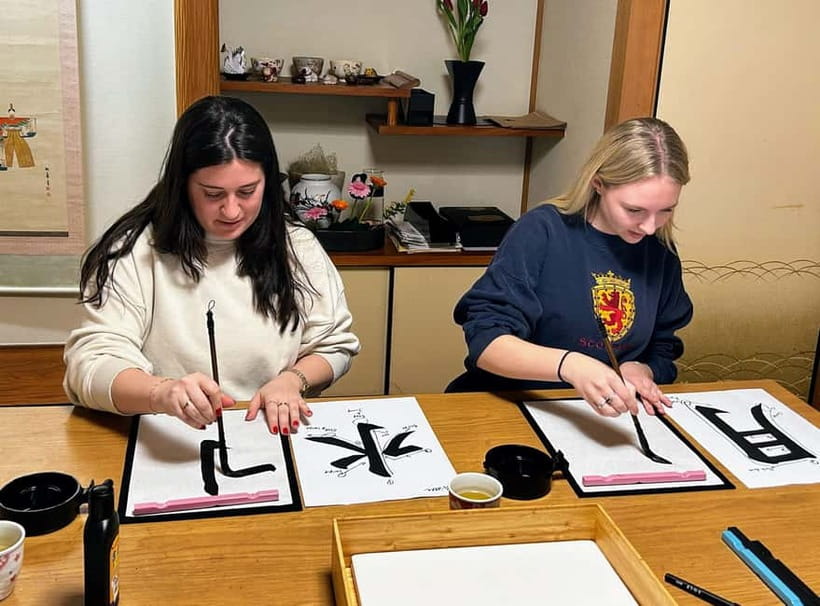
You may write several kanji during the practice stage. This is where the hour moves quickly. You are learning the stroke order, trying to keep the lines balanced, and adjusting your hand after feedback.
The class is conducted in English and Japanese. The private group format is useful here. If you are the only students in the room, you may receive close one-to-one help. If you book with friends or family, you still have a smaller setting than a large group workshop.
Choosing a kanji with personal meaning
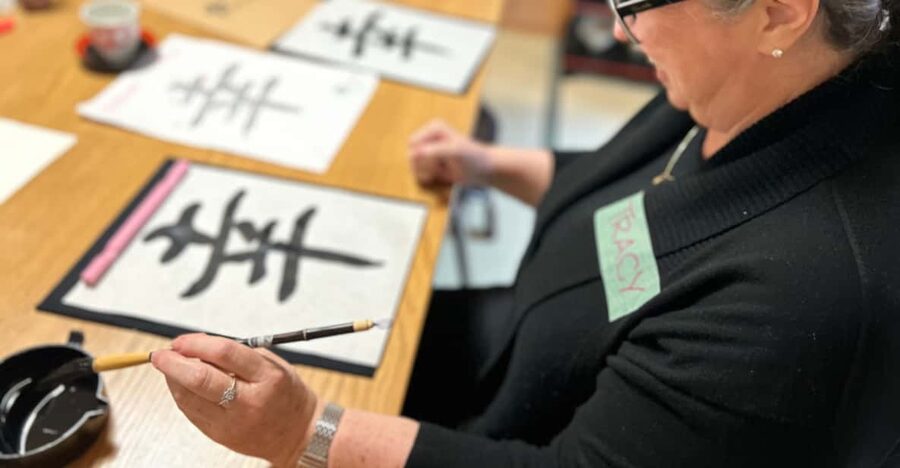
A particularly nice part of the class is choosing a kanji that means something to you. Possibilities include love, peace, strength, and wisdom, though the exact selection will depend on the teacher and the session.
This choice turns the final work into more than a practice sheet. You are not just copying an unfamiliar symbol. You are deciding what idea you want to carry home from Kyoto.
You can also add your name in Japanese. That small detail gives the piece an individual mark and makes it easier to remember which character you chose and why.
I recommend thinking about your preferred theme before the lesson. You do not need to know Japanese, and you should ask the instructor if you are unsure about a character’s meaning or appearance. A personal choice works best when you understand what you are writing.
The finished washi artwork
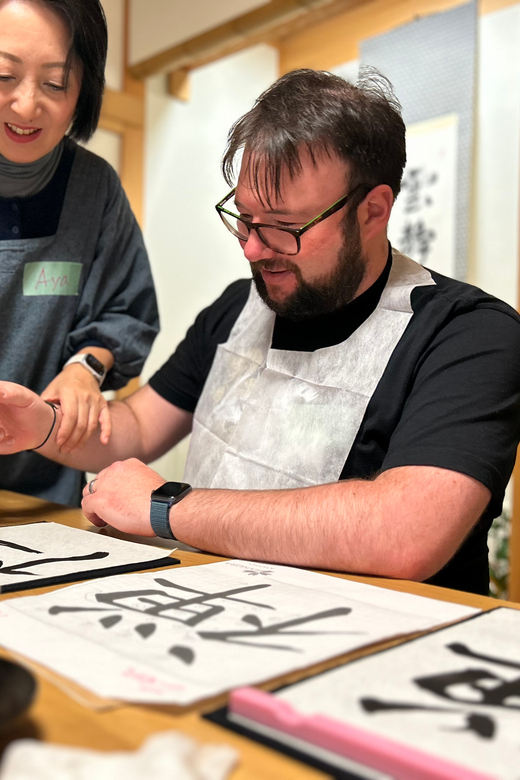
After practice, you create a final calligraphy piece on Japanese washi paper. Washi has a distinct feel from ordinary printer paper, and the ink behaves differently on it. Brush control matters because a heavy hand can spread the ink, while a hesitant stroke can look weak.
Do not expect museum quality after a single lesson. That is not a fair test of the activity. Japanese calligraphy takes years of practice, and the value here is learning enough to understand the discipline behind the finished work.
The payoff is a souvenir with your own hand in it. You may take home a character connected with your trip, your name, or a personal wish. Several participants used the artwork as a display piece at home, and one couple treated it as a special reminder of their honeymoon.
That makes the class a good choice if you prefer souvenirs with a story. A purchased print can be beautiful, but this one records an hour of your own effort, including the uneven bits that show it was made by you.
A few more Kyoto half-days to weigh up
- PERFECT KYOTO 1-Day Bus Tour
★ 5.0 · 13,518 reviews - Kyoto: Fushimi Inari, Kinkakuji, Bamboo Grove 1 Day Bus Tour
★ 4.8 · 4,316 reviews - Kyoto: Tea Ceremony in a Traditional Tea House in Kiyomizu
★ 4.9 · 3,519 reviews - Kyoto Geisha Walking Tour: Gion District & Hidden Gems
★ 4.7 · 3,273 reviews
Meeting Aya and the local hosts
Aya is the central instructor named in the feedback, and her teaching style is one of the strongest reasons to book. She explains the art clearly, gives practical corrections, and allows beginners time to improve without making the class feel stiff.
Her assistant may also help during the writing practice. The team has been described as friendly, welcoming, and professional, with enough patience to support people who have never held a calligraphy brush before.
The home visit adds another layer. You may have a chance to speak with your hosts about life in Kyoto, rather than spending the entire session in a tourist-focused venue. That conversation can be as meaningful as the brushwork, especially if you are interested in ordinary local life.
The information does not promise a long home tour or a meal, so you should book this for the calligraphy lesson and local contact, not for a full household visit. The activity lasts one hour, and the time is mainly devoted to instruction and practice.
Why the location near Nijo Castle helps
The meeting point is about 200 meters west of Nijo Castle, a UNESCO World Heritage Site. This makes the class easy to pair with sightseeing in the same part of Kyoto.
The location can be tricky to find because more than one address in Kyoto may share the same venue name. Enter the venue name into your map application, rather than relying on the address alone. If you take a taxi, give the driver the provided phone number.
The useful visual clues are specific: the home is on the north side of Ebisugawa Street, just west of Nishinotoin Street. The Lions Mansion building is across the street on the south side.
Plan your route before the lesson. If you arrive late, your class time is shortened. If you arrive more than 15 minutes after the starting time, the lesson cannot be offered. Kyoto sightseeing can run late, particularly around major temples and castle grounds, so leave a buffer.
Price, timing, and overall value
At $66 per person for one hour, this is not the cheapest short activity in Kyoto. You are paying for a private group format, an instructor-led lesson, rented tools, ink, Japanese paper, and a finished piece you can take home.
The value improves if you care about personal attention. A large workshop may offer a lower price, but it may also give you less time with the instructor. Here, the teacher can watch your strokes and correct them as you work.
The activity also fills a useful gap in a Kyoto itinerary. A full day of temples can become tiring, especially in summer. This gives you a seated, air-conditioned or indoor break, according to the conditions of the home, while still connecting you with Japanese culture.
The one-hour length is both a strength and a weakness. It is easy to fit between sightseeing plans, but it leaves little room for a late arrival or a long introductory conversation. You should see it as a beginner workshop, not a serious training course.
There is free cancellation up to 24 hours before the activity, and you can reserve now and pay later. That helps if your Kyoto schedule is still shifting.
Who will enjoy this most
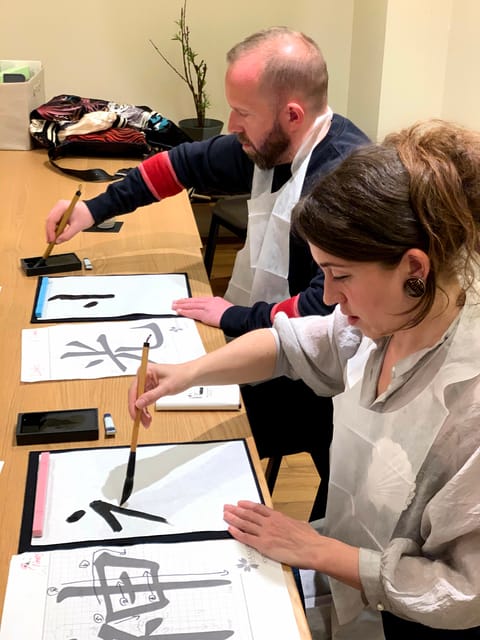
I would recommend this class to adults and older teenagers who enjoy making things with their hands. It suits couples particularly well because you can choose separate kanji and compare the finished pieces afterward.
It also works for solo visitors. A private format and patient teacher can make a hands-on class less awkward than joining a large group of strangers.
The activity is not suitable for children under 13. Anyone attending must remove shoes indoors, so bring socks. Bare feet are not accepted, and socks may be available for purchase if you forget them.
You should also avoid strong fragrances. Smoking, vaping, alcohol, and drugs are not allowed, and smoking indoors is prohibited.
Wheelchair access is available, but you should still confirm practical arrangements when booking if you have specific mobility needs. The setting is a home, so access details can matter more than they would in a purpose-built attraction.
What to bring and how to prepare
Bring socks. This is the most important packing tip, since shoes are not worn indoors and bare feet are not accepted.
Wear clothing that lets you sit comfortably and move your writing arm freely. The supplied information does not require any special clothing, but calligraphy rewards a relaxed posture.
Arrive five minutes before the start. Do not arrive much earlier because there is no waiting space. Save the venue name and phone number in your phone, and use both when checking directions.
It is also worth deciding what kind of kanji interests you. You might choose a word that reflects your trip, a quality you value, or a wish for the coming year. The teacher can help with the Japanese form and meaning.
The strongest reasons to book
The most praised parts of this activity are consistent: the instructors are warm, patient, and skilled; the historical explanation adds substance; and beginners receive enough help to produce something they feel proud of.
Aya’s teaching receives special attention. She explains the background of calligraphy, answers questions, and offers corrections without taking over the work. That balance is important. You want help, but you also want the final character to be yours.
The calm mood is another strong point. Participants describe feeling relaxed as they worked through the strokes. You may not leave as a calligraphy expert, but you should leave with a better sense of why the art demands such precision.
A few people also received helpful suggestions about temples and places to see nearby. Treat that as a pleasant extra, not a formal sightseeing service.
Should you book the Kyoto calligraphy class?
Book it if you want a short, personal cultural activity near Nijo Castle, especially if you value conversation, patient instruction, and a souvenir you create yourself.
Skip it if you want a long workshop, advanced calligraphy training, or a broad home visit with lots of sightseeing. One hour passes quickly, and the class is designed to introduce the basics.
For most suitable visitors, the $66 price is fair because the experience combines a local home setting, an English and Japanese speaking instructor, private-group attention, materials, and a personal washi artwork. Arrive on time, bring socks, and approach the brush as a beginner. That is where the class delivers its best value.
FAQ
Where does the calligraphy class take place?
It takes place in a local home about 200 meters west of Nijo Castle. The venue is on the north side of Ebisugawa Street, just west of Nishinotoin Street, with the Lions Mansion building across the street.
How long does the activity last?
The activity lasts one hour. If you arrive late, the lesson time is shortened.
Who teaches the class?
Aya is the named calligraphy instructor, and an assistant may also help during the practice. Instruction is available in English and Japanese.
Is the activity private?
Yes. The group type is listed as a private group.
What is included in the price?
The price includes calligraphy instruction and explanations, rental of the calligraphy tools, ink, and Japanese washi paper.
Can I take my calligraphy home?
Yes. You create your own calligraphy artwork and can bring it home as a souvenir.
What should I bring?
Bring socks. Shoes are not worn indoors, and bare feet are not accepted.
Can children join the class?
The activity is not suitable for children under 13.
Just added around Kyoto
- Kyoto: Zen Meditation at a Private Temple with a Monk★ 5.0 · 25 reviews
- Kyoto: Gion Geisha District & Sake-in-Hand Walking Tour★ 5.0 · 37 reviews
- Private Pewter Sake Cup Experience with a Kyoto Artisan★ 5.0 · 31 reviews
- Your Private Vacation Photography Session In Kyoto★ 5.0 · 110 reviews
- Private Guided Traditional Buddhist Cooking in Japan★ 5.0 · 16 reviews
- Kyoto Wagashi(Japanese sweets) Cooking Class near Fushimiinari★ 5.0 · 60 reviews
- Traditional Japanese Music show & Experience Tour in Kyoto★ 5.0 · 57 reviews
- Kyoto:Family-Friendly Kimono & Yukata Experience at WARGO★ 5.0 · 147 reviews
Kyoto Tours, compared.


Fushimi Inari, Kinkakuji, Bamboo Grove 1 Day Bus Tour
Read our review →
Tea Ceremony in a Traditional Tea House in Kiyomizu
Read our review →
Kyoto Geisha Walking Tour: Gion District & Hidden Gems
Read our review →

Gion Magical Night Walking Tour with Geisha Trivia
Read our review →

Gion Geisha District Walking Tour – Stories of Geisha
Read our review →Browse the lists this tour appears in