
Reviewed · KYOTO TOURS
Kyoto: Tea Ceremony with Maiko
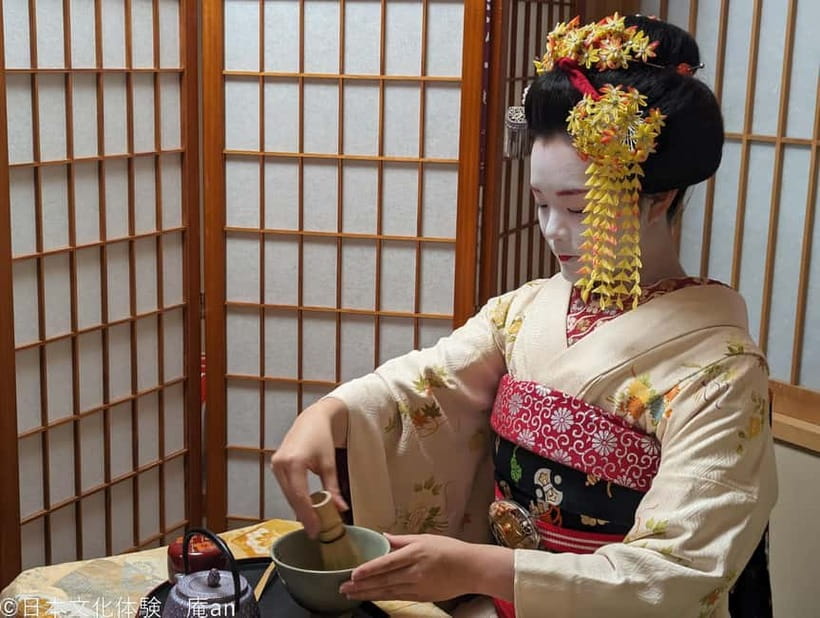
The most unusual part of this short Kyoto activity is the chance to sit close to a maiko, ask her direct questions, and then make matcha under her guidance. You get a personal look at a traditional performing world without needing to arrange an evening at an ochaya, Kyoto’s private teahouse.
I like the easy Gojo Station location and the sensible 45-minute format. I also like the balance of demonstration, hands-on tea making, questions, photographs, and a small senjafuda gift. The main consideration is that this takes place in a building rather than a traditional Japanese house, and English interpretation may be limited unless you request it ahead of time.
Key points to know before booking
- A maiko leads the matcha lesson: You watch her demonstration, then whisk your own tea.
- Two ohigashi sweets are included: These dry Japanese sweets balance the slightly bitter matcha.
- The question session matters: You can ask about a maiko’s daily life and path toward becoming a geiko.
- Photos are part of the program: You take a commemorative picture beside the maiko near the end.
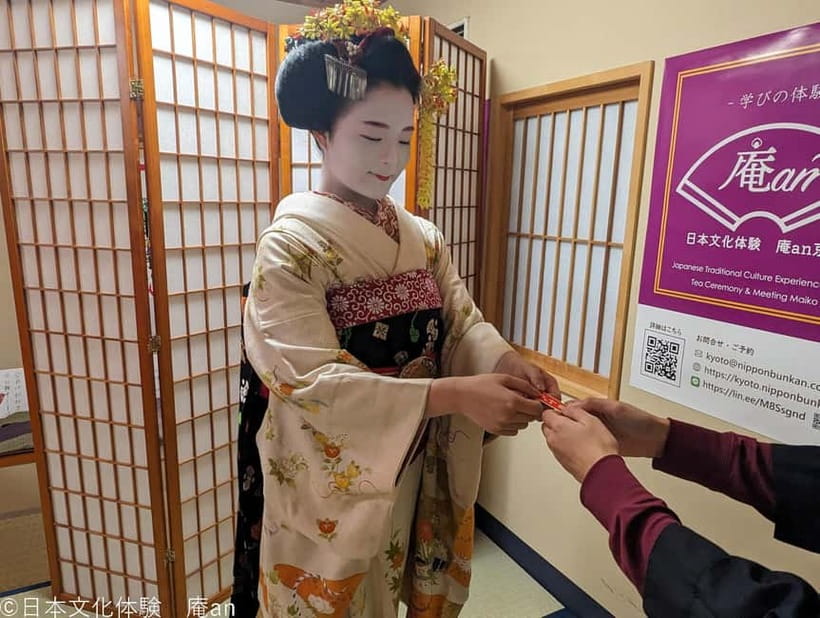
- You receive a senjafuda: This small paper charm is presented as a good-luck keepsake.
- The activity is close to Gojo Station: Exit 1 of the Subway Karasuma Line is about a one-minute walk away.
Meeting a maiko near Kyoto’s Gojo Station
This experience gives you a compact introduction to two symbols of Kyoto: the maiko and matcha. It is designed for visitors who want something more personal than simply watching a performance, but who do not have the time or budget for a longer cultural program.
The meeting point is one minute from Exit 1 of Gojo Station on the Subway Karasuma Line. The entrance faces Gojo-dori, the main street. The venue is in a building above a supermarket called Carnival, and you will need to use stairs because there is no elevator.
That location is convenient, but it is worth slowing down for the final approach. One useful route is to leave through Exit 1, walk straight, cross a small side street, and continue until you reach the entrance before the next small street. Look for the building above the supermarket rather than expecting a traditional teahouse doorway.
The room is not an ochaya or an old Kyoto machiya. It is a modern building venue with a relaxed atmosphere and staff who explain how the program works. That setting loses some of the atmosphere you might hope for from a classic tea-house visit, but it also makes the event less formal and easier for first-time visitors.
More Tea Ceremonies in Kyoto
- Kyoto: Tea Ceremony in a Traditional Tea House in Kiyomizu
★ 4.9 · 3,519 reviews - Kyoto: Tea Ceremony Ju-An at Jotokuji Temple
★ 4.9 · 3,207 reviews - Kyoto: 45-Minute Tea Ceremony Lesson Experience
★ 4.3 · 2,378 reviews
What the opening greeting sets up
The program begins with a greeting from the maiko. Depending on the date, the host may be a maiko or a geiko, so check the booking details if that distinction matters to you.
A maiko is an apprentice geiko, traditionally known for elaborate dress, makeup, and dance training. A geiko is an accomplished professional in Kyoto’s entertainment tradition. The difference gives the session a slightly different flavor, but both offer a direct connection to a part of Kyoto culture that can be difficult to encounter respectfully and affordably.
The greeting is followed by an explanation of the tea ceremony. You do not need special preparation, a particular dress code, or previous knowledge of Japanese tea customs. The staff are there to help you follow along, and the tone is intended to be welcoming rather than stiff.
The instructor language is Japanese. English translation is provided as much as possible, and you should contact the organizer if you want English support added. Several participants found the interpreter especially useful during the questions, since the maiko may answer in Japanese.
Making matcha instead of only watching
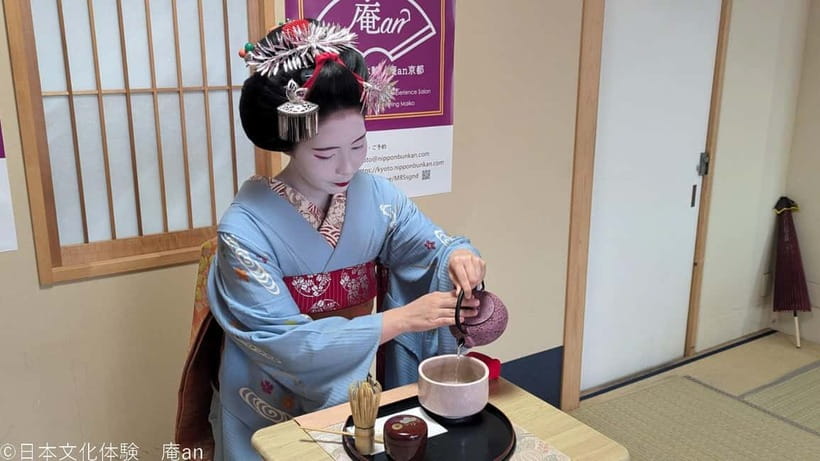
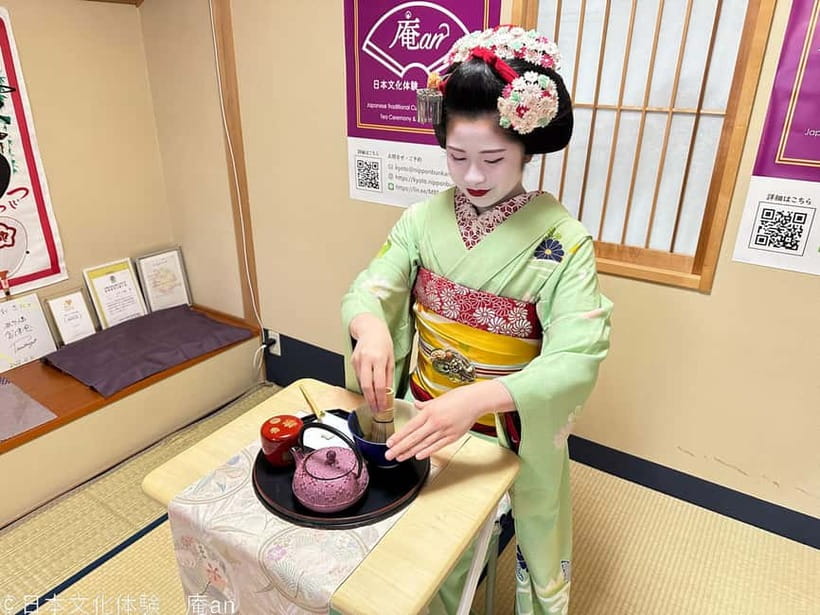
The central activity is the matcha preparation. First, the maiko demonstrates how to make the tea and explains the basic method. Then you prepare your own bowl.
That hands-on step is important. A demonstration alone can feel like a short show, while whisking your own matcha gives you a small task and a clearer sense of the care involved. You will see how the powder, hot water, and whisk come together, then try to produce the same kind of foamy drink yourself.
Do not expect a full-length formal tea ceremony with every traditional movement explained in detail. This is a short introduction, built for visitors with limited time. The value is in getting a friendly lesson from a maiko and trying the process yourself, not in mastering the complete rules of tea ceremony.
The matcha is served with two pieces of ohigashi, a dry Japanese sweet often made from pressed sugar or bean-based ingredients. These sweets are not like a soft Western cake or pastry. Their sweetness helps prepare your palate for matcha’s grassy, bitter edge, and their small size suits the short format.
The tea and sweets are included in the $28 price. That makes the experience fairly good value if you want both a cultural meeting and a simple activity rather than only a photograph with a costumed performer.
The question session is the real personal connection
After the tea portion, you have a question and answer session. This is where the activity moves beyond a staged introduction.
You can ask about the maiko’s lifestyle, her training, and the path toward becoming a geiko. Questions about daily routines and professional expectations can help you understand that the costume and makeup are only the visible part of a demanding cultural profession.
The session also gives you a chance to hear the maiko’s own personality. One host, Masaya-san, received particular appreciation for making the matcha lesson easy to follow and answering questions with confidence. An interpreter helped convey her answers in English.
Language remains a practical consideration. The official language is Japanese, and English help is offered as much as possible, not guaranteed in the same way at every session. If the question period is the main reason you are booking, contact the organizer before you go and ask about interpretation for your date.
A good approach is to prepare two or three respectful questions in advance. The short schedule does not leave unlimited time, so focused questions about training, work, food, clothing, or the transition from maiko to geiko will give you more than trying to cover everything.
Same base, a completely different sort of day:
- PERFECT KYOTO 1-Day Bus Tour
★ 5.0 · 13,518 reviews - Kyoto: Fushimi Inari, Kinkakuji, Bamboo Grove 1 Day Bus Tour
★ 4.8 · 4,316 reviews - Kyoto Geisha Walking Tour: Gion District & Hidden Gems
★ 4.7 · 3,273 reviews - Kyoto: Gion Magical Night Walking Tour with Geisha Trivia
★ 4.9 · 2,393 reviews
Photos and the senjafuda gift
The formal program reaches its scheduled end at about 30 minutes, followed by photographs and the gift presentation. You then leave the room at around 45 minutes.
The photo opportunity lets you stand beside the maiko for a commemorative picture. This is a practical advantage over trying to photograph a maiko on the street, where following or stopping her would be intrusive. Here, the photograph is part of an organized cultural encounter, with permission built into the program.
At the end, the maiko gives you a senjafuda. A senjafuda is a small paper name card or charm traditionally associated with visits to temples and shrines, and here it serves as a lucky keepsake from the meeting.
The photo and gift add a nice closing touch, but remember that they come after the tea and question portion. If you arrive late, you risk missing the main program and may not receive a refund. The event cannot be held for late arrivals, so allow extra time to find the entrance and climb the stairs.
What the $28 price really buys you
At $28 per person, this is priced below many longer cultural activities in Kyoto. You are paying for a short, concentrated experience that includes a maiko or geiko appearance, matcha, two sweets, a question period, a photograph, and a senjafuda.
The value is strongest if you are already near central Kyoto and want a compact activity between sightseeing stops. The 45-minute duration fits neatly into a day built around Gojo, Kyoto Station, or nearby areas. You do not have to commit to a half-day workshop, and the low cost makes it easier to add the experience to a larger itinerary.
The value is weaker if you want a formal tea-house setting, a long explanation of tea philosophy, or extensive English instruction. The building venue is practical rather than atmospheric, and the language support can vary.
Children who need their own seat pay the regular per-person price. Children under two who sit on a parent’s lap are free. Those who do not take part in the experience cannot enter, so this is not a convenient waiting-room arrangement for part of your group.
Who will enjoy this Kyoto experience most
I would recommend this for first-time visitors who want an accessible introduction to maiko culture without making a full evening commitment. It also suits people who enjoy asking questions and trying an activity themselves rather than sitting silently through a performance.
It works particularly well for:
- Couples looking for an unusual Kyoto memory
- Families with older children who can follow a short demonstration
- Visitors with only a few hours near Gojo
- Anyone curious about the difference between a maiko and a geiko
- People who want an organized, respectful photo opportunity
- Visitors interested in matcha but not ready for a longer tea workshop
It may not suit you if stairs are difficult, since the building has no elevator. It may also disappoint if you picture an old wooden teahouse, a large dance performance, or a completely English-language class.
One participant described a fuller session that also included sake, a dance performance, and a game. Those extras may be connected to a different package or particular event date, so do not assume they are part of this basic 45-minute program. The dependable features are the tea ceremony, two sweets, questions, photos, and senjafuda gift.
Timing, cancellation, and small practical details
The operating hours are 10:00 AM to 5:00 PM. Reservations received after 5:00 PM are processed the following day.
The activity lasts 45 minutes, although the main program is scheduled to finish around the 30-minute mark before photographs and departure. Check the available start times carefully, especially if you are connecting it with a train, lunch, or another timed admission.
You can cancel up to eight days in advance for a full refund. Changing the date or time within seven days of the booking may bring a fee, and cancellation charges can apply depending on the policy. The organizer does not cover travel expenses if the activity is canceled.
The most important rule is simple: arrive early. The venue can be easy to miss if you only look for a tea-house entrance, and late arrivals are not entitled to a refund. Gojo Station Exit 1 is the best starting point.
Is this maiko tea ceremony worth booking?
Book it if you want a short, affordable meeting with a maiko or geiko and like the idea of making your own matcha. The question session, photo, and senjafuda give it more substance than a quick staged appearance, while the Gojo location keeps the logistics simple.
Skip it if your priority is a traditional house, a long formal ceremony, or guaranteed detailed English translation. For the right expectations, this is a friendly and efficient way to connect with Kyoto culture. At $28, it offers solid value, especially for a visitor with limited time.
FAQ
Where is the tea ceremony held?
It is held one minute from Exit 1 of Gojo Station on the Subway Karasuma Line. The entrance faces Gojo-dori and is in a building above the Carnival supermarket.
How long does the experience last?
The full experience lasts about 45 minutes. The main tea ceremony and question session end at around 30 minutes, followed by photos, the senjafuda gift, and room departure.
Is the host always a maiko?
No. Depending on the event date, the host may be a maiko or a geiko.
Is English available?
The instructor language is Japanese. English translation is provided as much as possible, and you should contact the organizer if you would like English support added.
What is included in the price?
The price includes the tea ceremony with a maiko or geiko, matcha, two dried Japanese sweets called ohigashi, a photo opportunity, and a senjafuda gift.
Is the building accessible by elevator?
No. There is no elevator, and you must use stairs to reach the venue.
What happens if I arrive late?
The event will not be held for delayed arrivals. Late participants are not entitled to a refund, so allow time to find the entrance and reach the room.
More Geisha Experiences
- Kyoto: Gion Geisha District Walking Tour – Stories of Geisha
★ 4.7 · 2,187 reviews - Best of Kyoto: Gion, Geisha, Pagodas & Cobblestones
★ 4.9 · 2,058 reviews - Night Walk in Gion: Kyoto’s Geisha District
★ 4.5 · 2,003 reviews - Kyoto Night Foodie Tour in Gion (9+ dishes + 6 Sake tastings)
★ 5.0 · 1,762 reviews
Just added around Kyoto
- Kyoto: Zen Meditation at a Private Temple with a Monk★ 5.0 · 25 reviews
- Kyoto: Gion Geisha District & Sake-in-Hand Walking Tour★ 5.0 · 37 reviews
- Private Pewter Sake Cup Experience with a Kyoto Artisan★ 5.0 · 31 reviews
- Your Private Vacation Photography Session In Kyoto★ 5.0 · 110 reviews
- Private Guided Traditional Buddhist Cooking in Japan★ 5.0 · 16 reviews
- Kyoto Wagashi(Japanese sweets) Cooking Class near Fushimiinari★ 5.0 · 60 reviews
- Traditional Japanese Music show & Experience Tour in Kyoto★ 5.0 · 57 reviews
- Kyoto:Family-Friendly Kimono & Yukata Experience at WARGO★ 5.0 · 147 reviews
Kyoto Tours, compared.


Fushimi Inari, Kinkakuji, Bamboo Grove 1 Day Bus Tour
Read our review →
Tea Ceremony in a Traditional Tea House in Kiyomizu
Read our review →
Kyoto Geisha Walking Tour: Gion District & Hidden Gems
Read our review →

Gion Magical Night Walking Tour with Geisha Trivia
Read our review →

Gion Geisha District Walking Tour – Stories of Geisha
Read our review →Browse the lists this tour appears in