
Reviewed · TOKYO TOURS
Kawagoe 4hr Private Tour with Licensed Guide (Kawagoe Dep)
Kawagoe gives you old Japan without sending you deep into the countryside. About 30 minutes by train from central Tokyo, this former castle town still has black-and-white warehouse buildings, a wooden bell tower, temples, shrines, and streets lined with local food and souvenirs. The tour’s best feature is its private, custom-built format: you choose two or three sights, then explore with a licensed guide such as Masa, Show, Isao, or Yusuke.
I like the way four hours keeps the outing focused. I also like having a guide who can explain Shinto customs, Edo-period life, and the practical details of getting around, while still leaving room for shopping or a slower pace. The main drawback is simple: this is a walking tour, and taxis and buses can be sparse. You need comfortable shoes, and the heat can matter.
Key points to know before booking
- Choose only two or three sights: The long list of possible stops is a menu, not a promise that you will see them all.
- Kawagoe’s old warehouse district is the heart of the visit: Toki no Kane and the Kurazukuri streets give you the clearest sense of Little Edo.
- Private guiding makes the tour flexible: Guides can adjust the route for shopping, a wheelchair, or your interests.
- You pay extra for many attractions: Transportation, lunch, personal purchases, and most admission fees are not included.
- Plan for a real walk: Pickup is on foot within a designated Kawagoe area, with no private vehicle provided.
- The price buys personal attention: At $107.78 per person, value depends on your group size and how much you want historical context and local help.
Why Kawagoe works as a half-day trip from Tokyo
Tokyo can feel so modern that it is easy to forget how recent much of its present shape is. Kawagoe offers a useful change of pace. During the Edo period, it was a castle town and trading center, and it became known as Ko-edo, or Little Edo, because of its connection to the former Tokyo and its surviving traditional buildings.
The trip is efficient. Kawagoe is roughly 30 minutes by train from central Tokyo, yet the town feels different once you leave the capital behind. You are not signing up for a full-day expedition or an overnight stay. Four hours gives you enough time to see a few important places without turning the day into a race.
The private format matters here. Kawagoe’s attractions are spread across several areas, and a guide can help you decide what fits together. If you want architecture, the warehouse district and bell tower make sense. If temples interest you, Kitain deserves attention. If you want Japanese customs and romance-related charms, Hikawa Shrine may be the better choice.
At $107.78 per person, the tour is not a budget sightseeing walk, especially once you add entrance fees and any train fare. It becomes better value for a small group that would otherwise hire a guide separately. You are paying for a licensed local guide, private attention, language help, and an itinerary shaped around your priorities. If you only want to stroll the main street and take photos, you can spend less by exploring independently.
More Licensed Guide Tours in Tokyo
- Tokyo 6hr Private Tour with Government-Licensed Guide
★ 5.0 · 3,902 reviews - Tokyo 4hr Private Tour with Government-Licensed Guide
★ 5.0 · 1,394 reviews - Tsukiji Food and Toyosu Market with Government-Licensed Guide
★ 5.0 · 158 reviews
Start with Toki no Kane, Kawagoe’s timekeeper
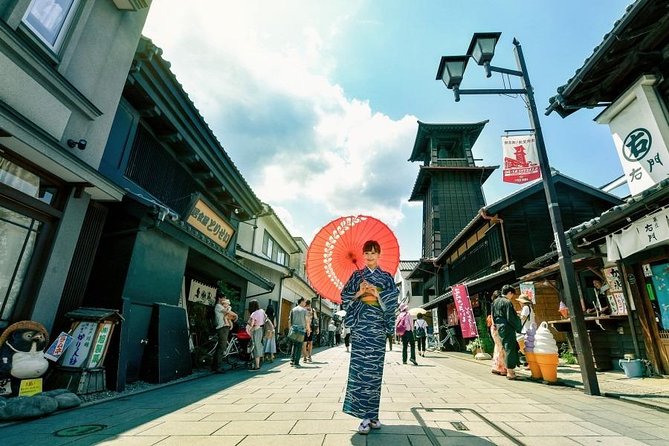
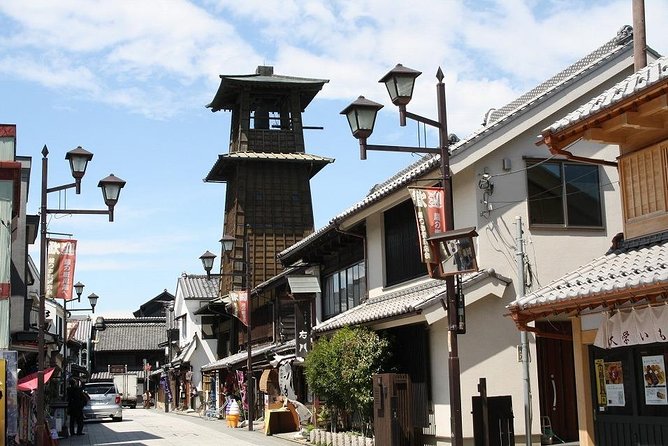
Toki no Kane, or the Bell of Time, is one of Kawagoe’s clearest symbols. In the Edo period, when household clocks were not common, the tower’s bell told local people when the day had reached important hours. The bell still rings at 6 a.m., noon, 3 p.m., and 6 p.m.
The scheduled visit is short, about five minutes, which is enough for a look, a photo, and an explanation. Do not expect a long interior visit or a major museum stop. The value comes from understanding what the tower meant to daily life. It gives the old town a human scale: people once organized work, meals, and movement around a public sound.
The tower also works well as an orientation point. From here, you can move toward the warehouse streets, restaurants, and shops. Ask your guide to explain how the bell fits into Kawagoe’s wider role as a castle town.
Walk the warehouse streets and Kawagoe Kurazukuri Museum
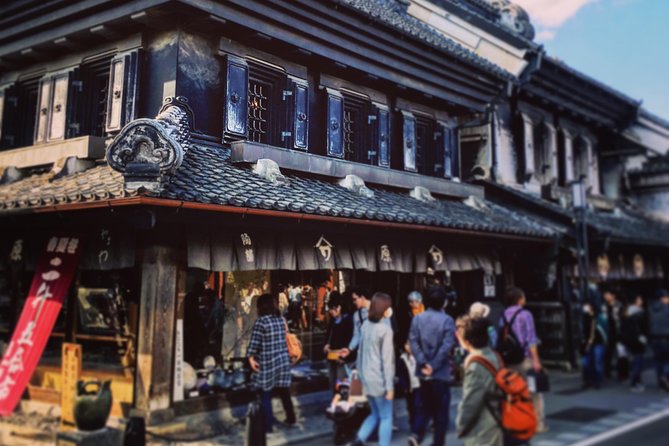
Kawagoe’s warehouse-style buildings are the reason many people make the trip. These thick-walled structures were built to protect goods from fire, and their dark exteriors give the old commercial streets a strong, distinctive look. The effect is not a reconstructed theme park. The buildings reflect the practical needs of merchants who lived and worked in a busy castle town.
The Kawagoe Kurazukuri Museum helps explain this building style. Allow about 30 minutes, with admission charged separately. The museum gives you more than a pretty street view, particularly if you want to understand why the warehouses were designed as they were and how merchants shaped the town.
This is one of the strongest choices for first-time visitors. You get architecture, local commerce, and a clear connection to the Edo period in one area. The limitation is that four hours does not allow endless browsing. If you stop at every shop, sample every snack, and spend time inside the museum, another planned attraction may need to go.
Your guide can help you balance sightseeing with shopping. One guide, Show, was especially flexible when a guest wanted more time to shop. That is a useful advantage over a fixed group schedule.
Add Koedo Yokocho for food and a rest
Koedo Yokocho is a warehouse-style building with restaurants serving Japanese dishes such as kamameshi and ramen. Kamameshi is a rice dish with meat and vegetables cooked and served in a small pot. There is also a free rest area.
This stop is less about monuments and more about making the half-day comfortable. A short food break can keep the tour from feeling like four hours of nonstop walking. It also gives your guide a natural chance to suggest local dishes and explain what you are eating.
Lunch is not included, so treat this as an optional spending stop rather than part of the tour price. With only four hours, you may prefer a quick meal or snack instead of a full restaurant visit. If food is a major reason you are coming to Kawagoe, tell the guide when you book so the route does not become overloaded with museums and temples.
More licensed-guide days in Tokyo:
- Toyosu Market Morning Tuna Auction and Tsukiji Food Tour with Licensed Guide
★ 4.5 · 146 reviews - Tokyo Tsukiji Food & Culture Private Tour Licensed Guide
★ 4.9 · 28 reviews - Kyoto 6hr Private Tour with Government-Licensed Guide
★ 5.0 · 1,369 reviews - Hiroshima / Miyajima Full-day Private Tour with Government Licensed Guide
★ 5.0 · 1,298 reviews
See the surviving parts of Kawagoe Castle
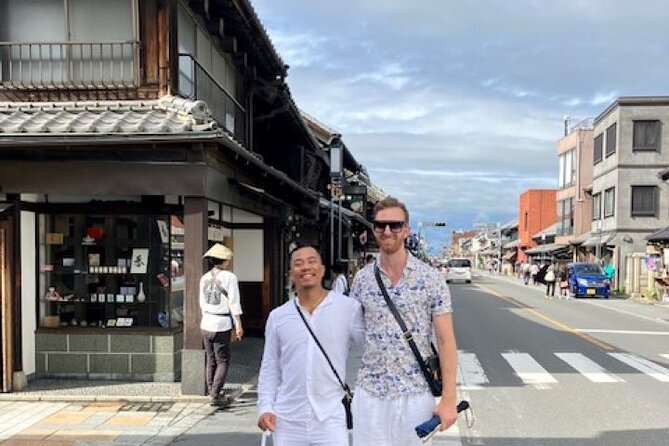
Kawagoe was built around Kawagoe Castle, but most of the castle no longer remains. The Naka no Mon remain and the Honmaru Palace offer two different ways to connect with that past.
Naka no Mon was an entrance area, and some rooms are open to the public. You can learn about the clothing and daily world of the period rather than simply photographing a gate. Admission is extra, and the suggested time is about 30 minutes.
Kawagoejyo Honmaru Palace is another possible 30-minute stop. Japanese castles attract visitors because they make history physical, and the palace offers a sense of how the castle complex once functioned. Do not book this tour expecting a complete castle with towers and defensive walls. The appeal is in the surviving pieces and the guide’s ability to explain what has disappeared.
These stops suit you if you want historical context more than shopping. They may be less satisfying if your main goal is the classic old-town streets, since time spent here means less time around the warehouse district.
Choose Hikawa Shrine for Shinto customs and love charms
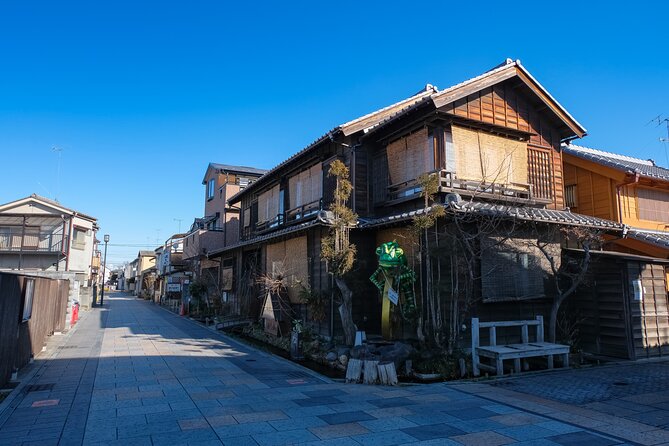
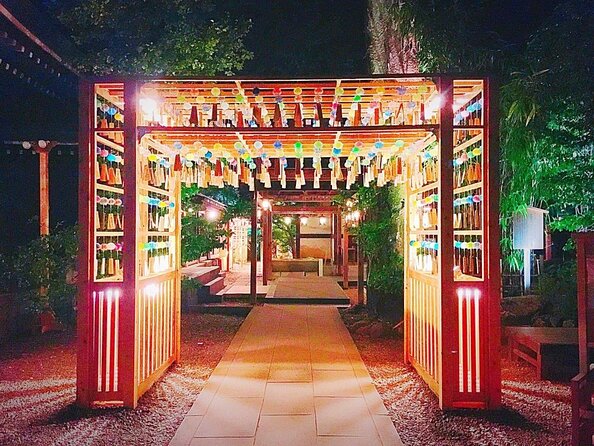
Kawagoe Hikawa Shrine is associated with love and good relationships. Its Enmusubi dama, described as a love-success stone, is a well-known charm. The shrine is a good choice if you want to understand how a working Japanese religious site fits into everyday life.
A guide can add real value here by explaining Shinto ideas, shrine behavior, and the meaning of amulets. One four-hour visit led to a clearer understanding of Shinto and Kawagoe’s past, which is exactly the sort of context that can be hard to gather from signs alone.
The shrine is free to enter and receives about 30 minutes in the suggested plan. That is enough for a respectful visit, a look at the grounds, and time to ask questions. If romance charms are not your interest, you can still choose the shrine for its religious importance, but Kitain or the old warehouse streets may give you more historical material.
Make time for Kitain Temple
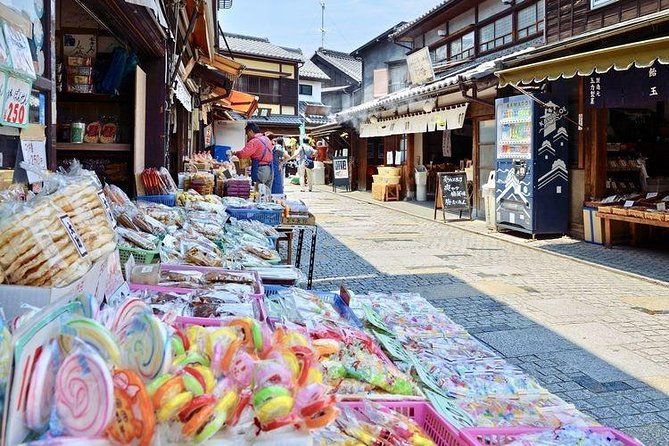
Kitain is one of the best choices for visitors who want a temple experience. The Buddhist temple has been in Kawagoe for about 1,200 years, and its atmosphere gives the tour a different tone from the commercial streets.
A 30-minute visit can cover the main points without taking over the day. The temple is also known for statues of 500 disciples, a detail that makes it more memorable than a quick stop at an anonymous shrine. You should ask your guide to point out the most important features rather than simply walking through the grounds.
Kitain received special praise from guide Yusuke’s tour guests, and the reason is easy to understand. The temple connects Kawagoe’s long religious life with the town’s Edo-era identity. It is a strong pairing with Toki no Kane or the Kurazukuri Museum.
Admission is listed as free for this tour, though you should still follow any posted rules about photography and behavior. As with all religious sites, the visit works best when you slow down and treat the place as more than a backdrop.
Consider the museums, festival hall, or onsen
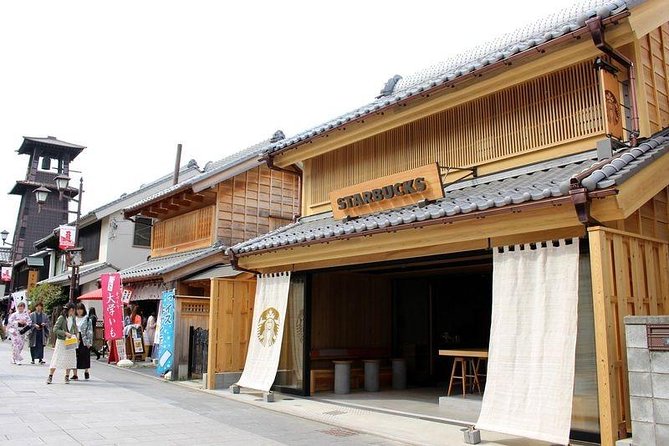
Kawagoe City Museum explains why the town is called Little Edo and provides background on the buildings and local development. Its exterior itself reflects Kawagoe’s traditional character. Allow about 30 minutes, with admission extra.
Kawagoe Matsuri Kaikan is the choice for anyone curious about local festivals. Japan’s festivals vary greatly from town to town, and this hall gives you a way to learn about Kawagoe’s own traditions even if your visit does not coincide with a festival. It also takes about 30 minutes and requires a separate admission fee.
Kawagoe Onsen offers a completely different experience. The natural hot spring facility has several baths, including wood and stone designs. It can be a pleasant way to finish a day, but it is not an easy add-on if you are trying to fit in several historic sights. You will need to account for bathing time, admission, and personal comfort with Japanese hot spring customs.
These three choices show why the private format is useful. A museum-focused visitor, a festival fan, and someone seeking a bath would build very different four-hour plans. You should not try to force all ten listed attractions into one outing.
How the four-hour custom plan really works
The experience includes a licensed local English-speaking guide and a customized visit to two or three selected sites. You meet the guide on foot within a designated area of Kawagoe. There is no private car, and transport fees are not included.
That wording matters. This is not a chauffeured tour that collects you at each sight. It is a private walking experience, so your route, stamina, weather, and footwear all affect the day. One guide helped a guest using a wheelchair, which shows that the route can sometimes be adapted, but you should discuss mobility needs in advance rather than assume every street or building will be easy.
The tour suits most people, and service animals are allowed. Still, the practical warning from the experience is worth taking seriously: buses and taxis can be sparse, and the walk between stops may be longer than expected. Hot weather can make the four hours feel demanding.
Give the provider your must-see places before the tour. If you list five or six priorities, the guide will need to narrow them down. A useful plan might be Toki no Kane, the Kurazukuri Museum, and Kitain for a first visit. Another might pair Hikawa Shrine with Kawagoe Castle sites and the City Museum.
What the guide adds to the price
A licensed guide is certified by the Japanese government and must have a strong understanding of Japanese culture and history. That does not guarantee that every guide will match your personality, but it does give you a trained interpreter rather than simply a person who points out buildings.
The guides named in the experience include Masa, Show, Isao, and Yusuke. Their strengths come through in practical ways: Masa is described as personable and professional, Show adjusted the route for shopping, Isao helped a mother and daughter using a wheelchair, and Yusuke made sure the historic sites were clearly explained.
Those details point to the tour’s strongest benefit: personal attention. You can ask why a shrine uses a certain charm, how a warehouse protected goods, or what happened to Kawagoe Castle. You can also ask for help with the route rather than trying to decode a map while walking.
The price makes most sense for couples, families, or small private groups who want this depth. Group discounts are offered, though the exact discount is not specified. You cannot combine separate tour groups, so each booking remains a private activity for your own party.
Who should book this Kawagoe tour?
Book it if you want a short, organized introduction to Kawagoe and prefer conversation over a self-guided walk. It is especially useful on a first visit, when you want to connect the bell tower, merchant warehouses, castle remains, temples, and shrines into one understandable story.
It also suits you if your group has mixed interests. One person can ask about Shinto, another can shop, and another can focus on castles or food. A fixed group tour usually cannot bend that way.
You may want to skip it if you are comfortable researching Kawagoe yourself, want to spend all day shopping, or dislike walking. You will also need to budget for entrance fees, meals, and transport. At $107.78 per person, the tour is a guide-led experience rather than a cheap sightseeing package.
The cancellation policy is friendly: cancel at least 24 hours before the start time for a full refund. Changes or cancellations inside that window are not refunded.
The bottom line for your Kawagoe day
I would book this tour when you want Kawagoe to feel like more than a photo stop from Tokyo. Choose two or three sites carefully, wear good shoes, and tell the guide whether you care most about Edo architecture, temples, Shinto, food, museums, shopping, or the hot spring.
For the best all-around first visit, I would favor Toki no Kane, the Kawagoe Kurazukuri Museum, and Kitain. Add Hikawa Shrine if religious customs and love charms matter more to you than castle remains. With the right choices, four hours is enough to see the town’s defining character and leave room for questions, snacks, and a little wandering.
FAQ
How long is the Kawagoe private tour?
The tour lasts approximately four hours.
How many sights can I visit?
The tour includes a customized itinerary built around two or three sites selected from the available attractions.
Is transportation included?
No. Transportation fees are not included, and the tour does not provide a private vehicle. You meet the guide on foot within a designated Kawagoe area.
Are admission fees included?
Admission fees are not generally included. Guide entry fees are covered only for sights listed under the tour’s included attraction information.
Is this a private tour?
Yes. Only your own group participates, and separate tour groups cannot be combined.
Can I cancel for a full refund?
Yes, if you cancel at least 24 hours before the experience start time. Cancellations or changes made less than 24 hours in advance are not refunded.
Just added around Tokyo
- Private Arrival Transfer : Narita International Airport to Central Tokyo City★ 4.5 · 12 reviews
- Narita Airport(NRT): Private Transfer to Tokyo/Yokohama 1-9pax★ 5.0 · 47 reviews
- Private Transfer from Narita Airport to Yokohama Port and City★ 4.5 · 17 reviews
- [Narita Airport Terminals 1, 2] 40-60km Sawara Itako Historic Bike Tour★ 5.0 · 13 reviews
- 3 Day Japan Highlights Tour: Tokyo, Mt.Fuji, Nara, Kyoto, Osaka★ 5.0 · 22 reviews
- Small Town in the Big City: Tasting Tokyo’s Kichijoji★ 5.0 · 195 reviews
- Small Town in the Big City: Tasting Tokyo’s Kichijoji★ 5.0 · 16 reviews
- The 10 Tastings of Tokyo With Locals: Private Street Food Tour★ 5.0 · 48 reviews
Tokyo Tours, compared.

Mt Fuji and Hakone 1-Day Bus Tour Return by Bullet Train
Read our review →

teamLab Planets TOKYO Digital Art Museum Entry Ticket
Read our review →
Mt Fuji & Hakone Cruise, Drum Show Bullet Train 1 Day from Tokyo
Read our review →
Sumo Show Experience with Chicken Hot Pot and a Photo
Read our review →
Shinjuku Food Tour (13 Dishes at 4 Local Eateries)
Read our review →
Tokyo Mt Fuji 5th St & Hakone Cruise Bus Tour w/Bullet Train
Read our review →
Flagship 2-Hours Official Street Go-Kart Tour – Tokyo Bay Shop
Read our review →Browse the lists this tour appears in