

Reviewed · KYOTO TOURS
Kyo-arashi Shibori Scarf Class
The best part of this Kyoto craft class is the reveal. You fold a long silk scarf, wrap it around a pipe, bind it tightly with string, then dye it in a color you choose. When the string comes off and the fabric opens, the pattern appears in a way you cannot fully predict. I like the hands-on process and the fact that you take home a useful, personal souvenir rather than a factory-made trinket.
I also like the compact format. The class takes about 30 to 60 minutes, and you can use the drying time to see the museum displays and try on a shibori kimono. The main consideration is the price, about $50.30 per person, which is fair for a private craft lesson and silk scarf, but more than a quick look at a museum. The minimum age is 12, so families with younger children need to check another activity.
Key points at a glance

- Your scarf measures about 180 by 44 centimeters, giving you a full-size silk accessory rather than a small sample.
- You choose the dye color, while the folding and binding create the final pattern.
- The class is usually individual or limited to your own group, so the instructor can give close help.
- The scarf-making takes 30 to 60 minutes, with museum viewing and kimono try-on time while the fabric dries.
- English assistance is available, and Nina is specifically named among the helpful museum staff.
- Free cancellation is available up to 24 hours before the start time, which helps when building a Kyoto schedule.
Making a Kyoto souvenir with your own hands

Kyoto is full of beautiful things to buy. It is far less common to make one yourself in a short, well-guided class. This experience focuses on kyo-arashi shibori, a Japanese resist-dyeing method in which folds, pressure, string, and fabric placement control how dye reaches the silk.
You do not need a background in sewing, textile work, or Japanese crafts. The instructor shows you each stage, and the process is simple enough to follow while still producing a result with real character. The technique has a pleasing balance of control and surprise: you choose the color and prepare the fabric, but the final pattern only becomes clear when you unfold the scarf.
That makes this a good choice for someone who wants a creative Kyoto activity without giving up half a day. You are not sitting through a long lecture. You are working with your hands, making decisions, and watching a traditional technique take shape.
The class is generally arranged for one person or one private group. That matters because you can ask for help as you fold, wrap, tie, and press the fabric. The available English support is another practical benefit. Nina is specifically named as a staff member, and English-speaking instruction is noted for the class.
More hands-on workshops in Kyoto:
- Kyoto: 45-Minute Tea Ceremony Lesson Experience
★ 4.3 · 2,378 reviews - Ramen Cooking Class at Ramen Factory in Kyoto
★ 5.0 · 1,937 reviews - Kyoto : Chopsticks Making Workshop in Gion with Engraving Option
★ 5.0 · 958 reviews
Inside the Kyoto Shibori Museum
The activity takes place at the Kyoto Shibori Museum at 135-5 Shikiamicho in Nakagyo Ward. The museum is near public transportation, and the activity begins and ends at the same meeting point.
Your admission is included, so the class is not the whole visit. The displays give you a chance to see more examples of shibori and understand how the technique can be used beyond the scarf in front of you. This extra museum time is especially useful if you are new to Japanese textile crafts and want a little context before or after your own work.
I would plan to arrive with enough time to find the building without rushing. Two car spaces and bicycle parking are available, but this is not a large parking facility. Public transportation is the more practical choice for most people.
The museum also offers the opportunity to try on a shibori kimono. That adds a visual and playful part to the visit. You get to see the textile technique at a larger scale, not just as a pattern on your scarf.
Step one: folding the 180-centimeter silk scarf
The class starts with a long silk scarf measuring about 70 inches by 17 inches, or 180 by 44 centimeters. That is a generous size. Once finished, it can serve as a proper scarf rather than a decorative cloth you leave in a drawer.
The instructor first shows you how to fold the fabric in a particular way. This is the stage where careful attention pays off. The folds affect how the dye travels through the material, so rushing can change the final design.
You then wrap the folded fabric around a pipe. This may sound easy, but the fabric needs to sit in the right position before you begin binding it. The teacher’s supervision is important here. A small adjustment can help keep the pattern more even and make the later steps easier.
This is also where the class feels different from buying a printed scarf. You are not choosing from finished designs. You are setting up the conditions that will create your own pattern.
Step two: binding, dyeing, and pressing
Once the fabric is wrapped around the pipe, you wind string around it and push or squish the fabric toward the bottom. The string compresses sections of silk and keeps dye from reaching every part of the cloth in the same way.
Next comes the color choice. You can select your preferred dye color, which gives you a personal say in the finished scarf. The available information does not specify a complete color chart, so you should expect to choose from the colors offered at the museum on the day of your visit.
The fabric is then dyed. Afterward, you unwind the string and roll the scarf with a towel before pressing it. These steps help remove excess moisture and reveal more of the design.
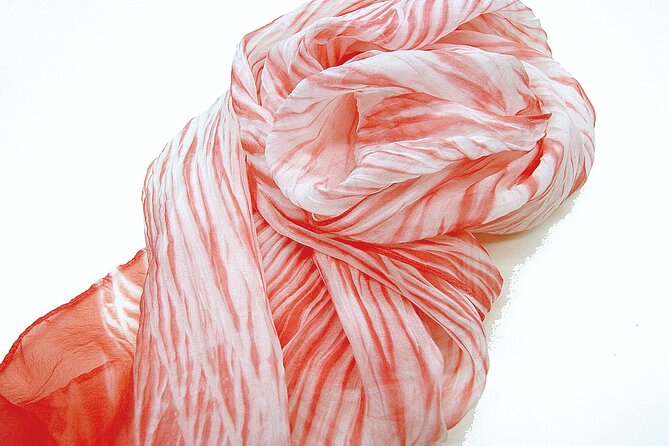
The final stage is the most satisfying: unfolding the fabric. The pattern appears from the contrast between dyed and protected sections. Since the exact result depends on your folds and binding, no two scarves should feel quite the same.
You should keep your expectations realistic. This is a guided introduction, not a full professional textile apprenticeship. Still, the process gives you a genuine understanding of how the pattern is made, and the finished scarf has a stronger connection to your Kyoto visit than a standard souvenir.
A few more Kyoto half-days to weigh up
- PERFECT KYOTO 1-Day Bus Tour
★ 5.0 · 13,518 reviews - Kyoto: Fushimi Inari, Kinkakuji, Bamboo Grove 1 Day Bus Tour
★ 4.8 · 4,316 reviews - Kyoto: Tea Ceremony in a Traditional Tea House in Kiyomizu
★ 4.9 · 3,519 reviews - Kyoto Geisha Walking Tour: Gion District & Hidden Gems
★ 4.7 · 3,273 reviews
What to do while the scarf dries
The scarf needs time to dry, so you are free to browse the museum displays during that interval. This pause works well in the schedule because you are not simply waiting beside your worktable.
The museum visit also helps you appreciate the scarf after making it. You may notice how larger textile pieces use folds, repeated patterns, or color in ways that are harder to understand from a short explanation alone.
The kimono try-on is another part of this waiting period. It gives you a chance to see shibori as clothing rather than only as a small craft project. If you are taking children or teenagers aged 12 and older, this can help keep the visit varied.
The exact order of drying, museum viewing, and kimono try-on may depend on the day and the class flow. The key point is that the included museum admission makes the short class feel like a fuller cultural stop.
Is $50.30 a fair price?

At about $50.30 per person, this is not Kyoto’s cheapest activity. The value depends on what you want from a souvenir and how much you value personal instruction.
You are paying for several things at once:
- A professional-led craft lesson
- A full-size silk scarf
- Your choice of dye color
- Museum admission
- Time to view shibori displays
- The opportunity to try on a kimono
- A private activity for your own group
If you only want a silk scarf, you can likely find finished textiles elsewhere. But purchasing one does not give you the process behind the pattern. Here, the souvenir carries a memory of folding the fabric, tying the string, selecting the color, and seeing the design appear.
The private format also improves the value for couples, families with eligible children, or small groups who want a shared activity. You are not paying for a large production with a crowded room and a rushed demonstration.
For a solo visitor, the price is a little easier to question, especially if you are watching every yen. I would book it if you enjoy making things or want a break from temple visits, shopping, and sightseeing on foot. If you are only interested in seeing the museum, the class may feel like more than you need.
Timing, transport, and group size

The class lasts roughly 30 minutes to one hour. That makes it easy to fit into a Kyoto day, though I would allow additional time for the museum displays and kimono experience.
Multiple start times are offered, so you can place the class around other plans. Even so, avoid scheduling a major timed attraction immediately afterward. The craft itself is short, but the drying period and museum visit can make the stop less predictable than a simple admission ticket.
The meeting point is the Kyoto Shibori Museum, and the activity returns there at the end. It is near public transportation. Limited parking is available, with two car spaces, and bicycle parking is also provided.
The activity is private, meaning only your group participates. That is useful if you want direct help or prefer not to work in a large class. It also makes the experience a better fit for people who may feel unsure about trying a traditional craft in front of strangers.
Confirmation is provided when you book. Adult pricing applies to all ages, and the stated minimum age is 12. Most people can participate, but anyone with concerns about handling fabric, string, or dye should ask the provider before booking.
Who will enjoy this class most?
I would recommend this class to:
- First-time visitors who want a hands-on Kyoto activity
- Couples looking for a small souvenir they can make together
- Families with children aged 12 and older
- Anyone interested in Japanese textiles and traditional crafts
- Shoppers who would rather create a personal item than buy a mass-produced one
- Visitors who want a short indoor activity with flexible start times
The class can also suit people who do not usually consider themselves artistic. The instructor handles the technical explanation, and the method gives you a clear sequence to follow. You are making choices, but you are not expected to invent a design from nothing.
It may be less suitable if you want a long workshop with several projects or detailed instruction in advanced dyeing. It is also not the right pick for families with children under 12 because of the stated age limit.
Practical ways to get more from the experience
Wear something you can work comfortably in, and pay close attention during the folding stage. The final look depends on how the fabric is arranged before dyeing, so this is the moment to ask questions.
Think about your preferred scarf color before you arrive, but stay open to the colors available at the museum. A color you choose for a souvenir may look different once it is broken up by the shibori pattern.
Do not judge the scarf while it is still bundled. The appearance changes as you unwind the string, press the fabric, and unfold it. The reveal is part of the craft, not just the last step.
If you are visiting with family, let each person make their own choices rather than trying to produce matching scarves. The appeal is in the personal result. Even similar colors can produce different patterns because the folds and binding vary.
I would also leave time for the museum and kimono try-on. Skipping those parts would reduce the activity to a quick dyeing lesson, while the included displays provide useful context for what you have just made.
Should you book the Kyo-arashi Shibori Scarf Class?
Book it if you want an authentic, compact craft experience and a souvenir with a story attached. The private format, English support, included museum admission, and full-size silk scarf make the $50.30 price easier to justify, especially for a couple or small group.
Think twice if you are seeking the lowest-cost activity, need a project for younger children, or want advanced instruction. For everyone else, this is a smart Kyoto break: practical, creative, and short enough to fit between larger sightseeing plans.
Free cancellation is available until 24 hours before the local start time. That gives you some flexibility, but changes or cancellations inside that window are not accepted for a refund.
FAQ
Where does the Kyo-arashi Shibori Scarf Class take place?
The class takes place at the Kyoto Shibori Museum, 135-5 Shikiamicho, Nakagyo Ward, Kyoto, 604-8261, Japan.
How long does the class last?
The class takes approximately 30 minutes to one hour. You can also spend time viewing the museum displays and trying on a shibori kimono while the scarf dries.
What will I make?
You will dye a silk scarf measuring about 180 by 44 centimeters, or 70 by 17 inches, using the kyo-arashi shibori method.
Can I choose the scarf color?
Yes. You can choose your preferred dye color from the options available during the class.
Is museum admission included?
Yes. Admission to the Kyoto Shibori Museum is included with the activity.
Can children participate?
The stated minimum age is 12, and adult pricing applies to all ages.
Is the activity private?
Yes. Only your group participates in the activity.
Can I cancel for a full refund?
Yes, if you cancel at least 24 hours before the experience start time. Cancellations or changes made less than 24 hours before the start time are not accepted for a refund.
Just added around Kyoto
- Kyoto: Zen Meditation at a Private Temple with a Monk★ 5.0 · 25 reviews
- Kyoto: Gion Geisha District & Sake-in-Hand Walking Tour★ 5.0 · 37 reviews
- Private Pewter Sake Cup Experience with a Kyoto Artisan★ 5.0 · 31 reviews
- Your Private Vacation Photography Session In Kyoto★ 5.0 · 110 reviews
- Private Guided Traditional Buddhist Cooking in Japan★ 5.0 · 16 reviews
- Kyoto Wagashi(Japanese sweets) Cooking Class near Fushimiinari★ 5.0 · 60 reviews
- Traditional Japanese Music show & Experience Tour in Kyoto★ 5.0 · 57 reviews
- Kyoto:Family-Friendly Kimono & Yukata Experience at WARGO★ 5.0 · 147 reviews
Kyoto Tours, compared.


Fushimi Inari, Kinkakuji, Bamboo Grove 1 Day Bus Tour
Read our review →
Tea Ceremony in a Traditional Tea House in Kiyomizu
Read our review →
Kyoto Geisha Walking Tour: Gion District & Hidden Gems
Read our review →

Gion Magical Night Walking Tour with Geisha Trivia
Read our review →

Gion Geisha District Walking Tour – Stories of Geisha
Read our review →Browse the lists this tour appears in