
Reviewed · BAMBOO GROVE TOURS
Kyoto: Arashiyama Bamboo Forest, Monkeys, Matcha & Temple Tour
Arashiyama packs Kyoto’s big themes into one very walkable outing: a Zen temple, towering bamboo, a mossy shrine, a classic bridge, matcha, and wild Japanese macaques. The best surprise is Monkey Park Iwatayama, where the city opens below you while monkeys move about nearby.
I like the variety here. You are not spending four hours looking at one type of sight, and the guide’s explanations help connect Zen gardens, Shinto tradition, bamboo culture, and local wildlife. I also like the small matcha break, which gives your feet a rest and adds a local taste to the walk.
The main drawback is the uphill hike to the monkeys. It is manageable for many people, but the path can be slippery in poor weather, and several people have chosen to skip the climb. Arriving on time matters, too, since one delayed start was a sore point for an otherwise happy group.
Key points at a glance
- Five distinct Arashiyama sights: Tenryu-ji, the Bamboo Forest, Nonomiya Shrine, Togetsukyo Bridge, and Monkey Park Iwatayama.
- A four-hour walking route: Expect steady walking, regular stops, and an uphill section to the macaque viewing area.
- Uji matcha included: The tea break adds a simple local food and drink experience to the sightseeing.
- Small-group format: The group is capped at 15 people, with some outings running at about 12.
- Guides shape the experience: Tim, Amy, Nay, Gabriele, Sofia, Shin, Maggie, Gabri, and Meg are among the guides praised for warmth, history, and good group control.
- Good value at $53.06: Admission to Tenryu-ji and Monkey Park is included, along with the English-speaking guide and matcha.
Why this Arashiyama route works
Arashiyama can feel scattered when you first arrive. The temple sits near the station, the bamboo paths branch through wooded lanes, Togetsukyo Bridge crosses the river, and Monkey Park rises on the opposite side. This tour gives the area a sensible order, so you spend less time puzzling over maps and more time noticing what is around you.
The route lasts about four to four and a half hours. That is long enough to see the main sights without turning the day into a rushed photo stop, though you should think of it as an active morning or afternoon rather than a gentle stroll.
The guide is a major part of the value. At its best, the tour turns familiar postcard scenes into places with meaning. Tenryu-ji becomes more than a pretty pond, and Nonomiya becomes more than a quick stop beside the bamboo. Guides including Tim, Amy, Nay, and Gabriele have been praised for keeping a friendly pace, answering questions, making room for photographs, and adding historical details.
The experience is limited to 15 people. That is not private touring, but it is small enough for a guide to keep an eye on the group. One outing had 12 people, and the guide was able to manage the group while still allowing breaks and bathroom stops.
More Arashiyama and bamboo walks:
- Kyoto: Fushimi Inari, Kinkakuji, Bamboo Grove 1 Day Bus Tour
★ 4.8 · 4,316 reviews - Osaka/Kyoto:Kinkakuji,Arashiyama,FushimiInariShrine,NaraPark
★ 4.1 · 1,596 reviews - Kyoto/Osaka: Nara, Fushimi Inari Taisha, Arashiyama Bus Tour
★ 4.7 · 1,275 reviews
Tenryu-ji and the calm of a Zen garden
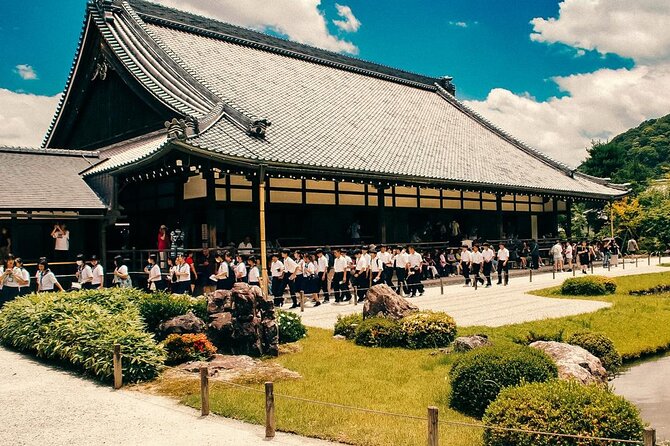
Tenryu-ji is the right place to begin. This UNESCO World Heritage Site is one of Kyoto’s best-known Zen temples, and its gardens provide a quiet counterpoint to the crowds that gather around Arashiyama’s famous paths.
The visit includes temple admission, which is important when judging the price. You can expect about 30 minutes here. That is enough time to walk through the garden, look across the pond, and hear the guide explain elements of the temple and its design.
The pond reflections are one of the visual highlights. Seasonal colors change the mood of the garden, so spring, summer, autumn, and winter each offer a different view. The setting is carefully arranged, but it does not feel stiff. Water, trees, rocks, and distant hills work together in the way Japanese garden design often seeks to frame nature rather than overpower it.
I would pay attention to the explanation here, not just take photographs. The guide can give you a starting point for understanding Zen spaces, and that makes later temple visits in Kyoto easier to read. The experience is brief, so anyone wanting a detailed architectural tour should plan extra time at Tenryu-ji independently.
The Bamboo Forest, beautiful but brief
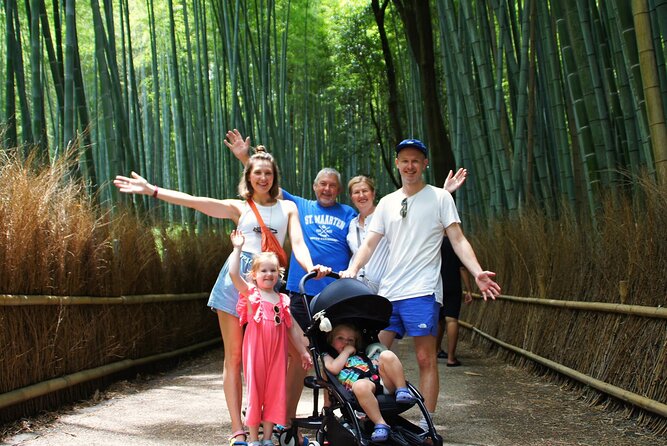
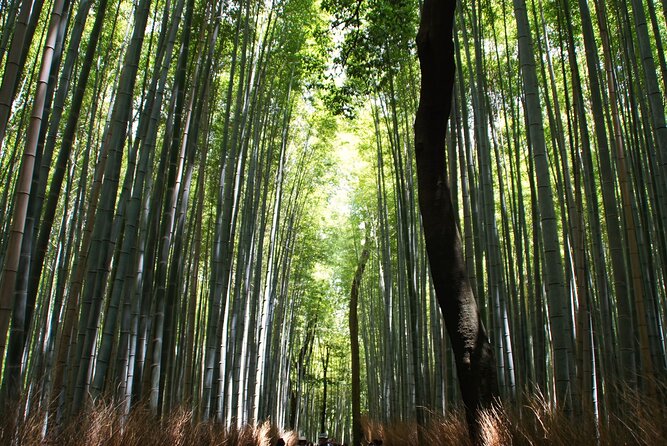
From the temple area, the route continues to the Arashiyama Bamboo Forest. The path is lined by tall bamboo stalks that rise overhead and move gently in the wind. It is one of Kyoto’s most recognizable scenes, and it earns that reputation because the setting feels unlike an ordinary city park.
The scheduled stop is about 30 minutes, with no separate admission fee. That is enough for a walk through the main section and for photographs, but not enough to explore every side path at leisure. If you have imagined a long, empty walk through bamboo, adjust your expectations. The grove is a famous public sight, so quiet moments may be interrupted by other groups.
Still, the short visit works well within this tour. You get the bamboo without allowing it to consume the whole outing. I like the contrast with Tenryu-ji: first you see a garden shaped with deliberate care, then you enter a natural corridor of bamboo that feels more untamed.
Your guide may also explain bamboo’s place in local life and culture. The exact level of detail depends on the person leading your group. Some guides have been singled out for giving a particularly strong cultural explanation, while one less satisfied participant found the commentary limited and overly scripted. That difference is worth keeping in mind. The route is reliable, but the personality and skill of the individual guide can shape the day.
Nonomiya Shrine and a quieter pause
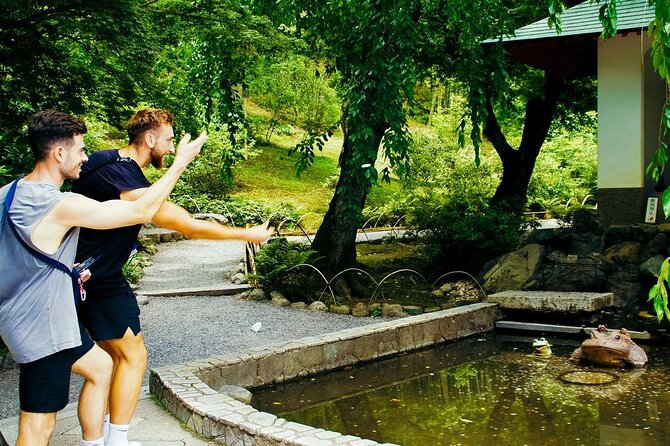
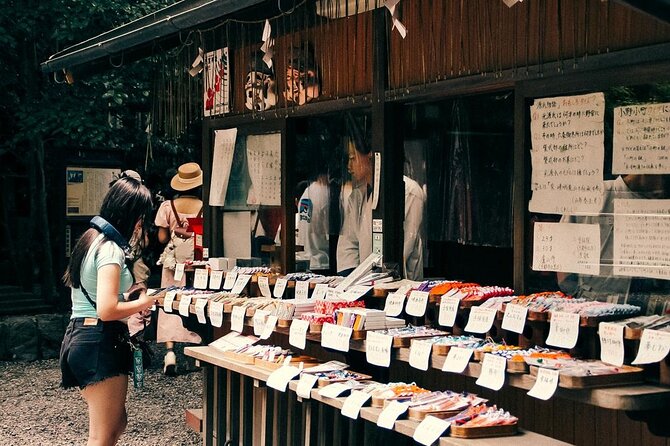
Nonomiya Shrine is a small but atmospheric stop tucked near the bamboo paths. The visit lasts about 15 minutes, and there is no additional admission fee.
The shrine is associated with ancient purification rituals. Its mossy surroundings make it feel more secluded than the larger Arashiyama sights, even though it sits close to a well-used walking route. This is a place where a short explanation adds real value. Without context, you might simply see a small shrine surrounded by trees. With context, you get a glimpse of older religious customs and the continuing role of Shinto practice in Japan.
Do not expect a long ceremony or extended free time. This is a focused stop. I would use it to look closely at the setting, listen to the guide, and take a few respectful photographs if permitted.
The shrine also helps break up the route. Arashiyama’s main sights can come in a quick visual rush, especially on a busy day. Nonomiya gives you a quieter moment before the tour moves toward the river and the more physical part of the outing.
A few more Kyoto half-days to weigh up
- PERFECT KYOTO 1-Day Bus Tour
★ 5.0 · 13,518 reviews - Kyoto: Tea Ceremony in a Traditional Tea House in Kiyomizu
★ 4.9 · 3,519 reviews - Kyoto Geisha Walking Tour: Gion District & Hidden Gems
★ 4.7 · 3,273 reviews - Kyoto: Tea Ceremony Ju-An at Jotokuji Temple
★ 4.9 · 3,207 reviews
Matcha before the climb
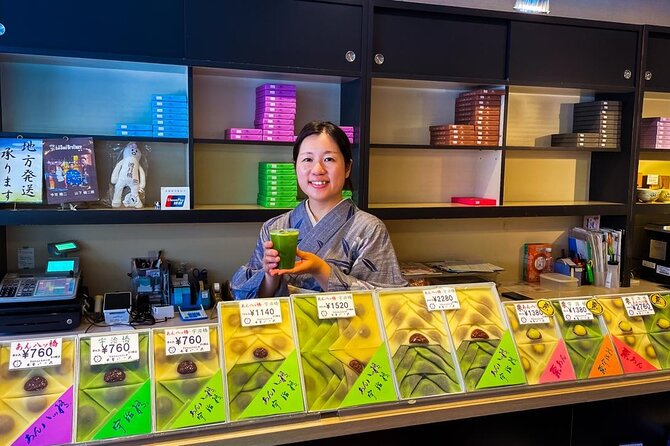
The included Uji matcha stop is a useful touch rather than a full tea ceremony. You receive one matcha drink, providing a chance to pause, taste a well-known Japanese tea, and reset before the Monkey Park walk.
The information supplied for the experience describes a matcha drink. Some comments describe matcha ice cream instead, so the exact serving may vary by departure or season. If the tea experience matters greatly to you, confirm the current offering before booking.
Either way, this pause adds something that many sightseeing walks leave out. You are not only moving from monument to monument. You get a small local flavor experience and a chance to chat with the guide or fellow group members.
Do not expect an elaborate tea ceremony with formal instruction. The value is simpler: a break, a taste of matcha, and a change of pace. Matcha can have a strong, earthy flavor, so this is most enjoyable if you are open to something less sweet and more bitter than a typical café drink.
Togetsukyo Bridge and the river view
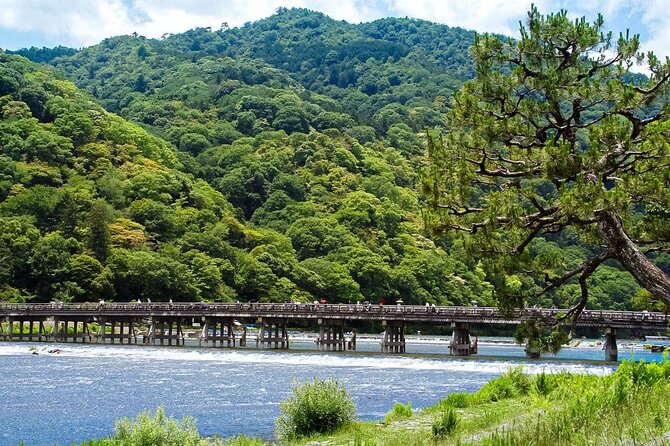
Togetsukyo Bridge is one of Arashiyama’s signature sights. Its name is often translated as Moon Crossing Bridge, and its position across the river gives you a classic view toward the surrounding hills.
The scheduled stop is only about 10 minutes. That sounds short, but it is enough to cross part of the bridge, take photographs, and hear why it matters to the district. The bridge is especially useful as a visual reset after the narrow bamboo paths. Here, the view opens to water, hills, and sky.
You should not expect a long riverside walk as part of the guided route. The bridge stop is a snapshot. If you want time beside the river, return after the tour, since the activity ends back at the meeting point near Randen Arashiyama Station.
This is also one of the easiest stops for anyone who decides not to climb Monkey Park. You still get a memorable Arashiyama view without the physical demand of the hill.
Monkey Park Iwatayama and the uphill reality
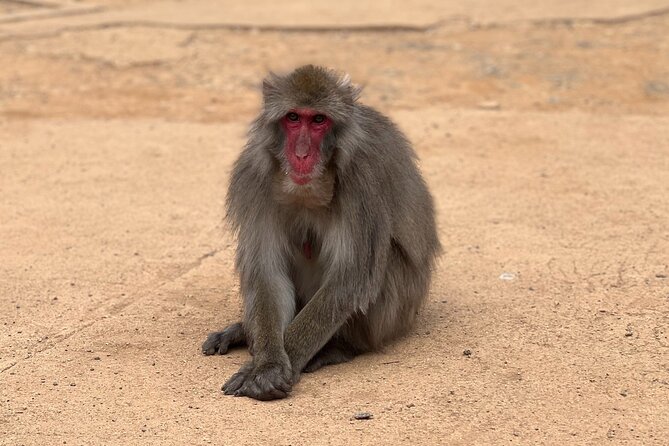
Monkey Park is the tour’s most active section. Reaching the viewing area requires a short but noticeable hike uphill, and the complete stop lasts about an hour, including time with the macaques and the broad view over Kyoto.
The monkeys are wild Japanese macaques. They are not presented as tame pets, and that is part of what makes the encounter interesting. You can watch them interact, including playful young monkeys, while keeping a sensible distance. The supplied advice notes that they generally do not approach unless you go to the feeding area.
The mountain view is almost as important as the animals. From the top, Kyoto spreads below you, with mountains beyond the city. The combination of macaques moving nearby and the city panorama gives this stop a different character from the temple and bamboo visits.
The hike deserves an honest warning. The path can be difficult for anyone who is not in good health, and wet conditions may make it treacherous. Two people in one group chose not to make the climb after recent hospital stays, while their friends continued and shared photographs. That is a sensible choice, not a failure to complete the tour.
If you have knee, balance, heart, or breathing problems, think carefully before booking. The guide may be helpful and the group may wait, but the basic route still includes the climb. Wear comfortable shoes with reliable grip. Sandals and smooth-soled footwear are poor choices.
At the feeding area, follow the posted rules and guide instructions. The monkeys may look entertaining, but they remain wild animals. The best experience comes from watching their behavior rather than trying to attract their attention.
The walking pace and group experience
This is a walking tour, not a hop-on, hop-off sightseeing circuit. You move between several nearby areas, stand during explanations, and climb to the monkey park. Four hours can feel long if you have already spent the morning on your feet, but the route is broken into short visits and pauses.
Several guides have been praised for pacing the group well. Tim is described as entertaining and attentive, while Amy is noted for adjusting to the group’s speed. Nay received praise for enthusiasm and cultural detail, and Gabriele for making time for questions and photographs. Sofia, Shin, Maggie, Gabri, and Meg have also been associated with friendly, helpful guiding.
That does not guarantee an identical style on every departure. One dissatisfied participant reported a late start caused by people arriving after the meeting time and found the explanations messy and scripted. If you value punctuality, arrive early at the stated meeting point, TULLY’S COFFEE at Randen Arashiyama Station.
The guide’s role is also practical. A group can easily lose time in Arashiyama, especially when people stop for photos or take a wrong turn. One group was helped after getting lost, and the guide adapted without making the problem a bigger issue. A maximum of 15 people makes that kind of supervision easier than it would be on a large coach tour.
What $53.06 buys you
At $53.06 per person, the price is fair if you plan to visit all these sights anyway. You receive an English-speaking guide, Tenryu-ji admission, Monkey Park admission, and one Uji matcha drink. You also save the work of planning the order and finding the route between the temple, grove, bridge, shrine, and monkey park.
The value is strongest for a first visit to Kyoto. You get orientation as well as sightseeing. A guide can point out places to eat and suggest other local experiences, details that may be harder to notice when you are focused on navigation.
The price is less compelling for a confident independent visitor who already knows Arashiyama and would prefer to linger. The Bamboo Forest and Togetsukyo Bridge are free, Nonomiya Shrine is free, and you could visit the public areas without a guide. The paid elements are Tenryu-ji, Monkey Park, and the matcha, while the rest of the cost pays for organization, explanations, and company.
The high rating and 99 percent recommendation figure suggest a strong overall record, but the occasional poor experience is useful to remember. The tour is not a private guide service, and the quality of the commentary can depend on the person leading your group.
Who should book this Kyoto walk
I would choose this tour if you want a compact introduction to western Kyoto and like having cultural background explained as you go. It suits first-time visitors, couples, families with older children, and anyone who wants the main Arashiyama sights arranged in one half-day outing.
It is also a good fit if you enjoy mixing culture and nature. Tenryu-ji supplies the quiet garden, the bamboo provides the memorable setting, Nonomiya adds a small religious site, the bridge brings the river view, and Monkey Park adds wildlife and exercise.
I would hesitate if you want a slow temple morning, have limited mobility, or dislike group timing. The monkey hike is optional in practice, but it is a central part of the advertised route. You can still enjoy the rest of the tour if you skip it, yet you should not book expecting a flat walk.
Wear comfortable walking shoes and allow room in your schedule for the full four to four and a half hours. The activity begins and ends at TULLY’S COFFEE Randen Arashiyama Station Shop, and it is near public transportation. Mobile tickets are used, and most people can participate, but the uphill section is the key physical test.
Should you book the Arashiyama tour?
Book it if you want efficient sightseeing with a real guide, especially on your first Kyoto visit. The mix is unusually good: Zen gardens, bamboo, Shinto tradition, matcha, a historic bridge, wild macaques, and a city view, all for $53.06 with two admission fees included.
Skip it if you already know Arashiyama, want extended time at each place, or cannot comfortably manage an uphill path. For everyone else, this is a practical way to get the district’s essential sights in one well-shaped half-day, with enough variety to keep the walk interesting.
FAQ
How long does the Arashiyama tour last?
The experience lasts approximately four to four and a half hours.
Where does the tour start?
The meeting point is TULLY’S COFFEE Randen Arashiyama Station Shop, at 20-2 Sagatenryuji Tsukurimichicho, Ukyo Ward, Kyoto, 616-8384, Japan.
Where does the tour end?
The activity ends back at the meeting point.
Is admission to Tenryu-ji Temple included?
Yes. The entry fee to Tenryu-ji Temple is included in the tour price.
Is Monkey Park Iwatayama admission included?
Yes. The entrance fee to Monkey Park is included.
Is matcha included?
Yes. One Uji matcha drink is included. Some descriptions of the experience refer to matcha ice cream, so confirm the current serving if that detail matters to you.
How many people can join the tour?
The group has a maximum of 15 participants.
Is the tour suitable for people with limited fitness?
Most people can participate, but the route includes an uphill hike to Monkey Park Iwatayama. The path may be difficult or slippery in poor weather, so comfortable shoes and an honest assessment of your fitness are important.
Just added around Kyoto
- Kyoto: Zen Meditation at a Private Temple with a Monk★ 5.0 · 25 reviews
- Kyoto: Gion Geisha District & Sake-in-Hand Walking Tour★ 5.0 · 37 reviews
- Private Pewter Sake Cup Experience with a Kyoto Artisan★ 5.0 · 31 reviews
- Your Private Vacation Photography Session In Kyoto★ 5.0 · 110 reviews
- Kyoto Wagashi(Japanese sweets) Cooking Class near Fushimiinari★ 5.0 · 60 reviews
- Private Guided Traditional Buddhist Cooking in Japan★ 5.0 · 16 reviews
- Traditional Japanese Music show & Experience Tour in Kyoto★ 5.0 · 57 reviews
- Kyoto:Family-Friendly Kimono & Yukata Experience at WARGO★ 5.0 · 147 reviews
Bamboo Grove Tours, compared.
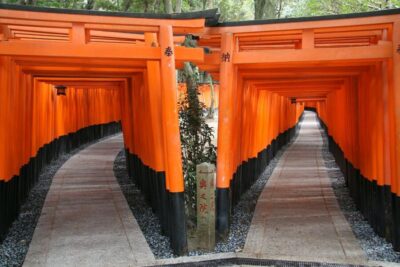
Fushimi Inari, Kinkakuji, Bamboo Grove 1 Day Bus Tour
Read our review →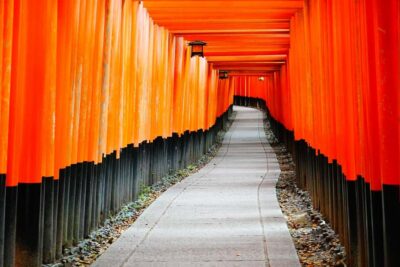
Osaka/Kyoto:Kinkakuji,Arashiyama,FushimiInariShrine,NaraPark
Read our review →
Kyoto/Osaka: Nara, Fushimi Inari Taisha, Arashiyama Bus Tour
Read our review →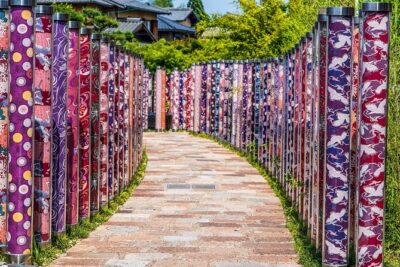
Kyoto Arashiyama Walking Tour: Bamboo, Monkeys, Gardens & Secrets
Read our review →
Arashiyama Bamboo, Temple, Monkeys, or Secret Sake Brewery
Read our review →
Osaka/Kyoto: Arashiyama, Nara & Fushimi Inari Shrine w/Lunch
Read our review →
Nijo, Kinkaku-ji, Arashiyama, Kiyomizu & Fushimi Inari
Read our review →
Kyoto Ghost Tour: Dark Tales, Urban Legends, Bamboo Forest Night
Read our review →Browse the lists this tour appears in