
Reviewed · KYOTO TOURS
Kyoto: Tea Ceremony with Maiko Premium
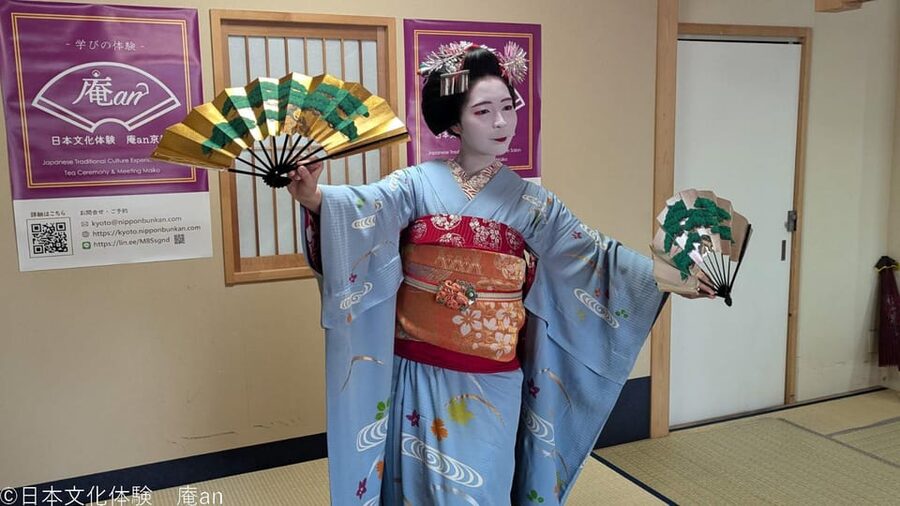
Kyoto’s Maiko culture is usually seen from a distance, in glimpses around Gion. This 90-minute Premium program brings a Maiko into a room where you can ask questions, learn to make matcha, watch two dances, and take a photo beside her. I especially like the open Q&A and the playful games, which make this more than a performance.
I also like the practical price, about $50 per person, for a full cultural program that includes two Japanese sweets, matcha, dances, and a keepsake Senjafuda charm. The main consideration is the setting: this is not an ochaya or tatami room, but a modern building with tables, stools, and company advertising that can appear in photos.
Key points at a glance
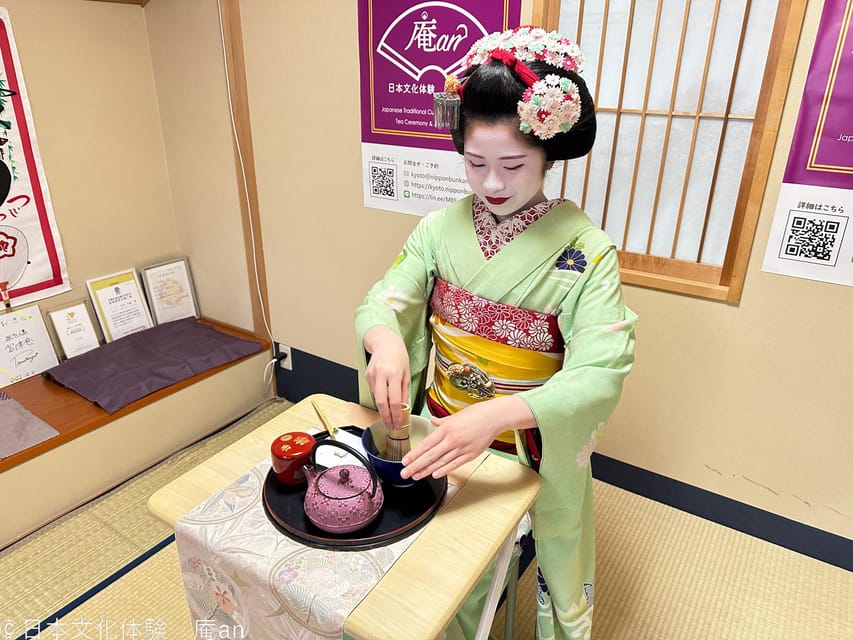
- You make your own matcha: The Maiko demonstrates the basic method, then you prepare your tea.
- Two traditional dances: The performance gives you a close look at precise gestures, posture, and seasonal themes.
- Direct questions are encouraged: Ask about Maiko training, daily routines, kimono, hairstyles, and life in the profession.
- Premium includes the lively parts: Games and dances are included, not just the tea demonstration.
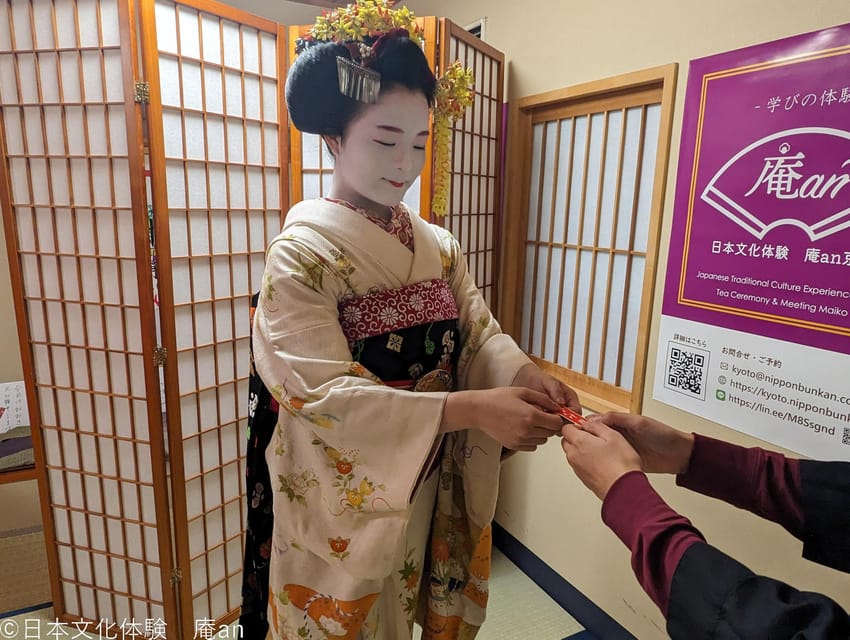
- Photos are part of the program: You can take a commemorative picture beside the Maiko and receive a Senjafuda charm.
- Gojo Station is very close: The venue is one minute from Exit 1 of Gojo Station, though you must use stairs inside the building.
Meeting a Maiko beyond the Gion street scene
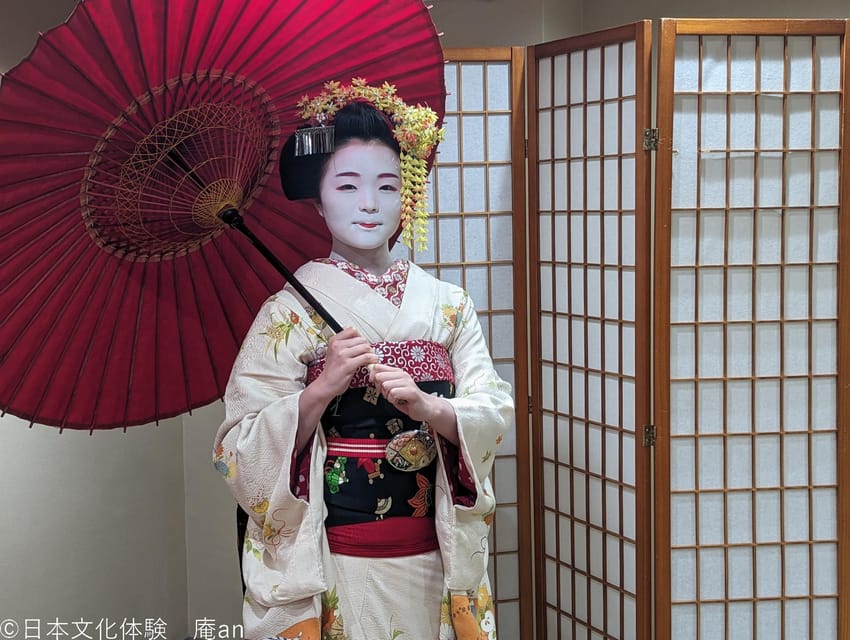
A Maiko is an apprentice geiko, recognized by her ornate kimono, elaborate hairstyle, and formal white makeup. Her training follows a traditional path, and the program gives you a chance to hear about that life directly rather than simply watching a costumed performance.
The exact performer can vary. Some sessions feature a Maiko, while others may include a Geiko. That change is not a downgrade. A Geiko is a fully trained performer, and the program remains focused on conversation, dance, tea, and interaction.
The most useful part for me is the chance to ask questions. The Maiko can talk about her training, routines, clothing, and traditions, while the host helps the group follow along. English translation is offered as much as possible, but the listed operating language is Japanese, so contact the provider in advance if English support matters to you.
This direct exchange gives the program its strongest cultural value. You are not just looking at a kimono and a hairstyle. You are hearing about the discipline behind them, and about a profession that still exists in modern Kyoto.
More Tea Ceremonies in Kyoto
- Kyoto: Tea Ceremony in a Traditional Tea House in Kiyomizu
★ 4.9 · 3,519 reviews - Kyoto: Tea Ceremony Ju-An at Jotokuji Temple
★ 4.9 · 3,207 reviews - Kyoto: 45-Minute Tea Ceremony Lesson Experience
★ 4.3 · 2,378 reviews
What happens during the 90 minutes
The published schedule allows about 75 minutes for the main program, followed by chatting time before you leave at roughly the 90-minute mark. Actual timing can vary, and one attendee found the active portion closer to 70 minutes, so I would not treat every minute as guaranteed performance time.
The order is straightforward:
- Greeting from the Maiko
- Tea ceremony demonstration and hands-on matcha preparation
- Two Japanese dried sweets and matcha
- Question-and-answer session
- Photo with the Maiko
- Senjafuda gift
- Two traditional dances
- Interactive game
- Departure and a short period for chatting
The structure works well because it alternates quiet cultural explanation with more social activities. You begin by watching and learning, then take part yourself, then finish with dance and games.
Making matcha with two Japanese sweets
The tea section is a basic introduction rather than a formal tea-school lesson. The Maiko shows you how to prepare matcha, explains what to do, and then gives you the chance to whisk your own bowl.
That simplicity is useful. You do not need prior knowledge, special clothing, or formal preparation. The focus is on understanding the basic rhythm of the process and enjoying the moment, not on testing your ability to follow every ceremonial rule.
Two dried Japanese sweets are included with the matcha. Their sweetness gives you a traditional pairing with the slightly bitter tea. If you have already taken a formal tea ceremony elsewhere in Kyoto, this part may feel familiar and less elaborate. If this is your first introduction, it is an easy, friendly starting point.
The tea itself is ordinary matcha rather than a rare tasting. That is worth knowing when you compare this with a specialist tea workshop. The value here comes from making it under the Maiko’s guidance and combining it with the rest of the program.
The Q&A is the cultural heart of the program
The question period is where the session becomes personal. You can ask about the Maiko’s life, training, clothing, hairstyles, and traditions. The questions are handled in a group, so you should expect to share time rather than receive a private conversation.
The host helps keep the exchange moving, and some sessions have included a host comfortable in both Japanese and English. Still, translation is not guaranteed in the same form every time. If you want to ask detailed questions, prepare a few short ones in advance.
I would ask about the difference between a Maiko and a Geiko, how long training takes, what daily routines look like, and which parts of the clothing are hardest to manage. One session included discussion of a training path taking about five years, which gives you a sense of the long commitment behind the appearance.
This is also a good moment to remember that the Maiko is a professional performer. The conversation is warm and accessible, but it is still a hosted cultural program, not an invitation into private life.
Same base, a completely different sort of day:
- PERFECT KYOTO 1-Day Bus Tour
★ 5.0 · 13,518 reviews - Kyoto: Fushimi Inari, Kinkakuji, Bamboo Grove 1 Day Bus Tour
★ 4.8 · 4,316 reviews - Kyoto Geisha Walking Tour: Gion District & Hidden Gems
★ 4.7 · 3,273 reviews - Kyoto: Gion Magical Night Walking Tour with Geisha Trivia
★ 4.9 · 2,393 reviews
Two dances, performed at close range
The Maiko performs two traditional dances. Their themes can relate to the seasons, love stories, or ordinary scenes from Japanese life.
The appeal is not speed or spectacle. Watch the hands, the controlled steps, the angle of the head, and the way a small movement carries meaning. From a nearby seat, you can see details that are easy to miss in a large theater.
The Premium option matters here. The dances are part of the expanded program, along with the games. If you are mainly interested in meeting a Maiko and seeing her perform, paying for Premium makes more sense than choosing a shorter tea-only format.
Photography is generally allowed during the presentation, but be considerate. Flash, raised phones, or constant movement can distract from the performance and affect the people sitting behind you.
The game changes the mood
After the formal dance, the program becomes playful. The Maiko leads a simple traditional game, and volunteers can join while everyone else claps and cheers.
This section is especially helpful for families. Children have an obvious way to take part, even if they do not follow every detail of the tea ceremony or Q&A. Kids as young as four have enjoyed the combination of games, photos, and a real performer in full dress.
The game also gives you a glimpse of Maiko hospitality. These entertainers are trained not only in dance and tradition, but also in keeping a room engaged. You do not need to volunteer, but watching can be just as amusing.
The balance is good: after sitting quietly for the tea and dance, you get a reason to laugh and participate. It keeps the event from feeling like a lecture.
Photo time and the Senjafuda keepsake
The photo opportunity lets you stand or sit beside the Maiko for a commemorative picture. You can also take photos during parts of the presentation, subject to the host’s instructions.
You receive a Senjafuda, a small lucky charm associated with the Maiko tradition. It is a more meaningful souvenir than a generic printed photograph because it connects directly to the culture you have just learned about.
There is one practical weakness. The photo area may have large advertisements, a company name, or a QR code in the background. Several people found this distracting, especially when trying to frame a polished portrait. If the photograph matters to you, ask where the cleanest angle is and follow the staff’s directions.
The Maiko’s kimono and hairstyle are among the visual highlights, so take a moment to look before reaching for your phone. A good photo is nice, but the close view of the costume is part of the value too.
A modern venue, not a traditional tea house
Set your expectations before you arrive. The venue is in a building, not an ochaya, machiya, or traditional Japanese house. The room has tables and stools, and the Maiko may sit behind a small table on a stool rather than kneel in a tatami room.
That makes the program less atmospheric than a formal tea ceremony in an old Kyoto residence. The plain wall and promotional signs can also weaken the visual effect during dance and photos.
On the other hand, the modern room is relaxed and approachable. You do not need to know how to sit on tatami, follow strict etiquette, or prepare for a highly formal ritual. The friendly format makes it easier for first-time visitors and families.
I would think of this as a cultural presentation in a convenient indoor venue, not as a peek inside the private world of an ochaya. The performer and the traditions are real, but the surroundings are functional.
Seating, access, and timing near Gojo Station
The meeting point is about one minute from Exit 1 of Gojo Station on the Subway Karasuma Line. The entrance faces Gojo-dori, the main street, so the location is easy to reach by subway.
There is no elevator in the building. You must use stairs to reach the venue, which matters if anyone in your party has limited mobility or is carrying a stroller.
Arrive early. The program will not wait for late arrivals, even when the delay is caused by transport problems. One useful tip is to arrive about 15 minutes ahead. You may see the Maiko arrive by taxi, though this is not part of the scheduled program and should not be treated as guaranteed.
The session may take place alongside people having lunch or dinner. That means the room may feel more like a hosted dining venue than a private cultural salon. Noise from other people can occasionally affect the atmosphere, so your experience may depend partly on the room on the day.
Seats in the first three rows cost extra:
- SS seat, first row: 3,300 yen
- S2 seat, second row: 2,200 yen
- S3 seat, third row: 1,100 yen
The standard ticket may be enough if you mainly want the Q&A and performance. Front-row seating is worth considering if close-up views and photos are your top priorities.
Is the $50 price fair?
At about $50 per person, the price is reasonable for a 90-minute program with a live cultural performer. You receive matcha, two sweets, a Q&A, two dances, a game, a photo opportunity, and the Senjafuda charm.
The value is strongest when you want several things in one booking. A separate tea introduction, dance show, and cultural talk could take more time and planning. Here, you get a compact Kyoto evening that works well in a busy itinerary.
The price is less attractive if you want a formal tea ceremony in a historic house or a private meeting. This is a group activity, and the setting is modern. The matcha preparation is also basic, so tea specialists may want a more focused workshop.
I would pay for Premium if you want the complete program. The dances and games are two of the most enjoyable parts, and the extra interaction makes the upgrade worthwhile. If you only want to taste matcha and see a short demonstration, a simpler tea experience may suit you better.
Who will enjoy this most?
I would recommend it to first-time visitors who want a clear introduction to Maiko culture without committing to a long or highly formal ceremony.
It suits:
- Families, since children can join the game and sit beside a parent if under two years old
- Couples seeking a memorable Kyoto activity
- Visitors who want a photo with a Maiko
- Anyone curious about training, clothing, and daily life
- People with only 90 minutes for a cultural program
- Visitors who prefer a friendly, participatory format
It may not suit you if your main goal is a traditional room, quiet atmosphere, or private attention. The venue is functional, seating is shared, and the program may include translation through a host rather than full English delivery.
Children under two are free when sitting on a parent’s lap. If a separate seat or meal is required, the regular one-person fee applies. Anyone who is not participating cannot enter the experience.
Booking advice and cancellation details
Reservations are processed during operating hours, from 10:00 to 17:00. Requests received after 17:00 are handled the next day.
You can cancel up to eight days in advance for a full refund. After that point, cancellation fees apply, and changing the date or time after a fee has been incurred can also bring an additional charge. The provider does not cover your transport costs if the booking is cancelled, so avoid making tight same-day plans around it.
Because the event does not wait for late arrivals, build in time to find the entrance and climb the stairs. Contact the provider before booking if English translation is important or if you need to clarify access arrangements.
Should you book the Kyoto Maiko Premium experience?
Book it if you want direct contact, photos, dance, and a little hands-on participation in one well-priced Kyoto activity. The Q&A and game keep it from feeling like a passive show, while the Maiko’s costume, gestures, and dances offer the visual moments you came to see.
Skip it if a historic tea house is essential to your idea of Kyoto. The modern room and advertising backdrop are real drawbacks, especially for photography. But if you can accept the setting, this is a practical and enjoyable way to meet a Maiko, learn about her world, and leave with both a Senjafuda charm and a memorable story.
FAQ
How long is the Kyoto Maiko Premium experience?
The scheduled duration is 90 minutes. The main program runs for about 75 minutes, followed by chatting time before room departure. Actual timing can vary.
How much does the experience cost?
The listed price is $50 per person. Optional seating upgrades cost 3,300 yen for the first row, 2,200 yen for the second row, and 1,100 yen for the third row.
Is the performer always a Maiko?
No. Depending on the circumstances, a Geiko may be invited instead of a Maiko. Both are part of Kyoto’s traditional entertainment culture.
What is included in the Premium program?
The program includes the Maiko tea ceremony, matcha preparation, two dried Japanese sweets, a Q&A session, a photo opportunity, a Senjafuda charm, two dances, an interactive game, snacks, and a drink.
Can I take photos with the Maiko?
Yes. You have a chance to take a commemorative photo beside the Maiko, and photos may also be allowed during parts of the presentation.
Is the experience conducted in English?
The listed language is Japanese. English translation is provided as much as possible, and you should contact the provider in advance if you would like translation support.
Where is the meeting point?
The venue is a one-minute walk from Exit 1 of Gojo Station on the Subway Karasuma Line. The entrance faces Gojo-dori.
Is the building accessible by elevator?
No. There is no elevator, and you must use stairs to reach the venue.
What is the cancellation policy?
You can cancel up to eight days in advance for a full refund. Cancellation fees apply after that point, and changing the date or time after a fee has been incurred may also result in a specified charge.
More Geisha Experiences
- Kyoto: Gion Geisha District Walking Tour – Stories of Geisha
★ 4.7 · 2,187 reviews - Best of Kyoto: Gion, Geisha, Pagodas & Cobblestones
★ 4.9 · 2,058 reviews - Night Walk in Gion: Kyoto’s Geisha District
★ 4.5 · 2,003 reviews - Kyoto Night Foodie Tour in Gion (9+ dishes + 6 Sake tastings)
★ 5.0 · 1,762 reviews
Just added around Kyoto
- Kyoto: Zen Meditation at a Private Temple with a Monk★ 5.0 · 25 reviews
- Kyoto: Gion Geisha District & Sake-in-Hand Walking Tour★ 5.0 · 37 reviews
- Private Pewter Sake Cup Experience with a Kyoto Artisan★ 5.0 · 31 reviews
- Your Private Vacation Photography Session In Kyoto★ 5.0 · 110 reviews
- Private Guided Traditional Buddhist Cooking in Japan★ 5.0 · 16 reviews
- Kyoto Wagashi(Japanese sweets) Cooking Class near Fushimiinari★ 5.0 · 60 reviews
- Traditional Japanese Music show & Experience Tour in Kyoto★ 5.0 · 57 reviews
- Kyoto:Family-Friendly Kimono & Yukata Experience at WARGO★ 5.0 · 147 reviews
Kyoto Tours, compared.
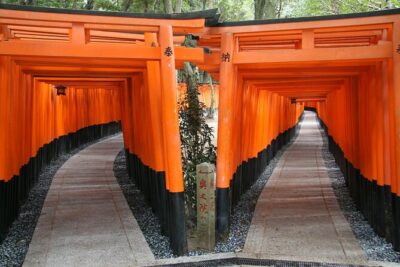
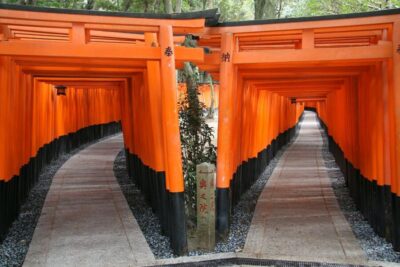
Fushimi Inari, Kinkakuji, Bamboo Grove 1 Day Bus Tour
Read our review →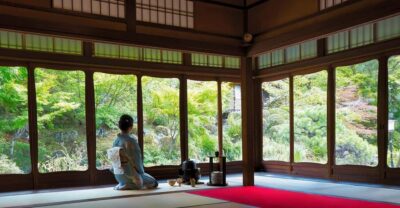
Tea Ceremony in a Traditional Tea House in Kiyomizu
Read our review →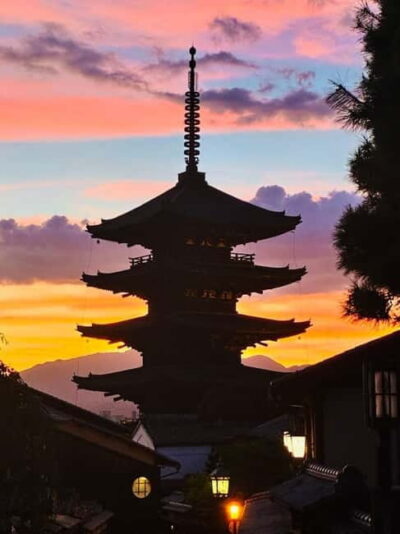
Kyoto Geisha Walking Tour: Gion District & Hidden Gems
Read our review →

Gion Magical Night Walking Tour with Geisha Trivia
Read our review →
Gion Geisha District Walking Tour – Stories of Geisha
Read our review →Browse the lists this tour appears in