
Reviewed · KYOTO TOURS
Kyoto 5-Star Geisha Night Walk: Small-Group Authentic Experience
Kyoto’s geisha districts make the most sense after sunset, when lanterns glow, wooden townhouses look their best, and daytime tour crowds begin to thin. This small-group night walk takes you from Gion through Higashiyama and on to Pontocho, with guide Richard explaining the customs behind the streets rather than simply pointing at them.
I like the maximum group size of eight, which gives you room to ask questions, and I like the broad range of topics: geisha training, kimono, Shinto, Zen, architecture, and Kyoto’s long connection with traditional arts. The main drawback is simple: three and a half hours on foot is a serious walk, with steps and uneven stone paths along the way.
Key points to know
- Gion after dark: See Hanamikoji Street and quieter geisha lanes when the district is less crowded.
- Richard’s cultural explanations: Expect detailed discussion of geisha life, Japanese history, shrines, kimonos, and local customs.
- Eight-person limit: The small group makes it easier to hear the guide and ask questions.
- Historic Kyoto in one evening: The route links Gion, Yasaka Pagoda, Ninenzaka, Yasaka Shrine, and Pontocho.
- A built-in snack stop: A Kyoto-style treat gives you a short break during the walk.
- A walking tour first: Good shoes matter, and anyone with walking difficulties should choose a less demanding activity.
Why Gion works best after sunset
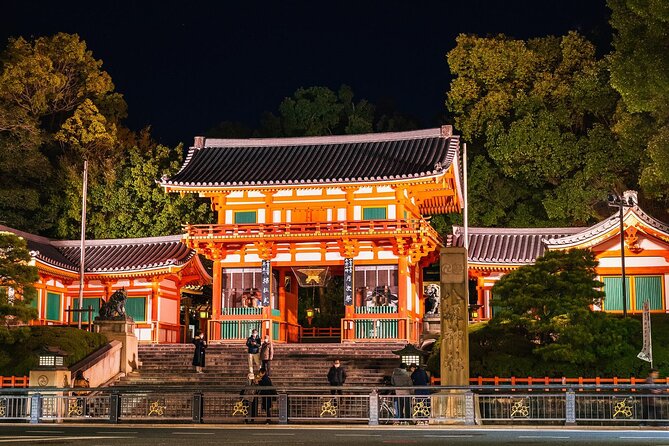
Gion is not a museum set behind glass. It is a working district of restaurants, tea houses, shrines, narrow lanes, and traditional wooden buildings. During the day, the main streets can feel packed. In the evening, the atmosphere changes. You may see doors opening for evening appointments, lanterns lighting up, and the district settling into its traditional role as a place of entertainment and hospitality.
That does not mean the walk guarantees a meeting with a geisha or maiko. The focus is on understanding the district and its customs, not chasing performers for photographs. If you happen to see geisha heading to work, the guide can help explain what you are seeing and how to behave respectfully.
The tour begins at 5:20 p.m. outside the Disney Store at Kyoto Shijo-Kawaramachi. This is a central meeting point near public transportation, though you should allow time to locate the correct corner of the building. The walk ends at Sanjo Ohashi Bridge, at the northern end of Pontocho Alley.
More geisha-district evenings:
- Kyoto Geisha Walking Tour: Gion District & Hidden Gems
★ 4.7 · 3,273 reviews - Kyoto: Gion Magical Night Walking Tour with Geisha Trivia
★ 4.9 · 2,393 reviews - Kyoto: Gion Geisha District Walking Tour – Stories of Geisha
★ 4.7 · 2,187 reviews
Hanamikoji Street and the working world of geisha
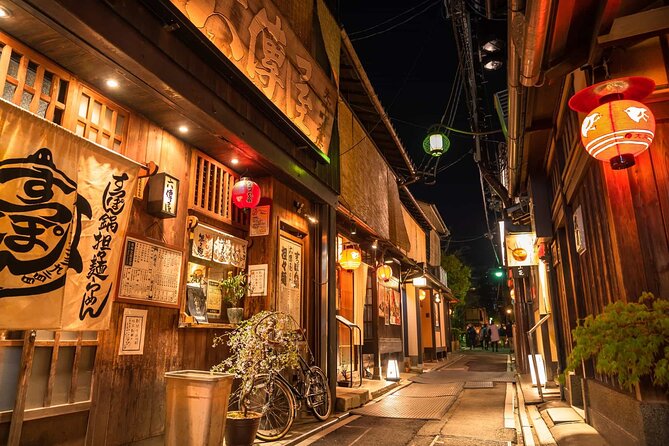
The first substantial stop is Hanamikoji Street, the best-known traditional street in Gion. Its preserved facades and side alleys give you an immediate sense of old Kyoto, but the useful part of this visit is the explanation of what lies behind those facades.
Richard discusses the geisha arts, their training, the distinction between different stages of that career, and the role of geisha houses. He also explains the buildings where geisha live and work, giving you context that is difficult to pick up by simply wandering alone.
This is where the guide’s storytelling matters most. The subject can easily be reduced to costumes and photographs. Instead, the walk connects clothing, music, dance, etiquette, apprenticeship, and the social setting in which these arts developed. Several people specifically praised Richard’s clear explanations of kimonos and the path toward becoming a geisha or maiko.
You will also pass Gion Corner, associated with the study and training of geisha arts. Do not expect a performance here as part of this walk. Think of it as a useful landmark while the guide explains how Kyoto preserves traditional entertainment.
Please keep your camera put away when appropriate and never block a doorway or follow someone down a private lane. The district remains a place where people work and live.
Kabuki, Zen, and the older temples of Kyoto
Near the Kabuki theater, Richard explains the traditions of this highly stylized form of Japanese theater. This adds an important layer to the evening because geisha culture does not exist in isolation. It belongs to a wider world of performance, patronage, craft, and formal hospitality.
The walk also passes one of Kyoto’s oldest temples, where the discussion turns to Zen. The supplied route does not promise entry into every temple, so you should expect exterior visits and explanations rather than a series of indoor tours. That is not a weakness. At night, temple gates, rooflines, stone paths, and shadowed courtyards can be more atmospheric than a rushed daytime stop.
The guide’s strength, according to the supplied comments, is his ability to connect individual sights to wider Japanese culture. He covers Shinto beliefs, samurai history, architecture, and daily life without keeping the evening limited to geisha trivia. That broader approach makes the walk useful early in your Kyoto stay, when you are still trying to understand how the city fits together.
Yasui-Konpiragu and the meaning of a small shrine
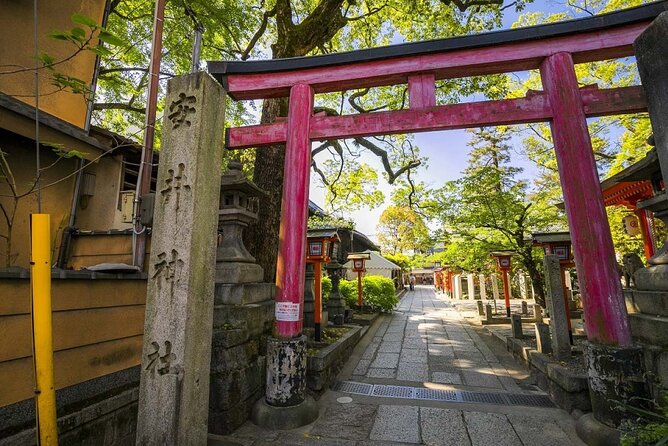
Yasui-Konpiragu is scheduled for about 30 minutes. This intimate shrine offers a change of scale after the more famous streets of Gion. Richard explains Shinto traditions and the purpose of the shrine, helping you understand the difference between a shrine and a Buddhist temple.
The stop is valuable because Japanese religious sites can look mysterious if you do not know what you are seeing. A guide can point out the basic customs and explain why people visit, pray, and leave offerings. You get more from the place when you understand its role rather than treating it as a photogenic pause.
The route includes steps and rocky, unpaved sections. Strollers can manage some parts only with difficulty, and the full walk is not suitable for anyone with walking issues. This is a proper walking experience, not a slow coach tour with occasional exits.
More walking tours in Kyoto:
- Night Walk in Gion: Kyoto’s Geisha District
★ 4.5 · 2,003 reviews - Kyoto Gion Geisha District Walking Tour – The Stories of Geisha
★ 5.0 · 1,441 reviews - Nishiki Market Brunch Walking Tour (7 Tastings + Brunch)
★ 5.0 · 1,355 reviews - Kyoto Arashiyama Walking Tour: Bamboo, Monkeys, Gardens & Secrets
★ 5.0 · 1,216 reviews
Yasaka Pagoda and the stone lanes of Higashiyama
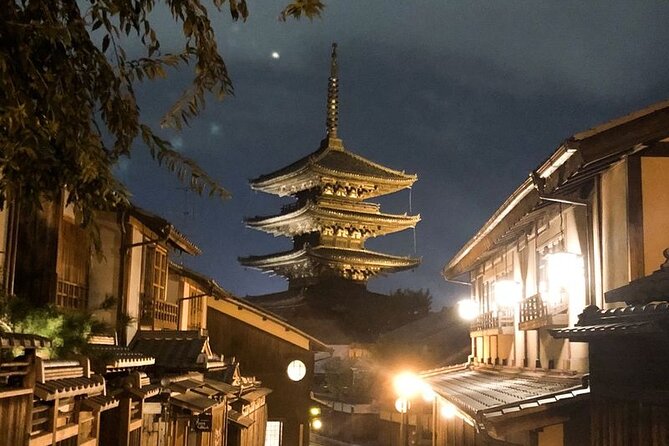
Hokanji Temple, better known for Yasaka Pagoda, is one of the evening’s strongest photo stops. The pagoda rises above a historic part of Kyoto where narrow streets, old facades, and lantern light create the classic image many people hope to see.
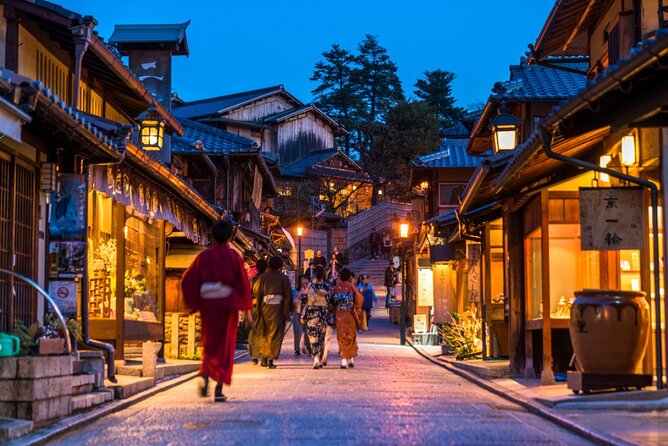
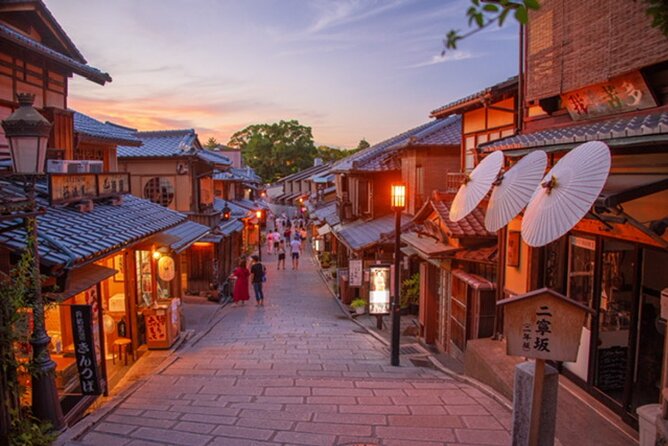
The stop itself lasts about 15 minutes, so think of it as a focused look and photo opportunity, not an extended temple visit. Ninenzaka follows, also for about 15 minutes. This sloping stone lane is especially appealing after dark, when the street feels quieter and the traditional buildings become the main subject.
Ninenzaka can be busy at popular times, so the promise of avoiding daytime crowds should be understood as a benefit, not a guarantee of solitude. The area is still one of Kyoto’s most famous sightseeing zones. Your guide helps by leading you through it efficiently and adding meaning to the buildings and street plan.
Wear shoes with a firm sole. Even if the pace is comfortable, stone paving and steps are less forgiving than a flat city sidewalk.
A Kyoto snack on Nene-no-Michi
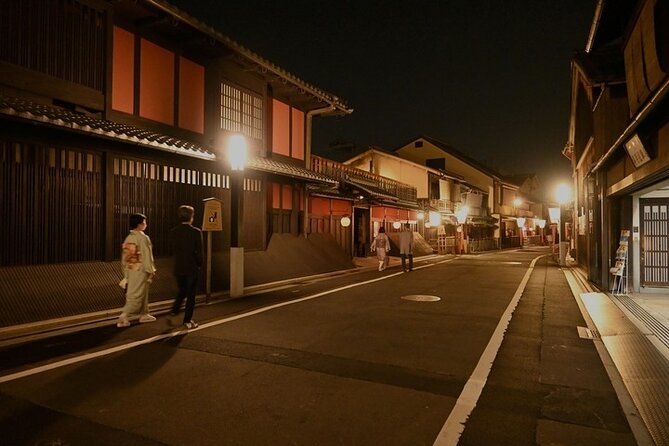
Nene-no-Michi provides a 30-minute break and an included local snack. This is a small feature, but it improves the shape of the evening. Three and a half hours of walking is much easier when you have a chance to sit or pause, eat something, and ask the guide questions away from the main flow of the route.
The exact snack is not specified, though the supplied comments describe it as a Kyoto-style treat and a Japanese dessert. One person found the traditional snack less suited to personal taste, while others enjoyed it. That is a fair warning: local sweets can be unfamiliar, and the snack is best viewed as a cultural sample rather than a meal.
It is also useful to know what is not included. Personal spending, including additional food and drinks, is your responsibility. If you want a full dinner afterward, the tour ends in Pontocho, where you can continue into the evening, though the experience itself does not include a restaurant meal.
Yasaka Shrine after dark
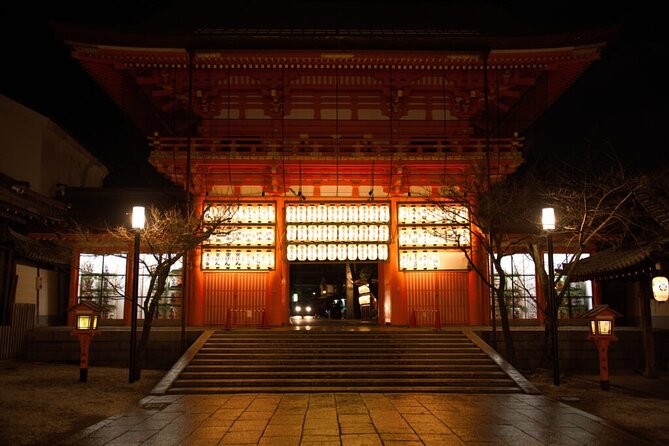
Yasaka Shrine is allotted about 30 minutes and gives the guide another chance to explain the features of a major Shinto site. It is one of Japan’s best-known shrines, yet a night visit can feel different from a daytime stop filled with school groups and sightseeing parties.
Look for the contrast between the broad shrine grounds and the narrow lanes visited earlier. Richard explains what makes the shrine important and how its features relate to Shinto practice. This is another point where the tour earns its price through interpretation. You could visit the shrine alone, but you would not necessarily know what details deserve attention.
The evening setting also gives you more time to observe how Kyoto’s sacred spaces sit beside entertainment districts. That relationship is one of the most interesting parts of Gion. The city’s temples, shrines, restaurants, theaters, and geisha houses are not separate attractions scattered at random. They form a compact historic quarter with different roles woven into daily life.
Pontocho, the evening finish, and restaurant advice
The final district is Pontocho, a narrow and lively lane known for geisha houses, bars, and nightlife. It is a good ending because the walk moves from the quieter lanes of Higashiyama into a more active evening setting.
Pontocho is narrow, so groups need to stay together and avoid blocking entrances. Richard can help you read the area, distinguish traditional buildings from modern businesses, and understand how the district functions at night.
The tour ends at Sanjo Ohashi Bridge, not back at the starting point. This is convenient if you want to continue dining or exploring near Pontocho, but it means you should plan your route home. Several comments praise Richard’s restaurant suggestions, so ask him for ideas if you have not chosen dinner yet. Those recommendations are informal guidance, not part of the tour price.
What $98 buys you
At $98 per person, this is not the cheapest way to walk around Gion. You can visit Hanamikoji, Yasaka Shrine, Ninenzaka, and Pontocho without paying an admission fee. The value comes from the structure, small group, and cultural explanation.
You are paying for about 3.5 hours with an English-speaking guide, a group capped at eight, a local snack, and a route that links several districts that can be confusing to connect on your own. For a first evening in Kyoto, that can be good value because the walk gives you both orientation and context.
I would not book it if you want a short photo stroll or a guaranteed private geisha encounter. I would consider it worthwhile if you want to understand what you are seeing and prefer asking questions to reading signs on your phone.
Tips are not included, and the provider says they are greatly appreciated. Budget for that if Richard’s guidance adds real value to your evening.
How the guide shapes the experience
Richard is the clear center of this tour. The supplied comments repeatedly highlight his ability to explain Kyoto history, geisha culture, Shinto, Zen, architecture, kimono, and Japanese customs in plain English. His background as an American and Japanese guide is also noted, with an ability to explain cultural differences clearly.
That matters because geisha culture includes terms and practices that can be misunderstood. Richard uses stories, visual explanations, and detailed answers to make the subject approachable. He also appears willing to adjust the pace and respond to the group’s interests, an advantage in a group of eight.
People also value his practical suggestions for restaurants and gift shops. Those recommendations are especially useful when the tour is taken on your first night, since you can use the advice during the rest of your stay.
Who should book this night walk
I would choose this experience if you:
- Want a serious introduction to Gion and geisha culture
- Prefer a small group instead of a large walking crowd
- Like history, architecture, religion, and local customs alongside photography
- Are comfortable walking for 3.5 hours
- Want to see Kyoto’s traditional districts after dark
- Are visiting early in your stay and want cultural context for later sightseeing
I would skip it if you have limited mobility, dislike uneven paths, or want a relaxed evening with lots of time inside buildings. The route includes steps and rocky sections, and most stops are outdoor visits.
The experience suits adults, families with older children, and curious first-time visitors. It may be less useful if you already have a strong understanding of Kyoto’s religious traditions and have spent several evenings exploring Gion independently.
Booking details and weather
You receive confirmation when booking, and the tour uses a mobile ticket. It begins at 5:20 p.m. at the Disney Store near Shijo-Kawaramachi and finishes at Sanjo Ohashi Bridge.
Free cancellation is available up to 24 hours before the start time. Cancellations within 24 hours are not refunded, and late changes are not accepted. The experience requires good weather, so a weather cancellation offers you a different date or a full refund.
Should you book it?
Book this tour if you want more than attractive streets and night photographs. The strongest reason to go is Richard’s detailed explanation of how geisha culture fits into Kyoto’s history, religion, theater, architecture, and daily life.
The $98 price makes the most sense for a first or second visit, especially if you value a small group and want a guide who can answer questions. Just bring comfortable shoes, respect the working neighborhoods, and arrive ready for a long walk. If that sounds like your kind of Kyoto evening, this is a well-focused and unusually useful introduction to Gion.
FAQ
How long is the Kyoto Geisha Night Walk?
The walking tour lasts approximately 3 hours and 30 minutes.
What time does the tour start?
The tour starts at 5:20 p.m.
Where does the tour meet?
The meeting point is the Disney Store at Kyoto Shijo-Kawaramachi, at the northeast corner of Shijo Street, near Kotocross Hankyu Kawaramachi.
Where does the tour end?
The tour ends at Sanjo Ohashi Bridge, at the northern end of Pontocho Alley.
How many people can join the tour?
The maximum group size is eight travelers.
Is a guide included?
Yes. The experience includes an expert guide who speaks clear, native English. The guide named in the supplied information is Richard.
Is food included?
Yes. A local Kyoto snack is included during a short break on Nene-no-Michi. Personal expenses and additional food are not included.
Is the walk suitable for people with mobility issues?
No. The 3.5-hour walk includes steps and unpaved, rocky paths, and it is not suitable for anyone with walking issues. Strollers may also need to manage difficult sections.
What happens if the weather is poor?
If the experience is canceled because of poor weather, you are offered another date or a full refund. You can also cancel for a full refund up to 24 hours before the start time.
More Evenings Out in Kyoto
- Kyoto Night Foodie Tour in Gion (9+ dishes + 6 Sake tastings)
★ 5.0 · 1,762 reviews - Kyoto Gion Night Walk & Geisha District Guided Tour
★ 5.0 · 786 reviews - Kyoto Ghost Tour: Dark Tales, Urban Legends, Bamboo Forest Night
★ 5.0 · 625 reviews - Kyoto Bar Hopping Night Tour
★ 5.0 · 613 reviews
Just added around Kyoto
- Kyoto: Zen Meditation at a Private Temple with a Monk★ 5.0 · 25 reviews
- Kyoto: Gion Geisha District & Sake-in-Hand Walking Tour★ 5.0 · 37 reviews
- Private Pewter Sake Cup Experience with a Kyoto Artisan★ 5.0 · 31 reviews
- Your Private Vacation Photography Session In Kyoto★ 5.0 · 110 reviews
- Private Guided Traditional Buddhist Cooking in Japan★ 5.0 · 16 reviews
- Kyoto Wagashi(Japanese sweets) Cooking Class near Fushimiinari★ 5.0 · 60 reviews
- Traditional Japanese Music show & Experience Tour in Kyoto★ 5.0 · 57 reviews
- Kyoto:Family-Friendly Kimono & Yukata Experience at WARGO★ 5.0 · 147 reviews
Kyoto Tours, compared.


Fushimi Inari, Kinkakuji, Bamboo Grove 1 Day Bus Tour
Read our review →
Tea Ceremony in a Traditional Tea House in Kiyomizu
Read our review →
Kyoto Geisha Walking Tour: Gion District & Hidden Gems
Read our review →

Gion Magical Night Walking Tour with Geisha Trivia
Read our review →

Gion Geisha District Walking Tour – Stories of Geisha
Read our review →Browse the lists this tour appears in