
Reviewed · KYOTO TOURS
Kyoto: Gion Magical Night Walking Tour
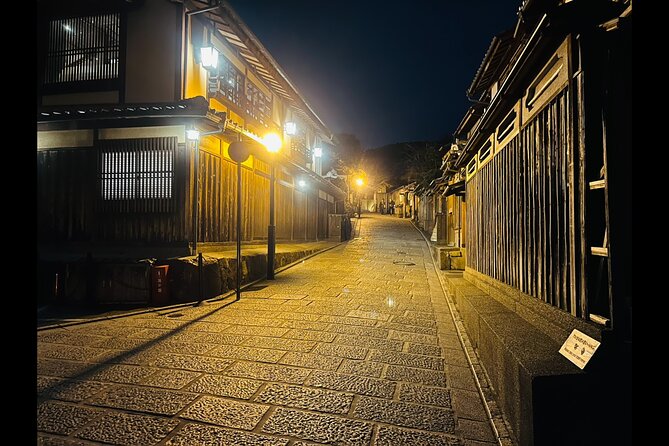
Gion feels most atmospheric after dark, when lanterns glow, the streets quiet down, and the district’s wooden lanes take on a more private air. This tour leads you through famous sights and less obvious corners while explaining geisha customs, shrine traditions, and the changing role of Maiko and Geiko.
I especially like the small-group format, which makes it easier to ask questions and less intrusive in a residential area. I also like the mix of night photography, religious sites, and cultural background, rather than a walk focused only on spotting geisha. The main drawback is the amount of walking, including slopes and stairs, and the route may feel brisk if you prefer a slow stroll.
Key points at a glance
- Gion after dark: See Kyoto’s most famous geisha district when the crowds have thinned and lanterns light the streets.
- Small group: The experience is designed for a maximum of eight people in the overview, with a maximum of 10 listed in the additional details.
- Cultural context: Learn about Maiko, Geiko, geisha etiquette, religious customs, and the role of Gion in Kyoto life.
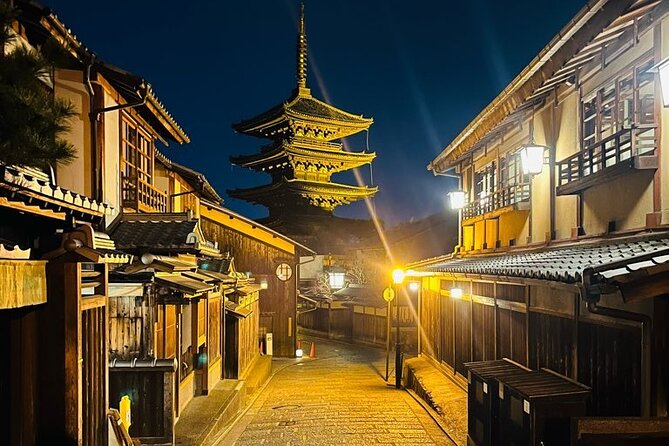
- Several strong photo stops: Gionmachi Minamigawa, Yasaka Pagoda, Sannenzaka, Ninenzaka, and lantern-lit shrines provide plenty of memorable views.
- About 100 minutes: The tour is long enough to cover several key areas, but short enough to fit after a day of sightseeing.
- Walking required: Expect slopes, stairs, and a fair amount of pavement. Comfortable shoes matter.
Why Gion works better at night
Gion is one of Kyoto’s most photographed districts, but daylight crowds can make it hard to appreciate its quieter character. By evening, the district often feels calmer, and the warm light around shrines and traditional streets gives the walk a different mood.
That timing is the chief reason to book this experience. You are not simply ticking off Gion landmarks. You are seeing the district when its wooden facades, narrow lanes, pagodas, and shrine gates look especially striking. A gentle rain may even reduce the crowds, though the tour requires suitable weather and can be canceled if conditions are poor.
The experience lasts about one hour and 40 minutes. That is a useful length for Kyoto. You get a proper introduction to Gion without giving up an entire evening, and you can still fit it around dinner or another activity.
The group size also matters. A guide can speak more naturally to eight or 10 people than to a large crowd, and you have a better chance to ask about a shrine, a street, or the difference between a Maiko and a Geiko. The format is also more respectful in a residential district where people work and live.
More geisha-district evenings:
- Kyoto Geisha Walking Tour: Gion District & Hidden Gems
★ 4.7 · 3,273 reviews - Kyoto: Gion Magical Night Walking Tour with Geisha Trivia
★ 4.9 · 2,393 reviews - Kyoto: Gion Geisha District Walking Tour – Stories of Geisha
★ 4.7 · 2,187 reviews
Meeting at Minamiza Theater
The walk begins at Minamiza Theater, at the eastern end of Shijo Bridge in Gion. The stated meeting location is on the second-floor west lobby of the theater, at Nakanocho 198 in Kyoto’s Higashiyama Ward.
Take a moment to confirm the exact meeting point before setting out. The theater address is specific, and one poor experience involved a missed meeting after communication problems, even though the tour proceeded as scheduled for the rest of the group. I would arrive early, keep the mobile ticket ready, and make sure I am standing at the correct part of the building.
The tour ends at 625 Gionmachi Kitagawa. That gives you a convenient point in the Gion area rather than returning you to the theater. The end location is useful if you plan to continue exploring on foot, find dinner nearby, or make your own way back toward central Kyoto.
A mobile ticket is accepted, and booking confirmation is provided at the time of booking. The activity is near public transportation, though the supplied details do not specify a particular station or bus route.
Gionmachi Minamigawa and the chance to see Maiko
The first listed stop is Gionmachi Minamigawa, one of Kyoto’s best-known streets. Its traditional appearance makes it an obvious starting point, but the guide’s explanation is what gives the place meaning.
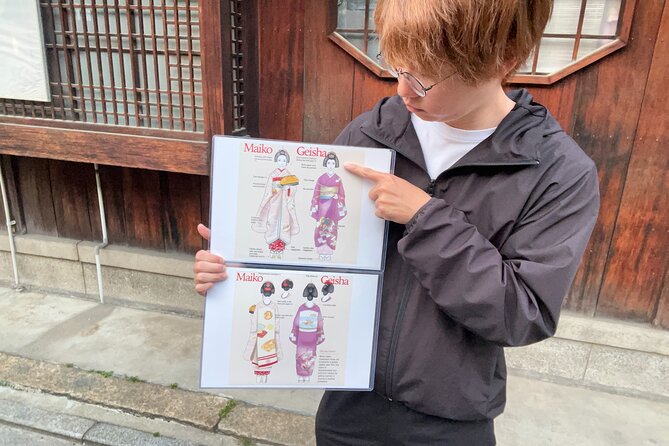
You will hear about Gion’s geisha world, including the difference between Maiko and Geiko and their place in Kyoto society. A Maiko is an apprentice, while a Geiko is an accomplished professional. The walk is not presented as a promise that you will see one, and that is important. Sightings depend on timing and luck.
If you do see a Maiko or Geiko, the practical advice is simple: greet her with a smile and say Konnichiwa. Do not treat the moment as a photo opportunity at any cost. The area is a working neighborhood, and the tour’s small size helps you move through it with less fuss.
This stop takes about 10 minutes. It is short, but it sets the tone for the rest of the walk. You begin with the public image of Gion, then move toward religious sites and side streets that explain how the district developed around its temples and shrines.
Yasui-Konpiragu and Kyoto’s relationship traditions
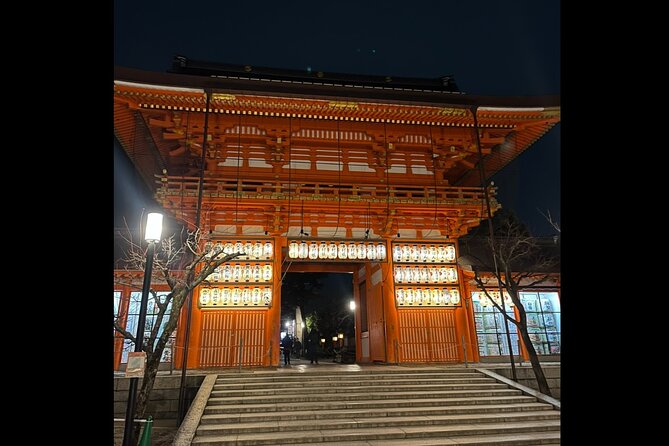
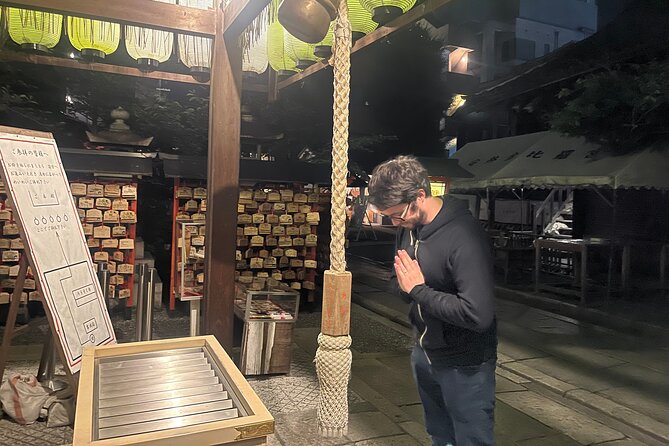
Yasui-Konpiragu is a compact but unusual shrine with a very particular purpose. It is associated with strengthening good relationships and cutting off harmful ones. The shrine is also connected with helping people meet a suitable partner.
That makes it more than another pretty gate or prayer hall. It gives the guide a chance to explain how religious sites in Japan often serve practical hopes: love, luck, protection, health, and family life. If you are traveling as a couple, the shrine’s tradition has an especially personal angle. Its meaning can also be appreciated if you are more interested in local customs than romance.
The stop lasts about 10 minutes and admission is free. The visit is not likely to satisfy anyone looking for a long temple tour, but it works well within a walking route. You get a clear story, a distinct tradition, and another view of Kyoto’s spiritual life without paying an additional entrance fee.
The path through this part of Gion also shows why good guiding helps. On your own, you might pass a small shrine, take a picture, and keep moving. With a guide, the site becomes part of a larger explanation about relationships, belief, and daily life.
More walking tours in Kyoto:
- Night Walk in Gion: Kyoto’s Geisha District
★ 4.5 · 2,003 reviews - Kyoto Gion Geisha District Walking Tour – The Stories of Geisha
★ 5.0 · 1,441 reviews - Nishiki Market Brunch Walking Tour (7 Tastings + Brunch)
★ 5.0 · 1,355 reviews - Kyoto Arashiyama Walking Tour: Bamboo, Monkeys, Gardens & Secrets
★ 5.0 · 1,216 reviews
Sannenzaka, Ninenzaka, and Yasaka Pagoda
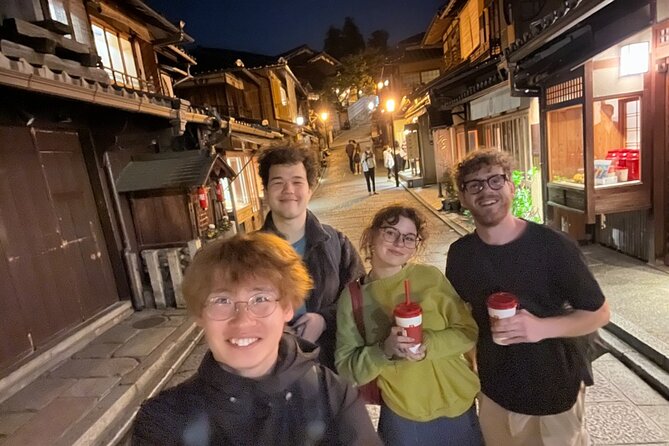
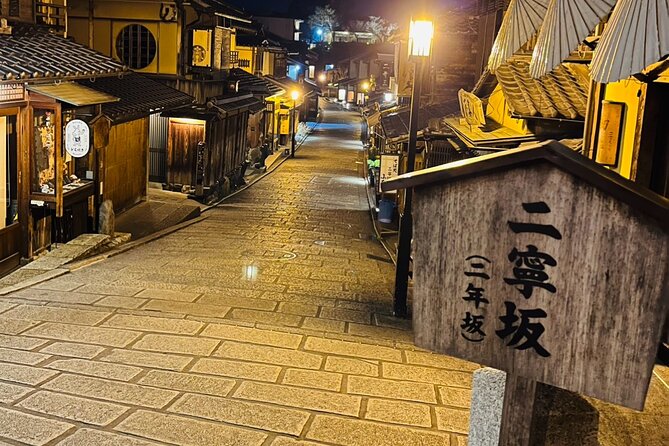
The route continues to Sannenzaka and Ninenzaka, the traditional streets leading toward Kiyomizu-dera Temple. These lanes are among Kyoto’s classic townscapes, with old-style buildings, sloping pavement, and strong views toward Yasaka Pagoda.
This is one of the most photogenic parts of the walk, especially at night. Streetlights and shrine lanterns create a softer scene than daytime crowds and bright shopfronts. You should have time to take photographs, but remember that this is a walking tour rather than a dedicated photography session.
The itinerary allows about 20 minutes here, longer than at the first two stops. That makes sense. Sannenzaka and Ninenzaka are not a single monument. They are a stretch of streets to experience as you move through them.
The tradeoff is physical effort. These lanes include slopes and stairs, and the walk covers more ground than the short stop descriptions might suggest. One participant expected a one-hour walk and found the experience closer to two hours, though the advertised duration is about 100 minutes. I would plan for the full time and wear shoes with good support.
You do not need to be a serious hiker, but this is not the right choice if you are uncomfortable walking uphill or using stairs. The route is manageable for most people who can walk at a steady pace, yet it is wise to save your most tiring Kyoto sightseeing for another day.
The Kannon statue and the 400-year-old temple setting
Two additional stops are described in the route but are not named in the supplied details. One was built in 1955 as a memorial for the victims of World War II and includes a very large statue of Kannon, the Buddhist figure associated with compassion.
That pause adds a sober note to the evening. Gion is easy to treat as a postcard district of lanterns and old houses, but memorial sites remind you that Kyoto is also a place of mourning and prayer. The large Kannon statue gives the guide a clear visual focus while explaining the site’s purpose.
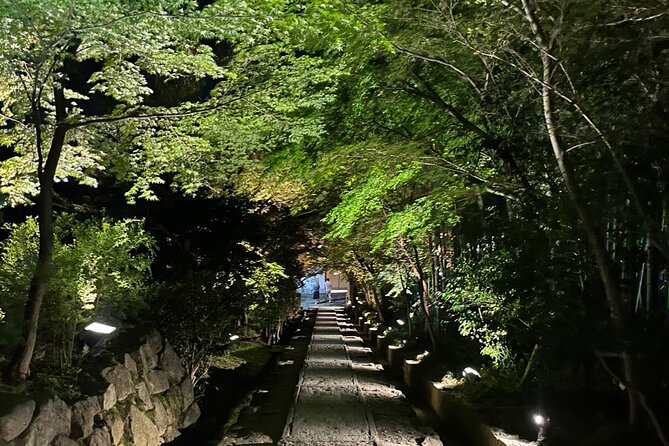
Another stop dates from about 400 years ago. It was built by a shogun’s wife to mourn her husband and includes a garden, a 400-year-old tea ceremony house, and a bamboo grove. These details offer a different kind of beauty from the busy streets outside.
The garden and bamboo grove may be especially appealing if you have already seen Kyoto’s major temples and want a smaller, more intimate setting. The route description does not state how long you spend inside this location or whether every feature is visited in detail, so I would treat it as a guided look rather than a full temple and garden tour.
Together, these two stops broaden the experience. You see places linked to grief, compassion, tea, gardens, and bamboo, not just geisha culture. That variety is one of the strongest features of the route.
Yasaka Shrine and Gion-san
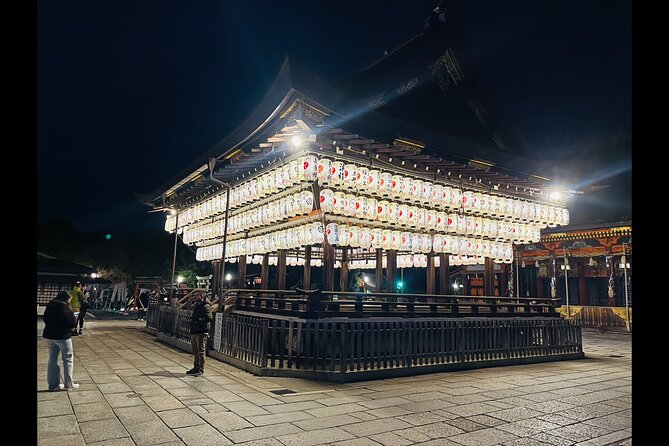
The final named stop is Yasaka Shrine, also called Gion-san. It is the head shrine of roughly 2,300 related shrines across Japan and is associated with warding off bad luck, bringing good luck, and promoting beauty.
At night, shrine lanterns can make this a particularly atmospheric place to visit. The tour allows about 10 minutes here, enough to take in the main setting and hear why the shrine matters, but not enough for a long independent exploration of every structure.
I like ending here because Yasaka Shrine ties together the walk’s main themes. Gion is not only an entertainment district linked with Maiko and Geiko. It is also a religious center, a place where people come to pray, celebrate, remember, and ask for help in ordinary life.
The ending at Gionmachi Kitagawa also keeps you in the middle of the area. You can continue walking through Gion, find a meal, or use public transportation from nearby. Since the tour does not include a meal or attraction admission, you remain free to plan the rest of your night.
What the guides add to the walk
The strongest part of this experience is the guide’s storytelling. Names that appear with especially warm feedback include Karen, Sho Hamada, Hina, Ricky, May, and Pam. You cannot choose a specific guide from the information provided, but the range of guide names gives you an idea of the personal style available.
Karen is described as patient, engaging, and willing to answer questions, including questions from children aged 12 and 14. Ricky is associated with explanations of Kyoto’s past and present, including the relationship between Maiko, Geiko, and wider society. Hina is noted for personal family connections to geisha culture, including a great-great-grandmother who was a Geisha.
Sho is described as local, enthusiastic, and fond of Kyoto. One account also notes that Sho was still learning English and sometimes struggled with questions. That is a fair point to keep in mind if precise English explanations are important to you. The overall feedback about the guides is highly positive, but no walking tour is identical from one evening to the next.
The best guides on this route do more than point at a pagoda. They explain why a shrine exists, how to behave around Maiko and Geiko, and what you are looking at when a traditional street seems merely decorative. That context is what makes the modest price worthwhile.
Price, group size, and overall value
At $29.60 per person, this is a reasonably priced introduction to Gion. You are paying for about 100 minutes of guiding, a planned route, cultural explanations, and the convenience of covering several areas without having to research each shrine yourself.
The value is strongest if this is your first visit to Gion or if you have already walked through the district but felt that you were missing the story. One direct benefit is efficiency: the route quickly reaches major locations and some less obvious places, which can save you time during a short Kyoto stay.
The value is weaker if you want long temple visits, extended photography time, or a tour devoted only to geisha. Several stops are brief, and admission to the listed sites is free, so the fee mainly covers the guide and route rather than attraction tickets.
The advertised small group is another reason the price works. A group of eight is listed in the main description, while the additional details allow up to 10 people. Either way, this is far smaller than a typical large walking group and should make conversation easier.
Who should book this Gion walk
I would recommend it to first-time Kyoto visitors who want a clear introduction to Gion without spending half a day on a formal temple tour. It also suits repeat visitors who have seen the main streets but want better cultural context and a calmer evening atmosphere.
Families can enjoy it if everyone is comfortable walking. The guide feedback includes a successful outing with children aged 12 and 14, but the slopes and stairs still deserve attention.
Photography-minded visitors should find plenty to like, particularly around Yasaka Pagoda, Sannenzaka, Ninenzaka, and Yasaka Shrine. Just bring realistic expectations. You will have photo opportunities, not a private night shoot with unlimited time at every viewpoint.
This is not the best match for anyone with limited mobility or anyone who dislikes hills and stairs. It also may not suit you if you want guaranteed geisha sightings. The tour can explain the culture respectfully, but no guide can control who appears on the street.
Comfortable shoes are the simplest preparation. I would also check the forecast, carry an umbrella if rain is possible, and allow extra time to find the meeting point at Minamiza Theater.
Should you book the Kyoto Gion Magical Night Walking Tour?
Book this tour if you want a compact cultural introduction to Gion, especially after the daytime crowds have faded. The strongest reasons are the small group, the night setting, the mix of shrines and traditional streets, and guides who can turn familiar sights into understandable stories.
Skip it if you need a fully accessible route, a slow pace, or guaranteed access to major temple interiors. At $29.60, it is a good-value way to get your bearings and understand Gion, provided you are happy to walk uphill and accept that the experience is a guided neighborhood walk rather than a ticketed attraction tour.
Free cancellation is available up to 24 hours before the start time. Cancellations within 24 hours are not refunded, and poor weather or failure to meet the minimum group size can lead to a new date, another experience, or a full refund.
FAQ
How long does the Gion Magical Night Walking Tour last?
The experience lasts approximately one hour and 40 minutes.
How much does the tour cost?
The listed price is $29.60 per person.
Where does the tour begin?
The meeting point is Minamiza Theater, at Nakanocho 198 in Kyoto’s Higashiyama Ward. The specified location is the second-floor west lobby.
Where does the tour end?
The walk ends at 625 Gionmachi Kitagawa in Kyoto’s Higashiyama Ward.
How large is the tour group?
The main description lists a maximum of eight people. The additional details list a maximum of 10 travelers, so the group may be capped at either eight or 10 depending on the booking information provided.
Is the tour suitable for people who do not like hills or stairs?
No. Because the route includes slopes and stairs, it is not recommended for people who are not comfortable walking.
Can I cancel for a full refund?
Yes. You can cancel at least 24 hours before the experience start time for a full refund. Cancellations or changes made within 24 hours are not refunded or accepted. If poor weather or an insufficient number of participants causes the tour to be canceled, you will be offered another date or experience, or a full refund.
More Evenings Out in Kyoto
- Kyoto Night Foodie Tour in Gion (9+ dishes + 6 Sake tastings)
★ 5.0 · 1,762 reviews - Kyoto Gion Night Walk & Geisha District Guided Tour
★ 5.0 · 786 reviews - Kyoto Ghost Tour: Dark Tales, Urban Legends, Bamboo Forest Night
★ 5.0 · 625 reviews - Kyoto Bar Hopping Night Tour
★ 5.0 · 613 reviews
Just added around Kyoto
- Kyoto: Zen Meditation at a Private Temple with a Monk★ 5.0 · 25 reviews
- Kyoto: Gion Geisha District & Sake-in-Hand Walking Tour★ 5.0 · 37 reviews
- Private Pewter Sake Cup Experience with a Kyoto Artisan★ 5.0 · 31 reviews
- Your Private Vacation Photography Session In Kyoto★ 5.0 · 110 reviews
- Private Guided Traditional Buddhist Cooking in Japan★ 5.0 · 16 reviews
- Kyoto Wagashi(Japanese sweets) Cooking Class near Fushimiinari★ 5.0 · 60 reviews
- Traditional Japanese Music show & Experience Tour in Kyoto★ 5.0 · 57 reviews
- Kyoto:Family-Friendly Kimono & Yukata Experience at WARGO★ 5.0 · 147 reviews
Kyoto Tours, compared.


Fushimi Inari, Kinkakuji, Bamboo Grove 1 Day Bus Tour
Read our review →
Tea Ceremony in a Traditional Tea House in Kiyomizu
Read our review →
Kyoto Geisha Walking Tour: Gion District & Hidden Gems
Read our review →

Gion Magical Night Walking Tour with Geisha Trivia
Read our review →

Gion Geisha District Walking Tour – Stories of Geisha
Read our review →Browse the lists this tour appears in