
Reviewed · KYOTO TOURS
Tea Ceremony with Kimono and Professional Photoshoot in Kyoto
Kyoto’s tea culture can feel distant behind museum glass. This experience puts you in the middle of it, dressed in a kimono, seated in a traditional house, and shown how to prepare your own matcha. The ceremony lasts about 90 minutes, with the full visit taking roughly 1 hour 45 minutes.
I like the mix of hands-on tea making and a professional photo session. You are not only watching a ritual. You whisk your own matcha, taste Japanese sweets, and leave with three digital photographs. I also like the small group limit of 10 people, which should make the English explanation easier to follow.
The main thing to consider is the sitting position. Much of the ceremony involves kneeling on the floor, which can be hard if your knees are not flexible. Chairs and tables are available, but you should mention any concerns before the ceremony begins.
Key points to know before booking
- Choose your kimono at the venue: You are escorted to the dressing room and select from a variety of traditional outfits.
- Make your own matcha: After watching the tea master, you prepare your tea and pair it with Japanese sweets.
- Receive three photos: A professional photographer takes pictures during the experience, then sends three digital images by email.
- English explanation included: The tea ceremony demonstration and cultural background are presented by an English-speaking tea master.
- Central Kyoto location: The meeting point is Nishiki Orizuruya at 452 Jūmonjichō, Nakagyo Ward, near public transportation.
- Small group, strict arrival rule: The maximum group size is 10, but arriving more than 30 minutes late means you cannot join and will not receive a refund.
Choosing a kimono at Nishiki Orizuruya
Your visit begins at Nishiki Orizuruya, at 452 Jūmonjichō in Kyoto’s Nakagyo Ward. You should arrive 10 minutes before the start time and check in at the reception desk. From there, staff take you to the dressing room.
The kimono selection is a major part of the appeal. You get to choose your favorite from the available collection, rather than simply being handed a standard outfit. That choice makes the experience feel personal, especially if you are marking a birthday, anniversary, honeymoon, or first visit to Kyoto.
You need to provide the height and gender of every participant in advance. This is not needless paperwork. The staff need those details to prepare suitable kimono sets before you arrive. If you book for several people, make sure the information is accurate and sent promptly.
The provided details do not promise a full hair-styling service, so do not book this expecting a complete salon appointment unless the operator confirms it separately. The central focus is the kimono, tea ceremony, and photography.
Once dressed, you move into the traditional house setting for the cultural portion of the visit. The change itself takes time, so the schedule is compact rather than leisurely. You should expect a guided activity with several planned stages, not an open-ended cultural workshop.
More Kimono Experiences in Kyoto
- Kimono Tea Ceremony at Kyoto Maikoya, NISHIKI
★ 5.0 · 911 reviews - Kyoto: Kimono Rental with Hairstyling and Accessories
★ 4.8 · 653 reviews - Kyoto: Kimono Tea Ceremony at Orizuruya Gion
★ 4.9 · 618 reviews
Watching the tea ceremony demonstration
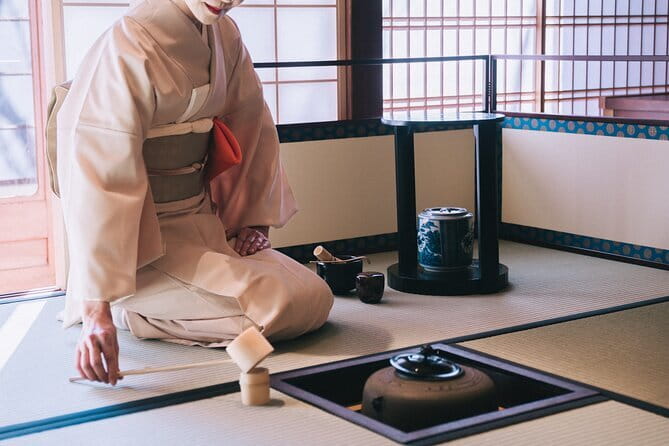
The tea master first demonstrates the ceremony and explains its history and customs in English. This introduction gives you a useful frame for what follows. Without it, the precise movements of the ceremony can look mysterious. With it, you can pay attention to the order of actions, the care given to the tea, and the respectful manner of serving it.
A traditional tea ceremony is not simply a way to make a hot drink. The movements are controlled, the setting matters, and the ritual asks you to slow down. Even in a short commercial experience, that change of pace is valuable. Kyoto offers countless temples and historic streets, but this activity lets you take part in a living cultural practice rather than only looking at one.
The quality of the explanation matters here. The English-speaking tea master has received strong praise for explaining the ritual clearly and treating the group warmly. No tea master’s name is provided, so you cannot request a particular instructor when booking.
You should also keep your expectations in check. This is a short introduction designed for visitors, not an extended study of tea schools or a private ceremony with years of formal training. One part of the experience may feel more like dressing up for photographs than a rare, private cultural encounter. That does not make it poor value, but it does help you understand what you are buying.
Preparing matcha and tasting Japanese sweets
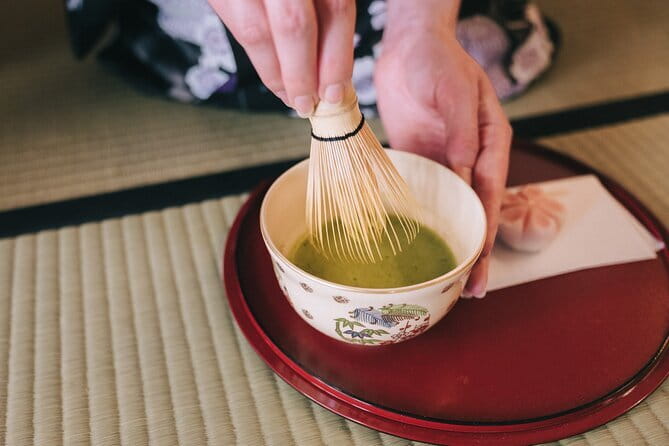
After the demonstration, you learn how to make your own matcha. This is the most active part of the visit. You are not left to guess what to do, since the tea master guides you through the preparation.
Matcha has a different character from ordinary brewed green tea. It is powdered tea whisked into water, so you drink the tea itself rather than straining out leaves. The process gives you a small but meaningful connection to the ceremony. You can see how much care goes into creating a simple bowl of tea.
Japanese sweets are served with the matcha. Their purpose is not only to provide a snack. The sweetness balances the tea’s sharper flavor and forms part of the traditional pairing. If you have food allergies, notify the operator in advance. Extra food and drink are not included beyond what is part of the stated experience.
I like this section because it gives you something to remember beyond the pictures. You learn a basic technique, taste a familiar part of Japanese culture, and take part in the ritual in a respectful setting. Still, this is not a cooking class. The focus remains on the ceremony, so expect a guided introduction rather than detailed instruction on tea grades, farming, or equipment.
How the professional photoshoot fits in
A professional photographer takes pictures during the experience. The photos are meant to record the kimono, ceremony, and matcha preparation, rather than function as a separate studio portrait session.
You receive three digital photos by email afterward. That is a useful souvenir because kimono rental and tea activities can blur together after a busy Kyoto trip. Three selected images give you something ready to save and share without carrying a printed package home.
Check that you can receive email from the operator before booking. You should also watch your inbox after the experience and check spam or junk folders if the images do not appear quickly. The provided information does not specify the delivery time or allow you to select particular photographs, so ask the venue directly if those details matter to you.
The photographs add value, but they also shape the tone of the visit. If your priority is a quiet, highly formal tea ceremony with no interruptions, the camera may feel distracting. If you want a clear visual record of wearing a kimono in Kyoto, the photographer is a strong advantage.
More Tea Ceremonies in Kyoto
- Kyoto: Tea Ceremony in a Traditional Tea House in Kiyomizu
★ 4.9 · 3,519 reviews - Kyoto: Tea Ceremony Ju-An at Jotokuji Temple
★ 4.9 · 3,207 reviews - Kyoto: 45-Minute Tea Ceremony Lesson Experience
★ 4.3 · 2,378 reviews - Kyoto: Table-Style Tea Ceremony at a Kyo-Machiya
★ 4.9 · 1,211 reviews
Sitting on the floor and other comfort concerns
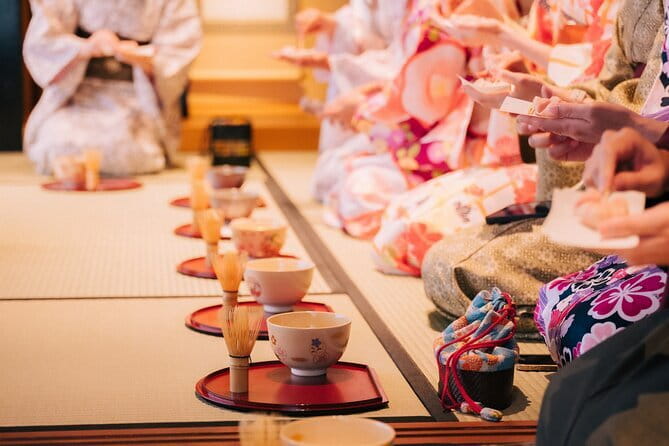
The seating deserves more attention than the short tour description suggests. You may need to kneel on the floor during the ceremony. Sitting cross-legged is not the expected position, and kneeling can become uncomfortable, especially for older participants or anyone with knee, hip, or ankle problems.
Two chairs and tables are available, according to the practical information provided. If you need one, ask at the venue rather than waiting until you are already uncomfortable. The activity is not presented as wheelchair accessible, and no detailed accessibility information is supplied, so you should contact the operator before booking if mobility is a concern.
The kimono itself may also affect comfort. Traditional clothing can restrict movement, and the ceremony requires careful posture. That is part of the experience, but you should not treat this as a casual activity in loose clothing.
Children under five are not permitted. The format is best for older children and adults who can follow instructions, remain still during the demonstration, and manage the clothing and floor seating.
Timing, group size, and location in Kyoto
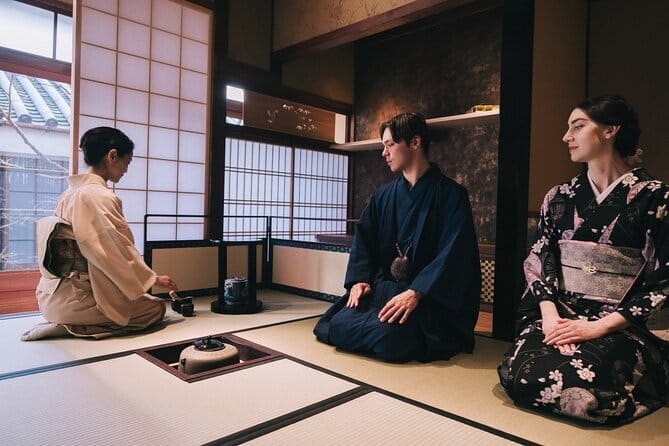
The stated duration is about 1 hour 45 minutes, while the ceremony portion is described as approximately 90 minutes. Allow the full period, since changing clothes, checking in, the demonstration, tea preparation, and photography all take time.
The maximum group size is 10 people. That is small enough for the tea master to demonstrate clearly and guide several participants, though it is not a private experience. If every person chooses a kimono and takes part in the tea preparation, the room may feel active rather than silent and meditative.
The location is convenient for a Kyoto sightseeing day. Nishiki Orizuruya is in Nakagyo Ward and near public transportation. The activity begins and ends at the same meeting point, so you do not need to arrange a separate return transfer. Hotel pickup, transportation to other attractions, and personal expenses are not included.
Plan your route carefully and arrive early. The late-arrival policy is strict: if you are more than 30 minutes late, you cannot join and no refund is available. Kyoto’s trains and streets can be busy, so do not schedule this with a tight connection to another paid activity.
Is $130.78 a fair price?
At $130.78 per person, this is not the cheapest way to taste matcha in Kyoto. You are paying for several services in one package: kimono selection and dressing, an English-language tea lesson, Japanese sweets, professional photography, and three digital photos.
The value is strongest if you would otherwise pay separately for a kimono rental and a photo session. You also save the effort of arranging those pieces yourself. The small group limit and central location make the package easier for a first-time visitor who wants a planned cultural activity.
The price is harder to justify if your only goal is drinking matcha or seeing a formal ceremony. Kyoto has many tea shops and cultural venues, and a simple tea stop costs far less. This experience earns its price through the clothing and photographs, not through the quantity of food or the length of the ceremony.
The activity had more than 10 bookings in the previous month and carries a 4.8 rating from 44 reviews, with 95 percent recommending it. Those figures suggest steady interest, but they do not change the key decision: you need to want both the kimono and the photo keepsake. If either one does not appeal to you, the price will feel high.
Who will enjoy this Kyoto experience most?
I would recommend it to first-time Kyoto visitors who want a clear introduction to tea culture without committing to a long formal course. It also suits couples, friends, and families with children old enough to follow the rules and sit quietly.
This is especially useful for people who want photographs in traditional clothing but prefer a planned setting to arranging a photographer on their own. The digital images are simple to store, and the activity takes less than two hours, leaving most of your day free for Nishiki Market, Gion, temples, or other central Kyoto sights.
It may not suit you if you have difficulty kneeling, dislike being photographed, or want a private and highly formal ceremony. It is also not a good choice for anyone likely to arrive late or for visitors who want a full meal, extensive tea education, or transportation from their hotel.
Booking details worth checking
Confirmation is received at booking, and the ticket is mobile, so you can keep it on your phone. Send the required height and gender details for every participant ahead of time, and report food allergies before the visit.
You can cancel for a full refund if you do so at least 24 hours before the local start time. Cancellations or changes inside that 24-hour window are not refunded or accepted. The same caution applies to your schedule on the day itself: arriving more than 30 minutes late means missing the activity without a refund.
The operator is Japan Wonder Travel. Since the tea master’s name, exact photo delivery time, and detailed accessibility arrangements are not provided, contact the operator directly if any of those points affect your decision.
Should you book it?
Book this experience if you want three things in one visit: traditional clothing, an understandable introduction to matcha, and professional photos in Kyoto. The English explanation, hands-on tea preparation, and choice of kimono make it more engaging than simply watching a ceremony.
Skip it if you are seeking a long, private, deeply formal tea study or if kneeling is likely to cause pain. For most visitors who see the kimono and photos as part of the value, $130.78 is reasonable. Just arrive early, prepare your sizing details, and make sure you can receive the digital photographs by email.
FAQ
How long does the tea ceremony and photoshoot last?
The full experience takes approximately 1 hour 45 minutes. The tea ceremony, matcha preparation, and photography portion is described as about 90 minutes.
Where does the activity begin and end?
It begins at Nishiki Orizuruya, 452 Jūmonjichō, Nakagyo Ward, Kyoto, 604-8121, Japan. The activity ends back at the same meeting point.
Is the tea ceremony explained in English?
Yes. An English-speaking tea master demonstrates the ceremony and explains its history and culture.
Do I get photos after the experience?
Yes. A professional photographer takes pictures during the activity, and three digital photos are sent to you by email.
Are children allowed to participate?
Children under five years old are not allowed to join the experience.
What happens if I arrive late?
You must arrive 10 minutes before the start time and check in at the reception desk. If you are more than 30 minutes late, you cannot join the activity and no refund is available.
More Photo Shoots in Kyoto
- Kyoto: Maiko Makeover and Photoshoot Experience
★ 4.7 · 239 reviews - Kyoto: Private Photoshoot Service
★ 5.0 · 158 reviews - Your Private Vacation Photography Session In Kyoto
★ 5.0 · 110 reviews - Kyoto: Tea Ceremony with Kimono and Photoshoot
★ 4.9 · 90 reviews
Just added around Kyoto
- Kyoto: Zen Meditation at a Private Temple with a Monk★ 5.0 · 25 reviews
- Kyoto: Gion Geisha District & Sake-in-Hand Walking Tour★ 5.0 · 37 reviews
- Private Pewter Sake Cup Experience with a Kyoto Artisan★ 5.0 · 31 reviews
- Your Private Vacation Photography Session In Kyoto★ 5.0 · 110 reviews
- Kyoto Wagashi(Japanese sweets) Cooking Class near Fushimiinari★ 5.0 · 60 reviews
- Private Guided Traditional Buddhist Cooking in Japan★ 5.0 · 16 reviews
- Traditional Japanese Music show & Experience Tour in Kyoto★ 5.0 · 57 reviews
- Kyoto:Family-Friendly Kimono & Yukata Experience at WARGO★ 5.0 · 147 reviews
Kyoto Tours, compared.


Fushimi Inari, Kinkakuji, Bamboo Grove 1 Day Bus Tour
Read our review →
Tea Ceremony in a Traditional Tea House in Kiyomizu
Read our review →
Kyoto Geisha Walking Tour: Gion District & Hidden Gems
Read our review →

Gion Magical Night Walking Tour with Geisha Trivia
Read our review →

Gion Geisha District Walking Tour – Stories of Geisha
Read our review →Browse the lists this tour appears in