
Reviewed · HIROSHIMA TOURS
Mitaki Peace Tour Beyond Central Hiroshima
Mitaki-dera gives Hiroshima’s peace story a quieter setting. Instead of spending the whole afternoon among the city’s major memorials, you move from the Atomic Bomb Dome and Rest House into wooded hills, where an old temple, stone Buddhist figures, and preserved bomb-damaged structures invite a slower kind of reflection. The change from city to mountain is the heart of the tour.
I like the small maximum of six people, which suits Mitaki’s narrow paths and quiet mood. I also like the practical use of local bus and train service, since you see a part of Hiroshima that is easy to miss without spending time sorting out the route yourself. The main consideration is walking: this is not a good choice if hills, steps, or a roughly four-hour outing are difficult for you.
Key points at a glance
- Peace Memorial Park first: Visit the Rest House, Atomic Bomb Dome, and possibly the hypocenter before heading to Mitaki.
- A mountain temple founded in 809: Mitaki-dera offers a very different setting from central Hiroshima.
- Seven connected experiences: Expect small activities, easy walks, explanations, and photo-friendly stops around the temple.
- Local transport included: The bus to Mitaki and train back toward central Hiroshima are covered in the price.
- Small-group format: The tour accepts no more than six people, a useful size for the wooded temple paths.
- Best for reflective walkers: The tour suits people who want history, nature, and peace themes in one afternoon.
Why Mitaki changes the way you see Hiroshima
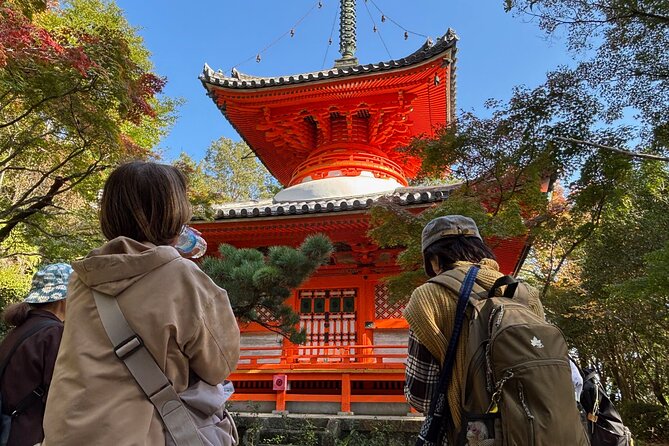
Most first visits to Hiroshima focus on Peace Memorial Park, the Atomic Bomb Dome, and perhaps Miyajima. Those places deserve their attention, but Mitaki-dera adds a different piece to the city’s story. The temple sits in the hills beyond central Hiroshima, with trees, stone figures, a pagoda, a bell hall, and a much slower rhythm.
That setting matters. At the park, the scale of the bombing is difficult to escape. At Mitaki, the subject becomes more personal and contemplative. You see how a religious site and its surrounding buildings were connected to the aftermath of the atomic bombing, then have space to think while walking through quiet grounds.
The tour begins at 1:00 pm near the Hiroshima Peace Memorial Park Rest House, at the fuel hall atomic-bomb damage explanation board. This is a useful starting point because your guide can give you the basic story before you leave the city center. The Mitaki visit then feels like a continuation of that story rather than a disconnected temple stop.
A few more Hiroshima half-days to weigh up
- Peaceful Hiroshima & Miyajima UNESCO 1 Day Bus Tour
★ 5.0 · 5,309 reviews - Hiroshima: Hiroshima and Miyajima UNESCO Sites 1-Day Tour
★ 4.9 · 2,330 reviews - Hiroshima / Miyajima Full-day Private Tour with Government Licensed Guide
★ 5.0 · 1,298 reviews
Peace Memorial Park from the Rest House to the Dome
The first section lasts about an hour and covers several important places in the park. The exact route may change slightly with the time available, but it includes the Rest House and the Atomic Bomb Dome, with a possible visit to the hypocenter.
The Rest House is especially useful as an opening stop because it is an actual building damaged by the atomic bomb. Its survival gives the bombing a physical scale that can be harder to grasp from memorial text alone. Your guide explains what you are seeing and sets up the connection between Hiroshima’s central memorial district and Mitaki-dera.
The Atomic Bomb Dome needs little introduction, yet having a guide nearby can make the visit more focused. You will hear explanations as you walk rather than simply taking photographs and moving on. That helps place the building within the wider story of the bombing and Hiroshima’s recovery.
If time allows, the group may also visit the hypocenter. Since this part is time dependent, you should not book the tour assuming that every possible point will always be included. The important thing is the sequence: the park establishes the reality of the atomic bombing, and Mitaki provides a quieter place to consider what followed.
This opening walk is free to enter, but it is not just a way to fill the first hour. It gives the afternoon a clear purpose. You are not being taken to a scenic temple at random. You are first asked to look directly at Hiroshima’s past, then to consider peace in a more secluded setting.
The bus ride to Mitaki and the shift in mood
After the Peace Memorial Park walk, you take a local bus from the Atomic Bomb Dome area toward Mitaki. The fare is included, so you do not need to buy a separate ticket for this part of the journey.
I like this transfer because it keeps the tour tied to ordinary Hiroshima life. You are not sealed inside a private coach moving between attractions. You use public transportation, then walk from the Mitaki area toward the temple. The change in surroundings becomes part of the experience.
The walk from the bus stop to Mitaki-dera takes about 10 minutes at a relaxed pace, with a few stopping points along the way. The route is not presented as a strenuous hike, but you should still expect uneven ground, uphill sections, and a temple setting with steps or inclines. The tour information specifically advises against joining if you have walking difficulties.
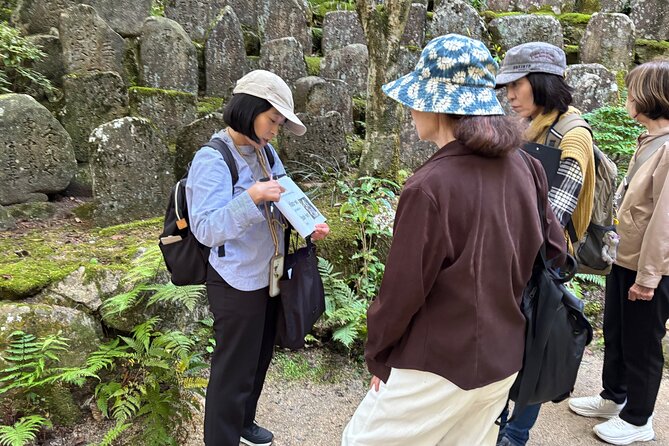
This is also when the tour becomes more intimate. Central Hiroshima’s memorial sites are broad and open, while Mitaki’s paths are narrower and quieter. A group of no more than six people is a sensible arrangement here. It allows the guide to speak without raising a voice and keeps the visit from feeling like a large procession.
Walking through Mitaki-dera’s wooded grounds
Mitaki-dera was founded in 809 and has been cared for by local people for centuries. Its age is important, but the appeal is not just the date. The temple gives you a sense of the religious and natural setting that existed before modern Hiroshima grew around it.
Your guide leads you through the grounds at an easy pace. Along the way, you can expect to see:
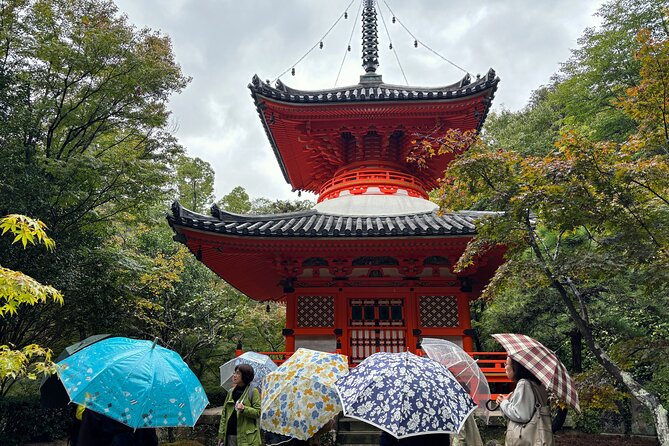
- A striking pagoda
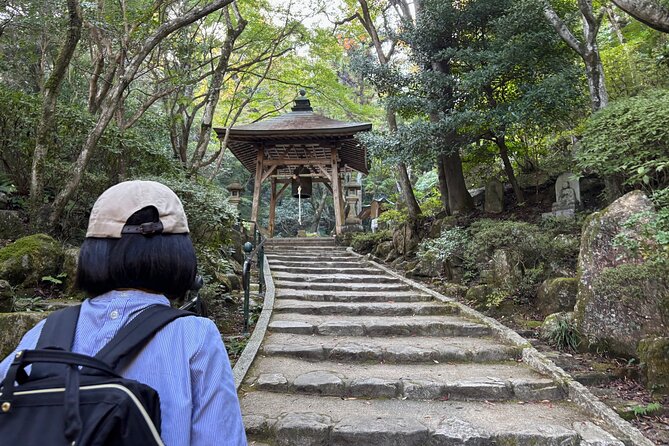
- A bell hall
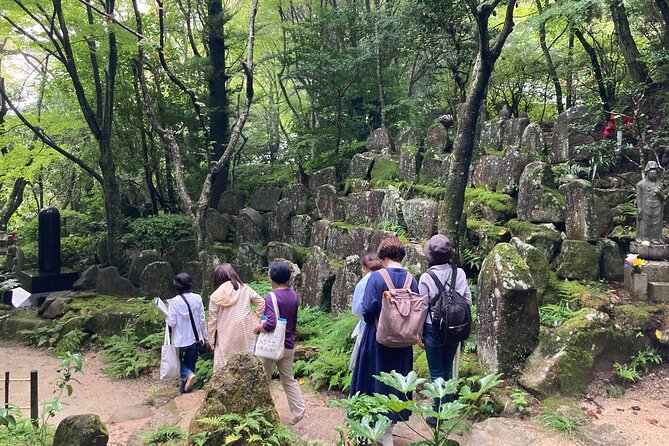
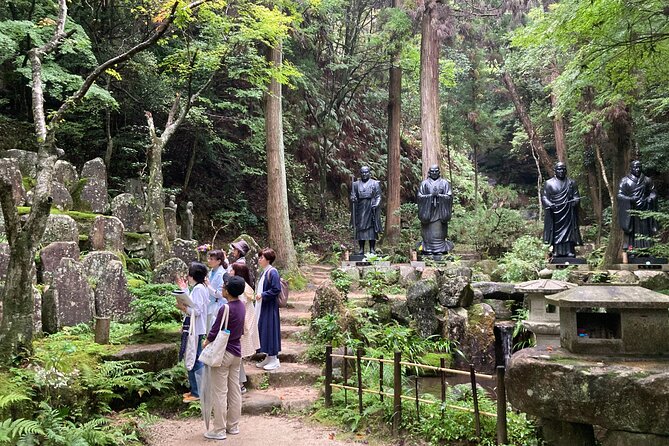
- Numerous stone Buddhist statues
- Peace and remembrance monuments
- Structures preserved after being damaged by the atomic bomb
- Photo-friendly views and quiet wooded paths
The seven experiences are built around these sights and the small activities along the way. The supplied details do not name each activity separately, so you should think of the tour as a guided sequence of stops and simple hands-on moments rather than a performance or formal workshop.
The temple’s strongest quality is its calm. Several parts of the experience are designed to help you pause, look closely, and listen. The forested setting softens the pace after the serious opening at the Peace Memorial Park, without removing the historical subject.
The stone Buddhist statues are likely to catch your eye first. They give the grounds a distinctly Japanese character and make the walk feel different from a standard city history tour. The pagoda and bell hall add recognizable architectural points, while the peace-related monuments tie the temple back to Hiroshima’s modern past.
A visitor who has already been to Mitaki-dera independently may still find value in the guide’s explanations. Information boards can tell you what a building is, but they do not always explain why the site matters in relation to the atomic bombing. That historical connection is one of the tour’s main reasons to pay for a guide.
Same base, a completely different sort of day:
- Hiroshima Historical Walking Tour – Why A-Bomb was Dropped
★ 4.8 · 893 reviews - Hiroshima Peace (Heiwa) Walking Tour at World Heritage Sites
★ 5.0 · 872 reviews - Hiroshima in a Nutshell: Morning Bike Adventure
★ 5.0 · 524 reviews - Hiroshima City 4hr Private Walking Tour with Licensed Guide
★ 5.0 · 437 reviews
The temple’s connection to the atomic bombing
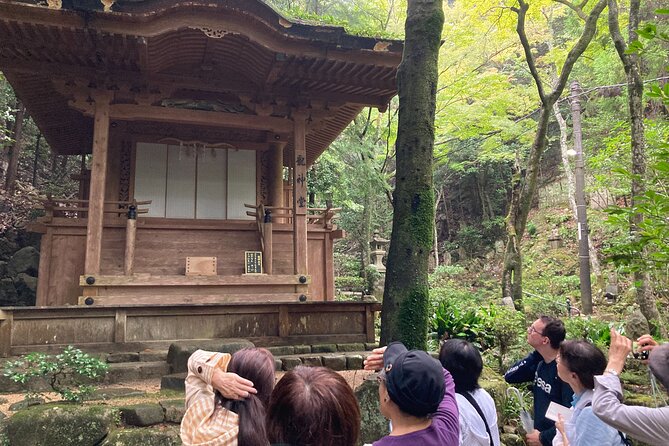
Mitaki-dera can seem remote once you are among the trees, which is precisely why its connection to the bombing has such force. The tour explains how this quieter place fits into Hiroshima’s wartime and postwar story. You are not asked to treat the temple as a simple escape from the city’s difficult past.
The preserved bomb-damaged structures make that connection visible. They also prevent the temple visit from becoming only a scenic walk. You can enjoy the trees and traditional architecture, but the site keeps bringing you back to the people and places affected by the atomic bombing.
This balance is handled through movement. At the park, you listen while standing among major public memorials. At Mitaki, you continue listening as you walk past statues, monuments, and old structures. The information has room to settle because the surroundings are not crowded or noisy.
I find that useful for visitors who want more than a quick look at Hiroshima’s famous landmarks. The tour does not replace a longer visit to the Peace Memorial Museum, and the museum is not part of the stated itinerary. Instead, it gives you a second setting in which to think about the same subject.
Seasonal scenery and the best time to visit
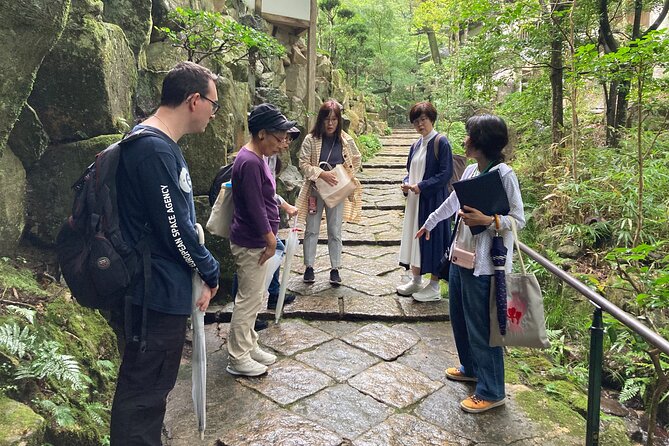
Mitaki is particularly appealing in autumn. The temple’s mountain setting brings changing leaves into the experience, and the walk can be beautiful even when the foliage is past its peak. Early December may still offer scattered autumn color, including red leaves higher along the paths.
You should treat seasonal color as a bonus rather than a guarantee. The tour runs in all kinds of conditions permitted by the operator, and the scenery will change from season to season. The temple’s quiet character, old buildings, statues, and peace memorials remain the main draw.
Bring water. Bottled water is not included, and the walking can make you thirsty, especially on a warm afternoon or while climbing through the temple grounds. Comfortable shoes are more important than dressy footwear, since the route includes a walk from the bus area and movement around a mountainside temple.
A camera is worthwhile, but try not to let photographs take over the visit. The pagoda, trees, statues, and temple paths are all attractive, yet the guide’s explanations are what give the place its full meaning.
Returning by train to central Hiroshima
After the temple visit, you walk to Mitaki Station and take the train back. The train fare is included, and your guide accompanies you as far as Hiroshima Station.
The stated total duration ranges from about 3 hours 25 minutes to 4 hours. Since the tour begins at 1:00 pm, you should expect to finish in the late afternoon, with the exact time depending on the pace, transport, and how much time is available at the Peace Memorial Park.
You do not have to remain on the train all the way to Hiroshima Station. You may get off at Yokogawa Station, the next stop, or Hakushima Station, the one after that. This is handy if your hotel or evening plans are closer to one of those stations.
The return by train is a pleasant practical touch. You finish with an ordinary local journey rather than being dropped at an unfamiliar point. It also means the tour can fit neatly into a day when you are staying near Hiroshima Station or the central city.
Is $88.68 a fair price?
At $88.68 per person, this is not the cheapest way to visit Mitaki-dera. You are paying for a licensed local guide, the temple entrance fee, the bus ride out, the train ride back, and the structure of a carefully timed small-group afternoon.
The value depends on what you want from the visit. If you only want to see the temple and take photographs, you could prefer an independent outing. Mitaki is close enough to central Hiroshima to be reached by public transport, and the basic entry cost alone would not justify this price.
The guided connection between the Peace Memorial Park and Mitaki is what makes the cost more reasonable. You get historical context before the temple visit, someone managing the bus and train movements, and explanations of details that may not be obvious from signs. The six-person limit is also meaningful on narrow, peaceful paths.
The recycled-paper crane postcard with a stamp is included as a small keepsake. It is not a major part of the value, but it gives the peace theme a physical reminder that you can take home.
Who should book this afternoon?
I would choose this tour if you have already seen, or plan to see, the main Peace Memorial Park sites and want a different side of Hiroshima. It works especially well for people interested in the connection between religion, nature, local life, and the atomic bombing.
It is also a good fit if you prefer a guide to explain the city while you walk, rather than reading every sign alone. The small group should appeal to anyone who dislikes large tours, especially in a quiet temple where a crowd would feel out of place.
You should think twice if you want a fast, low-effort sightseeing trip. The outing takes most of an afternoon, includes two public transport rides, and requires walking around a mountainside temple. It is not recommended for people with walking difficulties.
The tour requires good weather. If poor weather causes cancellation, you are offered another date or a full refund. Otherwise, you can cancel for a full refund up to 24 hours before the start time. Changes or cancellations inside that 24-hour window are not accepted for a refund.
Should you book the Mitaki Peace Tour?
Book it if you want Hiroshima’s peace message presented in two settings: first through the stark memorials of the city center, then through the quiet paths of an old mountain temple. The strongest part is the contrast between the Atomic Bomb Dome and Mitaki-dera, where the subject becomes slower and more personal.
Skip it if you have limited mobility, dislike guided commentary, or only want a quick temple visit. For everyone else, especially visitors looking beyond the usual Hiroshima route, the $88.68 price buys useful context, simple transport, a very small group, and access to a side of the city that is easy to miss.
FAQ
Where does the Mitaki Peace Tour begin?
The tour begins at 1:00 pm near the Hiroshima Peace Memorial Park Rest House, at the fuel hall atomic-bomb damage explanation board in Nakajimacho, Hiroshima.
How long does the tour last?
The experience takes approximately 3 hours 25 minutes to 4 hours.
What places are visited in the Peace Memorial Park?
The walk includes the Rest House and Atomic Bomb Dome. Depending on available time, it may also include the hypocenter.
How do I get to Mitaki-dera during the tour?
After the Peace Memorial Park walk, the group takes a local bus from the Atomic Bomb Dome area to the Mitaki area. The bus fare is included.
How do I return to central Hiroshima?
After visiting Mitaki-dera, you walk to Mitaki Station and take the train back. Your guide accompanies you to Hiroshima Station.
Can I get off before Hiroshima Station?
Yes. You may get off at Yokogawa Station or Hakushima Station before reaching Hiroshima Station.
Is the Mitaki-dera entrance fee included?
Yes. The temple entrance fee is included in the tour price.
Is the tour suitable for people with walking difficulties?
No. The tour is not recommended for people with walking difficulties. It includes walking from the bus area to the temple and movement around a mountainside temple.
Just added around Hiroshima
- The Peace Memorial to Miyajima : Icons of Peace and Beauty★ 4.5 · 31 reviews
- Shore Excursion from Hiroshima Port : Private Tour in Hiroshima★ 5.0 · 17 reviews
- Hiroshima Saijo Sake Tasting Tour with visit to 7 Breweries★ 5.0 · 104 reviews
- Hiroshima & Miyajima All-Inclusive Tour w/Licensed guide Pancho★ 5.0 · 54 reviews
- Okunoshima Rabbit Island Cycling Tour with Local Guide★ 4.5 · 17 reviews
- Private Full Day Hiroshima Tour★ 4.5 · 29 reviews
- Hiroshima Country Cycling: Explore Rural Life 1 HR from City★ 5.0 · 22 reviews
- Hiroshima Private Tour with a Local – Highlights & Hidden Gems★ 4.5 · 24 reviews
Hiroshima Tours, compared.

Peaceful Hiroshima & Miyajima UNESCO 1 Day Bus Tour
Read our review →
Hiroshima and Miyajima UNESCO Sites 1-Day Tour
Read our review →
Hiroshima Historical Walking Tour – Why A-Bomb was Dropped
Read our review →
Hiroshima Peace (Heiwa) Walking Tour at World Heritage Sites
Read our review →
Hiroshima in a Nutshell: Morning Bike Adventure
Read our review →
Hiroshima City 4hr Private Walking Tour with Licensed Guide
Read our review →

Japanesel Archery Experience HIROSHIMA CASTLE SHARAKU
Read our review →Browse the lists this tour appears in