
Reviewed · KYOTO TOURS
Kyoto Gion Historical Walking Tour
Kyoto’s eastern hills pack an astonishing amount of Japan into one walk: geisha traditions, Buddhist temples, samurai-era stories, imperial politics, narrow stone lanes, and some of the city’s best-known views. This Gion and Higashiyama route gives you a useful first look at the area without leaving you to puzzle out every gate, slope, and religious symbol alone.
I like two things in particular. First, the route connects famous sights rather than treating them as isolated photo stops. Second, guides such as Jay, Ben, Ayumi, and Tommy bring extra context, from theater and geisha culture to the Meiji Restoration and the changing role of emperors, monks, and samurai. The drawback is simple: three hours on foot includes stairs and uphill sections, and there are few real breaks for food.
Key points to know before booking
- Gion Shibashi begins the story: You start at Tatsumi Bridge, one of Kyoto’s prettiest traditional settings.
- The route links major eastern sights: Chion-in, Maruyama Park, Nene-no-Michi, Yasaka Pagoda, Ninen-zaka, Sannen-zaka, and Kiyomizu-dera follow in one continuous walk.
- History is the main attraction: Expect explanations of religion, geisha culture, theater, samurai, emperors, and the Meiji Restoration.
- The walk is physically real: Comfortable shoes, water, and a moderate level of fitness matter, especially on the slopes and stairs.
- Small-group format helps: The maximum group size is 12, though an off-season departure may be smaller, sometimes even private.
- Kiyomizu-dera admission is extra: The walking tour is included, but entrance fees are not, with Kiyomizu-dera specifically listed as excluded.
Starting among Gion’s old lanes at Tatsumi Bridge
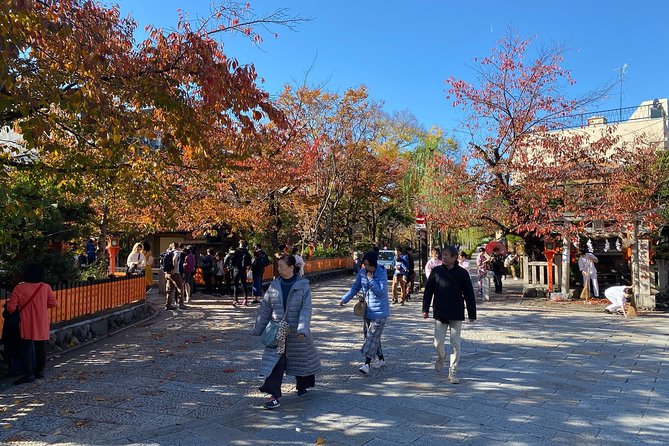
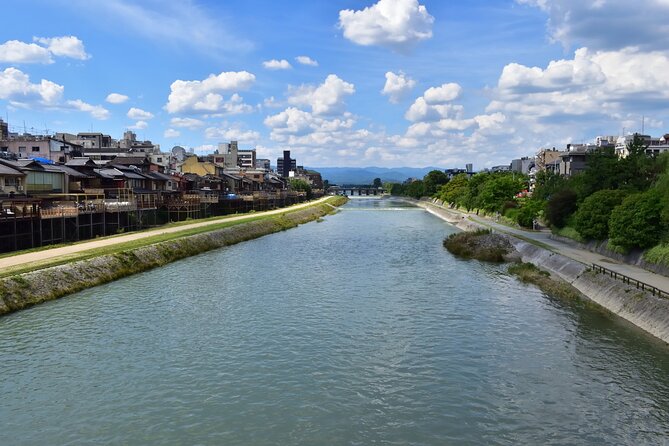
The meeting point is in front of Ben’s Cookies Kyoto at 89 Shinchō in the Shijō area. From there, the walk heads toward Tatsumi Bridge and Gion Shibashi, a graceful district of narrow lanes, traditional façades, and quiet canals.
This is a smart opening. Gion is often reduced to a hunt for geisha sightings, but the area makes more sense when you first understand its role as an entertainment quarter. Your guide may discuss theater, geisha culture, local customs, and the difference between seeing a historic district and treating it like a stage set.
Tatsumi Bridge itself is a brief stop, listed at about 15 minutes. It is a good place to take in the atmosphere and ask questions before the tour becomes more temple-focused. The area can be crowded, so your guide’s commentary helps you look beyond the obvious photograph.
You should also set expectations early. This is a history walk, not a food tour, tea ceremony, or geisha performance. The focus is on place, culture, and the forces that shaped Kyoto.
More geisha-district evenings:
- Kyoto Geisha Walking Tour: Gion District & Hidden Gems
★ 4.7 · 3,273 reviews - Kyoto: Gion Magical Night Walking Tour with Geisha Trivia
★ 4.9 · 2,393 reviews - Kyoto: Gion Geisha District Walking Tour – Stories of Geisha
★ 4.7 · 2,187 reviews
Chion-in’s enormous Sanmon gate
The next major stop is Chion-in, beginning with its Sanmon gate. This huge wooden entrance is one of the most impressive structures on the route. Even if you know little about Japanese Buddhist architecture, the scale tells you that you are entering an important religious complex.
The group spends about 10 minutes at the gate, then another 20 minutes at Chion-in Temple itself. That gives the guide time to explain the temple’s Buddhist role and its place in Kyoto’s religious life, rather than rushing past for a quick picture.
Chion-in was founded in the 13th century and is associated with Jōdo Buddhism. You do not need to remember every sect or date to benefit from the stop. The useful part is seeing how a working religious site fits into the larger story of Japan, where temples served spiritual, cultural, and social roles over many centuries.
The grounds also introduce the physical pattern of the tour: broad temple spaces followed by steps, slopes, and narrow lanes. If stairs are difficult for you, take the stated moderate fitness requirement seriously. One participant specifically noted that the amount of stair climbing affected the group, and that is useful advice for anyone with mobility limits.
Maruyama Park and the quiet turn toward Nene-no-Michi
Maruyama Park offers a change of pace after the grand temple gate and buildings. This old urban park gives you room to breathe and shows how Kyoto combines open green space with historic neighborhoods.
The stop is short, about 10 minutes, but it helps break up the religious sites. Your guide may use the park to explain seasonal customs, local leisure, or the way Kyoto’s older districts developed around temples and shrines.
From here, the walk continues along Nene-no-Michi, or the Path of Nene. The stone-paved lane takes its name from Nene, the wife of Toyotomi Hideyoshi, a major figure in Japan’s late 16th-century history. The path winds through the Higashiyama area and feels more intimate than the larger temple grounds.
Nene-no-Michi is one of the places where a guide adds real value. On your own, you can admire the paving and traditional buildings. With a guide, the name connects the street to political power, family history, and the period when Kyoto was shaped by military rulers as well as emperors and clergy.
There is no detailed stop time listed for Nene-no-Michi, so the pace may vary. That is helpful if the group is moving well, but it also means you should not expect a long pause at every location.
Yasaka Pagoda and the old Higashiyama lanes
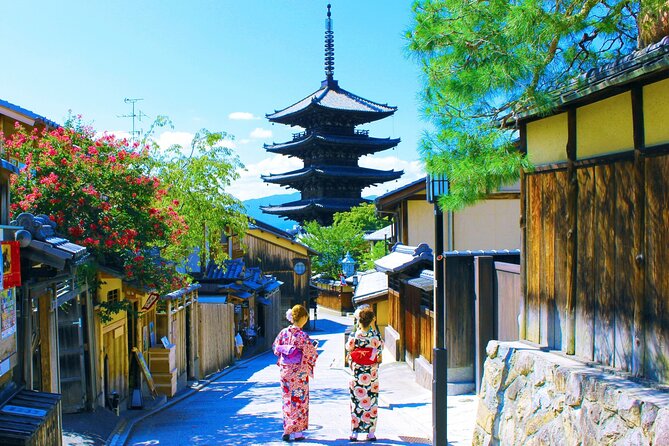
Hōkan-ji Temple, better known as Yasaka Pagoda, is one of the most recognizable sights in eastern Kyoto. Its five-story pagoda rises above the surrounding streets, creating the classic Higashiyama view that appears in many photographs.
The tour allows about 10 minutes here. That is enough to appreciate the exterior and hear the story of the temple, but not enough for an extended visit inside. Admission is listed as free for this stop, though the tour’s general admission policy says entrance fees are not included, so your guide is the best source for any current access details.
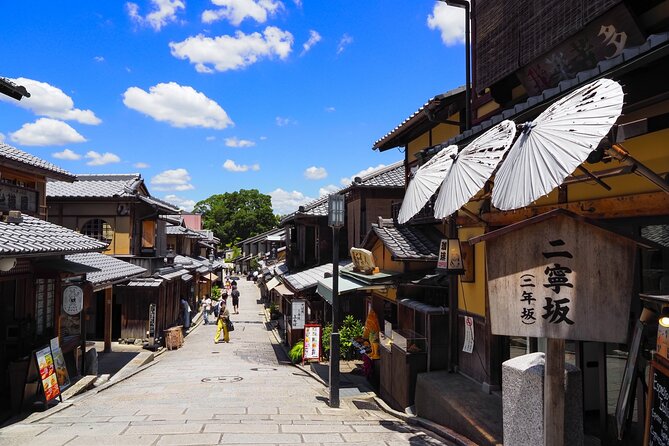
The walk then reaches Ninen-zaka and Sannen-zaka, two historic stone-paved slopes lined with traditional buildings, tea shops, and souvenir stores. Ninen-zaka means Two-Year Slope, while Sannen-zaka means Three-Year Slope. Together, they form one of Kyoto’s most atmospheric pedestrian areas.
These lanes are also among the busiest parts of the route. You will share them with many other people, particularly during popular visiting hours. The short listed stops, five minutes at Ninen-zaka and 10 minutes at Sannen-zaka, suggest that the guide uses them mainly to explain the setting and point out useful details rather than provide long shopping time.
I like this section because it lets you see both sides of Kyoto. The old houses and stone paving preserve a strong sense of place, yet the shops make clear that this is also a commercial district. That mix is more honest than presenting the lanes as untouched relics.
Keep your footing here. The slopes can be uneven, and the walking surface is harder than a smooth city sidewalk. Good shoes are not a polite suggestion for this tour. They are the sensible choice.
More history-led days in Kyoto:
- Kyoto Gion: 2-Hour Geisha Culture & History Walking Tour
★ 5.0 · 1,186 reviews - Historical Kyoto E-Bike Tour
★ 5.0 · 181 reviews - Kyoto: Nijo Castle World Heritage Guided Tour with Admission
★ 5.0 · 128 reviews - Kyoto: Private 2.5 Hour Historical Walking Tour
★ 4.9 · 121 reviews
Kiyomizu-dera, the grand finish above Kyoto
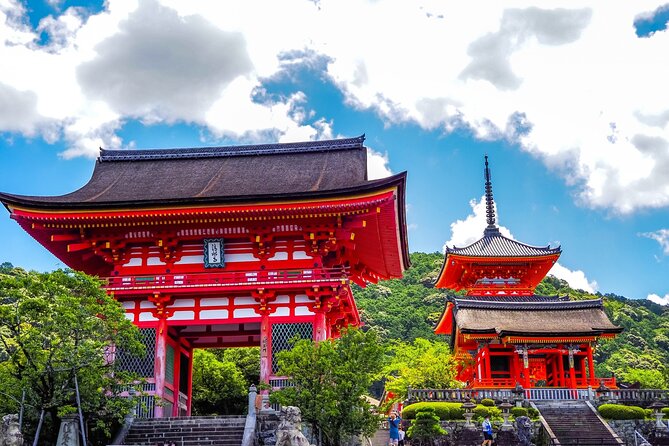
The route ends at Kiyomizu-dera, one of Kyoto’s signature temples and a UNESCO World Heritage Site. The temple dates to the eighth century and sits on a hillside above the city.
The listed stop is about 10 minutes, so the guided portion is an introduction rather than a full temple visit. You finish in front of the Kiyomizu-dera entrance, which is useful because you can continue exploring on your own after the group ends.
The temple’s hillside position gives you the chance to look back over Kyoto. The final stop also gives the walk a strong sense of progression: you begin with the entertainment streets of Gion, pass through parks and Buddhist grounds, follow old lanes, and end at one of the city’s most important religious sites.
Admission to Kiyomizu-dera is not included. Bring money for the entrance fee if you plan to go inside after the tour. Since lunch is also excluded and the itinerary provides only brief stops, eat before starting or carry water and a snack. One particularly practical point from the tour experience is that there may be bathroom breaks but not many opportunities for a proper meal.
What the guides add to the experience
The guide is the key reason to book this walk instead of copying the route from a map. Jay is repeatedly described as a history-focused guide with excellent English, a graduate degree in history, and a talent for explaining Kyoto within the wider story of Japan. He is also noted for answering questions, taking photographs, checking on the group, and sometimes staying beyond the scheduled finish.
Ben is praised for memorable stories, local suggestions, and a well-paced introduction to Gion and Higashiyama. Ayumi brings energy and clear English, with particular strength in explanations of geisha and samurai culture. Tommy is described as humorous, helpful, and a good choice for a first visit. Michel is noted for being accommodating and offering ideas for the following day.
Guide assignments can change, so you should not book on the assumption that one particular person will lead your departure. Still, the range of comments points to a consistent strength: the guides do more than recite dates. They connect buildings to political change, religious practice, folklore, theater, and everyday life.
The Meiji Restoration is an especially useful subject on a Kyoto walk. It helps explain how Japan shifted from the rule of the shogunate toward imperial government and rapid modernization. Kyoto was not simply a preserved old capital. It was part of the upheaval that changed the country.
Three hours, 12 people, and a serious amount of walking
The tour lasts about three hours and accepts a maximum of 12 people. That is a good size for a walking group. You are more likely to hear the guide clearly and ask questions than you would in a large coach-style group.
An off-season departure may be much smaller. One person ended up with a private tour and was able to ask many questions, but you should treat that as a possibility rather than a promise.
The route is not technically an athletic expedition, yet it is demanding enough to shape your day. You will walk for half a day, use stairs, climb slopes, and spend much of the time outside. A moderate fitness level is required. The tour is not the best fit if you need frequent seated breaks or want a slow, unhurried temple visit.
It may also be a lot for young children. An eight-year-old kept up on one departure, but the amount of information and the repeated temples and shrines became tiring. Adults interested in Japanese history will likely get more from the pace and subject matter.
The tour begins near public transportation and ends at Kiyomizu-dera, not back at the starting point. Plan your next activity from the eastern hills rather than assuming you will return to central Kyoto with the group.
Is $40 a fair price?
At $40 per person, this is a reasonable price if you want a strong historical introduction to Gion and Higashiyama. You are paying for about three hours of guided walking, an English-speaking guide, route planning, and explanations that can turn familiar postcard views into meaningful places.
The value is strongest on a first Kyoto visit. You cover a wide stretch of the eastern districts in one outing and learn which places deserve a longer return visit. The guide can also suggest temples, gardens, shops, and other stops for the rest of your trip.
The price does not cover lunch, gratuity, or admission fees. Kiyomizu-dera admission is specifically excluded, so budget for that separately. Since the walking tour itself is included, the total cost remains fairly modest, but it is not an all-inclusive sightseeing package.
A self-guided visit may cost less, especially if you already have good historical background. You would also control the pace. But you would need to research the route, understand the religious sites, and find your way through the lanes yourself. For many visitors, the guide’s explanations are what make the $40 worthwhile.
The experience is highly rated, with a 4.9 score from 188 ratings and a 98 percent recommendation figure. Those numbers do not remove the physical demands or guarantee a particular guide, but they support the idea that this is a dependable introduction to the area.
Practical advice for getting the most from the walk
Wear supportive walking shoes. The route includes cobbled paths, slopes, stairs, and a half day on foot.
Eat before you arrive. Lunch is not included, and there may be few food stops during the walk. A small snack and water will make the final hills easier.
Bring a phone with the mobile ticket ready. Confirmation is provided at booking, and the meeting point is at Ben’s Cookies Kyoto Shijo, 89 Shinchō, Shimogyo Ward.
Leave room in your schedule after the tour. The official duration is about three hours, but one guide continued beyond the planned finish after warning the group first. If you have a fixed reservation, tell the guide early and be prepared to leave at the scheduled time.
Plan to tip the guide if the service merits it. Gratuity is not included.
Service animals are allowed, and the tour operates near public transportation. The route is outdoors and weather-sensitive. If poor weather causes cancellation, you are offered another date or a full refund. Cancellation by you is free up to 24 hours before the start time; later cancellations and changes are not refunded or accepted.
Who should book the Kyoto Gion walk?
I would choose this tour for a first visit to Kyoto, especially if you want a clear overview before exploring temples on your own. It suits adults who enjoy history, local stories, religion, architecture, and plenty of walking.
It is also a good fit if you want to understand Gion beyond the hope of spotting a geisha. The route shows how entertainment, faith, political power, and tourism overlap in Kyoto’s eastern districts.
You may want another option if your priority is shopping, food, photography at your own pace, or a detailed visit inside each temple. Families with small children and anyone with stair or mobility concerns should think carefully about the route’s physical demands.
Should you book it?
Book it if you want a well-organized first look at Gion and Higashiyama, with history tying the sights together. The price is fair, the group cap is sensible, and the guide quality appears to be the main strength, particularly with guides such as Jay, Ben, and Ayumi.
Skip it if three hours of walking and stairs sounds tiring, or if you would rather spend that time inside one or two temples. For most fit adults visiting Kyoto for the first time, this walk offers a useful foundation and leaves you at Kiyomizu-dera with a better sense of where to return and what to see next.
FAQ
How long is the Kyoto Gion Historical Walking Tour?
The tour lasts approximately three hours.
Where does the tour begin?
It begins at Ben’s Cookies Kyoto Shijo, 89 Shinchō, Shimogyo Ward, Kyoto, 600-8001, Japan.
Where does the tour end?
The tour ends in front of the entrance to Kiyomizu-dera at 1-chōme-294 Kiyomizu, Higashiyama Ward, Kyoto, 605-0862, Japan.
What sights are included on the walking route?
The route includes Tatsumi Bridge, Chion-in Temple Sanmon, Chion-in Temple, Maruyama Park, Nene-no-Michi, Hōkan-ji Temple and Yasaka Pagoda, Ninen-zaka, Sannen-zaka, and Kiyomizu-dera.
Is admission to Kiyomizu-dera included?
No. Admission fees are not included, and Kiyomizu-dera is specifically listed as an extra cost.
How large can the group be?
The tour has a maximum of 12 people.
Can I cancel for a refund?
Yes. You can cancel at least 24 hours before the experience start time for a full refund. Cancellations or changes made less than 24 hours before the start time are not accepted or refunded.
More Walking Tours in Kyoto
- Night Walk in Gion: Kyoto’s Geisha District
★ 4.5 · 2,003 reviews - Kyoto Gion Geisha District Walking Tour – The Stories of Geisha
★ 5.0 · 1,441 reviews - Nishiki Market Brunch Walking Tour (7 Tastings + Brunch)
★ 5.0 · 1,355 reviews - Kyoto Arashiyama Walking Tour: Bamboo, Monkeys, Gardens & Secrets
★ 5.0 · 1,216 reviews
Just added around Kyoto
- Kyoto: Zen Meditation at a Private Temple with a Monk★ 5.0 · 25 reviews
- Kyoto: Gion Geisha District & Sake-in-Hand Walking Tour★ 5.0 · 37 reviews
- Private Pewter Sake Cup Experience with a Kyoto Artisan★ 5.0 · 31 reviews
- Your Private Vacation Photography Session In Kyoto★ 5.0 · 110 reviews
- Private Guided Traditional Buddhist Cooking in Japan★ 5.0 · 16 reviews
- Kyoto Wagashi(Japanese sweets) Cooking Class near Fushimiinari★ 5.0 · 60 reviews
- Traditional Japanese Music show & Experience Tour in Kyoto★ 5.0 · 57 reviews
- Kyoto:Family-Friendly Kimono & Yukata Experience at WARGO★ 5.0 · 147 reviews
Kyoto Tours, compared.


Fushimi Inari, Kinkakuji, Bamboo Grove 1 Day Bus Tour
Read our review →
Tea Ceremony in a Traditional Tea House in Kiyomizu
Read our review →
Kyoto Geisha Walking Tour: Gion District & Hidden Gems
Read our review →

Gion Magical Night Walking Tour with Geisha Trivia
Read our review →

Gion Geisha District Walking Tour – Stories of Geisha
Read our review →Browse the lists this tour appears in