
Reviewed · HIROSHIMA TOURS
Hiroshima Peace Park & Atomic Bomb Dome Guided Walk
Hiroshima Peace Memorial Park is not a place to rush through with a checklist. This two-hour guided walk moves from the Gates of Peace to the Atomic Bomb Dome, linking memorials, survivor-focused exhibits, and quiet places for reflection. Adina, the guide, explains both the human story of August 6, 1945 and the nuclear science behind it.
I like the route for two clear reasons: it includes the Peace Memorial Museum rather than leaving you to find it alone, and it covers smaller memorials many visitors miss, including the Korean Victims Memorial and Dr. Marcel Junod’s monument. Adina has also explained nuclear reactions in detail for visitors who wanted more than a basic outline of events.
The main consideration is pace. Two hours is enough for an introduction, but not a long museum visit or an unhurried look at every memorial. The activity information also gives conflicting accessibility details: it says wheelchair accessible, yet separately lists wheelchair users and people with mobility impairments as unsuitable. Confirm this directly before booking.
Key points to know before you book
- The route connects major and lesser-known memorials: You visit the Atomic Bomb Dome, Children’s Peace Monument, Korean Victims Memorial, Peace Bell, and several quieter sites.
- Adina brings both history and science: The tour can cover the human cost of the bombing as well as a more detailed explanation of nuclear reactions.
- The museum visit is part of the walk: You do not need to arrange a separate entry for the Hiroshima Peace Memorial Museum.
- The walk begins at the Gates of Peace: Meet in front of an Italian restaurant at 34.3906308, 132.4516662.
- The tour is short but serious: In two hours, you receive a guided introduction rather than enough time for every museum display.
- Bring water and sun protection: The route takes place outdoors, and comfortable shoes matter.
Starting at the Gates of Peace
Your meeting point is the Gates of Peace, in front of an Italian restaurant. The listed coordinates are 34.3906308, 132.4516662, so save them before setting out. Hiroshima Peace Memorial Park is easy to reach within the city, but a precise meeting point helps when you are navigating a new place.
The Gates of Peace frame the visit with a message of unity between nations. That is a useful beginning. Hiroshima can feel overwhelming when you first arrive, and the guide gives you a clear path through the park instead of leaving you to piece together the meaning of each site alone.
The opening explanation lasts about 10 minutes. Use it to ask what the tour will emphasize. If you want more scientific detail, mention that early. If you prefer personal stories and memorial symbolism, say so. Adina has been praised for taking time with questions and explaining things patiently, which makes this a good setting for a thoughtful conversation rather than a hurried lecture.
More walking tours in Hiroshima:
- Hiroshima Historical Walking Tour – Why A-Bomb was Dropped
★ 4.8 · 893 reviews - Hiroshima Peace (Heiwa) Walking Tour at World Heritage Sites
★ 5.0 · 872 reviews - Hiroshima City 4hr Private Walking Tour with Licensed Guide
★ 5.0 · 437 reviews
Dr. Marcel Junod and the first human stories
The route includes the Monument of Dr. Marcel Junod, a Swiss doctor who helped survivors after the bombing. This is one of the more personal stops on the walk. Instead of looking only at governments, weapons, and dates, you are directed toward the people who treated the injured and tried to bring aid into a devastated city.
That change in focus matters. Large memorials can make history feel distant. A doctor’s work puts attention back on the immediate needs of survivors and the difficult conditions they faced. Ask Adina how Junod’s role fits into the wider relief effort if the group has time.
This is also a point where the guide’s wider knowledge can add value. Adina is a PhD student and has explained nuclear reactions in detail, according to the available tour information. You can expect the possibility of a more precise account of what happened physically, without losing sight of the people affected.
Prayer Fountain, Flame of Peace, and the meaning of remembrance
At the Fountain of Prayer, the mood turns inward. The fountain honors the victims of the atomic bomb, and its water carries a simple human meaning in a city where many victims suffered from thirst and burns. You will have a short guided explanation here, followed by time to pause and take in the setting.
The Flame of Peace offers a different kind of symbol. It represents a commitment to a world without nuclear weapons. The flame connects memory with a demand for the future, so the park is not only looking backward at 1945. It is also asking what the world should do with that memory now.
I like this part of the route because the stops are close in theme but not identical in purpose. The Fountain of Prayer asks you to remember the dead. The Flame of Peace points toward global responsibility. A guide can make that distinction clear in a way that a quick solo walk might not.
You will be outdoors for much of this section. Hiroshima summers can be hot, and the supplied advice to bring water, sunscreen, and comfortable shoes is practical. A camera is allowed for outdoor photographs, but keep the tone of the place in mind. This is a memorial park, not a normal sightseeing stop.
The Peace Memorial Museum in a ten-minute window
The Hiroshima Peace Memorial Museum provides the main historical framework for August 6, 1945. Entry is included, which is important because the museum is the one stop on this route that can easily absorb far more time than the rest of the walk.
The planned itinerary gives about 10 minutes of guided touring at the museum. Treat that as an orientation, not a complete museum visit. You will get a guided introduction to the exhibits and the events of the bombing, but you should not expect to read every display or spend long periods with the personal belongings and testimony presented inside.
Food and drinks are not allowed inside the museum. Finish your water before entering, then carry it for the outdoor sections. Since the visit is emotionally demanding, a short guided introduction can be useful early in your Hiroshima stay. It gives you a framework for returning later on your own, if your schedule permits.
The museum is also where Adina’s ability to explain both history and science may be most useful. Some visitors want a straightforward account of the bombing. Others want to understand nuclear reaction, blast effects, and radiation. The available information suggests Adina can provide more detail when requested, while still keeping the walk accessible for people who want the broader human story.
A few more Hiroshima half-days to weigh up
- Peaceful Hiroshima & Miyajima UNESCO 1 Day Bus Tour
★ 5.0 · 5,309 reviews - Hiroshima: Hiroshima and Miyajima UNESCO Sites 1-Day Tour
★ 4.9 · 2,330 reviews - Hiroshima / Miyajima Full-day Private Tour with Government Licensed Guide
★ 5.0 · 1,298 reviews - Hiroshima in a Nutshell: Morning Bike Adventure
★ 5.0 · 524 reviews
Cenotaph, National Peace Memorial, and the Rest House
The Hiroshima Victims Memorial Cenotaph is one of the park’s central places of tribute. You will hear about its purpose and the people it remembers. This is a natural point to slow down, since the cenotaph gathers the park’s message of mourning into a single, carefully designed site.
The Hiroshima National Peace Memorial adds another layer. The route also includes the Rest House, a building connected with Hiroshima’s prewar past and survival through the bombing. These stops help you see that the park is not made only of monuments built after 1945. Parts of the earlier city remain within the memorial setting.
The itinerary assigns roughly 10 minutes to each listed stop, though actual timing may depend on the guide and group. Do not measure the experience too strictly by the clock. The value is in having someone explain why these sites are placed where they are and how they fit together.
Children’s Peace Monument and the power of paper cranes
The Children’s Peace Monument honors young people who died as a result of the bombing. It is among the most recognizable places in the park, and it gives the tour a particularly direct emotional focus.
The monument is also linked with the story of children and peace, including the paper crane tradition associated with Hiroshima. The information supplied for this activity does not promise a separate workshop or hands-on crane activity, so do not book it expecting one. You will visit the monument and receive a guided explanation.
This stop can be difficult, especially for families. It is also one of the clearest reminders that the bombing affected people who had no role in the decisions that led to war. Adina’s patient style should help here. You can ask questions, but you should also feel free to simply listen.
The Korean Victims Memorial
The Korean Atomic Bomb Victims Cenotaph recognizes Koreans who died in the bombing. It is an essential stop because Hiroshima’s story extends beyond the Japanese population. Koreans were living and working in the city, including people brought to Japan under Japan’s wartime system.
This memorial gives the walk a wider frame. A visit focused only on Japanese victims would leave out an important part of the human cost. The stop is relatively brief, but its inclusion is one of the tour’s strongest features.
If you are building your own walk through the park, this is exactly the sort of memorial that can be missed. You may find it away from the most obvious path, and without explanation its importance is easy to overlook. With a guide, it becomes part of the central story rather than an afterthought.
Ringing the Peace Bell and visiting the Peace Tower
The Peace Bell offers the tour’s most direct activity. You get the chance to ring it as a gesture for global harmony. The action is simple, but it gives you a physical way to take part rather than only looking at monuments.
The route also includes the Peace Tower. Details about the tower are not specified, so expect a guided visit and explanation rather than a guaranteed climb, special viewing platform, or extended interior access. Ask Adina what is open on the day of your tour.
These stops provide a modest change in tone after the museum and memorials. Hiroshima’s park includes moments of participation and hope alongside mourning. That balance keeps the walk from becoming a list of tragic facts, while never making the subject feel light.
Atomic Bomb Dome and the Hypocenter Monument
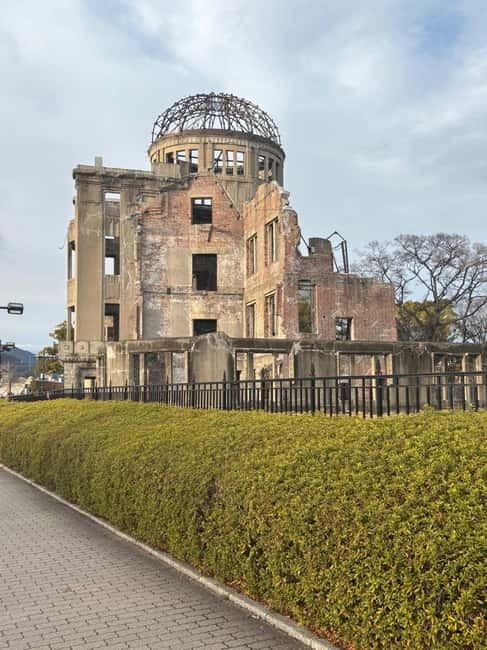
The Atomic Bomb Dome is the image most closely linked with Hiroshima. Its damaged structure remains a solemn reminder of the blast and the city’s destruction. Seeing it after the museum and memorials gives the building more meaning than a quick photograph from across the river would.
The tour does not stop at the Dome alone. It also includes the Hypocenter Monument, marking the point directly below the airburst. This is among the most important geographic facts in Hiroshima: the Dome is a surviving structure near the blast area, while the Hypocenter identifies the point at which the explosion occurred.
Pause here. The location is easy to photograph, but the significance calls for more than a camera stop. Adina can connect the physical location to the earlier explanations of blast and nuclear reaction, then bring the discussion back to the human consequences.
The route lists guided time at the Atomic Bomb Dome and the Hypocenter Monument, with blank entries in the supplied schedule likely corresponding to these final sites. The included stops clearly identify both, so you should expect them to form the closing part of the experience.
What two hours and $21 really provide
At $21 per person, this is a low-cost introduction to Hiroshima’s central memorial sites. You are paying mainly for a live guide, a planned route, explanations at each stop, and entry to the Peace Memorial Museum. Meals, hotel pickup, and hotel drop-off are not included.
The value is strongest if you are visiting Hiroshima for the first time and want structure. A solo walk through the park costs less, but you may miss smaller memorials or struggle to connect the sites into one story. The guide also saves you from spending your limited time checking maps and reading every sign before moving on.
The tradeoff is depth. Two hours is not enough for a full museum visit plus long pauses at every monument. I would use this tour as an introduction, then return to the museum or selected memorials alone if Hiroshima is a major part of your trip.
Free cancellation is available up to 24 hours before the activity for a full refund, and you can reserve now and pay later. Starting times vary, so check availability before planning other Hiroshima activities around it.
Who should book this Hiroshima walking tour?
I would recommend it to first-time visitors, history-minded visitors, and anyone who wants a guide to explain the park’s less familiar memorials. It also suits people who appreciate a mix of historical context, basic science, and quiet reflection.
The tour may be especially useful if English is your preferred language, since English, Urdu, and Hindi guiding are offered. Adina’s experience explaining nuclear reactions makes the walk a possible fit for students or curious adults who want more technical detail.
You should think twice if you want a long museum session, a private and silent visit, or a very slow pace. The itinerary is full, and the memorial park deserves time. You may prefer to visit independently if you already know Hiroshima’s history and mainly want to sit quietly at the sites.
Wear comfortable walking shoes and bring water, sunscreen, and a camera. The meeting point is outdoors, meals are not provided, and food and drinks cannot enter the museum.
Should you book it?
Book this tour if you want a clear, affordable introduction to Hiroshima Peace Memorial Park and the Atomic Bomb Dome, with a guide who can explain both the historical record and the science behind the bombing. The inclusion of the Korean Victims Memorial, Dr. Marcel Junod’s monument, the Peace Bell, and the Hypocenter Monument gives the route more substance than a simple Dome visit.
Skip it if your priority is an extended museum visit or a completely self-directed experience. Also confirm mobility arrangements before paying, since the accessibility information is contradictory. For most first visits, though, the $21 price offers a sensible way to understand the park before deciding where to spend more time on your own.
FAQ
How long does the Hiroshima Peace Park guided walk last?
The activity lasts two hours. Starting times depend on availability.
Where does the tour meet?
Meet at the Gates of Peace, in front of an Italian restaurant. The coordinates are 34.3906308, 132.4516662.
Is entry to the Hiroshima Peace Memorial Museum included?
Yes. Peace Memorial Museum entry is included in the activity.
Which languages are available?
The live guide is available in English, Urdu, and Hindi.
Is hotel pickup or drop-off included?
No. Hotel pickup and drop-off are not included.
Can I bring food and drinks into the museum?
No. Food and drinks are not allowed inside the Hiroshima Peace Memorial Museum. Bringing water for the outdoor portions is recommended.
Is the tour wheelchair accessible?
The activity information gives conflicting details. It lists the tour as wheelchair accessible but also says it is not suitable for wheelchair users or people with mobility impairments. Confirm access arrangements with the provider before booking.
Just added around Hiroshima
- The Peace Memorial to Miyajima : Icons of Peace and Beauty★ 4.5 · 31 reviews
- Shore Excursion from Hiroshima Port : Private Tour in Hiroshima★ 5.0 · 17 reviews
- Hiroshima Saijo Sake Tasting Tour with visit to 7 Breweries★ 5.0 · 104 reviews
- Hiroshima & Miyajima All-Inclusive Tour w/Licensed guide Pancho★ 5.0 · 54 reviews
- Hiroshima Country Cycling: Explore Rural Life 1 HR from City★ 5.0 · 22 reviews
- Okunoshima Rabbit Island Cycling Tour with Local Guide★ 4.5 · 17 reviews
- Private Full Day Hiroshima Tour★ 4.5 · 29 reviews
- Hiroshima Private Tour with a Local – Highlights & Hidden Gems★ 4.5 · 24 reviews
Hiroshima Tours, compared.

Peaceful Hiroshima & Miyajima UNESCO 1 Day Bus Tour
Read our review →
Hiroshima and Miyajima UNESCO Sites 1-Day Tour
Read our review →
Hiroshima Historical Walking Tour – Why A-Bomb was Dropped
Read our review →
Hiroshima Peace (Heiwa) Walking Tour at World Heritage Sites
Read our review →
Hiroshima in a Nutshell: Morning Bike Adventure
Read our review →
Hiroshima City 4hr Private Walking Tour with Licensed Guide
Read our review →

Japanesel Archery Experience HIROSHIMA CASTLE SHARAKU
Read our review →Browse the lists this tour appears in