
Reviewed · FUSHIMI INARI TOURS
Inside of Fushimi Inari – exploring and lunch with locals
Fushimi Inari is famous for its endless rows of red torii gates, but the best part of this four-hour walk is what lies between the headline sights. Your guide leads you through cedar forest, bamboo, quiet worship spots, a waterfall, and a torii-making factory before taking you to the summit.
I like the small-group size of 10, which makes it easier to ask about Shinto customs and keep a relaxed pace. I also like the local lunch: soba noodles and inari sushi at a traditional restaurant, with vegetarian and vegan arrangements possible if you tell the operator in advance. The catch is simple: this is a real uphill walk, with stairs and roughly three hours on the shrine paths.
Key points to know
- The quieter side of Fushimi Inari: You spend time away from the busiest gate-lined sections, including a peaceful bamboo and cedar forest.
- A 233-meter summit walk: The climb takes about 20 minutes on a forest route, with more walking before and after it.
- Local guides with useful Kyoto advice: Guides including Ko, Go, Kenji, Yuya, and Taishi explain the shrine and suggest places to visit after the tour.
- A tea break in the mountains: Japanese hot tea and a salted boiled egg provide a welcome rest at a mountain hut.
- Authentic local food: Soba noodles and inari sushi are included, while drinks at the lunch restaurant cost extra.
- A practical four-hour format: The tour starts and ends at the Great Torii near JR Inari Station and is easy to fit into a Kyoto sightseeing day.
Why this Fushimi Inari walk feels different
Many people come to Fushimi Inari, take photographs under the first stretch of torii gates, and turn back. That gives you the famous image, but not much sense of how the shrine works as a living religious site.
This experience takes a wider view. You begin with the main shrine and the thousands of red gates, then move into the wooded slopes where the shrine feels quieter and more local. Your guide explains the history of the torii, the customs connected with Inari worship, and the meaning of the smaller sacred sites along the mountain.
I especially like the way the walk combines explanation with ordinary local encounters. You may see a torii craftsman at work, meet people connected with the neighborhood, and stop for food rather than rushing from one photo point to the next. The emphasis is not just on seeing Fushimi Inari, but on understanding how the place fits into daily life.
The experience has a 4.9 rating from 30 bookings, and the strongest praise centers on the guides, quieter paths, local contact, and food. That matches the design of the tour: it is less about checking off a shrine and more about spending half a day in its surroundings.
More ways to walk Fushimi Inari:
- Kyoto: Fushimi Inari, Kinkakuji, Bamboo Grove 1 Day Bus Tour
★ 4.8 · 4,316 reviews - Fushimi Inari Hidden Hiking Tour (Private Option Available)
★ 5.0 · 1,750 reviews - Kyoto/Osaka: Nara, Fushimi Inari Taisha, Arashiyama Bus Tour
★ 4.7 · 1,275 reviews
Meeting at the Great Torii near JR Inari Station
The meeting point is the stone pillar at the first Great Torii, across from the JR Inari Station exit. This is a useful location because you do not need to search through side streets or walk far into the shrine grounds before finding the group.
You can also reach the meeting point by walking about 10 minutes from Fushimi-Inari Station on the Keihan Line. The tour returns to the same Great Torii, so you finish where you began.
Because the walk includes stairs and forest paths, wear comfortable shoes and clothes. A hands-free backpack is a smart choice. You will want both hands available for balance, photographs, and the occasional pause at a shrine or gate.
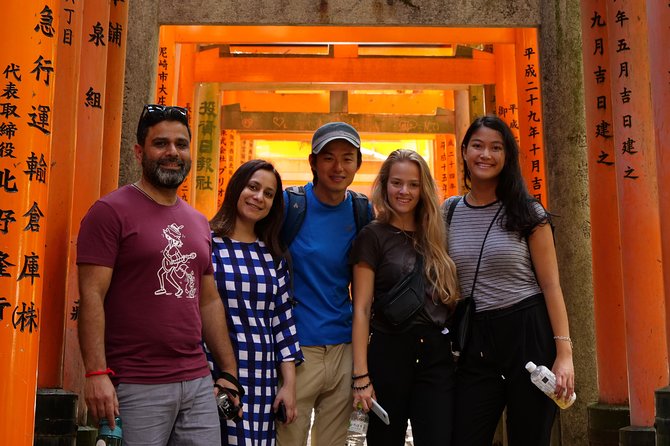
The group is limited to 10 people, and the guide speaks English. That size should keep the walk personal without making it feel like a private tour. Your exact guide depends on the date, but past tours have been led by Ko, Go, Kenji, Yuya, Taishi, and others from Japan Exploration Tours JIN.
Starting with the main shrine and thousands of torii gates
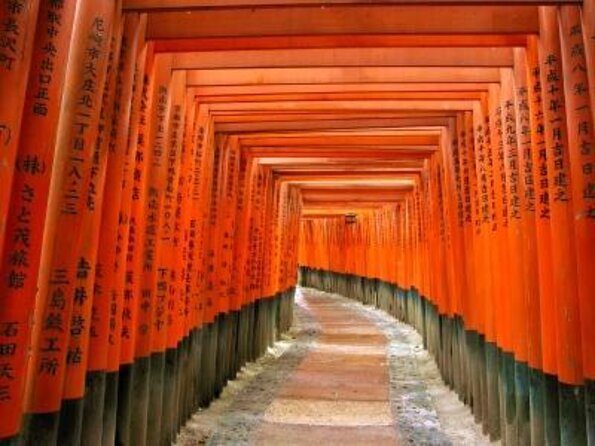
The first part gives you the classic Fushimi Inari experience: the main shrine buildings and the long corridors of red-orange torii gates. Your guide explains why the gates are donated, how they relate to worship, and how Inari shrine traditions connect with Japanese religious life.
This is where a guide adds real value. Without context, the gates can become a repeating wall of color. With an explanation, you begin to notice the names and dates on the posts, the offerings, and the changing feel of the shrine as the path rises.
Expect crowds around the lower section, especially at popular photo spots. The tour does not remove that busy stretch, but it helps you move beyond it. The quieter sections arrive as you go higher, where the cedar trees close in and the steady stream of people thins.
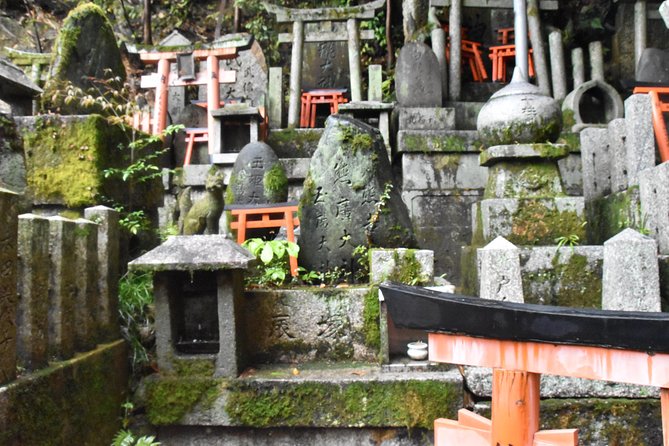
Your guide can also help with shrine etiquette. You will have chances to see worship stones and other holy places that are easy to pass without recognizing. This gives the visit a stronger sense of place than simply walking through the torii for photographs.
Bamboo, cedar, worship stones, and a working torii factory
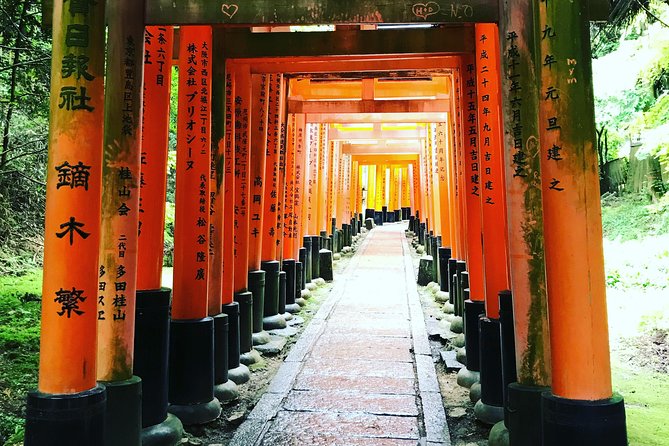
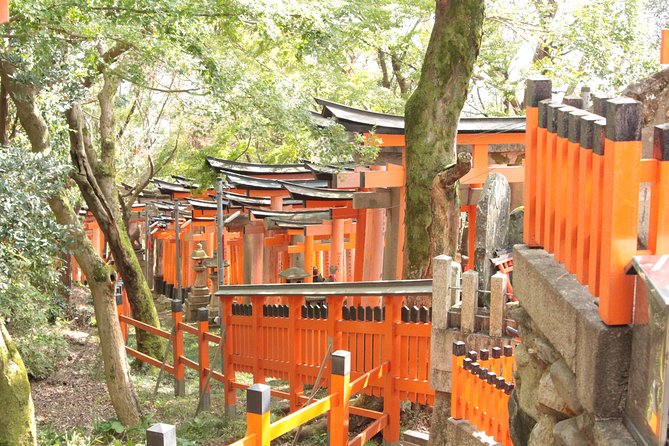
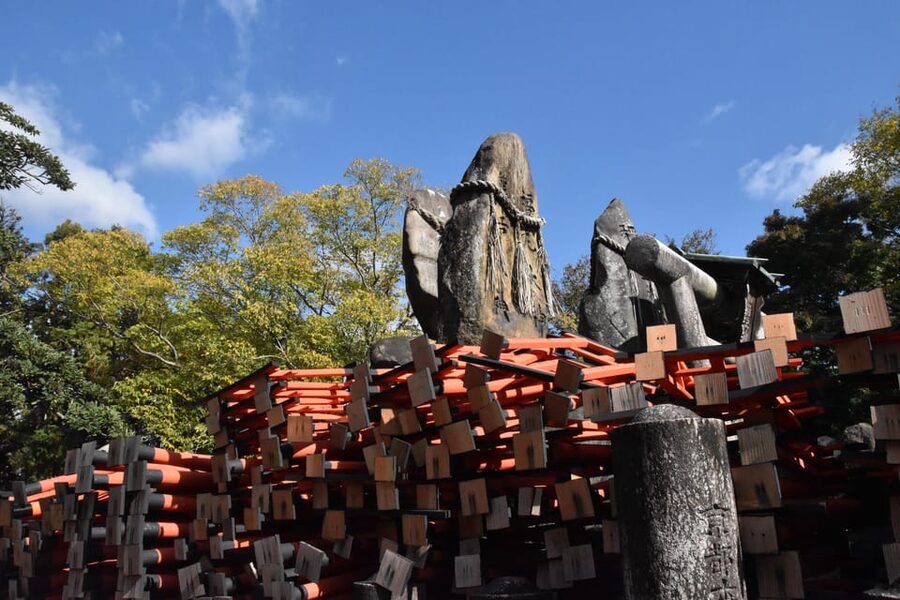
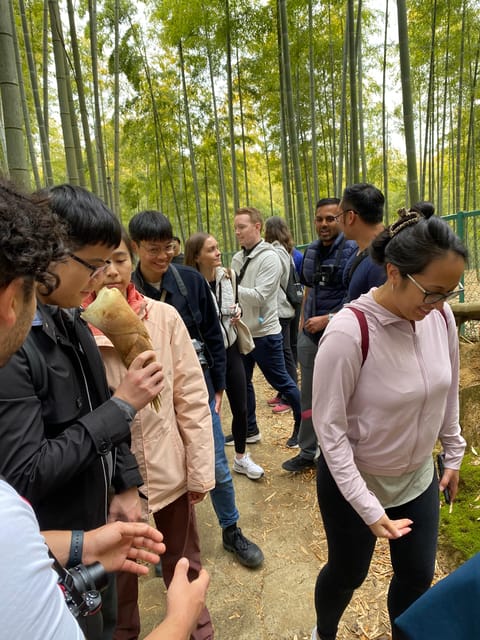
One of the most appealing parts of the route is the transition from the famous gates to a peaceful forest path. You walk through bamboo and cedar trees, visiting sacred spots that are less familiar to most first-time visitors.
A waterfall is included, along with worship stones and a factory connected with the making of torii gates. Seeing a torii maker at work can be a memorable surprise. One recent tour also included a chance to watch a master carve torii columns, which shows the physical skill behind the objects that define the shrine.
This section is valuable because it slows the pace. You are not simply climbing toward a summit. You are seeing the woods, small religious sites, and local work that give the mountain its character.
The paths are well organized, but do not mistake that for flat or effortless. You will go up and down stairs, and the total walking time is about three hours within the four-hour experience. The guide adjusts the schedule to walking speed, and the pace is described as casual with regular breaks, but you should still be comfortable with moderate uphill walking.
More lunch stops in Kyoto:
- Bike Tour Exploring North Kyoto plus Lunch
★ 5.0 · 1,087 reviews - Osaka/Kyoto: Arashiyama, Nara & Fushimi Inari Shrine w/Lunch
★ 4.4 · 754 reviews - Kyoto Zen Meditation & Garden Tour at a Zen Temple with Lunch
★ 5.0 · 441 reviews - 4.5-Hour Kyoto Bike Tour with Lunch and UNESCO Zen Temples
★ 5.0 · 122 reviews
The 20-minute forest climb to the summit shrine
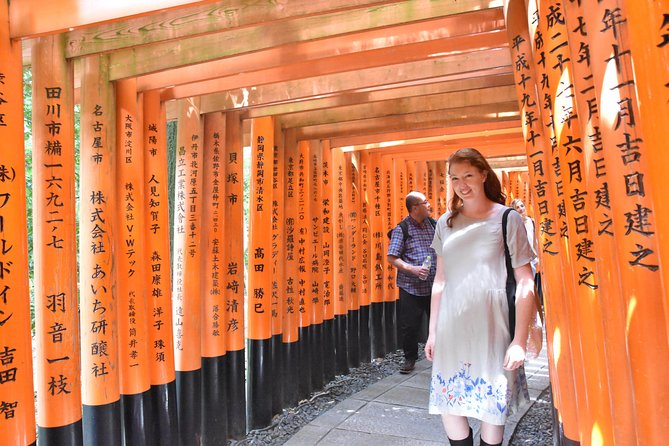
The route continues toward the summit shrine, at 233 meters. The uphill section takes about 20 minutes by a forest route, though the full hike includes more walking around the shrine grounds and on the descent.
The summit is not a dramatic mountain peak in the usual sense. Its appeal comes from reaching the upper shrine area, seeing how the religious site continues above the main crowds, and understanding the scale of the mountain complex.
Your guide shows you around the summit shrine and answers questions about what you are seeing. This is a good point to pay attention rather than rushing straight to photographs. Fushimi Inari is not one building with a short path around it. It is a mountain network of gates, shrines, stones, and routes, and the summit helps you grasp that layout.
If you are concerned about fitness, ask yourself whether you can manage stairs at a relaxed pace. This is not a suitable choice if you want a mostly flat shrine visit. On the other hand, you do not need to treat it as a race or serious mountain hike. The guides allow breaks and let you walk at your own speed.
Photo stops where the path quiets down
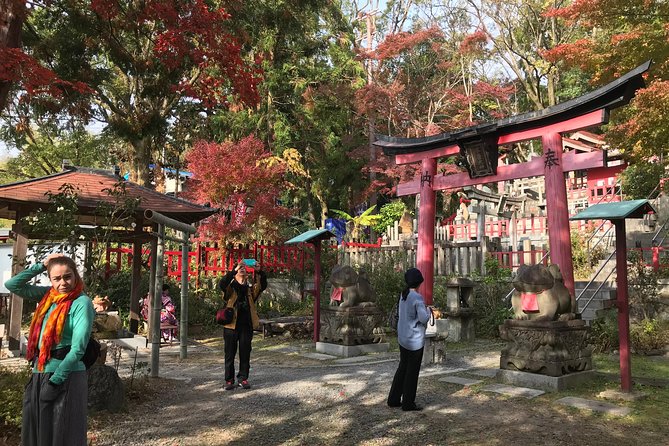
The descent includes a dedicated photo-shooting portion. Rather than stopping only at the most obvious lower gates, the guide points out less crowded places where you can frame the torii, forest, and shrine details with more space around you.
That matters at Fushimi Inari. The lower gates can be packed with people posing, walking, and waiting for a clear photograph. A local guide who knows alternative viewpoints can save you from spending the entire visit trying to find an empty section on your own.
You should still keep your expectations sensible. The shrine is one of Kyoto’s best-known sights, so no route can guarantee complete solitude. The advantage here is that the walk includes quieter paths and several places chosen for photographs, rather than leaving you to compete for the same angle as everyone else.
The route also includes a panorama view over Kyoto, where you stop for a snack and drink. This is one of the tour’s most practical choices. After the climb, a view and a pause give you time to catch your breath while seeing how the city spreads out below.
Tea, a salted egg, and a mountain rest
The included break is simple but distinctly Japanese: hot tea and a boiled egg with salt at a scenic mountain hut. You may also receive other small offerings or refreshments during the experience, depending on the day.
I like this better than a rushed snack bought at the end of the walk. You sit in the mountain setting, take a proper pause, and try a modest local food combination that many visitors might not think to order themselves.
Vegan options are available for the tea break, according to the activity details. If you have allergies or dietary restrictions, tell the operator in advance rather than waiting until the meal. The same advice applies to vegan lunch arrangements.
The break also makes the pace more forgiving. You are not expected to climb continuously for three hours. Still, bring water and dress for walking, since the included tea does not replace your own supply for the full route.
Soba noodles and inari sushi at a local restaurant
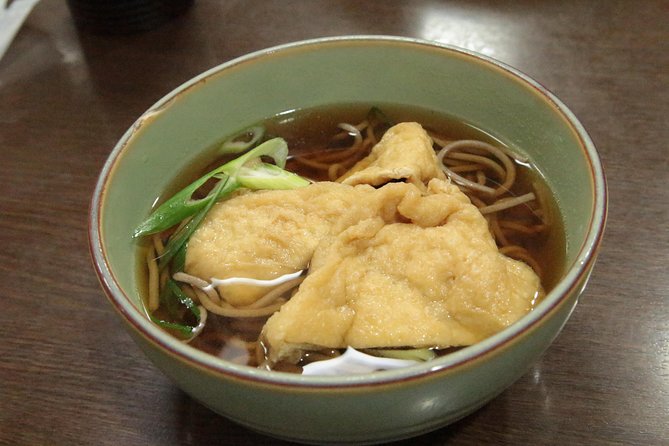
Lunch is built into the experience, not added as an afterthought. You eat soba noodles and fried sweet sushi, known as inari sushi, at a traditional local restaurant.
For me, this is a strong part of the value. A guide can lead you to a restaurant that fits the route and explain what you are eating, while you avoid spending precious Kyoto time comparing menus after a tiring walk. The meal is scheduled for about 30 minutes, so it is a satisfying stop rather than a long restaurant session.
Vegetarian and vegan options are available, but you must notify the operator in advance. This is especially important for vegan diners, since soup stock and other ingredients in Japanese noodle dishes may not be obvious from the menu.
Drinks at the lunch restaurant are not included. Food is included, as are the mountain tea and boiled egg, but budget a little extra if you want a restaurant drink.
The meal also helps the tour feel connected to the neighborhood. You are not being returned to a generic restaurant near a major station. You are eating as part of a local morning and afternoon route around Fushimi Inari.
How much value do you get for $67?
At $67 per person, this is not the cheapest way to visit Fushimi Inari. You can enter the shrine grounds without paying an admission fee and walk the lower torii gates independently.
The comparison changes once you count what the price includes: four hours with an English-speaking guide, a small group capped at 10, a structured route through quieter forest areas, the summit, a viewpoint, a snack and drink, and lunch with soba and inari sushi.
The biggest value is the access to context and local direction. If you already know the shrine well, speak Japanese, and enjoy planning your own food and walking route, the price may feel unnecessary. If this is your first visit and you want to understand more than the famous gate corridor, the cost is easier to justify.
I would also view it as a half-day Kyoto activity rather than simply a guided entrance to a shrine. You receive a walk, a meal, rest stops, photographs, and local recommendations. Guides such as Go, Kenji, and Taishi have also offered suggestions for other places to visit in Kyoto, which can be useful if you are still shaping your itinerary.
The free cancellation policy allows cancellation up to 24 hours before the experience for a full refund, and you can reserve now and pay later. Those terms are helpful when your Kyoto schedule is still moving around.
Who should book this experience?
I would choose this tour if you want a fuller visit to Fushimi Inari, prefer local food to a quick convenience-store lunch, and enjoy asking questions while you walk.
It is a particularly good fit for:
- First-time visitors who want an explanation of Shinto customs and shrine traditions
- Photographers who would rather find quieter angles than stay with the main crowd
- People who enjoy gentle, moderate walking with regular stops
- Solo visitors or couples who want the social ease of a small group
- Vegetarian and vegan diners who can give advance notice
- Anyone interested in the people and crafts connected with the shrine, including torii making
I would hesitate if you have difficulty with stairs, want a completely private experience, or prefer to move quickly through the shrine without stopping for explanations. Four hours is a long time if your only goal is to see the lower torii gates.
The route is also not fully predictable in timing. Walking speed affects the schedule, and the experience combines uphill and downhill sections with a set lunch break. Plan to treat the morning or afternoon as occupied rather than trying to squeeze in another major attraction at the same time.
Should you book the Fushimi Inari local walk?
Book it if you want to see the mountain beyond the famous gates. The bamboo and cedar paths, worship stones, waterfall, torii workshop, summit shrine, Kyoto viewpoint, tea break, and soba lunch create a much more rounded visit than a quick independent walk.
At $67, the tour earns its price through the guide, food, route planning, and quieter viewpoints. The main question is your walking ability. If you can handle stairs and a moderate forest climb, this is a thoughtful way to spend four hours at Fushimi Inari. If you only want a short photo stop, save the money and explore the lower shrine on your own.
FAQ
How long does the Fushimi Inari experience last?
The experience lasts four hours. The schedule includes about three hours of hiking and a lunch stop of about 30 minutes, with timing adjusted according to walking speed.
Where does the tour meet?
You meet at the Great Torii, at the stone pillar by the first gate across from the JR Inari Station exit.
How do I reach the meeting point?
The meeting point is near JR Inari Station. It is also about a 10-minute walk from Fushimi-Inari Station on the Keihan Line.
Where does the tour finish?
The experience ends back at the Great Torii, the same place where the group meets.
Is the tour conducted in English?
Yes. The tour has a live English-speaking guide.
How large is the group?
The experience is limited to 10 participants.
Is lunch included?
Yes. Lunch includes Japanese soba noodles and inari sushi. Drinks at the lunch restaurant are not included.
Are vegan or vegetarian options available?
Yes. Vegan and other dietary options are available, but you need to tell the operator in advance.
What should I wear and bring?
Wear comfortable clothes and walking shoes. Bring a hands-free backpack because the route includes stairs and uphill and downhill walking.
Just added around Kyoto
- Kyoto: Zen Meditation at a Private Temple with a Monk★ 5.0 · 25 reviews
- Kyoto: Gion Geisha District & Sake-in-Hand Walking Tour★ 5.0 · 37 reviews
- Private Pewter Sake Cup Experience with a Kyoto Artisan★ 5.0 · 31 reviews
- Your Private Vacation Photography Session In Kyoto★ 5.0 · 110 reviews
- Private Guided Traditional Buddhist Cooking in Japan★ 5.0 · 16 reviews
- Kyoto Wagashi(Japanese sweets) Cooking Class near Fushimiinari★ 5.0 · 60 reviews
- Traditional Japanese Music show & Experience Tour in Kyoto★ 5.0 · 57 reviews
- Kyoto:Family-Friendly Kimono & Yukata Experience at WARGO★ 5.0 · 147 reviews
Fushimi Inari Tours, compared.

Fushimi Inari, Kinkakuji, Bamboo Grove 1 Day Bus Tour
Read our review →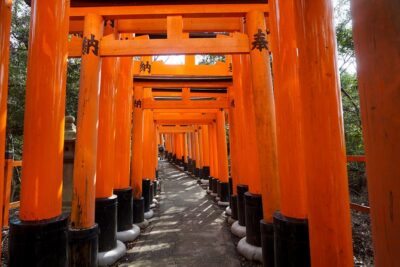
Fushimi Inari Hidden Hiking Tour (Private Option Available)
Read our review →
Kyoto/Osaka: Nara, Fushimi Inari Taisha, Arashiyama Bus Tour
Read our review →
Osaka/Kyoto: Arashiyama, Nara & Fushimi Inari Shrine w/Lunch
Read our review →
Nijo Castle, Kiyomizu & Fushimi Inari Guided Tour
Read our review →
Nijo, Kinkaku-ji, Arashiyama, Kiyomizu & Fushimi Inari
Read our review →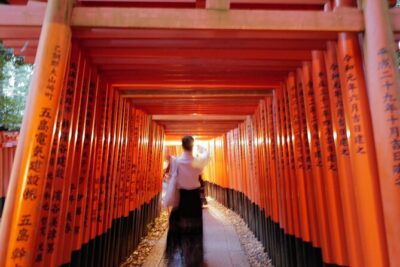
Browse the lists this tour appears in