
Reviewed · KYOTO TOURS
Authentic Maiko Experience&Kyoto Dinner (Free drink) at Noh Stage
The evening’s real draw is not simply watching a maiko dance. You sit close enough to notice the kimono, hair ornaments, gestures, and quiet discipline behind the performance, then move into conversation, questions, photos, and traditional ozashiki games. I like the small maximum of 20 people and the way live shamisen music carries through the entire program.
I also like that dinner, drinks, translation, and interaction are folded into one two-hour visit rather than sold as separate extras. The main consideration is price: at $150, this is a special-occasion experience, not a cheap dinner show. You’ll also need socks or tabi, since bare feet are not allowed on the Noh stage.
Key points at a glance
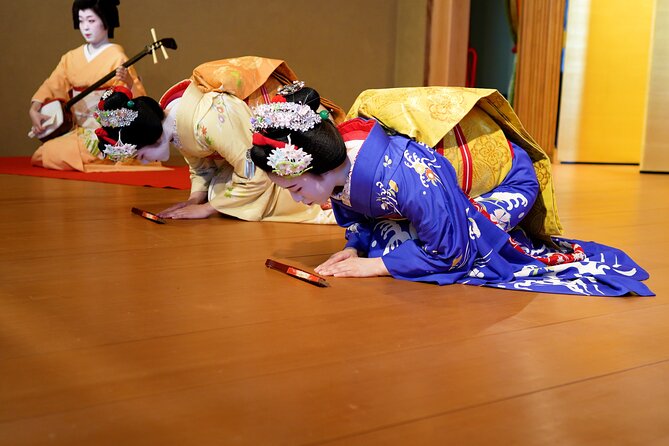
- Live dance on a Noh stage: Watch the maiko perform with a jikata musician playing shamisen.
- Conversation, not just observation: Ask questions about the maiko’s life, kimono, kanzashi hair ornaments, and traditions.
- Kaiseki-style dinner included: The meal gives the evening a proper Kyoto dining setting rather than a quick snack.
- Ozashiki games: Join traditional games with the maiko, accompanied by live shamisen.
- Photos on the stage: Take an individual two-shot photo and enjoy a free photo period before the program.
- Two hours of drinks: Meals and unlimited drinks are included during the scheduled experience.
What makes this Kyoto maiko evening different
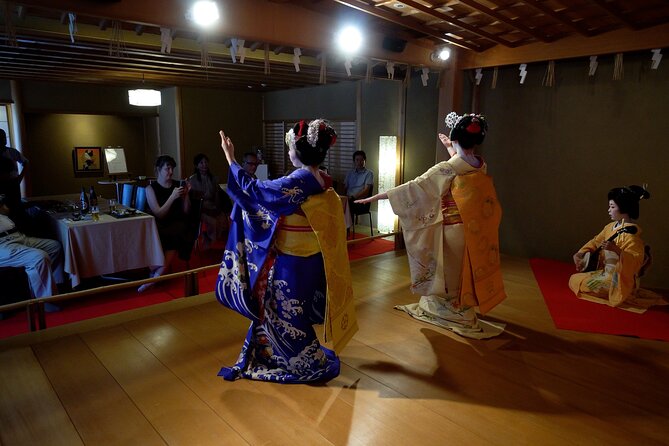
Many cultural shows give you a seat, a short performance, and a polite round of applause. This program aims for something closer to an ozashiki evening, a traditional entertainment setting where music, dance, conversation, games, and hospitality work together.
That difference matters. You are not only watching an artist from across a large room. You get time to see the maiko enter, perform, introduce herself, answer questions, and take part in playful exchanges. The format is intentionally limited, with no more than 20 people, so the room should feel more personal than a large stage production.
The setting also does useful work. A Noh stage is spare and formal, with a polished surface and a strong sense of ceremony. It gives the dance room to breathe, while the historic-house setting at Okazaki-an helps the meal and conversation feel connected to Kyoto rather than placed in an ordinary event hall.
The experience is presented by people with long-standing ties to Kyoto’s hanamachi, the traditional entertainment districts. That background is important because the details of an ozashiki evening are easy to flatten for tourists. Here, the stated goal is to retain traditional etiquette, presentation, and performance standards.
You should still keep your expectations sensible. This is a planned cultural experience for international visitors, with an interpreter and a fixed schedule. It is not a private teahouse appointment or a chance to wander into a working geisha district. Its strength is that it offers access to traditions that are normally difficult to encounter in a respectful, understandable format.
More geisha-district evenings:
- Kyoto Geisha Walking Tour: Gion District & Hidden Gems
★ 4.7 · 3,273 reviews - Kyoto: Gion Magical Night Walking Tour with Geisha Trivia
★ 4.9 · 2,393 reviews - Kyoto: Gion Geisha District Walking Tour – Stories of Geisha
★ 4.7 · 2,187 reviews
Arriving at Okazaki-an before 6 p.m.
The meeting point is Okazaki-an, at 9165 Okazaki Enshōjichō, Sakyo Ward, Kyoto, postal code 606-8344. The venue is near public transportation, but the supplied information does not specify a particular station or walking time, so I would allow extra time for the final approach and aim to arrive before the 6 p.m. start.
Doors open at 5:50 p.m. If you arrive early, you can wait in the first-floor café space. The formal gathering takes place upstairs on the second floor of the Noh stage.
Pay attention to your footwear. Socks or tabi are required for the stage, and bare feet are not permitted. This is easy to overlook during a warm-weather visit, so put on clean socks before leaving your hotel. Food and drinks are also not allowed during the early photo period on the stage.
Oversize luggage is not included in the arrangements. I would leave large bags at your accommodation rather than arrive hoping the venue can store them.
The first photo period on the Noh stage
Before dinner and the main program, you have free photo time on the Noh stage. This is a pleasant chance to take in the room while it is still quiet and to photograph the setting without competing with the later activities.
The no-food and no-drink rule makes sense here. The stage is part of the cultural setting, not just a backdrop, and the footwear requirement helps preserve the formal atmosphere.
The early photo period is also useful for practical reasons. You can check where you are sitting, settle your belongings, and take general photos before the maiko arrives. Do not assume this is the same as the later two-shot photo. The scheduled individual photo with the maiko comes after the dance and introductions.
Dinner begins with a welcome toast
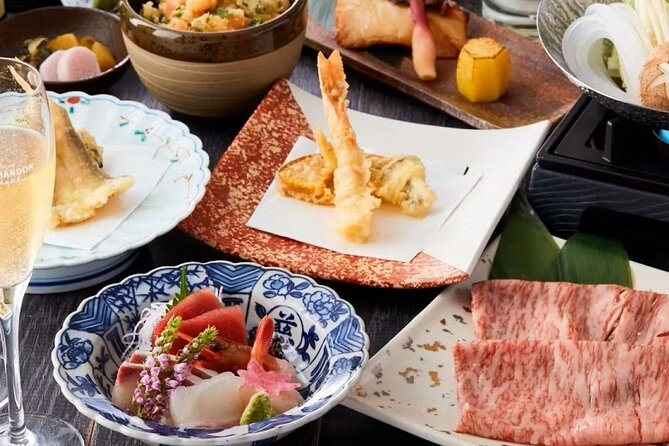
At 6 p.m., the welcome toast and dinner start. The meal is described as Kyoto traditional food and a kaiseki-style dinner. Kaiseki is known for careful presentation, seasonal balance, and a progression of small dishes, so this is more than a plate of standard banquet food.
The meal helps set the pace. You are not rushing through dinner before a show. Food, music, and conversation share the evening, which makes the experience feel more like a social gathering than a performance with a meal attached.
The drink arrangement is another practical plus. Free drinks are included for the two-hour program, and the highlights describe them as unlimited. That gives the evening a relaxed rhythm, though you should still pace yourself because the program includes listening, questions, games, and photos.
The exact menu is not provided, and seasonal dishes can vary. If you have food restrictions, the available information does not state how the venue handles them, so ask before booking rather than assuming substitutions are available.
More dinners out in Kyoto:
- Kyoto Gion Cultural Walk & Geisha Show with Dining Options
★ 5.0 · 518 reviews - Kyoto Gion Cultural Walk & Geisha Show with Dining Options
★ 5.0 · 483 reviews - Dinner with Maiko in a Traditional Kyoto Style Restaurant Tour
★ 5.0 · 175 reviews - Kyoto: Geisha Dinner & Gion Cultural Walk
★ 5.0 · 73 reviews
A maiko dance with live shamisen
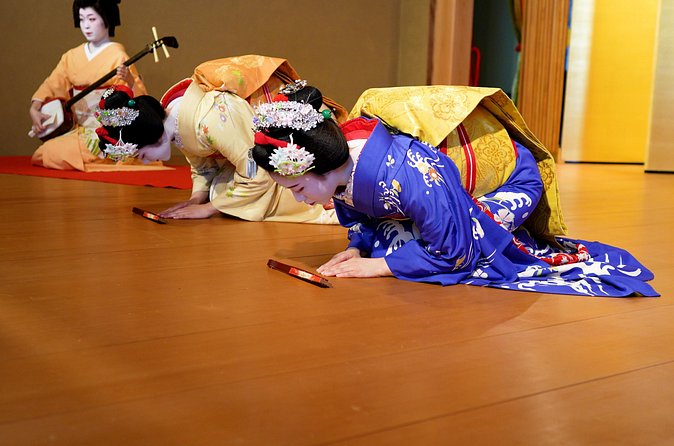
The entrance of the maiko and jikata musician marks the main performance portion. The jikata provides live shamisen accompaniment, and the maiko dances on the Noh stage.
Live music changes the feeling of the performance. The shamisen is not background audio added after the fact. Its timing, pitch, and pauses help shape the dance, giving you a clearer sense of how the two artists work together.
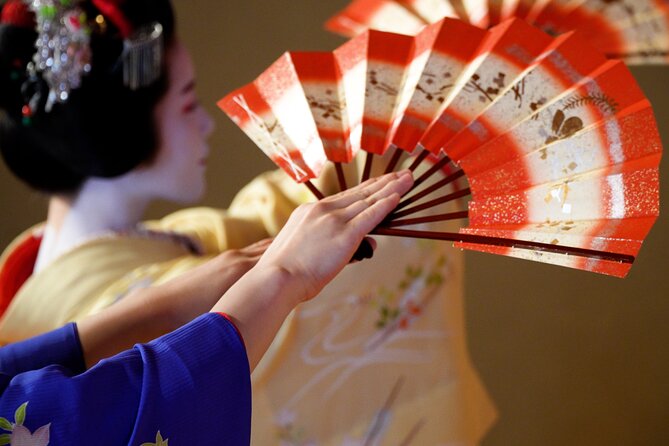
The program includes multiple maiko dance performances. One account of the evening describes seeing two dances, though the exact number may depend on the schedule. You can expect elegance and control rather than a loud theatrical production. The gestures may be small, but that is part of the point. Watch the hands, fan movements, posture, and measured turns.
This is a good place to lower your camera and simply observe for a few minutes. Photos are allowed at designated times, but the performance itself is easier to appreciate when you are not trying to record every movement.
Introductions, kimono details, and questions
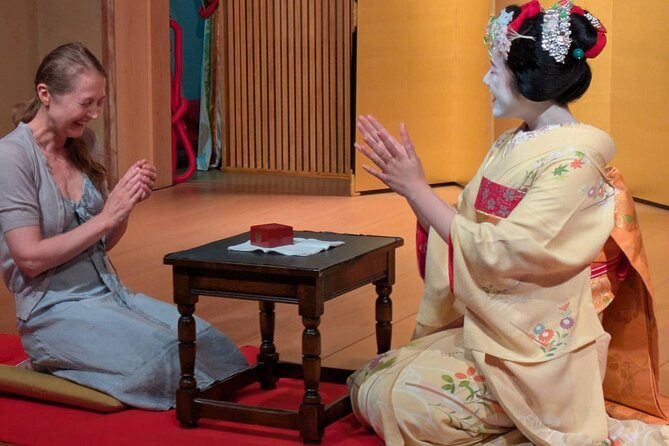
After the dance, the maiko and participants introduce themselves. This changes the room from audience and performer into a shared gathering.
A Kyoto-certified interpreter guide helps make the exchange accessible. That matters because the most useful part of a cultural experience is often the explanation around the performance. You can ask questions directly and receive context rather than relying on a short scripted speech.
The Q&A covers the maiko’s kimono and kanzashi, the decorative hair ornaments that are among the most recognizable parts of her appearance. These details are not random decoration. They help you read the costume and understand how much care goes into presenting the maiko’s role.
You can also ask about the maiko’s life and traditions. Keep your questions polite and focused. The program offers conversation, not an invitation to treat the maiko as a costume model or photo prop.
The interpreter is especially helpful if you want to ask something more specific than the usual basic questions. The available information does not name the interpreter or the maiko in advance, so do not expect to choose a particular performer when booking.
The two-shot photo and personal conversation
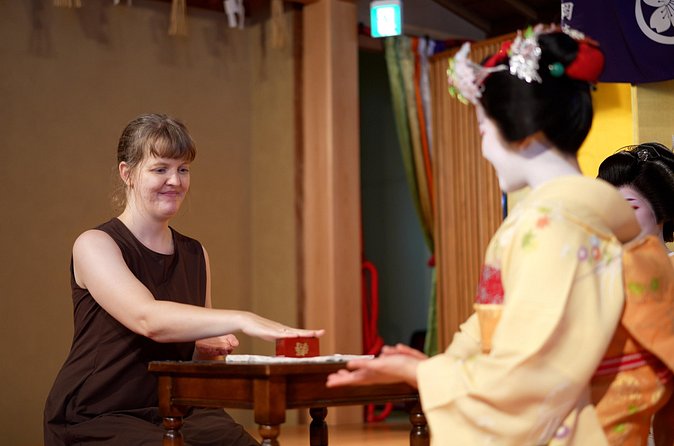
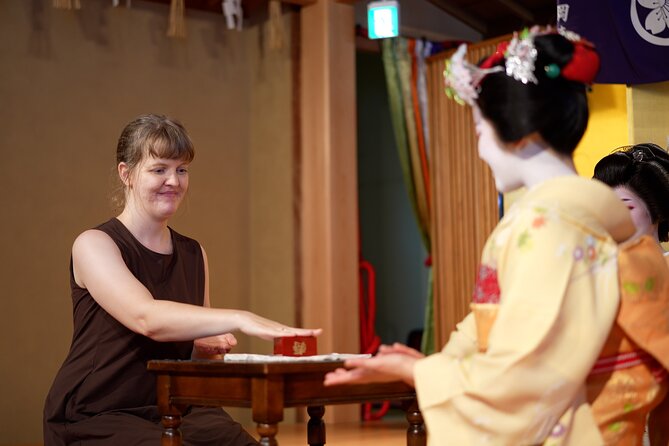
The scheduled two-shot photo takes place on the Noh stage. This is one of the clearest benefits of the small format. You do not have to settle for a distant view from a theater seat.
The photo is a short moment, so have your camera or phone ready and follow the staff’s directions. The earlier free photo time is separate, allowing you to photograph the stage before the more organized portrait.
Conversation follows the photo session. You may be able to ask follow-up questions or exchange a few words directly, with interpretation provided. The result is more personal than a quick meet-and-greet, but you should remember that time is shared among the group.
That shared format is both an advantage and a limit. A group of up to 20 is small enough to create contact, yet it is not a private booking. If you want long, one-to-one conversation, this may feel brief. If you want a respectful first introduction to maiko culture, the balance works well.
Ozashiki games with music
The final major activity is an ozashiki game on the Noh stage, accompanied by live shamisen. These games are playful, social, and often much less formal than the dance.
This is where the evening becomes participatory. You are not expected to understand every rule before you begin. The interpreter and staff help explain what to do, and the maiko sets the tone.
Games also reveal a different side of the evening. The dance shows discipline and refinement. The games show timing, humor, and the social skill that has long been part of traditional entertainment gatherings.
If you are shy, you may feel a little exposed at first. That is normal. The activities are designed for participation, and the small group means you may be invited to join rather than quietly watch from the side. Come ready to laugh at your own mistakes.
Is $150 good value?
At $150, I would treat this as a cultural splurge. The cost covers a kaiseki-style meal, unlimited drinks for two hours, live shamisen, multiple dances, interpreter support, conversation, ozashiki games, and a two-shot photo.
A separate dinner and a performance would quickly take up part of that amount, but the value here is not only the food. The difficult-to-arrange element is the personal access to the maiko, plus the explanation that helps you understand what you are seeing.
The price makes the most sense if you want direct contact and cultural context. If your main goal is simply to watch a short maiko dance, a less expensive public performance may suit you better. If you want dinner, questions, photos, and games in one small setting, the package is easier to justify.
Group discounts are available, which may improve the cost for families or friends booking together. The experience requires at least two participants, so it is not designed as a solo one-person departure.
Who should book this experience?
I would recommend it to first-time visitors who want a clear, respectful introduction to Kyoto’s maiko tradition without trying to arrange access to a private teahouse. It also suits anyone interested in costume, Japanese music, dance, food, or social customs.
Couples and small groups should find the format particularly comfortable. The two-shot photo gives you a tangible memory, while the dinner and games keep the evening from feeling like a formal lecture.
Families with older children may also enjoy it if everyone can follow stage etiquette and take part politely. The program says most people can participate, but it does not provide a detailed accessibility statement. Anyone with mobility concerns should confirm the venue arrangements before booking, especially since the gathering is on the second floor and includes time on a stage.
I would not choose it if you dislike group participation, want a completely private encounter, or are looking for a late-night Kyoto activity. The program begins at 6 p.m. and ends around 8 p.m., returning you to the meeting point.
Practical details before you book
Your confirmation is issued at booking, and the experience uses a mobile ticket. Keep the ticket available on your phone, while also allowing enough time to find Okazaki-an.
The activity ends at the same place where it begins. Transportation from your home or hotel is not included, so you arrange your own way to and from the venue.
The cancellation rule is friendly if your plans are firm: cancel at least 24 hours before the local start time for a full refund. Cancellations or changes inside that window are not accepted and are not refunded.
I would also plan your clothing with the stage in mind. Clean socks or tabi are essential, and comfortable clothing will make it easier to sit, move, and participate in the games.
Should you book the Kyoto Noh Stage maiko dinner?
Book it if you want more than a performance. The best parts are the combination of live shamisen, carefully presented Kyoto food, direct questions, a stage photo, and games that let you take part in the evening.
Skip it if $150 is beyond your cultural-activity budget or if you prefer a short, inexpensive show with no interaction. For everyone else, this is a strong choice for a special Kyoto night, especially when you value personal contact and traditional detail as much as the dance itself.
FAQ
How long does the maiko dinner experience last?
The experience lasts approximately two hours, from the 6 p.m. gathering until the scheduled 8 p.m. end.
Where does the experience begin and end?
It begins and ends at Okazaki-an, 9165 Okazaki Enshōjichō, Sakyo Ward, Kyoto, postal code 606-8344.
What is included in the $150 price?
The price includes the meal, free unlimited drinks for two hours, maiko dance performances, live shamisen music, conversation, ozashiki games, a two-shot photo with the maiko, and interpreter support.
Are photographs allowed?
Yes. There is free photo time on the Noh stage before the program, and a scheduled two-shot photo with the maiko later in the evening. Socks or tabi are required on the stage, and food and drinks are not allowed during the early photo period.
How many people can join the experience?
The maximum group size is 20 people. The experience is available with a minimum of two participants.
Can I cancel for a refund?
You can receive a full refund if you cancel at least 24 hours before the experience start time. Cancellations or changes made within 24 hours are not accepted and are not refunded.
More Places to Eat in Kyoto
- Private Dinner with a Geisha
★ 5.0 · 65 reviews - Kyoto Evening Gion Food Tour Including Kaiseki Dinner
★ 5.0 · 62 reviews - Kyoto: Maiko Dinner in Traditional Restaurant and Tour
★ 4.8 · 55 reviews - Kyoto: Lunch or Dinner with Maiko
★ 4.2 · 52 reviews
Just added around Kyoto
- Kyoto: Zen Meditation at a Private Temple with a Monk★ 5.0 · 25 reviews
- Kyoto: Gion Geisha District & Sake-in-Hand Walking Tour★ 5.0 · 37 reviews
- Private Pewter Sake Cup Experience with a Kyoto Artisan★ 5.0 · 31 reviews
- Your Private Vacation Photography Session In Kyoto★ 5.0 · 110 reviews
- Private Guided Traditional Buddhist Cooking in Japan★ 5.0 · 16 reviews
- Kyoto Wagashi(Japanese sweets) Cooking Class near Fushimiinari★ 5.0 · 60 reviews
- Traditional Japanese Music show & Experience Tour in Kyoto★ 5.0 · 57 reviews
- Kyoto:Family-Friendly Kimono & Yukata Experience at WARGO★ 5.0 · 147 reviews
Kyoto Tours, compared.


Fushimi Inari, Kinkakuji, Bamboo Grove 1 Day Bus Tour
Read our review →
Tea Ceremony in a Traditional Tea House in Kiyomizu
Read our review →
Kyoto Geisha Walking Tour: Gion District & Hidden Gems
Read our review →

Gion Magical Night Walking Tour with Geisha Trivia
Read our review →

Gion Geisha District Walking Tour – Stories of Geisha
Read our review →Browse the lists this tour appears in