
Reviewed · HIROSHIMA TOURS
Hiroshima Kagura Performance Entry Ticket
Hiroshima Kagura turns Japanese mythology into a compact stage drama, with pounding music, graceful dance, fierce swordplay, and costumes that seem to grow larger as the story unfolds. The weekly performance at Hiroshima Prefectural Citizen’s Culture Center gives you a direct look at a local art form without asking you to spend an entire evening deciphering a long play.
I especially like the English subtitles and printed story summary, which make the legends easy to follow, and the excellent value: about $11.86 for live musicians, trained performers, scenery, and nearly an hour of entertainment. The main thing to consider is that the show is short, usually around 40 to 45 minutes, and the optional backstage experience costs extra.
Key points to know before you book
- Mythology with movement: Stories come from Japanese mythology and classical literature, often featuring gods, demons, heroes, and supernatural battles.
- English help is built in: English subtitles appear above the stage, and an English synopsis helps you follow the plot.
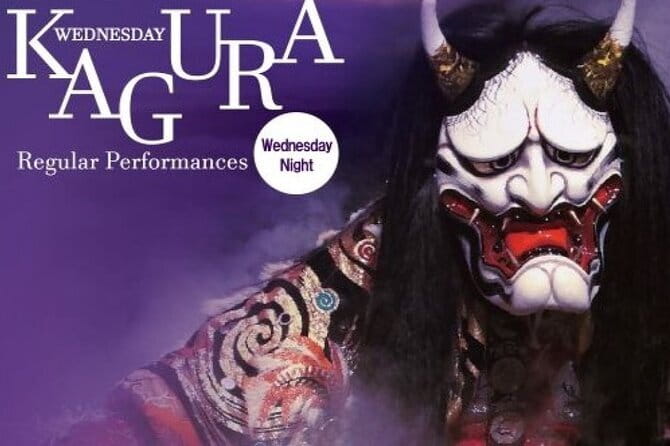
- A different troupe each week: Performers come from across Hiroshima Prefecture, with the schedule commonly featuring a Wednesday performance.
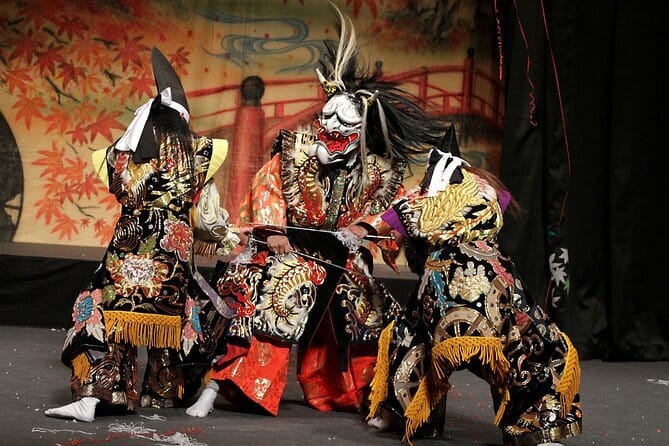
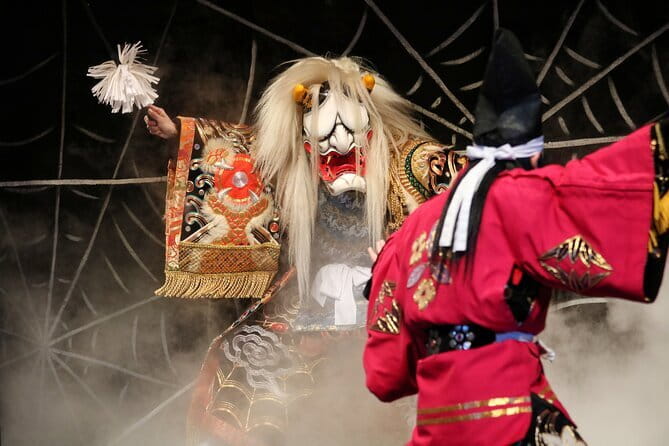
- The costumes are part of the drama: Elaborate masks and heavy, colorful outfits make every turn, leap, and entrance more striking.
- Prime seats may be arranged: The booking area has designated seating, and arriving early helps you get settled before the 7:00 pm start.
- Backstage contact is optional: Some dates offer paid after-show tours with costume try-ons, photos, explanations, and questions for the performers.
Hiroshima Kagura in one evening
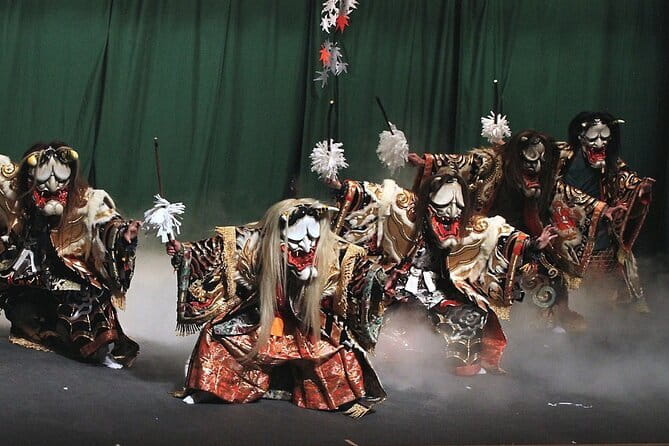
Kagura began as a ritual dance connected with Shinto worship, but Hiroshima developed its own theatrical version. The result is more energetic than a quiet ceremonial performance. It is closer to a folk play with music, dance, masks, dramatic entrances, and carefully timed action.
The stories draw on Japanese myths and classical tales. One production may feature a battle between a hero and a monster. Another may focus on a deity, a revenge tale, or a supernatural creature. The performance schedule changes, so you should not book expecting one fixed story unless the date specifically names it.
One example presented at this venue is Yamata no Orochi, the famous tale of an eight-headed serpent. Even if the legend is unfamiliar, you can follow the broad action through the English text above the stage and the printed explanation provided at the entrance.
The show is designed to work for people who know Japanese theater and people seeing kagura for the first time. You do not need a long background lesson before taking your seat. The introductory emcee explains what you are about to see, then the music and movement carry the story forward.
A few more Hiroshima half-days to weigh up
- Peaceful Hiroshima & Miyajima UNESCO 1 Day Bus Tour
★ 5.0 · 5,309 reviews - Hiroshima: Hiroshima and Miyajima UNESCO Sites 1-Day Tour
★ 4.9 · 2,330 reviews - Hiroshima / Miyajima Full-day Private Tour with Government Licensed Guide
★ 5.0 · 1,298 reviews
What happens at the 7:00 pm performance
Your evening begins at Hiroshima Prefectural Citizen’s Culture Center, at 1-chōme-5-3 Ōtemachi, Naka Ward, Hiroshima. The ticket redemption point is at the center itself. The venue is near public transportation, and private transportation is not included, so you make your own way there.
The performance starts at 7:00 pm. Arriving a bit early is a smart move, especially if you want time to find the entrance, collect any instructions, and choose a good seat within the designated booking area. Staff members are available to guide you, and the seating arrangement provides a clear view of the stage.
The auditorium uses sloped, theater-style seating. That matters because kagura depends on visual details. A mask lifted toward the audience, a long sleeve spinning through the air, or a performer crouching low can be easy to miss from a flat floor. The sloped arrangement helps keep the action visible.
Before the dance begins, an emcee explains the story and the basic features of kagura. This introduction is particularly useful when the plot involves unfamiliar names or a supernatural figure with several identities. You get enough information to watch the show as a story rather than as a string of impressive movements.
The performance itself usually lasts about 40 to 45 minutes, though the advertised experience is approximately one hour. That difference is worth noting. The ticket gives you a full theatrical presentation, but not a long, multi-act production. For many people, the shorter length is an advantage. You can fit it neatly after dinner or before another evening plan.
Music, masks, and movement on stage
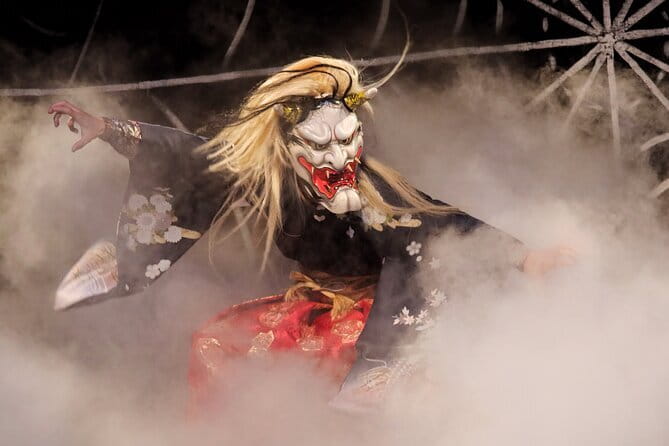
The strongest feature of Hiroshima Kagura is its physical style. Performers spin, jump, kneel, swing their sleeves, and use sharp changes in posture to show fear, power, anger, or triumph. The movement is precise, but it does not feel stiff. The action builds through rhythm and repetition until a major entrance or battle feels much larger than the modest theater suggests.
The musicians are an important part of the performance. Live rhythmic music gives the dance its pulse, and the sound can change the mood faster than words can. A measured passage may introduce a god or noble figure. Faster playing can turn a scene toward danger or combat.
Then come the costumes. They are colorful, ornate, and often much heavier than they look from the audience. Large sleeves and layered fabric make every turn more dramatic. Masks help performers shift into gods, demons, animals, or legendary characters, while the costumes give each figure a strong silhouette.
The clothing is not just decoration. It changes how the performers move. A dancer must control the weight and shape of the outfit while keeping the story clear. After the show, you may have the chance to see or try on some of the costumes, which gives you a better sense of the physical work involved. Several costume pieces are surprisingly heavy.
Because the action is so visual, you can enjoy much of the performance even without perfect Japanese. English subtitles still add useful context, especially when a character is explaining a plan, naming a place, or announcing a challenge. The subtitles appear on a screen above the stage, and a written English synopsis helps fill in the story.
How useful are the English subtitles?
The English support is one of the main reasons this experience works well for international visitors. You receive a story summary, the emcee explains the setup, and English captions appear during the production. You are not left trying to guess which warrior is which.
The subtitles are most useful in the spoken sections. Kagura contains limited dialogue compared with a conventional play, so you can understand much of the action through gesture, music, costume, and staging. Still, the captions help you catch the details that turn a pretty performance into a coherent legend.
The opening explanation also sets expectations. Kagura is not a naturalistic drama in which performers quietly behave like modern people. Its style is formal, theatrical, and symbolic. A broad gesture may show authority. A slow turn may reveal a supernatural figure. Once you understand that language, the performance becomes easier to read.
If you are traveling with children or with someone who does not speak Japanese, the subtitles are especially helpful. The short running time also keeps the experience manageable for anyone with limited attention for traditional theater. You get a real cultural presentation without committing to several hours.
One small limitation is that English may not be available in every part of the informal post-show interaction. The main show is made accessible through the written material and subtitles, but the performers may not speak English during photographs or costume sessions. If conversation is important to you, treat the backstage add-on as a visual and hands-on experience first.
Same base, a completely different sort of day:
- Hiroshima Historical Walking Tour – Why A-Bomb was Dropped
★ 4.8 · 893 reviews - Hiroshima Peace (Heiwa) Walking Tour at World Heritage Sites
★ 5.0 · 872 reviews - Hiroshima in a Nutshell: Morning Bike Adventure
★ 5.0 · 524 reviews - Hiroshima City 4hr Private Walking Tour with Licensed Guide
★ 5.0 · 437 reviews
The optional backstage experience
Some performances offer a backstage tour after the main show for an additional fee. This is not included in the basic admission ticket, and availability can vary, so check the details for your date before counting on it.
The extra experience may include explanations from the performers, a chance to ask questions, photographs with the cast, and opportunities to try on costumes and masks. This is where the show’s craftsmanship becomes much easier to appreciate. From the seats, a costume looks elegant and weightless. Up close, you can see its construction and feel the effort required to wear it.
The photo opportunity is a fun finish, particularly for families and anyone who wants a souvenir beyond a standard stage picture. The process can be organized and brief, rather than a long private conversation with each performer. You may move through the photo line quickly, and English conversation with the cast is not guaranteed.
That is not necessarily a problem. The main value is the rare chance to see the performers and costume pieces at close range. If you want a detailed discussion about the story, the emcee’s introduction and the English synopsis may be more useful than the post-show photo session.
If the backstage option is offered on your evening and you are genuinely interested in how kagura is performed, I would consider paying for it. If you mainly want to watch a traditional Japanese show, the regular ticket is enough.
Why the $11.86 price works
At about $11.86 per person, this is one of the easier cultural purchases to justify in Hiroshima. You are paying less than many large theatrical attractions while getting live music, elaborate costumes, a full performance, an introduction, English subtitles, and a central venue.
The value is strongest if you want something beyond memorial sites and daytime sightseeing. Hiroshima is rightly known for its Peace Memorial Park and museum, but a visit to this performance shows another side of the prefecture. The troupes come from communities across Hiroshima Prefecture, bringing a local performing tradition into the city for a regular public audience.
The low price also reduces the risk. If you find traditional theater difficult, you have not committed a large part of your budget or an entire evening. The 40 to 45 minute performance gives you a clear taste of kagura. If it captures your interest, you can consider the paid backstage option or seek out another performance during your stay.
The main value limit is the short length. Someone expecting a large, extended stage production may feel the evening ends quickly. The basic ticket is best understood as an accessible cultural presentation, not a full-night theater event.
Seating, timing, and practical details
The listed start time is 7:00 pm. The show begins on time, so I would arrive early rather than cutting it close. This gives you time to redeem the ticket, find the correct section, and read the English story material before the lights go down.
The venue has staff support, and the experience is near public transportation. Private transportation is not part of the booking. You should plan your route to the Hiroshima Prefectural Citizen’s Culture Center before the evening begins, especially if you are unfamiliar with the Ōtemachi area.
The seating is arranged so that the stage can be seen from the sloped rows. The designated booking section is reported to have good views, but arriving early remains useful. You can settle in, look over the program information, and avoid a rushed entrance.
Photography and short videos may be permitted during the show, according to the experience information. Follow the venue’s instructions on the night, and keep your phone screen dim so it does not distract the people behind you. The costumes are worth photographing, but the live performance is better enjoyed when you are not watching the whole thing through a screen.
Service animals are allowed, and most people can take part. The activity does not list special physical demands, but you should contact the provider if you have a specific seating or access concern, since only general participation information is provided.
Cancellation is free up to 24 hours before the local start time. A cancellation less than 24 hours before 7:00 pm is not refundable, and late changes are not accepted.
Who will enjoy this most?
I would recommend Hiroshima Kagura to you if you want a traditional Japanese experience that is easy to fit into a busy schedule. It works especially well after a day of sightseeing, when you want an evening activity with a clear start and finish.
It is a good match for:
- First-time visitors curious about Japanese mythology
- Families looking for a short, visual cultural show
- People who do not speak Japanese but want an accessible performance
- Fans of costume design, masks, dance, or live music
- Anyone seeking a low-cost evening activity in Hiroshima
- Visitors who want the option of a more hands-on backstage experience
You may want to skip it if your main goal is a long spoken drama with detailed dialogue. The story is supported in English, but the emotional force comes from movement, music, and visual symbols rather than extended conversation.
You should also be aware that the exact troupe and story change. That variety is part of the appeal, but it means you cannot assume every date will feature Yamata no Orochi or offer the same post-show activities.
My verdict on this Hiroshima evening
I would book the regular performance if the schedule fits your visit. At a modest price, you get a polished introduction to a local art form, English help throughout the story, strong costumes, live music, and a short running time that leaves room for other plans.
The best way to approach it is with the right expectations. This is not a museum lecture or a quiet folk demonstration. It is bold theater, with mythic characters, formal gestures, rhythmic playing, sudden leaps, and costumes that command attention.
Add the backstage option if it is available and you want to handle the masks, try on costume pieces, or take photos with the performers. Otherwise, the standard ticket already delivers the essential experience. For a compact and affordable look at Hiroshima’s traditional culture, this is an easy recommendation.
FAQ
Where does the Hiroshima Kagura performance take place?
The performance takes place at Hiroshima Prefectural Citizen’s Culture Center, 1-chōme-5-3 Ōtemachi, Naka Ward, Hiroshima, Japan. The ticket redemption point is at the culture center.
What time does the performance start?
The listed start time is 7:00 pm. Arriving early is recommended so you can redeem your ticket, find your seating area, and read the English story information before the performance begins.
How long does the show last?
The experience is advertised as approximately one hour. The performance itself generally takes about 40 to 45 minutes, leaving you time for other evening plans afterward.
Are English subtitles available?
Yes. English subtitles are shown above the stage, and an English synopsis is provided to help you understand the legend and follow the action.
Is the backstage tour included?
No. Backstage tours are offered occasionally and require an additional fee. When available, they may include performer explanations, questions, costume and mask try-ons, and commemorative photographs.
Can I cancel the ticket for a refund?
Yes, you can cancel for a full refund if you cancel at least 24 hours before the local start time. Cancellations or changes made less than 24 hours before the performance are not accepted for a refund.
Just added around Hiroshima
- The Peace Memorial to Miyajima : Icons of Peace and Beauty★ 4.5 · 31 reviews
- Shore Excursion from Hiroshima Port : Private Tour in Hiroshima★ 5.0 · 17 reviews
- Hiroshima Saijo Sake Tasting Tour with visit to 7 Breweries★ 5.0 · 104 reviews
- Hiroshima & Miyajima All-Inclusive Tour w/Licensed guide Pancho★ 5.0 · 54 reviews
- Hiroshima Country Cycling: Explore Rural Life 1 HR from City★ 5.0 · 22 reviews
- Okunoshima Rabbit Island Cycling Tour with Local Guide★ 4.5 · 17 reviews
- Private Full Day Hiroshima Tour★ 4.5 · 29 reviews
- Hiroshima Private Tour with a Local – Highlights & Hidden Gems★ 4.5 · 24 reviews
Hiroshima Tours, compared.

Peaceful Hiroshima & Miyajima UNESCO 1 Day Bus Tour
Read our review →
Hiroshima and Miyajima UNESCO Sites 1-Day Tour
Read our review →
Hiroshima Historical Walking Tour – Why A-Bomb was Dropped
Read our review →
Hiroshima Peace (Heiwa) Walking Tour at World Heritage Sites
Read our review →
Hiroshima in a Nutshell: Morning Bike Adventure
Read our review →
Hiroshima City 4hr Private Walking Tour with Licensed Guide
Read our review →

Japanesel Archery Experience HIROSHIMA CASTLE SHARAKU
Read our review →Browse the lists this tour appears in