
Reviewed · HIROSHIMA TOURS
Hiroshima: Peace Memorial Park and Atomic Bomb Dome Tour
Hiroshima’s Peace Memorial Park can feel quiet and orderly until you understand what each monument marks. This two-hour walking tour connects the park’s memorials with the Atomic Bomb Dome and the bombing’s human stories, giving you a clear path through a difficult subject.
I like the guide-led approach, especially the attention to details you could easily miss alone. I also like the price: $23 buys a focused introduction before you explore the museum or city on your own. The main drawback is the pace and amount of walking, and one booking reached its finish in about 90 minutes rather than two hours.
- Personal stories alongside major history: Guides such as Syed and Hussain explain both the wider events and the lives affected by the bombing.
- A useful route through the park: You visit the Cenotaph, Flame of Peace, Children’s Peace Monument, Korean Victims Cenotaph, Peace Bell, Aioi Bridge, and Atomic Bomb Dome.
- A direct look at the target area: The walk ends at the Hiroshima Atomic Bomb Hypocenter Monument.
- A question many visitors have answered: The tour addresses why Hiroshima was chosen as the primary target.
- Local life after 1945: The story continues into rebuilding, modernization, food, traditions, and Hiroshima today.
- Low cost, but bring your own basics: Water, sunscreen, a hat, and comfortable shoes matter because there is no food and the tour runs in all weather.
Why a guided walk helps in Hiroshima
The park is easy to reach and simple to walk through, but its meaning is not always obvious from a quick look at the monuments. A guide gives you the order and context needed to connect them: loss in 1945, remembrance, responsibility, reconstruction, and the city’s continuing call for peace.
I especially value the personal stories. The tour does not stop at dates and military decisions. It also brings attention to individuals who survived, those who did not, and the long effects of the bombing. That human scale can make the park feel less like a collection of monuments and more like a place where real lives are remembered.
The guides are listed as Hussain, and tours have also been led by Syed, Shah, Khan, and Aaze. Syed is described as completing a PhD, and his style comes through as energetic, clear, and open to questions. Several guides have also helped visitors connect the park with local food afterward, including okonomiyaki recommendations.
The tone matters here. Hiroshima is not a light sightseeing stop. A good guide needs to explain painful material without turning it into a spectacle. This tour is designed around tribute, historical understanding, and peace, with time for questions and quiet reflection.
Starting at the Gates of Peace
Meet at the Gates of Peace, on the front side of the Italian restaurant Mario. This is a practical starting point because the group begins among the park’s symbolic entrances rather than jumping straight to the most famous building.
The opening guided portion lasts about 20 minutes. Here, you begin to understand how the park is arranged and why the memorials are placed along the route. The gates help set the tone: you are entering a place dedicated to memory, but also to a future without nuclear weapons.
The meeting point is not hotel pickup, so you need to make your own way there. Check the start time carefully before setting out. One participant encountered confusion over the time, although the guide recovered the situation well. A quick message to the operator before the tour is a sensible precaution.
A few more Hiroshima half-days to weigh up
- Peaceful Hiroshima & Miyajima UNESCO 1 Day Bus Tour
★ 5.0 · 5,309 reviews - Hiroshima: Hiroshima and Miyajima UNESCO Sites 1-Day Tour
★ 4.9 · 2,330 reviews - Hiroshima / Miyajima Full-day Private Tour with Government Licensed Guide
★ 5.0 · 1,298 reviews
Prayer Fountain and the meaning of remembrance
The Prayer Fountain receives about 10 minutes. It is a short stop, but it adds an important layer to the visit by showing how the park remembers suffering through symbols of prayer and compassion.
You will not simply be rushed past a marker for a photograph. The guide explains what the site represents and how it fits the wider memorial area. This is one reason the walking format works better than a fast independent circuit. You can ask why a monument exists, what it commemorates, and how it relates to the bombing.
At this stage, I recommend keeping your camera away for a moment. Photography is allowed, but the park calls for restraint. Look first, listen, and take pictures later if they feel appropriate.
Hiroshima Peace Memorial Park in one clear route
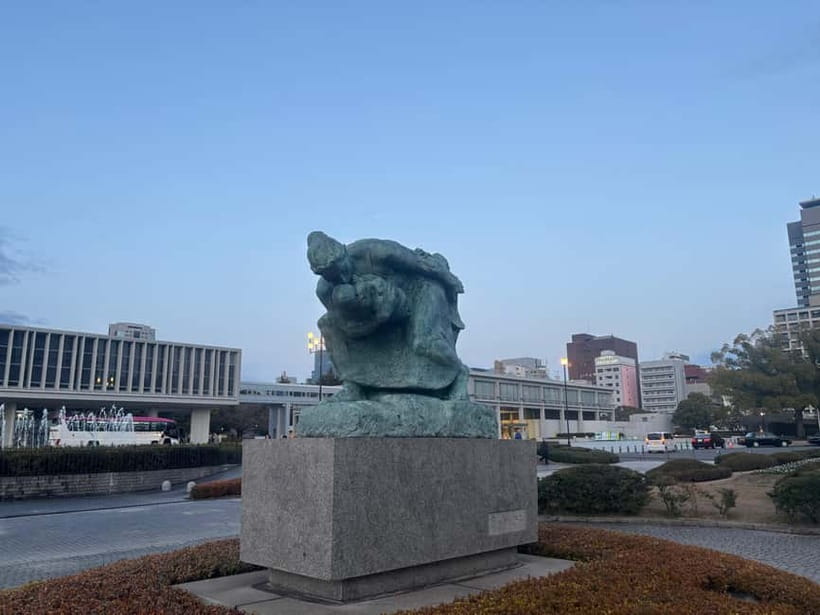
The main Peace Memorial Park section takes around 40 minutes, making it the longest part of the walk. It gives you time to see the central memorial spaces without spending the entire afternoon on a single guided activity.
The guide explains Hiroshima’s place in the events of 1945, the destruction caused by the atomic bombing, and the city’s long work of rebuilding. You also hear about the decision to select Hiroshima as the primary target, a question many people carry with them when they arrive. The tour provides the historical context needed to approach that subject with care.
This section is valuable if you plan to visit the Hiroshima National Peace Memorial Hall or the Peace Memorial Museum separately. The walk gives you a framework first, so the exhibits and names you encounter later are less likely to blur together.
You should expect a steady amount of walking and standing. The route is not described as suitable for wheelchair users or people with mobility impairments. If heat or rain is likely, bring water and dress for the forecast because the tour operates in all weather.
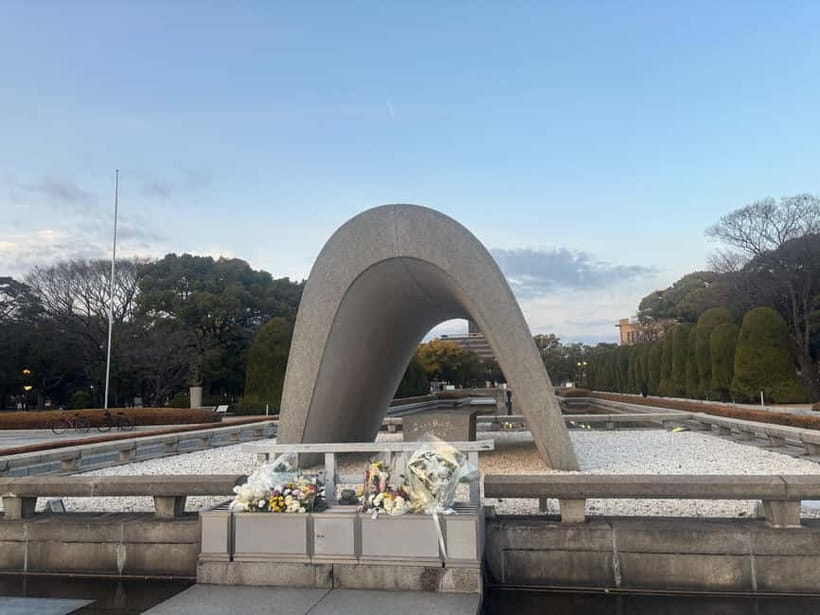
Flame of Peace and the Cenotaph for A-bomb Victims
The Flame of Peace receives about 20 minutes. It is one of the tour’s strongest symbolic stops, and the guide uses it to discuss the city’s hope for the end of nuclear weapons.
You then pay tribute at the Cenotaph for A-bomb Victims, listed among the main memorial points included in the tour. This is one of the places where the walk becomes especially quiet and personal. The guide helps you understand the purpose of the memorial rather than treating it as another item on a checklist.
I like that the tour places the Cenotaph within a wider sequence. You first learn where you are, then consider prayer, loss, remembrance, and peace. The order gives the visit a natural emotional rhythm.
Same base, a completely different sort of day:
- Hiroshima Historical Walking Tour – Why A-Bomb was Dropped
★ 4.8 · 893 reviews - Hiroshima Peace (Heiwa) Walking Tour at World Heritage Sites
★ 5.0 · 872 reviews - Hiroshima in a Nutshell: Morning Bike Adventure
★ 5.0 · 524 reviews - Hiroshima City 4hr Private Walking Tour with Licensed Guide
★ 5.0 · 437 reviews
Sadako and the Children’s Peace Monument
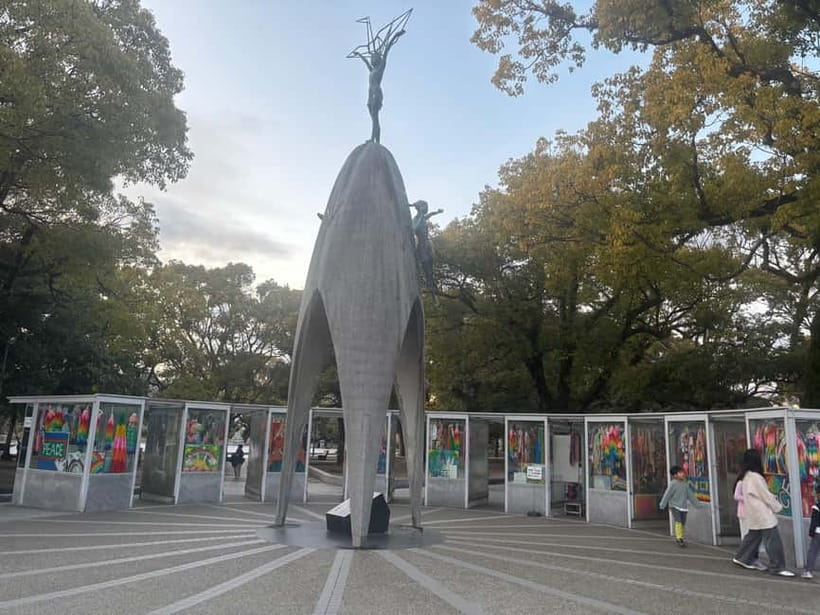
The Children’s Peace Monument has its own 10-minute stop. Here, you learn about Sadako Sasaki and the thousand paper cranes, one of Hiroshima’s best-known stories.
This monument gives the history a child’s face. It also shows how remembrance has continued beyond the people who lived through the bombing. The story of Sadako helps explain why the monument matters to school groups, families, and visitors from around the world.
You may find this stop more moving than expected because it connects a vast historical event with one young person’s life. The guide’s role is useful here: rather than presenting the cranes as a simple symbol, the tour places them within Hiroshima’s wider memory culture.
Korean Atomic Bomb Victims Cenotaph
The Korean Atomic Bomb Victims Cenotaph receives about 10 minutes and broadens the story beyond the Japanese victims usually named first.
This stop matters because the bombing affected people from different backgrounds, including Koreans who were in Hiroshima at the time. The guide gives you a fuller understanding of who was present in the city and why memorial spaces do not all tell exactly the same story.
It is also a reminder to look beyond the most photographed monuments. The park contains several layers of remembrance, and this cenotaph is easy to pass without context. I would pay close attention here and ask questions if you want to understand the memorial’s place in Hiroshima’s public memory.
The Peace Bell and a small act of participation
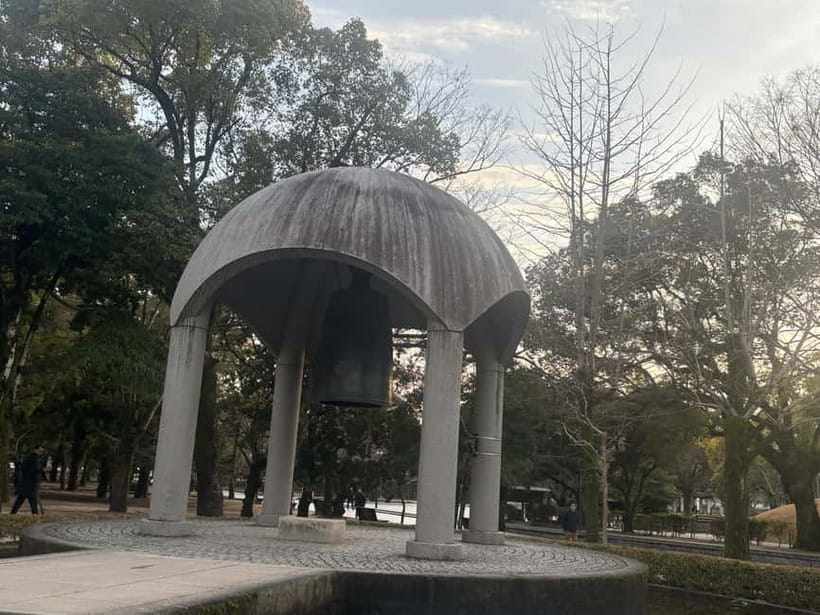
The Bell of Peace receives about 10 minutes. You are invited to ring the Peace Bell as a symbol of hope and world peace.
This is one of the few parts of the walk where you take an active role rather than simply observing. The act is brief, but it gives the tour a human touch. You are not asked to perform or make a speech. You simply take part in a peaceful tradition and then continue through the park.
Keep the tone respectful. Smoking is not allowed, and photography in memorial areas should be handled with care. The tour encourages participation, but it is not designed as a casual photo stop.
Aioi Bridge and why the target question matters
The walk continues to Aioi Bridge for about 10 minutes. This is a key location in understanding the bombing’s geography and the city’s physical layout.
The guide addresses why Hiroshima was selected as the primary target, giving you the broader military and geographic context behind that decision. The supplied details do not provide a full explanation of the reasons, so the value here is in hearing the subject explained at the site rather than trying to reconstruct it from a map later.
Aioi Bridge also helps you connect the park’s memorials with the city around them. Hiroshima is not frozen in 1945. Roads, restaurants, public spaces, and modern city life continue around the park, making the contrast between past and present impossible to miss.
The Atomic Bomb Dome, Hiroshima’s clearest symbol
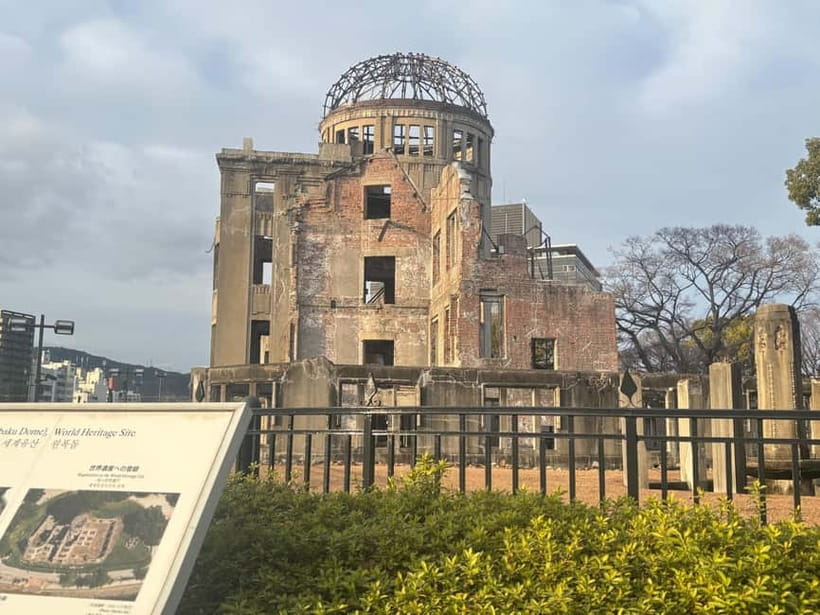
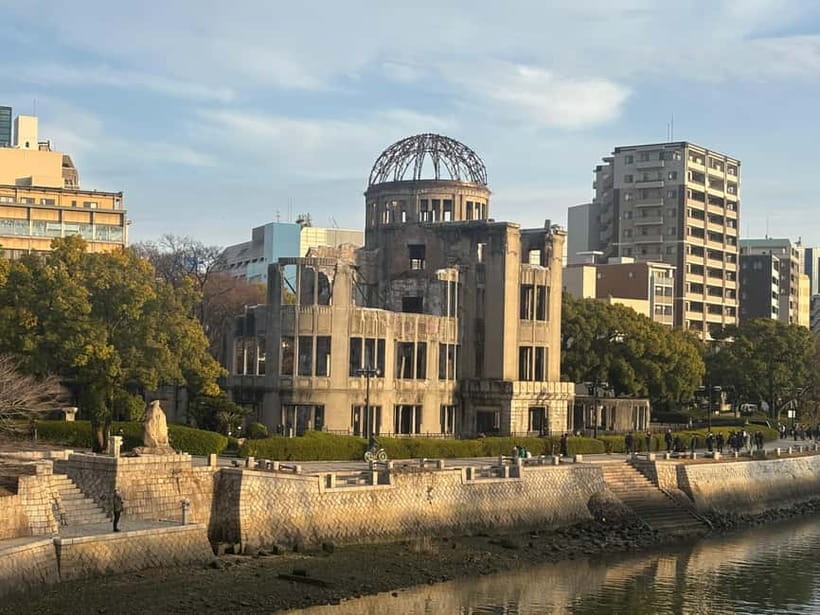
The Atomic Bomb Dome is the tour’s most recognizable stop and a UNESCO World Heritage Site. The guided portion lasts about 10 minutes, which is enough for a focused explanation but not enough for a long architectural study.
The building survived in a damaged form near the explosion’s central area, and its exposed structure became a lasting image of Hiroshima. You see why it has become the city’s best-known symbol of destruction, memory, and peace.
Do not expect to spend a long time inside the Dome. The tour is a walking introduction, and the building is viewed as part of the surrounding memorial area. You should allow extra time before or after the walk if you want to study it closely and take photographs.
The Dome can be visually striking, but the guide keeps the emphasis on what happened to the people and city around it. That balance is important. The building is famous, but it is not the whole story.
Finishing at the Atomic Bomb Hypocenter Monument
The route ends at the Hiroshima Atomic Bomb Hypocenter Monument. Ending here gives the walk a direct physical point of reference for the blast itself.
This final stop can sharpen your understanding of everything you have seen. The monuments, stories, and discussions about destruction and recovery lead back to the place marking the bombing’s central point. It is a serious finish, not a cheerful finale, so give yourself a little time afterward before rushing to your next activity.
The walk does not include hotel transportation, food, or personal expenses. You may receive a local lunch suggestion from the guide, and several guides have been especially helpful with okonomiyaki recommendations, but you will need to pay for that meal separately.
How the two-hour timing works
The advertised duration is two hours, with several stops ranging from 10 to 40 minutes. In practice, timing may depend on the group, questions, weather, and walking speed. One booking lasted about 90 minutes, and the ending felt sudden because the participant expected the full two hours.
That makes this a good first introduction, but not a substitute for a full day in Hiroshima. I would use the tour to get your bearings, then continue at the Peace Memorial Museum, National Peace Memorial Hall, or other sites at your own pace.
The route includes a significant amount of walking. Wear comfortable shoes, carry water, and bring sunscreen and a hat in warm weather. A camera is fine, but keep it secondary to the memorial setting.
The tour runs in English, Urdu, and Hindi. The guide’s ability to answer questions is one of its most useful features, especially if you want more than a prepared speech. The tone and pacing can vary by guide, so look at the named guide on your booking if that information is available.
Is $23 good value?
At $23 per person, I consider this a strong-value introduction to the Peace Memorial Park. You are paying for a live guide, a clear two-hour route, and explanations at sites that are easy to overlook. The price is modest compared with a private tour, while the content reaches well beyond the Atomic Bomb Dome photograph.
The value is greatest if you are visiting Hiroshima for the first time or have limited time in the city. You get the park’s main memorial points, personal stories, post-war reconstruction, and some local context without spending hours planning your own route.
The limitations are clear. There is no meal, hotel pickup, or drop-off. The tour does not include a long visit inside a museum, and you may need to continue exploring alone afterward. It is also not suitable for wheelchair users or people with mobility impairments.
Free cancellation up to 24 hours in advance and reserve-now, pay-later booking make it easier to fit into a changing Japan itinerary. Those policies do not change the walking demands, so book only if you can manage the route.
Who should book this Hiroshima walking tour?
I would book it if you want a human explanation of Hiroshima rather than a quick circuit of famous monuments. It suits first-time visitors, history-minded adults, older children who can handle a serious subject, and anyone who wants to understand the park before visiting its museums.
It is also useful for people who want to ask questions. The guide-led format has enough interaction for you to clarify difficult points, and the strongest guides, including Syed and Hussain, are described as warm, articulate, and engaged.
I would think twice if you dislike group walking tours, need guaranteed two-hour timing, or want extensive museum time built into the booking. I would also avoid it if you cannot walk comfortably outdoors or if poor weather would make the route difficult.
Some people prefer to visit the park alone and absorb it quietly. That can work, but you will likely miss the meaning of smaller memorials such as the Korean Victims Cenotaph, Prayer Fountain, or Dr. Marcel Junod and Norman Cousins memorials. The tour’s real value is the explanation between the headline stops.
My verdict: a worthwhile first step in Hiroshima
I recommend this tour for the way it connects places, people, and Hiroshima’s recovery. The Atomic Bomb Dome is the visual anchor, but the Children’s Peace Monument, Korean Victims Cenotaph, Peace Bell, and Hypocenter Monument give the walk its substance.
Book it early in your Hiroshima stay if you can. Then use what you learn to decide how much more time you want at the museum and memorial halls. Bring water, wear good shoes, check the start time, and leave room afterward for a quiet meal, perhaps okonomiyaki if your guide points you in the right direction.
For $23, this is an affordable and thoughtful way to begin understanding Hiroshima. Just come prepared for walking, serious subject matter, and a schedule that may finish a little earlier or later than expected.
FAQ
How long is the Hiroshima Peace Memorial Park tour?
The advertised duration is two hours. The route includes guided stops at the Gates of Peace, Prayer Fountain, Peace Memorial Park, Flame of Peace, Children’s Peace Monument, Korean Atomic Bomb Victims Cenotaph, Peace Bell, Aioi Bridge, Atomic Bomb Dome, and Hypocenter Monument.
How much does the tour cost?
The price is $23 per person.
Where does the tour meet?
The meeting point is at the Gates of Peace, on the front side of the Italian restaurant Mario.
Where does the tour finish?
The tour finishes at the Hiroshima Atomic Bomb Hypocenter Monument.
Which languages are available?
Live guided tours are available in English, Urdu, and Hindi.
Is food included?
No. Food is not served during the tour, and personal expenses are not included.
Do I need comfortable shoes?
Yes. The tour involves a significant amount of walking, so comfortable shoes and water are recommended. A hat and sunscreen are also useful.
Can I take photographs?
Yes, photography is allowed. You should be respectful when photographing memorial areas.
Is the tour suitable for wheelchair users?
No. The tour is not suitable for wheelchair users or people with mobility impairments.
Just added around Hiroshima
- The Peace Memorial to Miyajima : Icons of Peace and Beauty★ 4.5 · 31 reviews
- Shore Excursion from Hiroshima Port : Private Tour in Hiroshima★ 5.0 · 17 reviews
- Hiroshima Saijo Sake Tasting Tour with visit to 7 Breweries★ 5.0 · 104 reviews
- Hiroshima & Miyajima All-Inclusive Tour w/Licensed guide Pancho★ 5.0 · 54 reviews
- Hiroshima Country Cycling: Explore Rural Life 1 HR from City★ 5.0 · 22 reviews
- Okunoshima Rabbit Island Cycling Tour with Local Guide★ 4.5 · 17 reviews
- Private Full Day Hiroshima Tour★ 4.5 · 29 reviews
- Hiroshima Private Tour with a Local – Highlights & Hidden Gems★ 4.5 · 24 reviews
Hiroshima Tours, compared.

Peaceful Hiroshima & Miyajima UNESCO 1 Day Bus Tour
Read our review →
Hiroshima and Miyajima UNESCO Sites 1-Day Tour
Read our review →
Hiroshima Historical Walking Tour – Why A-Bomb was Dropped
Read our review →
Hiroshima Peace (Heiwa) Walking Tour at World Heritage Sites
Read our review →
Hiroshima in a Nutshell: Morning Bike Adventure
Read our review →
Hiroshima City 4hr Private Walking Tour with Licensed Guide
Read our review →

Japanesel Archery Experience HIROSHIMA CASTLE SHARAKU
Read our review →Browse the lists this tour appears in