
Reviewed · HIROSHIMA TOURS
Hiroshima Walking Tour Why A Bomb was dropped to Hiroshima
Hiroshima’s story is best understood on foot, where a quiet shrine, castle grounds, sports arena, and memorial park connect the city’s past with its life today. This 2.5-hour walking tour explains the events leading to August 6, 1945, the bombing’s effects, and Hiroshima’s continuing work for peace.
I like the small-group format, which is advertised for no more than 12 people, though the additional information allows up to 15. I also like the guides’ use of maps, photographs, and personal family connections, including one guide whose grandfather was a bomb survivor. The main consideration is that some time goes to broader Japanese history, so anyone wanting only detailed atomic-bomb history may prefer to spend extra time at the museum afterward.
Key points to know before you book
- The route links Hiroshima Castle with the Peace Memorial Park, giving you both the city’s older political history and its wartime memory.
- The Atomic Bomb Dome, Children’s Peace Monument, and Victims Memorial Cenotaph form the emotional center of the walk.
- Guides including Chihiro, Thomas, Katya, Emi, and Chisa are praised for clear English, thoughtful explanations, and a personal touch.
- Maps and old photographs help you picture Hiroshima before and after the bombing.
- The walk is mostly flat, with several places to pause, listen, take photographs, and ask questions.
- The Peace Memorial Museum is the finishing point, so you can continue your visit there after the guide says goodbye.
Why this Hiroshima walk matters
Hiroshima can be confusing on a first visit. The city is easy to get around, but its important sites are spread across a setting that looks calm and ordinary today. Without context, you may see a shrine, a castle, a sports center, and a memorial park without understanding how they fit together.
This experience gives those places a shared thread. It begins with Hiroshima’s earlier identity, moves through the wartime period and the decision to use the atomic bomb, then ends with the city’s memorial work and call for peace.
The emphasis is not only on destruction. Guides explain Hiroshima before 1945, the factors that led to the bombing, its immediate and lasting effects, and the city’s direction after the war. That broader frame matters. You are not simply looking at ruins. You are learning how a city remembers, rebuilds, and speaks to future generations.
I especially like that the walk includes time for questions. Guides such as Thomas have been praised for making difficult material clear even for families with children. One guide used knowledge of Pokémon to keep younger members of a family engaged, a small detail that shows how a serious subject can still be handled with warmth.
More walking tours in Hiroshima:
- Hiroshima Historical Walking Tour – Why A-Bomb was Dropped
★ 4.8 · 893 reviews - Hiroshima Peace (Heiwa) Walking Tour at World Heritage Sites
★ 5.0 · 872 reviews - Hiroshima City 4hr Private Walking Tour with Licensed Guide
★ 5.0 · 437 reviews
Starting at Hiroshima Gokoku Shrine
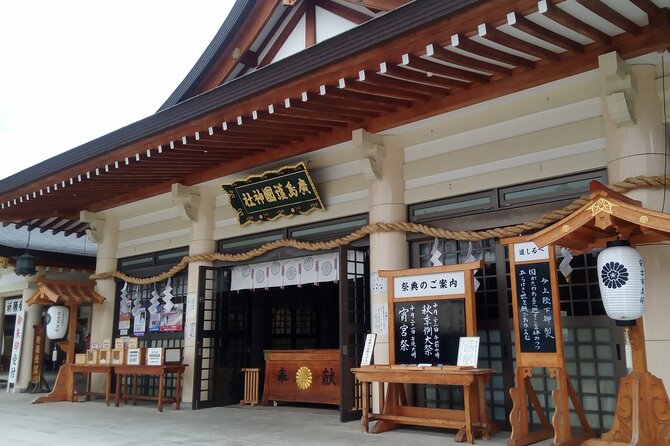
The meeting point is Hiroshima Gokoku Shrine, at 21-2 Motomachi in Naka Ward. The shrine offers a calm opening to a subject that soon becomes much heavier.
You begin by looking at the shrine’s architecture and grounds. It was originally established to honor protective deities connected with Hiroshima domain, so it introduces the city’s older religious and political setting before the tour turns toward the twentieth century.
This is a sensible first stop. Hiroshima is not defined only by the atomic bomb, and the shrine helps establish that point from the start. Your guide can place the modern city within a longer story of local authority, tradition, and change.
The first scheduled visit lasts about 20 minutes, and admission is free. Arrive ready to walk rather than expecting a formal indoor presentation. The route uses public spaces, and the guide’s explanation is the main source of interpretation.
Hiroshima Castle and the city before 1945
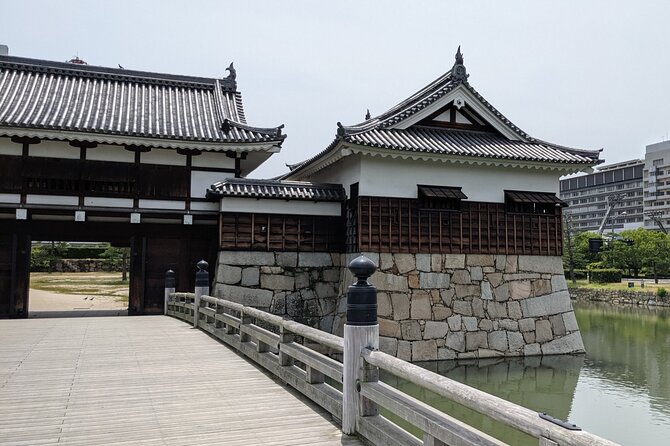
Hiroshima Castle is also called Carp Castle. First built in the 1590s, it served as the home of the feudal lord of Hiroshima domain. The castle grounds give you a useful look at Hiroshima’s premodern identity and the role the city played before the events of World War II.
The tour allows about 20 minutes here. Based on the information provided, you visit the grounds rather than taking an interior tour of the castle. That distinction is important if you are hoping to explore the castle museum or climb its main keep. This walk is concerned with setting and explanation, not a full castle visit.
The stop works well because the route does not treat Hiroshima as a place that began on August 6, 1945. You first see a symbol of the city’s older power structure, then hear how Hiroshima developed into a modern military and industrial center. Your guide’s maps and photographs can make that change easier to follow.
If castle interiors are high on your list, plan separate time for them. The tour’s short stop is enough for orientation and photographs, but not for a detailed visit.
A pause near Hiroshima Green Arena
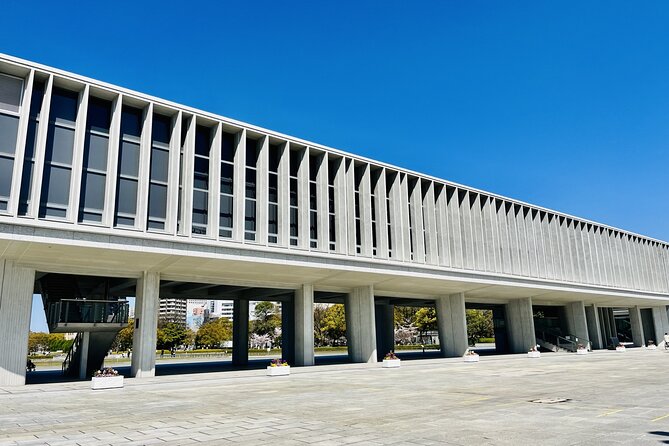
Hiroshima Green Arena, officially Hiroshima Prefectural Sports Center, is a multipurpose indoor venue used for sporting events and other activities. At first, this may seem like an odd stop on a memorial walk.
That is part of its value. Hiroshima is not an open-air museum frozen in 1945. People use its streets and public buildings for ordinary life, including sport and entertainment. The arena gives the guide a place to talk about present-day Hiroshima and the contrast between the city now and the city before and after the bombing.
This portion lasts about 30 minutes, making it one of the longer scheduled stops. The guide may use the time for a seated explanation, since the walk includes two roughly 10-minute history talks according to the details provided by the operator’s customers. You can expect a clearer account of Japan’s development, the road to World War II, the reasons given for dropping the bomb, and the aftermath.
This is also where the tour’s balance becomes clear. It is not a narrow military-history lecture. Some people will appreciate the wider Japanese context. If you already know the broader history and want every minute focused on Hiroshima’s atomic-bomb experience, this section may feel less targeted.
A few more Hiroshima half-days to weigh up
- Peaceful Hiroshima & Miyajima UNESCO 1 Day Bus Tour
★ 5.0 · 5,309 reviews - Hiroshima: Hiroshima and Miyajima UNESCO Sites 1-Day Tour
★ 4.9 · 2,330 reviews - Hiroshima / Miyajima Full-day Private Tour with Government Licensed Guide
★ 5.0 · 1,298 reviews - Hiroshima in a Nutshell: Morning Bike Adventure
★ 5.0 · 524 reviews
Orizuru Tower and the modern memorial district
Orizuru Tower is a newer building beside Hiroshima Peace Memorial Park. Opened in 2016, it has 13 stories and a distinctive design.
The supplied schedule names Orizuru Tower but does not give a separate duration or state that admission is included. Treat it as a viewpoint or orientation stop from the outside unless your guide explains otherwise. The tour includes all listed fees and taxes, but it does not specifically promise entry to the tower.
Its location helps you understand how the memorial district fits into the city around it. You are moving from ordinary modern buildings toward the area where the bombing’s physical and human story becomes most direct.
The Atomic Bomb Dome: the central visual moment
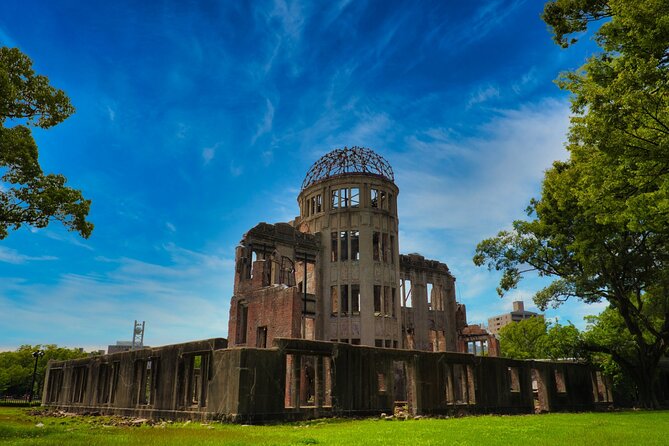
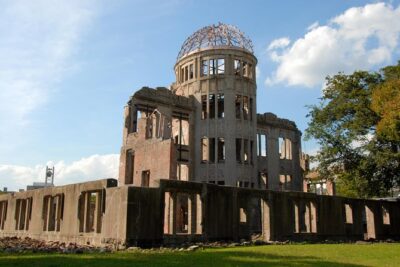
The Atomic Bomb Dome is the tour’s most recognizable site. Before the bombing, it was the Hiroshima Prefectural Industrial Promotion Hall. Its position near the blast’s epicenter left part of the structure standing, and the remaining shell became a lasting reminder of nuclear destruction.
The scheduled visit lasts about 20 minutes. That may sound short, but the Dome does not need a long lecture to make an impression. The important thing is having a guide explain what the building was, why it survived in its damaged form, and how it came to serve as a memorial.
This is one of the places where photographs and maps are especially useful. Your guide may show you images of the area before and after the bombing, helping you understand that the Dome was once part of a working city rather than a purpose-built monument.
Give yourself time to look carefully. The structure is powerful from a distance, but details matter: exposed framework, broken walls, and the relationship between the ruins and the surrounding park. Your guide should also leave room for questions and quiet reflection. This is not a spot for a rushed group photograph and a quick departure.
The Children’s Peace Monument and Sadako’s story
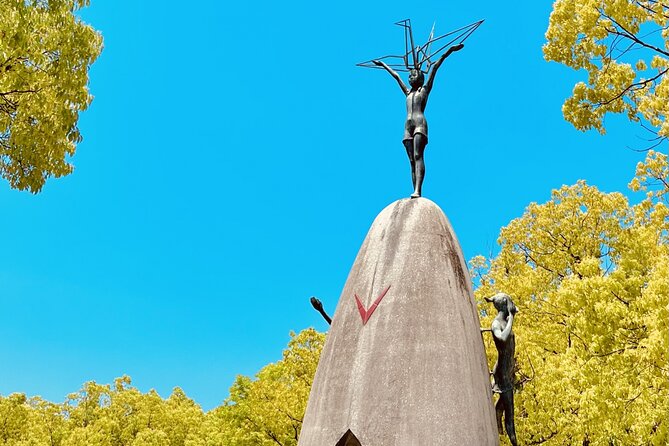
The Children’s Peace Monument is in Peace Memorial Park and commemorates Sadako Sasaki along with the many children who died in the atomic bombing.
The stop is planned for about 10 minutes. It is brief, but the subject gives the memorial park a human scale. Instead of discussing only buildings, military decisions, and casualty figures, the guide brings attention to children and the long effect of radiation and illness.
Sadako’s story has become closely tied to paper cranes and the international wish for peace. The information provided identifies the monument as being inspired by her and dedicated to child victims. Your guide can explain the meaning of the site and connect it to Hiroshima’s wider message for future generations.
This is a good place to slow down. The stop is short on paper, but you may want a little extra time afterward if the subject affects you strongly.
The Victims Memorial Cenotaph and Peace Park
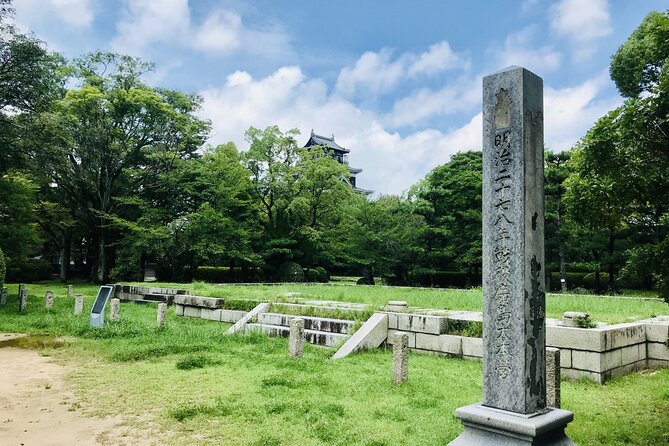
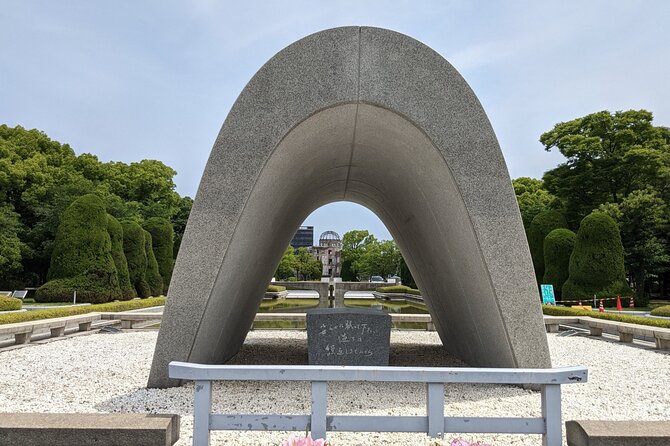
The Hiroshima Victims Memorial Cenotaph is in Hiroshima Peace Memorial Park, near the center of the memorial area and close to the bombing’s epicenter. The park is dedicated to those who died in the atomic bombing on August 6, 1945.
The scheduled time here is about 30 minutes, the longest stop in the memorial district. This gives your guide room to explain the purpose of the cenotaph, the layout of the park, and Hiroshima’s focus on remembering victims rather than glorifying war.
The sequence matters. After the Atomic Bomb Dome, you see a building damaged by the blast. At the Children’s Peace Monument, you consider individual lives and young victims. At the cenotaph, the story widens again to include the many people remembered by the park.
The walk ends in front of the Peace Memorial Museum at 1-2 Nakajimacho. Museum admission is not specifically included in the tour details, so check the current entry arrangements if you want to go inside immediately. Finishing here is practical: the guide gives you a framework, and the museum can supply objects, testimony, photographs, and further detail.
How the guides handle a difficult subject
The strongest part of this experience is the guide’s role. Names connected with particularly positive feedback include Chihiro, Thomas, Katya, Emi, and Chisa. The exact guide depends on the departure, but you can expect a local guide who explains the subject in English and takes questions.
Thomas is described as clear, amusing, sympathetic, and well prepared. Chihiro is praised for combining local knowledge with a personal element, including family information. Katya has been singled out for making a cold January walk enjoyable while explaining Hiroshima before and after 1945. Emi is noted for enthusiasm and for explaining the history in a way that made the route easy to follow.
Those details point to an important strength: the tour does not rely only on memorized dates. Guides use maps, photographs, personal stories, and plain explanations. One guide was identified as the granddaughter of a bomb survivor, while another shared family information that made the subject more immediate.
The tone also seems flexible. The material is tragic, but the best guides make space for a little humor without making light of the bombing. That balance is useful, especially for families and for anyone who finds war history difficult to process for two and a half hours.
Guide quality can vary from one departure to another. One piece of feedback found the tour average because it spent too much time on general Japanese history and lacked the depth suggested by the title. Another noted that the guide could have moved faster and made decisions more firmly. Those are fair cautions, particularly if your main goal is a detailed explanation of the bombing itself.
Walking pace, group size, and comfort
The tour lasts approximately two hours and 30 minutes. The route is described as mostly flat, and the main sites are close enough that there is not a great deal of strenuous walking.
You should still wear comfortable shoes. The experience moves between several outdoor locations, and your attention will be divided between walking, standing, listening, and taking photographs. Bring water, since bottled water is not included. Weather matters too. One guide made a cold January outing pleasant, but winter conditions can still affect your comfort.
The advertised group maximum is 12 people, while the additional information permits up to 15. That small discrepancy is worth noting. Even at 15, the group is likely to feel more manageable than a large coach tour, but you should not assume the smaller number is guaranteed.
A small group makes it easier to ask about sensitive subjects and hear explanations at outdoor sites. It also means the walking pace may depend on the whole party. One comment praised the relaxed pace, while another wanted quicker movement. If you prefer a brisk, tightly timed walk, tell the guide early.
The tour is near public transportation, and service animals are allowed. Most people can participate. No special fitness level is stated, but you should be comfortable walking and standing for the duration.
Is $28 a fair price?
At $28 per person, this is a modestly priced way to get an organized introduction to Hiroshima. The cost includes all listed fees and taxes, and the route covers several major sites without requiring you to plan the order yourself.
The real value is the interpretation. You can reach the Atomic Bomb Dome, Peace Park, castle grounds, and shrine independently, but you may not connect them as quickly or understand what you are seeing at each stop. A guide also gives you a chance to ask about the bombing, Japanese history, family memories, and the city’s peace message in real time.
The price does not include bottled water. It also does not clearly promise interior admission to Hiroshima Castle, Orizuru Tower, or the Peace Memorial Museum. Think of the experience as a guided introduction to the city and memorial district, not a package covering every attraction.
For the best value, schedule the walk early in your Hiroshima stay. You will finish with the museum in front of you and a better sense of what deserves more of your time. If you already have strong background knowledge and plan to follow a detailed self-guided route, the benefit may be smaller.
Who should book this walk?
I would choose this tour for a first visit to Hiroshima, especially if you want historical context before entering the Peace Memorial Museum. It suits solo visitors, couples, and families who prefer conversation over a recorded audio guide.
It is also a good fit if you want a gentle introduction rather than an intense specialist lecture. The walk covers the main memorial locations, offers photographs and maps, and leaves room for questions.
Families should consider it seriously. The route is mostly flat, the guides have kept children interested, and the mix of stories, visual aids, and city sights can work better for young minds than a long museum visit alone.
I would be more cautious if you want a tightly focused study of the military decision to use the bomb. The tour includes wider Japanese history and the city’s earlier development, and one person found that emphasis too general. In that case, use the walk as a foundation, then allow extra time at the Peace Memorial Museum and other memorial sites.
Free cancellation is available when you cancel at least 24 hours before the start time. Changes or cancellations inside that window are not accepted for a refund, and the cut-off follows Hiroshima local time.
Should you book it?
Book this walk if you want the main Hiroshima memorial sites explained in a human, clear way, rather than simply checking them off a map. The combination of Hiroshima Gokoku Shrine, castle grounds, the Atomic Bomb Dome, the Children’s Peace Monument, the cenotaph, and the museum entrance gives you a sensible two-and-a-half-hour introduction.
I particularly value the local perspective and the guides’ use of family stories, maps, and photographs. Just keep your expectations in line: the castle interior and museum visit are not the focus, and the guide may spend part of the walk on wider Japanese history.
At $28, the tour is worth booking for most first-time visitors. Plan to carry water, wear good shoes, and leave time afterward for the Peace Memorial Museum. That combination gives you both the human explanation and the fuller evidence needed to understand Hiroshima.
FAQ
Where does the Hiroshima walking tour begin?
The tour begins at Hiroshima Gokoku Shrine, 21-2 Motomachi, Naka Ward, Hiroshima, 730-0011, Japan.
Where does the tour finish?
It ends in front of the Peace Memorial Museum at 1-2 Nakajimacho, Naka Ward, Hiroshima, 730-0811, Japan.
How long does the tour last?
The walking tour lasts approximately two hours and 30 minutes.
What is the price?
The listed price is $28 per person.
What sites are visited?
The route includes Hiroshima Gokoku Shrine, Hiroshima Castle, Hiroshima Green Arena, Orizuru Tower, the Atomic Bomb Dome, the Children’s Peace Monument, and the Hiroshima Victims Memorial Cenotaph in Peace Memorial Park.
Is admission included?
All listed fees and taxes are included. The information does not specifically confirm interior admission to Hiroshima Castle, Orizuru Tower, or the Peace Memorial Museum.
Is bottled water provided?
No. Bottled water is not included, so bring your own.
How large is the group?
The tour is described as a small-group experience with a maximum of 12 guests. The additional information lists a maximum of 15 travelers, so the exact group size may vary.
Is the route physically demanding?
The walk is described as mostly flat, with the main sites close together. Most people can participate, but you should be comfortable walking and standing for about two and a half hours.
Can I cancel for a refund?
Yes. You can cancel at least 24 hours before the start time for a full refund. Cancellations and changes made less than 24 hours before the start time are not accepted for a refund.
Just added around Hiroshima
- The Peace Memorial to Miyajima : Icons of Peace and Beauty★ 4.5 · 31 reviews
- Shore Excursion from Hiroshima Port : Private Tour in Hiroshima★ 5.0 · 17 reviews
- Hiroshima Saijo Sake Tasting Tour with visit to 7 Breweries★ 5.0 · 104 reviews
- Hiroshima & Miyajima All-Inclusive Tour w/Licensed guide Pancho★ 5.0 · 54 reviews
- Hiroshima Country Cycling: Explore Rural Life 1 HR from City★ 5.0 · 22 reviews
- Okunoshima Rabbit Island Cycling Tour with Local Guide★ 4.5 · 17 reviews
- Private Full Day Hiroshima Tour★ 4.5 · 29 reviews
- Hiroshima Private Tour with a Local – Highlights & Hidden Gems★ 4.5 · 24 reviews
Hiroshima Tours, compared.
Peaceful Hiroshima & Miyajima UNESCO 1 Day Bus Tour
Read our review →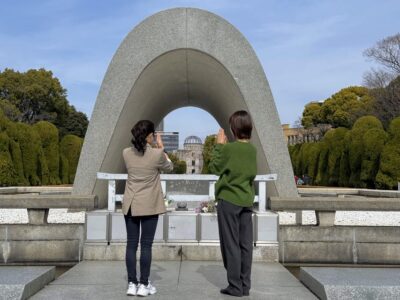
Hiroshima and Miyajima UNESCO Sites 1-Day Tour
Read our review →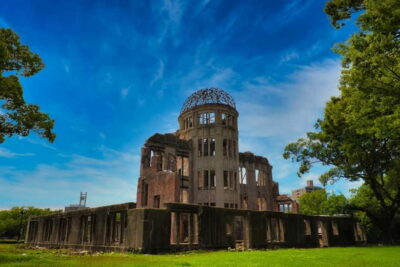
Hiroshima Historical Walking Tour – Why A-Bomb was Dropped
Read our review →
Hiroshima Peace (Heiwa) Walking Tour at World Heritage Sites
Read our review →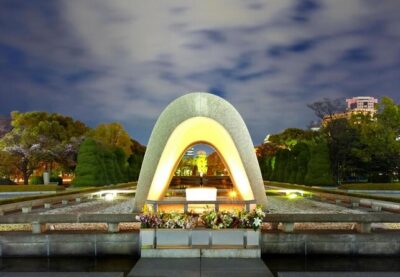
Hiroshima in a Nutshell: Morning Bike Adventure
Read our review →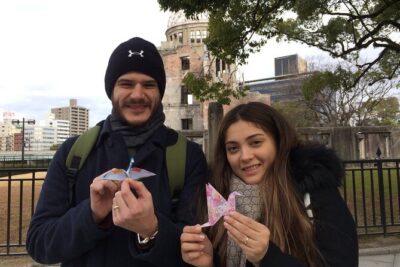
Hiroshima City 4hr Private Walking Tour with Licensed Guide
Read our review →

Japanesel Archery Experience HIROSHIMA CASTLE SHARAKU
Read our review →Browse the lists this tour appears in