
Reviewed · HIROSHIMA TOURS
Miyajima Guided Tour and Fresh Oyster Farm Tour
Miyajima’s best-known sight is the Great Torii, but this tour adds something most shrine visits lack: a look at Hiroshima’s working oyster waters and a hands-on lunch at Shimada Suisan. You begin with Itsukushima Shrine, then leave the usual sightseeing route by boat for an oyster farm and a meal you help cook yourself.
I like two things in particular. First, the English-speaking guide puts Japanese worship customs into plain language, which makes the shrine more meaningful than a quick photo stop. Second, the small group, capped at eight people, allows the cruise and oyster lunch to feel personal. The main consideration is time: four and a half hours gives you a focused Miyajima visit, not a full day for Mount Misen, temples, and every lane on the island.
Key points to know before booking
- See the Great Torii from the sea: The charter boat offers a close water-level view that you cannot get from the shrine grounds.
- Pair culture with local food: Itsukushima Shrine and a fresh oyster lunch make this more varied than a standard sightseeing walk.
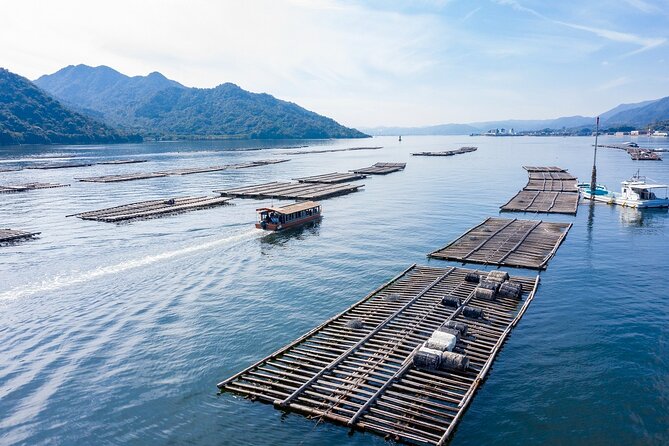
- Learn how oysters are raised: The cruise includes commentary from local oyster producers and views of Hiroshima’s oyster rafts.
- Expect a small group: The maximum is eight people, with an English-speaking guide.
- Plan around the 9 a.m. start: You meet at Miyajimaguchi, and the tour returns there after about four and a half hours.
Why this Miyajima tour feels different
Miyajima is easy to visit on your own. You can take the ferry, walk to Itsukushima Shrine, wander through Omotesando Shopping Street, and eat oysters without booking a tour. The value here comes from connecting those familiar sights to the island’s coastal life.
The day moves from religious tradition to seafood production. At the shrine, you learn how people approach and use a sacred place. On the boat, you see the Great Torii from a new angle and hear about oyster cultivation from people connected to the industry. At lunch, you handle the food yourself by grilling oysters at Shimada Suisan.
That mix suits you if you want more than a checklist of Miyajima sights. It also works well if you are visiting solo. Solo bookings are accepted, and the small maximum group size should make it easier to ask questions and keep track of the guide.
The format is also practical for a short Hiroshima stay. Starting at 9 a.m. and finishing back at Miyajimaguchi around early afternoon leaves the rest of your day open. Still, the schedule is fairly tight. If you want a long stop for deer photographs, a climb toward Mount Misen, or a slow temple visit, you will need extra time before or after the tour.
More farm visits around Hiroshima:
- Wasabi Farm Walking Tour & Lunch
★ 4.5 · 20 reviews
Beginning at Miyajimaguchi
The meeting point is at 1 Chome-11 Miyajimaguchi in Hatsukaichi, Hiroshima. This is the mainland gateway for Miyajima, rather than a meeting point on the island itself. You should allow enough time to arrive before the 9 a.m. departure, since the group uses scheduled transport and a planned sequence of boat transfers.
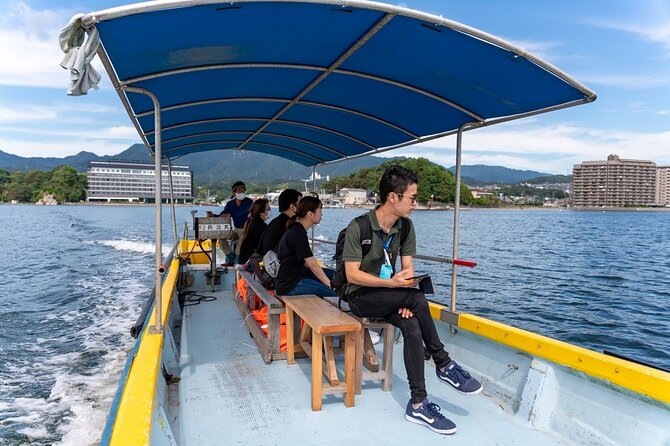
The package includes the Miyajimaguchi to Miyajima ferry fare, private transportation connected with the tour, and a charter boat from Miyajima to Shimada Suisan. That matters because you are not left to work out each transfer while watching the clock.
The tour returns to the same meeting point. This makes it easier to continue toward Hiroshima afterward, although the supplied details do not specify the exact finishing time beyond the approximate four-and-a-half-hour duration. Bring only what you need for the morning. You receive one bottle of mineral water, and personal purchases are your responsibility.
Itsukushima Shrine and the meaning behind the torii
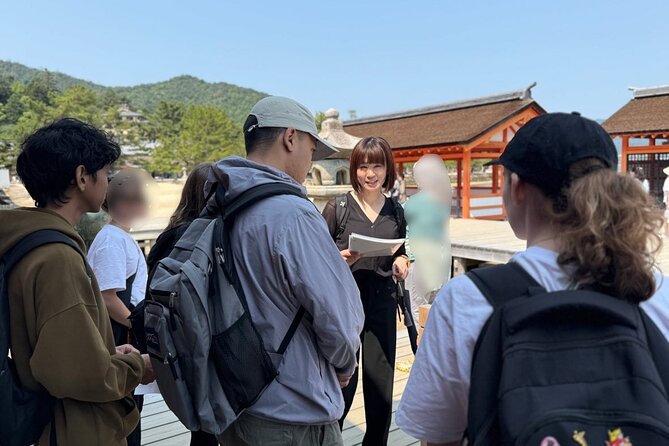
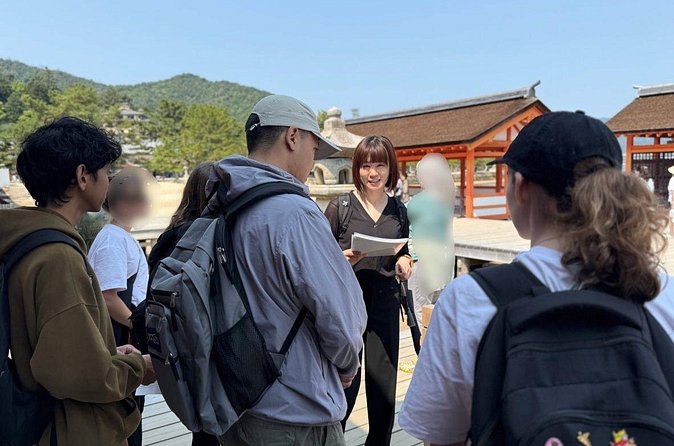
The first major stop is Itsukushima Shrine, a UNESCO World Heritage Site. Admission is included, as is the Miyajima tourism tax. You spend about an hour here with an English-speaking guide.
The useful part is not simply entering the shrine. The guide explains Japanese worship customs and traditions, giving you a better sense of how to behave and what you are seeing. Several tour accounts single out guides such as Takeshi-san for clear explanations of the shrine, torii, temples, and island stories.
That guidance can change the way you look at the buildings. Without context, a shrine visit can become a sequence of colorful gates, prayer spaces, and photographs. With a guide, you can ask why certain actions matter and how the site fits into Japanese religious practice.
The Great Torii of Itsukushima Shrine is the island’s famous symbol, and its position in the water is central to the experience. The exact view can vary with weather and conditions, but the later cruise gives you a particularly useful second look from offshore.
One hour is enough for a guided introduction, but not for every corner of the shrine area. If you have already visited Miyajima and want a long, quiet return to the shrine, the group schedule may feel brisk. If this is your first visit, the pace is a fair trade for having the guide explain the setting before you explore independently.
One hour on Omotesando Shopping Street
After the shrine, you get about an hour of free time on Miyajima Omotesando Shopping Street. This is your chance to sample food, browse souvenirs, and choose how you want to spend a short unstructured break.
The stop adds flexibility to an otherwise guided morning. You can look for local treats, shop for gifts, or simply walk through the district without needing to stay beside the guide. Since lunch comes later at the oyster farm, you may want to sample lightly rather than fill up here.
The limitation is the one-hour window. Omotesando can easily absorb more time if you shop carefully or stop for several foods. You also will not have time during this tour to combine the shopping street with a long independent walk across the island. Think of this as a useful preview, not a complete Miyajima visit.
That is one reason the tour works best as part of a broader Hiroshima plan. You get the major shrine, a taste of the shopping district, and the oyster farm experience. You do not get a full island day.
A few more Hiroshima half-days to weigh up
- Peaceful Hiroshima & Miyajima UNESCO 1 Day Bus Tour
★ 5.0 · 5,309 reviews - Hiroshima: Hiroshima and Miyajima UNESCO Sites 1-Day Tour
★ 4.9 · 2,330 reviews - Hiroshima / Miyajima Full-day Private Tour with Government Licensed Guide
★ 5.0 · 1,298 reviews - Hiroshima Historical Walking Tour – Why A-Bomb was Dropped
★ 4.8 · 893 reviews
Cruising toward the Great Torii and oyster rafts
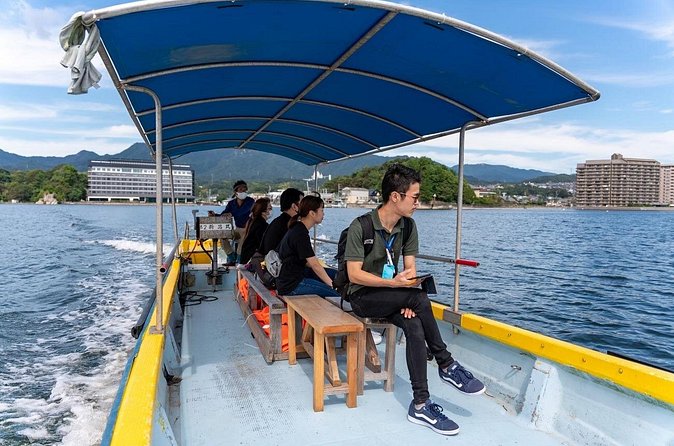
The most unusual part begins when you take a charter boat from Miyajima to Shimada Suisan. The cruise offers close views of the Great Torii from the sea, a perspective that changes the scale and setting of the landmark.
From shore, the torii reads as a dramatic entrance to the shrine. From the boat, you see its relationship to the water and understand why the view is so closely tied to Miyajima’s identity. The cruise also gives you a more direct look at the waters around the island.
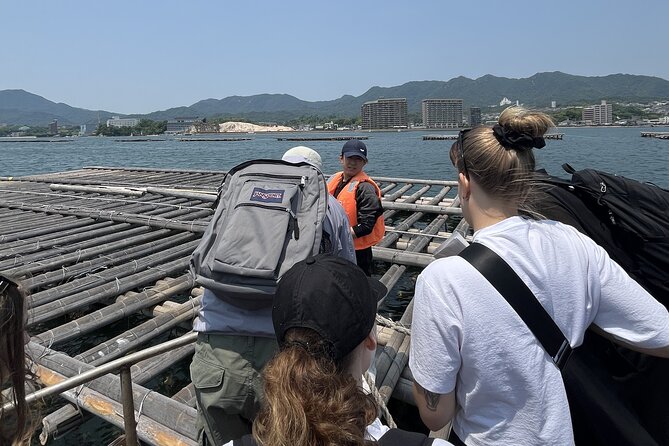
The boat portion is not just sightseeing. You hear commentary from local oyster producers about Hiroshima’s oyster rafts and the area’s role as Japan’s top oyster-producing region. That local voice gives the ride a clear purpose. You are not simply passing scenery. You are learning how an important regional food is raised.
The full Shimada Suisan portion lasts about two hours and includes the cruise, oyster-farm context, and lunch. Weather matters here. The tour requires good conditions, and poor weather can lead to a different date or a full refund. You should also expect the boat experience to be more exposed to the day’s conditions than the shrine visit.
Grilling oysters at Shimada Suisan
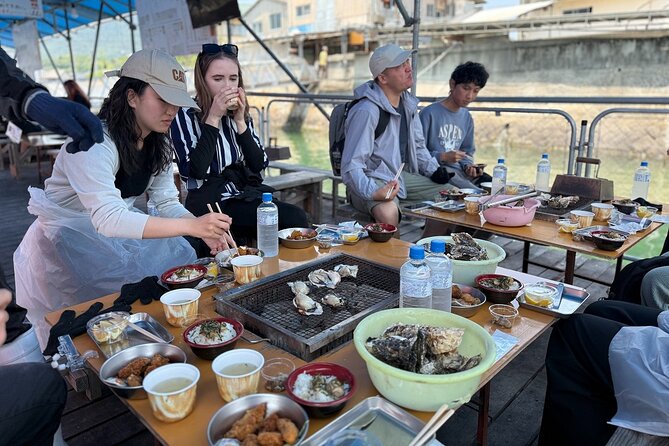
The meal is the tour’s most hands-on feature. At Shimada Suisan, you enjoy an oyster feast and grill your own oysters. This is a better way to understand the food than simply ordering a plate in a restaurant, because the meal follows the farm visit and connects directly to what you saw on the water.
The activity is especially appealing if you like regional food with a sense of place. Hiroshima is known for oyster production, and the tour lets you see the rafts, hear from producers, and then eat the result. It is a simple sequence, but an effective one.
Lunch is included in the $97.55 price. Beverages are not included apart from the supplied mineral water, so plan for that extra cost. You can also add a bottle of white wine from Hiroshima Miyoshi Winery for 8,000 yen. The wine was served to world leaders at the G7 Hiroshima Summit, making it an optional local pairing with a clear regional connection, though the price is high compared with the tour itself.
If you do not eat oysters, this is not the right outing. The meal is not a minor add-on. It is one of the central reasons to book. The supplied information does not specify alternatives for dietary restrictions, so you should confirm those directly before reserving.
What the $97.55 price covers
At $97.55 per person, the price is easiest to judge by looking at what you would otherwise have to arrange. It includes lunch, the ferry between Miyajimaguchi and Miyajima, the charter boat to Shimada Suisan, shrine admission, the tourism tax, and one bottle of water.
You also pay for the guide’s explanations and for a coordinated small-group outing. On your own, the shrine and shopping street are straightforward. The charter boat, oyster-farm visit, producer commentary, and grilling lunch are the parts that make this more than a standard Miyajima day.
The price is reasonable if you value organized transport and a distinctive meal. It is less attractive if your main goal is only to see Itsukushima Shrine, since that can be done independently for less. You should also budget for personal purchases and lunch drinks. Alcohol is not included, and the optional wine costs 8,000 yen.
A maximum of eight people helps protect the value. This is not a large coach outing where you wait for a crowd at each stop. The group still follows a fixed schedule, but the small size should make the guide’s explanations and boat transfer easier to manage.
The guide and the pace
The strongest human element is the guide. Takeshi-san is specifically associated with clear explanations, a warm manner, and useful stories about Miyajima’s shrines and temples. The operator is Discover Chugoku Shikoku, also known as DiCS, and the tour is conducted in English.
You should expect cultural interpretation rather than a lecture packed with dates. The emphasis is on understanding what you are looking at and how Japanese worship traditions work. That approach is useful if you have questions or if shrine customs are unfamiliar.
The 4.5-hour length keeps the experience manageable, but it also means you need to stay aware of the schedule. The shrine receives about an hour, the shopping street about an hour, and the cruise and oyster-farm stop about two hours. The remaining time covers movement between the stops.
The tour suits most people, and service animals are allowed. It is near public transportation, and the supplied details say most participants can take part. Specific information about steps, boat boarding, or accessibility equipment is not provided, so contact the operator if you have mobility concerns.
Who should book this experience
I would choose this tour if you want Miyajima in a compact format and care about food as much as monuments. It is a strong fit for first-time visitors who want the shrine explained, solo visitors who prefer company, and repeat visitors looking for something beyond the usual shopping street and torii photographs.
It also suits families and friends who enjoy a shared meal and a simple activity. Grilling oysters gives the day a clear focus, and the small group should make the outing easier to follow.
I would be more cautious if you are vegetarian, allergic to shellfish, or uninterested in oysters. I would also hesitate if your priority is Mount Misen, extensive hiking, or several hours of independent exploration. This tour uses its time for the shrine, coastal views, and oyster production instead.
Book only after checking the meeting point and start time carefully. Cancellation is free up to 24 hours before the experience, but changes or cancellations inside that window are not accepted for a refund. Poor weather can cause the operator to offer another date or a full refund.
Should you book the Miyajima oyster farm tour?
Book it if you want a cultural introduction and a local food experience in one morning. The shrine visit alone is easy to arrange, but the boat access to the Great Torii, view of oyster rafts, producer commentary, and hands-on lunch are harder to reproduce independently.
Skip it if you want a loose, unplanned island day or if oysters are not for you. For everyone else, $97.55 buys a well-connected half-day with transport, admission, lunch, and a small group. It gives you both the Miyajima people photograph and the working coastal world that helps explain Hiroshima’s food culture.
FAQ
Where does the tour start?
The tour starts at Miyagimaguchi 1 Chome-11, Miyajimaguchi, Hatsukaichi, Hiroshima 739-0411, Japan.
What time does the tour begin?
The scheduled start time is 9:00 a.m.
How long does the experience last?
The tour lasts approximately four hours and 30 minutes.
Where does the tour finish?
The activity ends back at the meeting point in Miyagimaguchi.
Is ferry transportation included?
Yes. The Miyajimaguchi to Miyajima ferry fare is included.
Is the charter boat included?
Yes. The charter boat from Miyajima to Shimada Suisan is included.
Is admission to Itsukushima Shrine included?
Yes. The Itsukushima Shrine admission fee is included.
Is lunch included?
Yes. Lunch at Shimada Suisan is included, including the oyster feast and grilling experience.
Are drinks included with lunch?
One bottle of mineral water is included. Other beverages and alcohol are not included. White wine from Hiroshima Miyoshi Winery can be added for 8,000 yen.
What happens if bad weather cancels the tour?
If poor weather causes cancellation, you will be offered a different date or a full refund.
Just added around Hiroshima
- The Peace Memorial to Miyajima : Icons of Peace and Beauty★ 4.5 · 31 reviews
- Shore Excursion from Hiroshima Port : Private Tour in Hiroshima★ 5.0 · 17 reviews
- Hiroshima Saijo Sake Tasting Tour with visit to 7 Breweries★ 5.0 · 104 reviews
- Hiroshima & Miyajima All-Inclusive Tour w/Licensed guide Pancho★ 5.0 · 54 reviews
- Hiroshima Country Cycling: Explore Rural Life 1 HR from City★ 5.0 · 22 reviews
- Okunoshima Rabbit Island Cycling Tour with Local Guide★ 4.5 · 17 reviews
- Private Full Day Hiroshima Tour★ 4.5 · 29 reviews
- Hiroshima Private Tour with a Local – Highlights & Hidden Gems★ 4.5 · 24 reviews
Hiroshima Tours, compared.

Peaceful Hiroshima & Miyajima UNESCO 1 Day Bus Tour
Read our review →
Hiroshima and Miyajima UNESCO Sites 1-Day Tour
Read our review →
Hiroshima Historical Walking Tour – Why A-Bomb was Dropped
Read our review →
Hiroshima Peace (Heiwa) Walking Tour at World Heritage Sites
Read our review →
Hiroshima in a Nutshell: Morning Bike Adventure
Read our review →
Hiroshima City 4hr Private Walking Tour with Licensed Guide
Read our review →

Japanesel Archery Experience HIROSHIMA CASTLE SHARAKU
Read our review →Browse the lists this tour appears in