
Reviewed · KYOTO TOURS
Start from Kyoto Station: Early Morning E-Bike Tour with Kyotoite
Kyoto is at its best before the tour buses wake up. This early-morning e-bike ride gets you from Kyoto Station to Fushimi Inari, Gion, Nanzen-ji, and Heian Shrine while the streets are still calm. You cover far more ground than on foot, yet the route slips through backstreets, river paths, and quieter corners.
I like the small group of no more than six, which keeps the ride manageable and gives you time to ask questions. I also like that the bikes, helmets, bottled water, raincoat, and liability insurance are included, so you can arrive at Kyoto Station and simply get moving.
The main consideration is that this is still a bike tour, not a flat sightseeing cruise. The route includes some hills, and the total time includes riding between stops. You should also bring breakfast or a snack, since food is not included.
Key points at a glance
- Fushimi Inari before the crowds: Reach Kyoto’s famous torii gates early, when the shrine area is more peaceful.
- A compact six-person group: You stay close to the guide and avoid the feel of a large cycling convoy.
- A local-led route: Guides including Aki, Sato, and Ryuto have been praised for Kyoto knowledge, English, navigation, and thoughtful explanations.
- Five different sides of Kyoto: The ride links a Shinto shrine, Buddhist temples, Gion lanes, a river, and a modern historical symbol.
- Practical equipment included: You get an e-bike, helmet, bottled water, raincoat, and liability insurance.
- Some hills require effort: The ride is described as manageable, but it is not completely effortless.
Why an e-bike is a smart way to see Kyoto early
Kyoto’s major sights are spread across several districts. Walking between them takes much of a day, while the subway often leaves you with a walk at either end and little sense of how the neighborhoods connect.
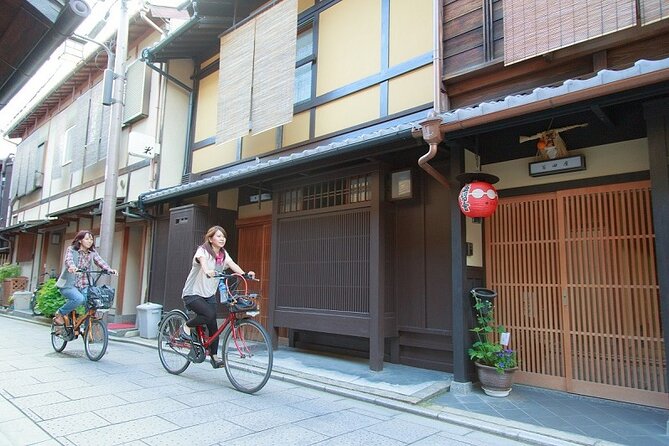
This ride gives you another option. You pedal through the city rather than moving from station to station underground. An e-bike helps with the distance and takes some pressure off when the road tilts upward, though you still need to pedal and remain comfortable on city streets.
The early start matters. From March through June, the tour begins at 7:30 a.m. and ends around 11 a.m. From January through February, the listed Monday start is 8:30 a.m., with a noon finish. Starting early helps you reach Fushimi Inari before the busiest part of the day and gives the ride a quieter rhythm.
The route is also designed to avoid as much pedestrian traffic as possible. That does not mean every stretch is empty, but it does mean you are not simply pushing a bicycle through Kyoto’s most crowded walkways. The ride uses old backstreets, the Shirakawa River area, and the Kamogawa River for a more varied view of the city.
More bike days around Kyoto:
- Hidden Kyoto E-Biking tour
★ 5.0 · 1,843 reviews - Bike Tour Exploring North Kyoto plus Lunch
★ 5.0 · 1,087 reviews - Arashiyama Bamboo Forest & Hidden Gems Bike Tour (Early Bird)
★ 5.0 · 613 reviews
Meeting near Kyoto Station
The tour begins at Rental Bicycle KYOTO ECO TRIP Flagship shop, at 58 Higashikujo Muromachi, Minami Ward, Kyoto, 601-8001. This is the practical part of the experience: you meet at a bicycle shop, receive the included equipment, and return to the same place at the end.
Because the ride begins near Kyoto Station, it fits well on your first full morning in the city or on a day when you want to finish near central Kyoto before lunch. You should allow enough time to find the shop and arrive ready for the morning departure. The tour has mobile ticketing, and confirmation is provided when you book.
The maximum group size is six people. That is a useful middle ground. You get the social ease of a guided outing without the long line of bikes and repeated stops that can slow a large group.
Fushimi Inari’s torii gates before the rush
The first ride takes about 20 minutes from the shop to Fushimi Inari-taisha Shrine. This is one of Kyoto’s essential sights, famous for its thousands of orange torii gates climbing through the wooded shrine grounds.
The tour allows about 50 minutes here. That is enough time to see the best-known gate paths, take photographs, and hear about the shrine without spending the entire morning walking up the mountain. You should not expect to cover every trail on the full Fushimi Inari complex in this time. The point is to experience the shrine as part of a wider Kyoto route.
The early timing is the real advantage. Fushimi Inari becomes much harder to enjoy once the narrow gate corridors fill with people. Arriving early gives you a better chance to notice the repeating gates, stone fox figures, and changes in light along the path.
The ride also includes lesser-known sights along the way. The exact route can vary with street conditions and the guide, but the appeal is clear: you get the famous shrine plus a sense of the surrounding city rather than only the standard approach from the train station.
Sanjusangendo and the scale of Buddhist art
After Fushimi Inari, it is about a 15-minute ride to the Sanjusangendo area. The temple is famous for its 1,001 statues of Kannon, the Buddhist goddess of mercy, displayed inside the long wooden hall.
The supplied route describes passing through Sanjusangendo rather than giving it a separate timed admission stop. That distinction matters. You should treat this portion as a chance to see another important Kyoto sight from the route, not assume that a full interior visit is included in the schedule.
Sanjusangendo adds a different kind of experience after the bright torii gates. Fushimi Inari is a path through repeated gates and wooded slopes. Sanjusangendo is about scale, symmetry, and the powerful visual effect of a long hall filled with statues.
If you want a slow, detailed visit inside every temple on the route, this tour may feel brisk. If you want a smart introduction to several major places in one morning, the variety works well.
More e-bike rides in Kyoto:
- 5 Top Highlights of Kyoto Full Day Bike Tour (E-bike option)
★ 5.0 · 511 reviews - E-Bike Tours of the highlights of Kyoto!!!
★ 5.0 · 291 reviews - Kyoto: City Secrets eBike Tour
★ 4.9 · 196 reviews - Pedal Adventure Kyoto’s iconic landmarks on an e-bike tour
★ 5.0 · 189 reviews
Gion by the Shirakawa River
From Sanjusangendo, the ride takes about 10 minutes before following the Shirakawa River through older backstreets toward Miyagawa-cho and Tatsumi Bridge in Gion.
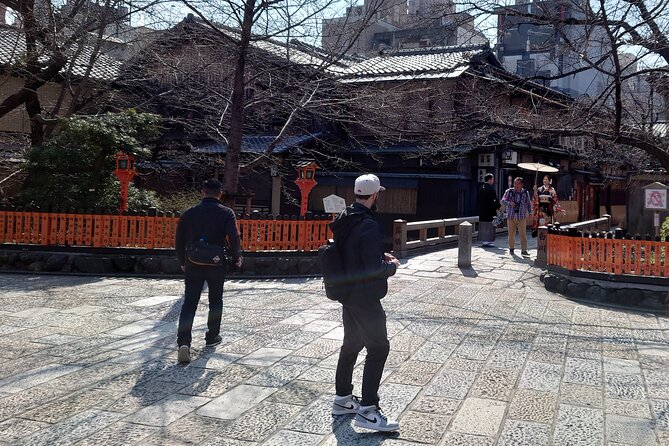
This is one of the most appealing parts of the route because it shows Kyoto at neighborhood level. Gion is widely known as the city’s geisha district, but the pleasure here comes from the lanes, bridges, river edge, and traditional streets rather than from treating the area as a stage set.
Cycling gives you a useful sense of distance. You see how the historic districts fit together and how quickly the scenery changes once you leave the main road. The guide can also help explain what you are seeing, which is especially useful in Gion, where quiet observation and respectful behavior matter.
The route does not promise an encounter with geisha, and you should not book it expecting one. Instead, you get a ride through a famous district at a time when the morning atmosphere is gentler. Tatsumi Bridge is a natural photo stop, and the narrow lanes make this section feel quite different from the open river ride later in the morning.
Nanzen-ji and Kyoto’s Zen tradition
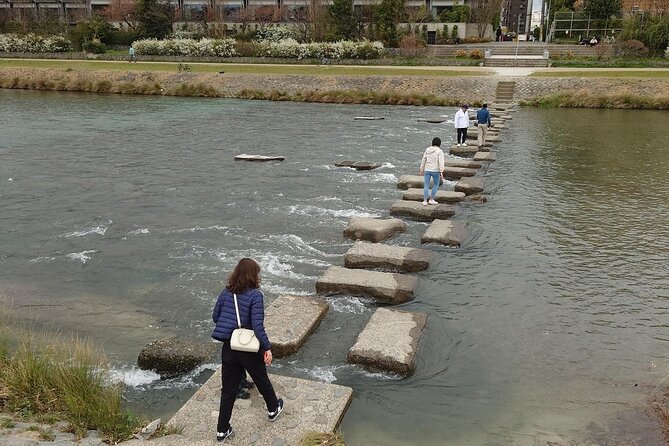
The route then continues for about 15 minutes to Nanzen-ji Temple, one of Kyoto’s most important Zen temples. The planned stop lasts about 20 minutes, with no admission ticket listed.
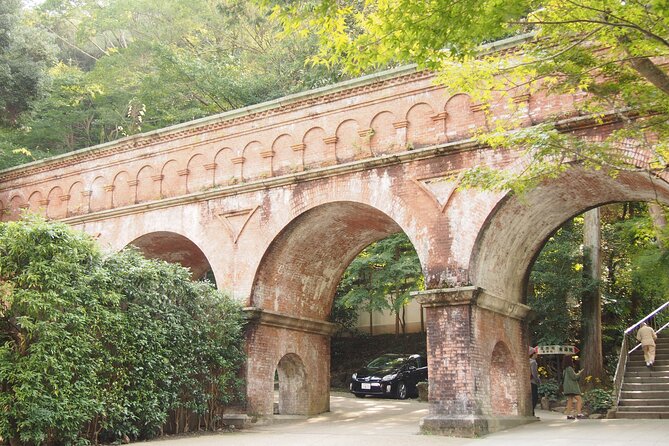
Nanzen-ji is a strong choice for a short guided visit. Its temple grounds offer a sense of space after the tighter streets of Gion, and the site gives your guide a chance to explain Zen Buddhism and Kyoto’s religious traditions in context.
You should keep the 20-minute timing in mind. Nanzen-ji has enough to occupy a much longer visit, especially if you want to explore every garden, gate, and subtemple. Here, you are getting an introduction and a chance to see one of the city’s key religious centers before moving on.
The cycling route itself adds another detail: the tour can include some hills. One rider described the ride as not too strenuous but noted that there were uphill sections. The e-bike helps, yet you will still appreciate comfortable clothes, shoes suited to pedaling, and a willingness to work a little.
Heian Shrine and the old capital of Kyoto
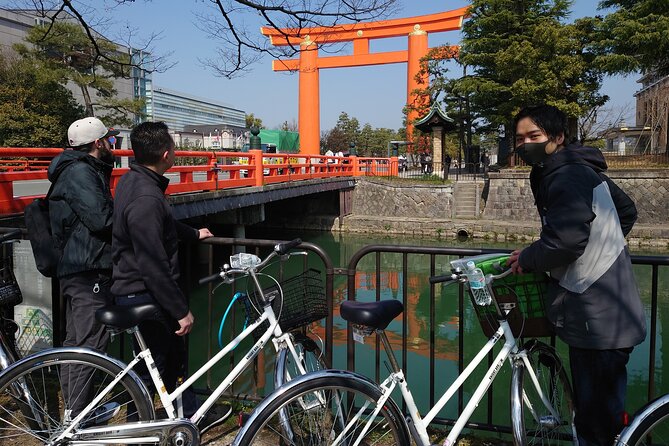
About 10 minutes after Nanzen-ji, you reach Heian Shrine. The stop lasts around 20 minutes.
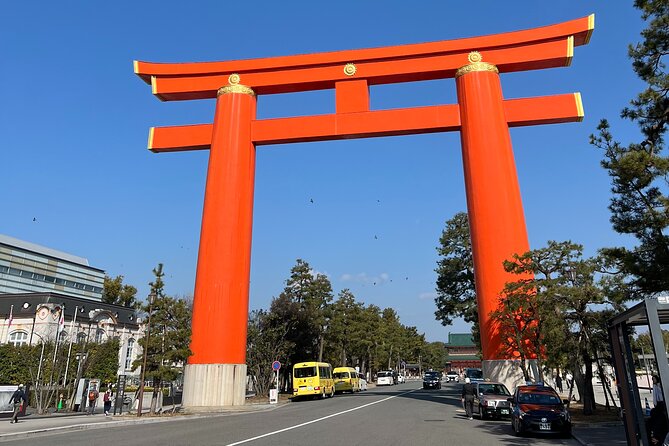
Heian-Jingu Shrine is known as a symbol of Kyoto’s role as Japan’s capital about 800 years ago. Its broad approach and large shrine architecture create a change of scale from the intimate Gion lanes and the enclosed torii path at Fushimi Inari.
This stop rounds out the religious picture. You have seen Fushimi Inari, a major Shinto shrine tied to Inari worship; Sanjusangendo, with its striking Buddhist statuary; Nanzen-ji, linked with Zen; and now Heian Shrine, with its connection to Kyoto as an imperial capital.
Twenty minutes is enough for orientation, photographs, and an explanation of the site. It is not a full visit to every part of the shrine grounds. The tour is best understood as a broad morning sampler, with riding between the major stops keeping the experience active.
Returning along the Kamogawa River
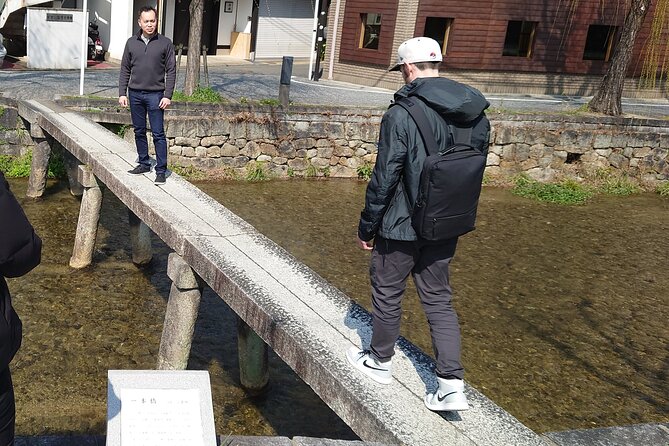
From Heian Shrine, it takes about 10 minutes to reach the Kamogawa River route. The return ride follows the river for approximately 20 minutes before arriving back at the Flagship shop.
This final stretch provides a welcome change after the temples and shrine grounds. The Kamogawa is one of Kyoto’s most recognizable rivers, and riding beside it gives you an open view of the city and a calmer finish to the morning.
The return also helps make the tour feel like a connected journey rather than a list of unrelated stops. You begin near Kyoto Station, travel southeast to Fushimi Inari, cross through historic districts, head toward the center, and then return by the river.
The stated duration is about three and a half hours, including riding time. One outing lasted closer to four and a half hours, so you should avoid scheduling a tight appointment immediately afterward. The extra time may depend on the group, questions, traffic, weather, and how long the guide spends at each stop.
Guides who add more than directions
The guide can make a major difference on a tour like this. Aki has been praised for explaining Kyoto clearly and taking family photographs at several stops. Sato has been described as kind and helpful with food suggestions after the ride.
Ryuto, also written as Riuto in one account, has been praised for strong English, local Kyoto roots, navigation, and explanations of Shinto, Buddhism, and Kyoto’s past. He is described as an English student from Kyoto, which may appeal to you if you prefer a young guide with a personal connection to the city.
The strongest pattern is not simply that the guides point out buildings. They answer questions, explain religious traditions, navigate the streets, and help with photographs. That personal attention is more likely in a group of six than on a large bus tour.
Guide availability can change, so you should not assume that Aki, Sato, or Ryuto will lead your specific departure. Still, the names give you a useful sense of the guiding style offered: friendly, local, conversational, and focused on helping you understand what you are seeing.
Bikes, weather, and physical effort
The tour includes use of an e-bike, helmet, bottled water, raincoat, and liability insurance. You do not need to arrange a separate rental, compare bike shops, or return a bicycle to another location.
The bikes have been described as more traditional in style and not overly bulky. That is useful in Kyoto’s older streets, where a large or awkward bicycle could make stopping and turning less comfortable.
Rain is possible, and the included raincoat provides basic protection. One ride finished in light rain and still went ahead, but conditions can affect comfort and timing. You should dress for the season and bring any personal rain gear you prefer.
Most people can participate, but this is not a passive sightseeing activity. You need to ride for several hours, share roads and paths, and handle some hills. The e-bike reduces the strain but does not remove the need for balance, attention, and moderate effort.
Is $84.92 a fair price?
At $84.92 per person, the price is higher than renting a bicycle for a morning. You are paying for more than the bike itself: a helmet, water, rain protection, liability insurance, route planning, and a guide who handles navigation and interpretation.
The value is strongest if you have limited time in Kyoto or want a useful orientation on your first morning. In three and a half hours, you connect Fushimi Inari, Sanjusangendo, Gion, Nanzen-ji, Heian Shrine, and the Kamogawa River. Doing that independently would require more route planning and a good understanding of Kyoto’s streets.
The price is less compelling if you prefer to spend an hour or more inside each temple, or if you already know the city and simply want a cheap bike rental. Snacks are not included, so eat beforehand or plan food after the tour. The ride ends back at the starting shop, making lunch planning easier, but no meal is part of the booking.
The high rating and full recommendation record are encouraging, but the sample is small. I would focus less on the number and more on the practical fit: small group, early start, local guide, and willingness to cycle.
Who should book this Kyoto e-bike ride?
I would choose this tour for first-time Kyoto visitors who want to see several major sights quickly without spending the morning underground or on crowded buses. It also suits families with older children and teenagers, provided everyone can handle a moderate bike ride.
It is a good match for you if you enjoy seeing how neighborhoods connect. The route moves from shrine paths to temple grounds, old lanes, riverbanks, and central Kyoto streets. You get a wider feel for the city than you would from visiting one temple at a time by taxi.
It may not suit you if you want a slow, contemplative temple morning, dislike cycling in a city, or need a fully flat and effortless route. You should also be comfortable with an early start and a schedule that includes several brief stops.
Free cancellation is available when you cancel at least 24 hours before the start time. Changes or cancellations inside that window are not accepted for a refund.
My recommendation
I would book this tour if you want a friendly, active introduction to Kyoto and value a local guide more than maximum time inside any one temple. The route is well chosen, the group is small, and the early departure tackles Fushimi Inari before the day becomes crowded.
Choose it especially if you are staying near Kyoto Station or want to finish with much of the afternoon still free. Skip it if your priority is an unhurried temple visit or if hills and several hours in the saddle sound like work rather than fun.
FAQ
How long does the Kyoto e-bike tour last?
The scheduled duration is approximately 3 hours and 30 minutes, including travel time between stops. An outing can run longer, so avoid booking a tight appointment immediately afterward.
Where does the tour begin?
It begins at Rental Bicycle KYOTO ECO TRIP Flagship shop, 58 Higashikujo Muromachi, Minami Ward, Kyoto, 601-8001, Japan.
Where does the tour end?
The activity ends back at the same meeting point, the Kyoto ECO TRIP Flagship shop.
How many people can join the tour?
The tour has a maximum of six travelers.
What equipment is included?
The tour includes the e-bike, helmet, bottled water, raincoat, and liability insurance.
Are snacks included?
No. Snacks are not included.
What sights are visited?
The route includes Fushimi Inari-taisha Shrine, Sanjusangendo Temple, the Shirakawa River area, Miyagawa-cho, Tatsumi Bridge in Gion, Nanzen-ji Temple, Heian Shrine, and a return ride along the Kamogawa River.
What are the tour’s operating hours?
From January 1 through February 28, 2026, the listed schedule is Monday from 8:30 a.m. to noon. From March 1 through June 30, 2026, departures are listed Monday through Sunday from 7:30 a.m. to 11 a.m.
More Morning in Kyoto
- Kyoto Early Morning Tour with English-Speaking Guide
★ 5.0 · 1,427 reviews - Kyoto: Early Morning Tour with English-Speaking Guide
★ 4.9 · 1,128 reviews - From Kyoto: Nara Guided Morning Tour
★ 4.6 · 335 reviews - Kyoto Morning Tour from Kyoto or Osaka
★ 4.0 · 281 reviews
Just added around Kyoto
- Kyoto: Zen Meditation at a Private Temple with a Monk★ 5.0 · 25 reviews
- Kyoto: Gion Geisha District & Sake-in-Hand Walking Tour★ 5.0 · 37 reviews
- Private Pewter Sake Cup Experience with a Kyoto Artisan★ 5.0 · 31 reviews
- Your Private Vacation Photography Session In Kyoto★ 5.0 · 110 reviews
- Private Guided Traditional Buddhist Cooking in Japan★ 5.0 · 16 reviews
- Kyoto Wagashi(Japanese sweets) Cooking Class near Fushimiinari★ 5.0 · 60 reviews
- Traditional Japanese Music show & Experience Tour in Kyoto★ 5.0 · 57 reviews
- Kyoto:Family-Friendly Kimono & Yukata Experience at WARGO★ 5.0 · 147 reviews
Kyoto Tours, compared.


Fushimi Inari, Kinkakuji, Bamboo Grove 1 Day Bus Tour
Read our review →
Tea Ceremony in a Traditional Tea House in Kiyomizu
Read our review →
Kyoto Geisha Walking Tour: Gion District & Hidden Gems
Read our review →

Gion Magical Night Walking Tour with Geisha Trivia
Read our review →

Gion Geisha District Walking Tour – Stories of Geisha
Read our review →Browse the lists this tour appears in