
Reviewed · HIROSHIMA TOURS
Hiroshima/Guided Virtual Tour of Peace Park/PEACE PARK TOUR VR
Hiroshima’s Peace Park is quiet today, but this small-group tour uses VR scenes, old photographs, and survivor testimonies to show what the area looked like before the atomic bombing, on that terrible day, and during the difficult months that followed. You walk only a short distance, yet the time span is enormous.
I like two things right away. First, the tour begins at the Rest House, where you go below ground and learn about Eizo Nomura, the only person known to have survived inside the former fuel building. Second, the group is limited to six people, giving you room to ask questions instead of simply following a flag through the park.
The main drawback is value. At $33.03 per person for about 80 minutes, the tour costs more than a simple park walk, and the VR clips may seem modest if you have already used high-end VR games or visited the Peace Memorial Museum. It works best as a guided supplement, not a replacement for the museum.
Key points to know before booking
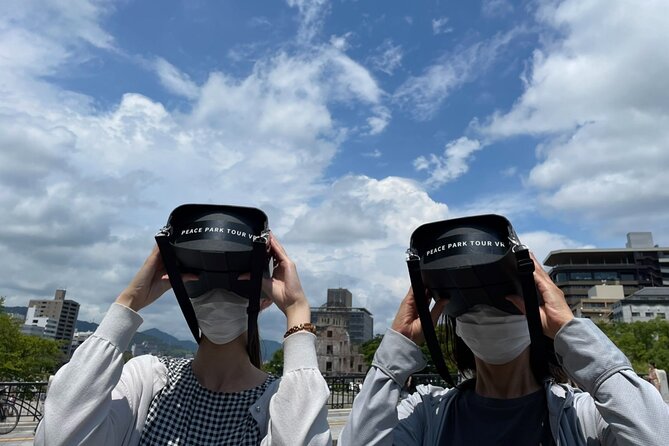
- Prewar Hiroshima appears through VR: You see the city before the bombing, then compare it with the ruined streets that followed.
- Eizo Nomura’s story begins underground: The Rest House stop connects the technology to one person’s survival account.
- The Atomic Bomb Dome gets a before-and-after explanation: At the Peace Clock Tower, the guide explains how the building was damaged and preserved.
- The tour uses a very short walking route: The five stops fit into about 80 minutes, useful if you want a focused visit.
- The group maximum is six people: This is a better setup for questions and personal discussion than a large tour.
- The final stop asks for a personal response: You can leave a message on the River of Hope wall and express your condolences.
Why VR changes the way you see Peace Park
Peace Memorial Park can be hard to read at first. It is open, green, and carefully maintained, while the event it remembers is almost impossible to picture from the present-day setting alone. The VR portion gives you a visual bridge between the calm park you see now and the city that existed before August 6, 1945.
This is not a theme-park simulation. The material is based on historical photographs, documented facts, and accounts from A-bomb survivors. That matters here. The technology is being used to restore a sense of place, not to turn the bombing into entertainment.
You put on the goggles at the start, and the guide explains how to use them. The short videos and reconstructed scenes then appear at several points along the route. You may find the image quality less polished than modern commercial VR, but the value comes from seeing the same locations in different periods.
I find this approach especially useful if dates and buildings alone do not stay with you. Seeing a street before the bombing, then seeing it reduced to fire and ruins, gives the park’s memorials a clearer frame. The experience remains brief enough that the guide’s spoken explanation does not get lost behind the headset.
A few more Hiroshima half-days to weigh up
- Peaceful Hiroshima & Miyajima UNESCO 1 Day Bus Tour
★ 5.0 · 5,309 reviews - Hiroshima: Hiroshima and Miyajima UNESCO Sites 1-Day Tour
★ 4.9 · 2,330 reviews - Hiroshima / Miyajima Full-day Private Tour with Government Licensed Guide
★ 5.0 · 1,298 reviews
Starting below the Rest House with Eizo Nomura
The meeting point is the Hiroshima Peace Park Rest House at 10:30 a.m. Your guide waits at reception, explains the equipment, and then takes you downstairs to the basement. The change in setting is important: you begin in a real historic building rather than with a general introduction on an ordinary path.
The basement section focuses on Eizo Nomura. He was inside the former fuel building when the atomic bomb exploded and is described here as the only survivor from that building. His story gives the tour a human scale before the wider views of destruction appear.
This first stop takes about 20 minutes. That is a generous share of an 80-minute tour, and rightly so. A quick explanation of the bombing can become a list of numbers. One person’s experience helps you understand what survival meant in a building close to the blast.
The Rest House also provides a practical beginning. You learn how the goggles work before using them outdoors. If you are not comfortable with VR equipment, ask the guide to repeat the instructions. The group is small, so this is a sensible place to get your bearings.
Seeing the Atomic Bomb Dome from the Peace Clock Tower
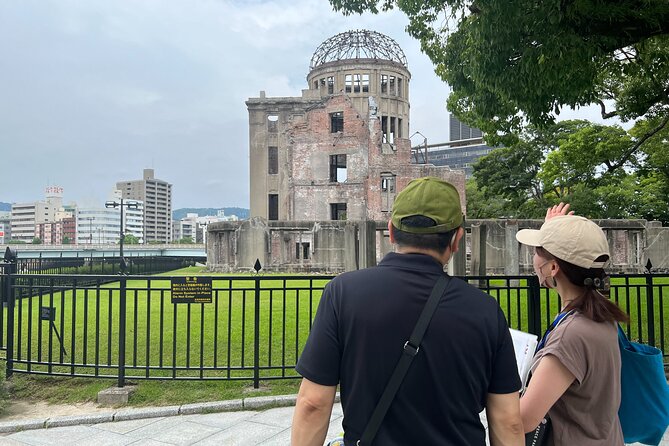
The second stop lasts about 15 minutes at the Peace Clock Tower. Here, the VR presentation shows the view before and after the moment of the bombing. The guide explains how the Atomic Bomb Dome was damaged and how it became the preserved structure you see today.
The Atomic Bomb Dome is familiar from photographs, but photographs often make it seem like an isolated symbol. This stop helps connect the surviving walls to the building’s former place in the city. The before-and-after sequence gives you a stronger sense of what was lost.
The Dome is also unusual because it retains visible traces of the bombing. It was registered as a World Heritage site in 1996. The tour does not ask you to admire the ruin as an object. Instead, it links the structure to the people, streets, and civic life that surrounded it.
You will likely spend more time looking at the building itself once the headset comes off. That is one of the tour’s better qualities. The VR does not end the visit to the site. It gives you a question to carry into the next stop: how did a city begin again after such destruction?
Aioi Bridge and the city two months later
At Aioi Bridge, another 15-minute section looks at Hiroshima about two months after the bombing. The scene shows a town transformed into a sea of fire, while survivor accounts help explain what people faced in the immediate aftermath.
The bridge is a strong location for this part because it lets the tour shift from one building to the wider city. The first stop is personal. The second is architectural. This one broadens the view to streets, movement, and the scale of the destruction.
The guide also tells an episode connected to what happened after the bombing. The available tour information does not give every detail of that story, but the purpose is clear: to show that Hiroshima’s history did not stop at the blast. The tour follows the first painful steps toward rebuilding.
This is where a guide’s ability matters most. The VR images provide the visual material, but the spoken context keeps the story from becoming a silent sequence of ruins. Kazuko, one of the guides associated with the tour, has been praised for answering questions and bringing the subject to life. You may not receive Kazuko specifically, so treat that as a useful example rather than a guaranteed assignment.
Same base, a completely different sort of day:
- Hiroshima Historical Walking Tour – Why A-Bomb was Dropped
★ 4.8 · 893 reviews - Hiroshima Peace (Heiwa) Walking Tour at World Heritage Sites
★ 5.0 · 872 reviews - Hiroshima in a Nutshell: Morning Bike Adventure
★ 5.0 · 524 reviews - Hiroshima City 4hr Private Walking Tour with Licensed Guide
★ 5.0 · 437 reviews
Motoyasu Bridge and the road toward recovery
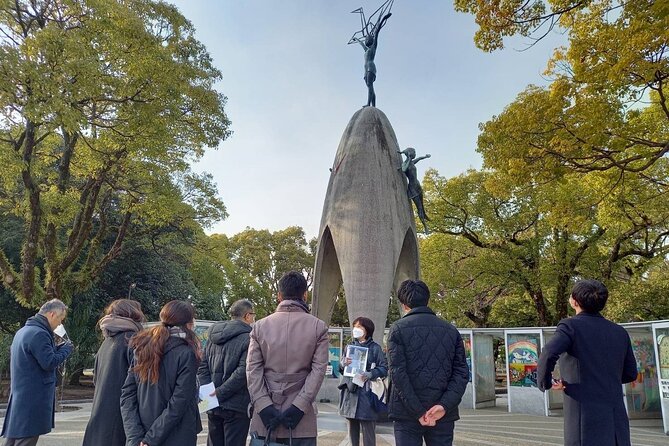
The fourth stop is Motoyasu Bridge, also about 15 minutes. The focus shifts to the first year after the bombing and the period leading to the present. The story is about people getting back on their feet amid chaos and taking practical steps toward recovery.
This section keeps the tour from ending only with destruction. That balance is essential. Hiroshima’s memorial work is about the bombing and its victims, but it is also about the choices made afterward, including the city’s appeal for peace.
You should expect a thoughtful, serious tone here rather than a long lecture. The guide has limited time at each point, so the explanation stays focused. If you have a question about rebuilding, memorials, or the city’s message of peace, this is a good moment to ask it.
The short walking route helps the emotional pacing. You are not marching across the entire city while trying to process difficult material. Instead, each stop gives you a small amount of information, a VR scene, and time to look at the real surroundings.
Returning to the Rest House and leaving a message
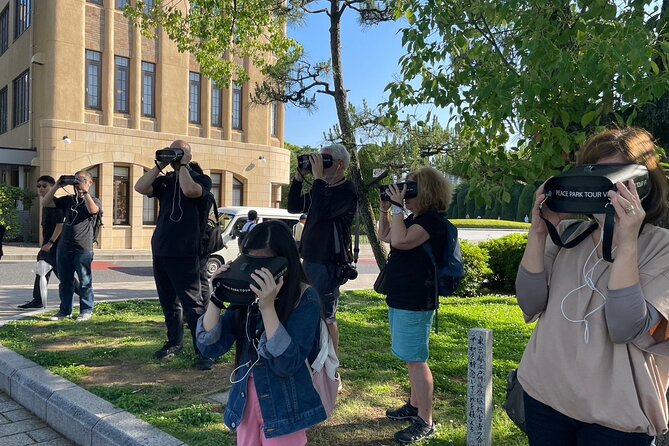
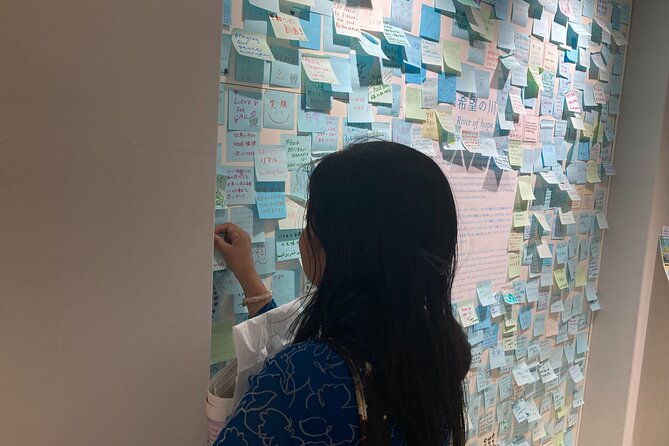
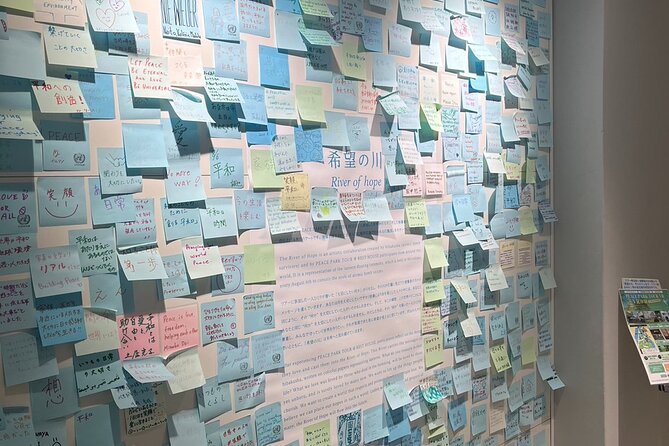
The tour finishes where it began, at the Rest House. The final 15 minutes are set aside for reflection. You can write a comment on the River of Hope wall, a place where people leave messages wishing for peace, and express your condolences.
This ending may appeal to you if you prefer a tour with a clear closing ritual. It gives the experience a personal action rather than ending with the last headset sequence. You do not simply walk away with information. You are invited to record a response.
It may feel less necessary if you prefer to process the subject privately. Still, the final stop is brief, and the return to the starting point makes the whole route simple. You do not need to find a different exit or arrange transport from another part of the park.
Is $33.03 a fair price for 80 minutes?
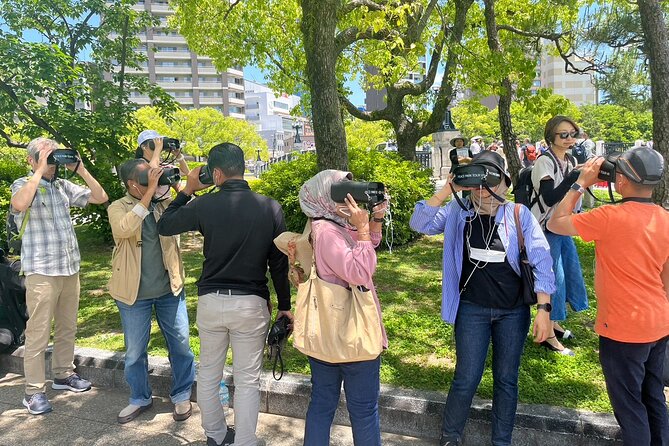
The price is $33.03 per person. That is not a bargain for a short walk, especially when admission to the stops is listed as free and the tour does not include food, drinks, or transport to the meeting point.
You are paying mainly for three things: the VR equipment, the English-speaking guide, and the way the material is arranged across the park. The group size matters too. With a maximum of six people, the price buys a more personal format and a better chance to ask questions.
The value depends heavily on what else you plan to do in Hiroshima. If you have already visited the Peace Memorial Museum and seen strong VR productions elsewhere, you may find the clips technically basic. One critical assessment found only a few videos and questioned the cost for someone who had visited the museum the previous day.
I would not book this as a substitute for the museum. I would book it if you want help connecting the museum’s exhibits to the actual streets, bridges, and buildings of Peace Park. The combination of place, guide, and time-shifted images is the point.
The tour is booked an average of 37 days ahead, so you should not assume there will be a last-minute place. Confirmation is sent within 48 hours, subject to availability. If your Hiroshima schedule is fixed, reserve early.
The guide makes more difference than the headset
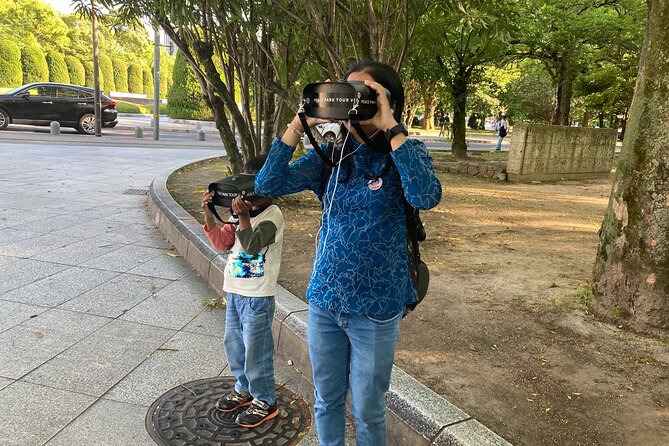
The VR is the advertised feature, but the guide determines how useful the visit feels. A headset can show a reconstruction. It cannot answer your question about what you are seeing, explain why the Dome was preserved, or help you connect one stop with the next.
The small group is a real advantage here. Six people is enough for conversation but not so many that every question slows the tour. The English-speaking format also helps if you want historical context without relying only on museum labels.
The strongest praise has been directed at the guide’s professionalism and ability to make the material understandable and moving. Kazuko has been singled out by name for answering questions and helping bring the experience to life. Again, guide assignments can vary, but that gives you a clear idea of the quality this tour aims for.
I recommend treating the guide as your main resource. Look around between VR scenes, ask about what remains visible today, and do not rush to remove the historical setting from the modern view. The headset is only one part of the visit.
Who will get the most from this Peace Park tour?
I think this tour fits you best if you want a short, focused introduction to Hiroshima’s memorial district. The 80-minute format works well before another activity, and the limited walking may suit you better than a long city tour.
It is also a good choice for families or mixed-age groups who need visual help to understand the past. Most people can participate, and the guide provides the goggles and instructions. The subject is serious, so younger participants should be prepared for difficult images and accounts, but the tour does not require a long day on foot.
You may also like it if you have only one day in Hiroshima and want more context than a self-guided walk allows. The route covers the Rest House, Peace Clock Tower, Aioi Bridge, Motoyasu Bridge, and the Atomic Bomb Dome area without taking over your whole morning.
I would be more cautious if you want a polished, entertainment-style VR production. The historical purpose is stronger than the technical spectacle. If you have already spent substantial time in the museum and are looking for entirely new information, the added value may be limited.
Plan to visit the museum separately if it matters to you. The tour’s strength is the connection between testimony, reconstruction, and the physical park. It is not designed to provide the full collection of documents, objects, and exhibits found in a museum.
Timing, meeting point, and practical details
Meet at the Hiroshima Peace Park Rest House, at 1-1 Nakajimacho, Naka Ward, Hiroshima, postcode 730-0811. The start time is 10:30 a.m., and the tour returns to the same place.
Your ticket is mobile, and the VR goggles are included. Transportation to the meeting point is not included, so you need to arrange your own way there. Food and drinks are also not part of the price.
The entire activity lasts approximately one hour and 20 minutes. Each of the five sections takes about 15 to 20 minutes, which leaves little spare time for wandering away from the group. Arrive ready to begin at the stated time.
Free cancellation is available if you cancel at least 24 hours before the start time. Cancellations or changes made inside that period are not accepted for a refund, and the cut-off follows Hiroshima local time.
Should you book PEACE PARK TOUR VR?
Book it if you want a guided, human-scale introduction to Hiroshima Peace Park, especially if you value survivor accounts and visual comparisons between the old city, the bombed city, and the recovering city. The small group and short walking route make it easier to focus.
Skip it if your budget is tight, you have already seen the museum and similar VR material, or you expect cutting-edge graphics. At $33.03, the tour needs to earn its price through the guide and the setting, not through technology alone.
My practical advice is to schedule the museum and this tour on the same Hiroshima visit, but not treat them as duplicates. The museum supplies detail and evidence. This tour places those stories at the bridges, buildings, and paths where the city’s history unfolded.
FAQ
How long does the PEACE PARK TOUR VR last?
The tour lasts approximately one hour and 20 minutes.
Where does the tour start and finish?
It starts at the Hiroshima Peace Park Rest House at 1-1 Nakajimacho, Naka Ward, Hiroshima. It ends back at the same meeting point.
What time does the tour begin?
The stated start time is 10:30 a.m.
Is an English-speaking guide included?
Yes. An English-speaking guide is included, along with the rental fee for the VR goggles.
How many people can join the tour?
The activity has a maximum of six participants.
Can I cancel for a full refund?
Yes, if you cancel at least 24 hours before the experience start time. Cancellations or changes made less than 24 hours before the start time are not accepted for a refund.
Just added around Hiroshima
- The Peace Memorial to Miyajima : Icons of Peace and Beauty★ 4.5 · 31 reviews
- Shore Excursion from Hiroshima Port : Private Tour in Hiroshima★ 5.0 · 17 reviews
- Hiroshima Saijo Sake Tasting Tour with visit to 7 Breweries★ 5.0 · 104 reviews
- Hiroshima & Miyajima All-Inclusive Tour w/Licensed guide Pancho★ 5.0 · 54 reviews
- Hiroshima Country Cycling: Explore Rural Life 1 HR from City★ 5.0 · 22 reviews
- Okunoshima Rabbit Island Cycling Tour with Local Guide★ 4.5 · 17 reviews
- Private Full Day Hiroshima Tour★ 4.5 · 29 reviews
- Cultural Activities :Kimono, tea ceremony, Calligraphy and Amulet★ 5.0 · 44 reviews
Hiroshima Tours, compared.

Peaceful Hiroshima & Miyajima UNESCO 1 Day Bus Tour
Read our review →
Hiroshima and Miyajima UNESCO Sites 1-Day Tour
Read our review →
Hiroshima Historical Walking Tour – Why A-Bomb was Dropped
Read our review →
Hiroshima Peace (Heiwa) Walking Tour at World Heritage Sites
Read our review →
Hiroshima in a Nutshell: Morning Bike Adventure
Read our review →
Hiroshima City 4hr Private Walking Tour with Licensed Guide
Read our review →

Japanesel Archery Experience HIROSHIMA CASTLE SHARAKU
Read our review →Browse the lists this tour appears in