
Reviewed · HIROSHIMA TOURS
Hiroshima’s Heart: A 4-Hour Private Storytelling Walk
Hiroshima’s hardest story makes more sense when you first see the city that existed before 1945. This private walk with Alex links Shukkeien Garden, Hiroshima Castle, and Gokoku Shrine with the A-Bomb Dome and Peace Memorial Park, giving you both the old city and the modern city’s peace message.
I like the relaxed pace and the chance to ask questions as you go. I also like that Alex, who has lived in Hiroshima for more than 20 years, adds local details about families, schools, rituals, food, and daily life. The main drawback is simple: four hours of walking, plus the museum, can feel full, and Shukkeien and the museum require small admission fees.
Key points
- A private tour for up to six people: Your group gets Alex’s full attention, with room to adjust the route and ask direct questions.
- A before-and-after view of Hiroshima: Shukkeien, the castle, and Gokoku Shrine explain the city before the bombing, while Peace Park addresses what followed.
- Personal storytelling rather than a site checklist: Alex brings survivor and local family stories into the monuments and memorials.
- A flexible start: Meet at Peace Memorial Park, in front of Shukkeien Garden, or another convenient central location when arranged in advance.
- Clear English and easy conversation: Alex is described as approachable and easy to understand, and he also communicates in several languages, including Dutch.
- Useful help beyond the walk: The tour includes recommendations for food and things to do afterward, with okonomiyaki a recurring local favorite.
Why this Hiroshima walk feels different
Many Hiroshima tours begin and end with the Peace Memorial Park. That is understandable, since the park is the city’s emotional center. But the park alone can leave you with a narrow picture of Hiroshima, as if the city began on August 6, 1945.
This tour takes a wider view. You can begin at Shukkeien Garden, where ponds, bridges, winding paths, and carefully arranged plantings offer a quiet introduction to Hiroshima’s older culture. From there, the route moves toward Hiroshima Castle and Gokoku Shrine before reaching the Peace Line and the memorial district.
That order matters. You first see Hiroshima as a castle town with samurai roots, religious customs, gardens, and ordinary civic life. Then you consider how completely the bombing changed it. The result is more human than a string of dates and monuments.
Alex’s role is central to the experience. He has lived in Hiroshima for over two decades, so the walk is not limited to textbook facts. You can ask how the city feels today, how local families relate to its past, or where to eat after the tour. The tone is described as relaxed, friendly, and straightforward, which helps with a difficult subject.
More walking tours in Hiroshima:
- Hiroshima Historical Walking Tour – Why A-Bomb was Dropped
★ 4.8 · 893 reviews - Hiroshima Peace (Heiwa) Walking Tour at World Heritage Sites
★ 5.0 · 872 reviews - Hiroshima City 4hr Private Walking Tour with Licensed Guide
★ 5.0 · 437 reviews
Shukkeien Garden: a calm place to begin
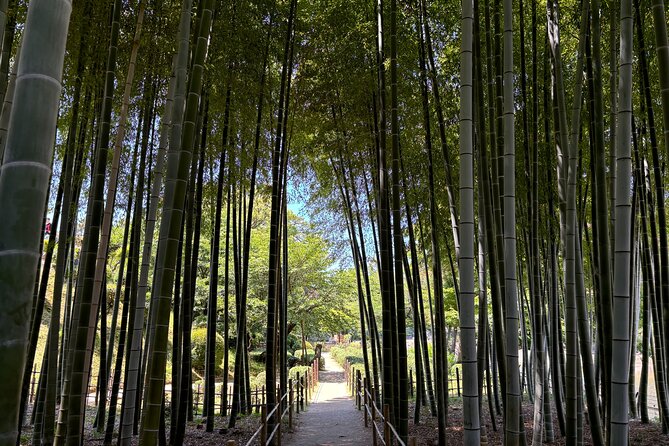
If you choose the garden as your starting point, allow about an hour here. Shukkeien is a traditional Japanese garden with paths, ponds, and bridges. It gives you space to settle into Hiroshima before the tour reaches the memorial sites.
I like this opening because it slows the day down. You are not pushed straight into the most emotionally demanding part of the city. Instead, Alex can explain Hiroshima’s early history and cultural roots while you walk through a peaceful setting.
The garden is also a useful reminder that Hiroshima was not only a military target or a memorial city. It had an established identity, traditions, and civic life long before 1945. That background makes the later stops easier to place.
Admission is not included. The listed fee is ¥360 per person. Ask about the exact starting plan when you book, since the tour can begin at Shukkeien or at Peace Memorial Park depending on your preference. If you start in the park, the garden may not fit into the same four-hour route.
Hiroshima Castle and the city before 1945
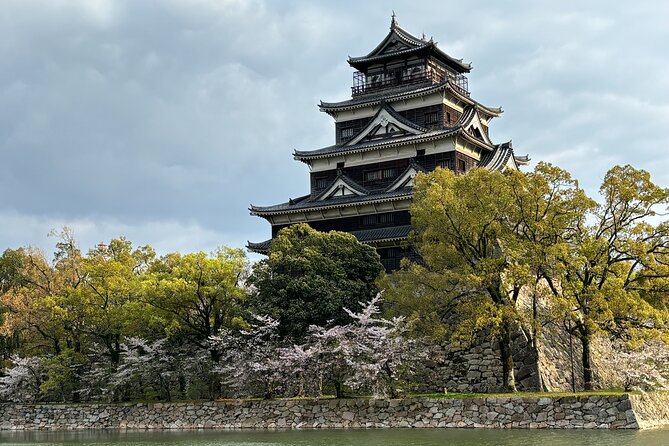
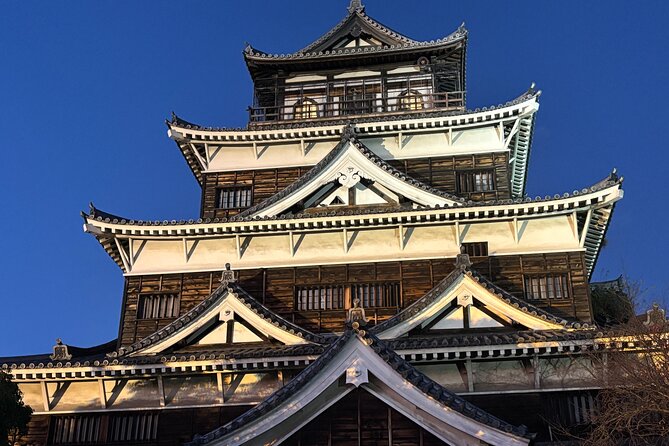
The reconstructed Hiroshima Castle takes about 30 minutes and has no admission charge for the grounds included in this walk. The castle once sat at the center of the city’s samurai-era life, making it a useful bridge between the garden and the memorial district.
Alex uses the castle area to discuss how people lived before the bombing and how this part of Hiroshima changed afterward. You will not simply photograph the castle and move on. The point is to understand the shape of the older city and the role the castle played in it.
The castle itself is reconstructed, so you should not expect an untouched medieval structure. That is a limitation if your main goal is original architecture. As part of a four-hour history walk, though, the grounds work well because they provide physical evidence of Hiroshima’s earlier identity.
This is also one of the easier portions of the route. The stop is short, free, and focused on setting the scene. If you have already visited the castle, the time can likely be adjusted because the tour is private and customizable.
Gokoku Shrine and everyday Japanese tradition
Hiroshima Gokoku Shrine adds another side of the city. The shrine is a peaceful Shinto site connected with local history and tradition, and Alex explains rituals, festivals, and everyday spiritual life.
This stop helps keep the tour from becoming only a lesson about destruction. A shrine is a place where local customs continue through ordinary visits, ceremonies, and seasonal events. You get a glimpse of the practices that shape Japanese life beyond the major sights.
Plan for about 30 minutes here. It is a short stop, but it has a clear purpose. The castle explains the political and social city of the past. The shrine brings in faith, ritual, and community.
Because this is a working religious place, the experience depends on your interest in observation and explanation rather than on a long list of objects to see. Alex’s storytelling is especially useful here. Without context, a shrine can be beautiful but puzzling. With context, its details become easier to read.
A few more Hiroshima half-days to weigh up
- Peaceful Hiroshima & Miyajima UNESCO 1 Day Bus Tour
★ 5.0 · 5,309 reviews - Hiroshima: Hiroshima and Miyajima UNESCO Sites 1-Day Tour
★ 4.9 · 2,330 reviews - Hiroshima / Miyajima Full-day Private Tour with Government Licensed Guide
★ 5.0 · 1,298 reviews - Hiroshima in a Nutshell: Morning Bike Adventure
★ 5.0 · 524 reviews
Peace Memorial Park: monuments with human context
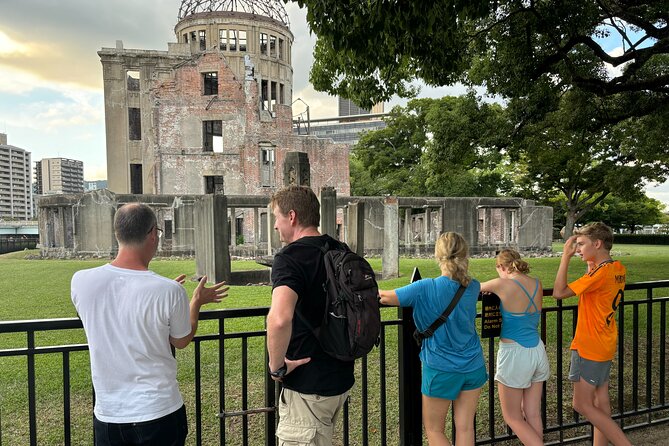
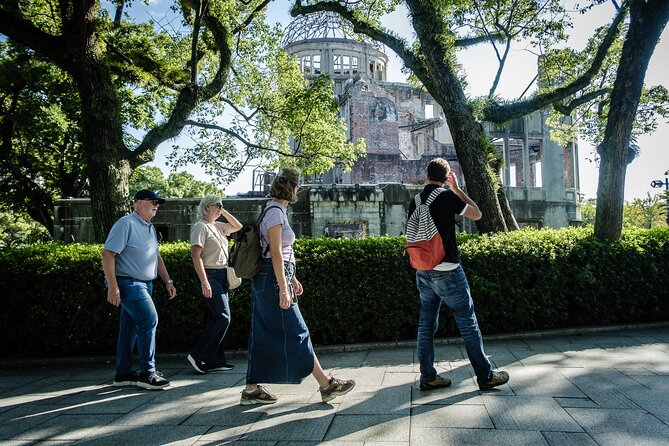
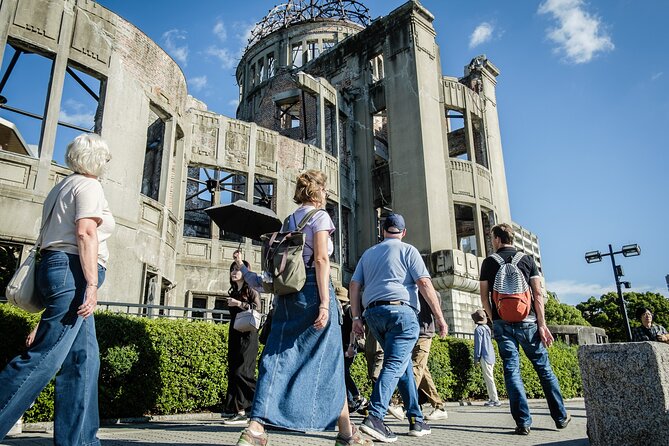
The walk then follows the Peace Line into Hiroshima Peace Memorial Park. Expect about an hour among major monuments, including the A-Bomb Dome and the Children’s Peace Monument.
The park is spacious and open, but the subject is heavy. This is where Alex shares stories and perspectives connected with survivors and local families. That personal framing can help you move beyond the familiar image of the A-Bomb Dome and consider the people who lived, died, survived, and rebuilt here.
The A-Bomb Dome is the most recognizable structure in Hiroshima’s memorial district. Its damaged frame is powerful, but a guide can explain why it matters as part of the city’s memory rather than leaving you to take a photograph and guess at the details.
The Children’s Peace Monument brings the human cost into sharper focus. It is linked to the stories of children affected by the bombing and its aftermath. Give yourself time here. The tour’s unhurried approach is an advantage, since rushing through the park would work against its purpose.
You can also ask questions that are not easily answered by signs. Alex’s experience living locally lets him connect the memorial sites with present-day Hiroshima without turning the walk into a lecture. His style is reported as clear and approachable, which is important when the material is difficult.
The Peace Memorial Museum: useful guidance, with a choice
The Peace Memorial Museum takes about an hour and requires a separate entrance fee of ¥200 per person. Alex can guide you through key sections when conditions allow, explaining the material and helping you understand its setting.
Museum crowds may affect how this works. If it is busy, or if you prefer to look quietly on your own, Alex provides an introduction before you explore independently. This is a sensible arrangement. A private guide is helpful for orientation, but some museum displays call for silence and personal reflection.
The museum is emotionally demanding. You should not schedule this tour on the assumption that it will feel light or casual. The earlier garden and castle stops soften the transition, but the museum remains the most intense part of the day.
If you prefer a more personal visit, tell Alex in advance that you want time to read and reflect. If you want more explanation, ask him to point out the key sections. The private format gives you more control than a large group tour.
A guide who adjusts to families and different interests
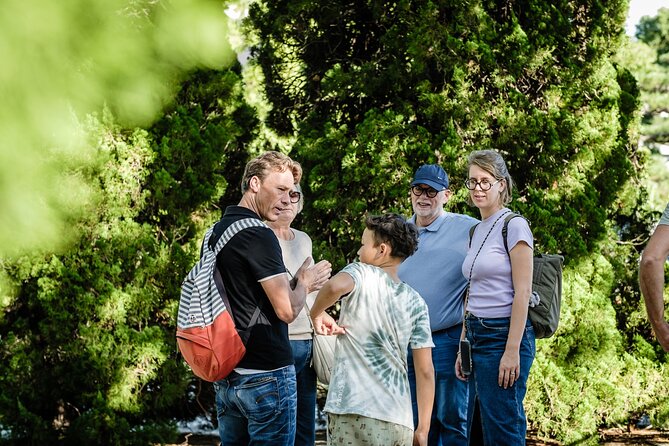
The tour suits families particularly well because the group size is limited to six. Alex has guided families with children and has been praised for encouraging questions and keeping younger participants engaged during a long walk from the castle through the city and into the museum.
That does not mean the day is effortless for every child. Four hours on foot, followed by a serious museum visit, requires stamina and attention. Families should discuss the subject with children beforehand and tell Alex if they need a shorter museum visit or extra pauses.
The private setup also works for couples, older relatives, and small groups with different interests. One person might want more detail about the bombing, while another wants food advice or a better sense of present-day Hiroshima. A private conversation can handle those differences more easily than a fixed group lecture.
Alex’s communication is another strength. His English is described as clear and easy to understand, and he speaks several languages, including Dutch. That can make a major difference when the topic includes names, dates, memorial terms, and personal stories.
Food advice and local conversation after the walk
Food is not included, but personal recommendations are. Several tours with Alex have included a meal at a small local restaurant or okonomiyaki, Hiroshima’s famous layered savory dish. For this specific four-hour walk, treat that as a possible recommendation or add-on conversation, not as a promised meal.
I like having food advice at the end of a history tour. You can ask Alex where to eat nearby, what local dish to try, or what to do with the rest of your day. His suggestions may be more useful than choosing a restaurant at random after an emotional museum visit.
The tour also offers recommendations for further activities. This is one reason to book it early in your Hiroshima stay, if your schedule allows. You can use Alex’s advice to plan later sightseeing rather than receiving it after you have already left.
The experience is booked, on average, 83 days ahead. That suggests you should reserve well before your trip if your dates are fixed, especially since the group is private and limited to six people.
Price, group size, and what you receive
The price is $209.03 per group of up to six people. For six, that works out to about $35 per person before entrance fees. For two people, the effective cost is about $105 per person, so the value depends heavily on your group size.
You are paying for four hours of private guiding, a flexible meeting point in central Hiroshima, a customizable route, and personal recommendations. You are not paying for lunch, transportation if needed, Shukkeien admission, or the Peace Memorial Museum entrance.
For a full group, the price is attractive because a private guide can give everyone room to ask questions. For a couple, it is a larger spend than a group tour, but you get a more personal pace and can shape the conversation around your interests.
Transportation is not included. The experience is presented as a walking tour, and the main stops are in central Hiroshima. If you need transport to or from the starting point, clarify that before booking. Pickup is offered, and Alex has accommodated hotel meetings, but the exact arrangement should be confirmed in advance.
Timing, meeting points, and practical planning
The tour lasts about four hours and can begin at Peace Memorial Park or in front of Shukkeien Garden. The central meeting point is flexible, and the exact location is confirmed after booking.
The published start and end information lists Peace Memorial Park, with the tour concluding either there after the museum or at Shukkeien if that is the selected route. Confirm the finish point so you can plan your next train, meal, or activity without a tight connection.
Wear comfortable shoes. The route covers a garden, castle grounds, shrine, park, and museum, and the walking time adds up. The pace is relaxed, but relaxed does not mean short.
Most people can take part, and service animals are allowed. The tour is near public transportation. Since the museum and memorial park can be emotionally intense, plan a little quiet time afterward rather than scheduling another major attraction immediately.
Free cancellation is available if you cancel at least 24 hours before the start time. Inside that window, the amount paid is not refunded, and changes are not accepted. The cut-off follows Hiroshima local time.
Who should book this private Hiroshima experience?
I would choose this walk if you want Hiroshima explained as a living city, not only as a memorial destination. It is especially well suited to first-time visitors, families, and small groups who prefer questions and conversation over a fixed script.
It is also a good fit if you want to connect the city’s samurai-era past with its postwar peace message. The sequence from garden to castle to shrine to Peace Park gives you that structure in a way a museum visit alone cannot.
You may want something else if you dislike walking, prefer to explore museums entirely alone, or want a tour focused only on architecture and sightseeing. The subject is serious, and the museum portion can be difficult. You should also weigh the private price carefully if you are traveling as a pair.
Should you book Hiroshima’s Heart?
Book it if Alex’s personal storytelling, a calm pace, and a flexible private route sound more useful than a fast list of landmarks. The strongest feature is the connection between Hiroshima before 1945 and the city you see today.
For the best value, bring a group of four to six, start early in your Hiroshima stay, and tell Alex what you want from the museum and the rest of your day. Allow for the garden and museum fees, wear good shoes, and leave some breathing room afterward.
This is not a light sightseeing loop. It is a thoughtful introduction to Hiroshima, with enough local context to make the major sites easier to understand and remember.
FAQ
How long does the Hiroshima walking tour last?
The tour lasts approximately four hours.
How many people can join the private tour?
The price covers one private group of up to six people.
Who guides the tour?
The guide is Alex, an English-speaking local guide who has lived in Hiroshima for more than 20 years.
Where can the tour begin?
You can arrange to meet at Peace Memorial Park, in front of Shukkeien Garden, or at another convenient location within central Hiroshima.
Where does the tour end?
The tour ends at Peace Memorial Park after the museum or at Shukkeien Garden, depending on the chosen starting point and route.
Is Shukkeien Garden included in the price?
The private tour is included, but Shukkeien Garden admission is separate. The listed fee is ¥360 per person.
Is the Peace Memorial Museum admission included?
No. The museum entrance fee is separate, and the listed price is ¥200 per person.
Does the tour include transportation or lunch?
No. Lunch and transportation, if needed, are not included.
Can Alex guide me inside the Peace Memorial Museum?
When conditions allow, Alex guides you through key sections. If the museum is crowded or you prefer quiet exploration, he gives you an introduction and you can continue independently.
What is the cancellation policy?
You receive a full refund if you cancel at least 24 hours before the experience begins. Cancellations or changes made less than 24 hours before the start time are not refunded or accepted.
Just added around Hiroshima
- The Peace Memorial to Miyajima : Icons of Peace and Beauty★ 4.5 · 31 reviews
- Shore Excursion from Hiroshima Port : Private Tour in Hiroshima★ 5.0 · 17 reviews
- Hiroshima Saijo Sake Tasting Tour with visit to 7 Breweries★ 5.0 · 104 reviews
- Hiroshima & Miyajima All-Inclusive Tour w/Licensed guide Pancho★ 5.0 · 54 reviews
- Hiroshima Country Cycling: Explore Rural Life 1 HR from City★ 5.0 · 22 reviews
- Okunoshima Rabbit Island Cycling Tour with Local Guide★ 4.5 · 17 reviews
- Private Full Day Hiroshima Tour★ 4.5 · 29 reviews
- Cultural Activities :Kimono, tea ceremony, Calligraphy and Amulet★ 5.0 · 44 reviews
Hiroshima Tours, compared.

Peaceful Hiroshima & Miyajima UNESCO 1 Day Bus Tour
Read our review →
Hiroshima and Miyajima UNESCO Sites 1-Day Tour
Read our review →
Hiroshima Historical Walking Tour – Why A-Bomb was Dropped
Read our review →
Hiroshima Peace (Heiwa) Walking Tour at World Heritage Sites
Read our review →
Hiroshima in a Nutshell: Morning Bike Adventure
Read our review →
Hiroshima City 4hr Private Walking Tour with Licensed Guide
Read our review →

Japanesel Archery Experience HIROSHIMA CASTLE SHARAKU
Read our review →Browse the lists this tour appears in