
Reviewed · KYOTO TOURS
Private Pewter Sake Cup Experience with a Kyoto Artisan
A blank pewter cup becomes your own piece of Japanese craftwork here. Under artisan Kanako’s guidance, you choose the hammer, set the cup on an anvil, and build its pattern stroke by stroke. The result is not a factory souvenir, but a useful cup shaped by your own hands.
I especially like the private format, which gives your group room to work at its own pace, and the chance to stamp initials, numbers, or a date into the base. The main catch is the location: the workshop sits well outside central Kyoto, and reaching it may take roughly an hour by scenic train.
Key points to know
- Hammer your own pattern: Use different hammers, rotate the cup, and create a surface no one else can copy.
- Meet artisan Kanako: She teaches the process patiently and gives clear instructions in English.
- Personalize the base: Add letters, initials, numbers, or a meaningful date.
- Expect a finished cup: It measures about 64 millimeters across, 53 millimeters high, and holds about 90 milliliters.
- Plan for the setting: Craft Gallery SALUK is in a quiet, mountainous part of northern Kyoto, away from the city center.
- Allow two and a half hours: The class includes decorating, filing, rim shaping, polishing, and time to enjoy your new cup.
Why this Kyoto craft class is worth your time
Kyoto has no shortage of temples, gardens, and shopping streets. Those are essential, but a hands-on craft class gives you a different kind of memory. You leave with a cup, but the real souvenir is knowing how its marks got there.
This experience focuses on pewter, a soft metal that can be shaped with controlled hammering. You do not arrive with a design already fixed in your head. Instead, the cup changes as you work. A light tap creates a delicate mark. A stronger blow makes a deeper impression. The hammer’s shape matters, too.
That makes the class friendly to beginners. You are not expected to arrive as a metalworker. Kanako explains the process, helps you avoid mistakes, and guides the final stages. The craft still belongs to you, but you are not left alone with a hammer and a piece of metal.
The setting adds to the appeal. Craft Gallery SALUK is in northern Kyoto, in a calmer area than the central sightseeing districts. One detailed account described a scenic train ride of about an hour from Kyoto Station, with a stream near the workshop. Exact travel time will depend on your starting point and route, but you should treat this as a half-day outing rather than a quick activity between major sights.
More drinks-led nights in Kyoto:
- Kyoto Night Foodie Tour in Gion (9+ dishes + 6 Sake tastings)
★ 5.0 · 1,762 reviews - 3-Hour Kyoto Insider Sake Brewery Tour with Tastings & Pairings
★ 5.0 · 917 reviews - Arashiyama Bamboo, Temple, Monkeys, or Secret Sake Brewery
★ 4.8 · 886 reviews
Meeting Kanako at Craft Gallery SALUK
The meeting point is Craft Gallery SALUK, at 35-2 Shizuichinonakachō in Sakyo Ward. The activity ends at the same place, so you do not need to work out a second meeting point after the class.
Kanako is the artisan and instructor. Her teaching style, as described through the activity details, centers on patience and straightforward instruction. That matters because metalwork can feel intimidating at first. You need enough guidance to make a good cup, but also enough freedom to make choices of your own.
The workshop has also been described as a peaceful place where tea and snacks may be offered at the beginning. Since the class is private, your group has a more personal setting than a large public demonstration. Couples, families, and small groups can work side by side and compare designs without feeling rushed.
If you do not drink alcohol, the activity can still suit you. Green tea has been offered in handmade cups, and the finished vessel can also be used for whiskey, chilled green tea, or other drinks. Its purpose is not limited to sake.
Choosing a hammer and making the first marks
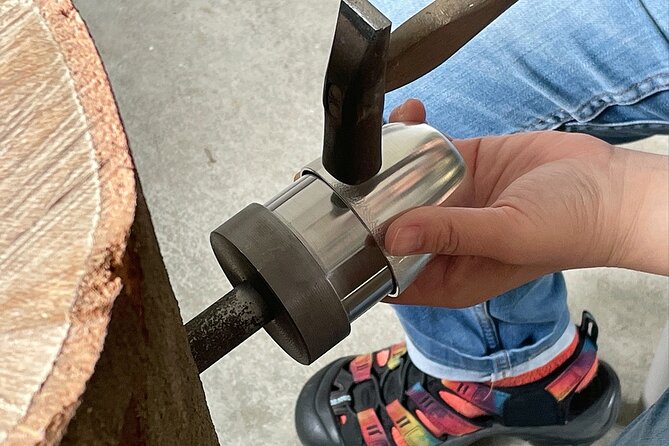
The main activity begins with a simple choice: select your preferred hammer from several types. Each hammer produces a different pattern, so this is the first creative decision of the class.
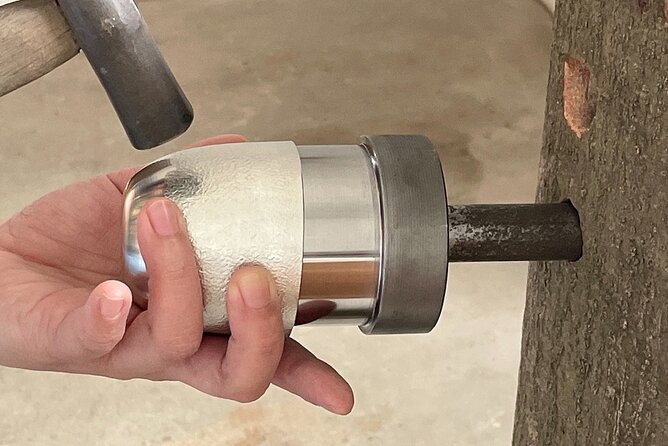
You place the pewter cup on an anvil and strike it while rotating it. The technique sounds simple, but rhythm and control matter. Work too quickly and the pattern may become uneven. Strike too hard and you may make marks you did not intend. The process rewards patience more than strength.
You can use one hammer throughout, or combine several hammers for a more varied surface. That is where the private format helps. You can take time to look at the developing pattern and decide if you want a regular finish or something more playful.
The cup’s rounded shape is designed to fit comfortably in your hand. It is small, with a capacity of about 90 milliliters in normal use, or 115 milliliters when filled to the rim. That size suits a modest pour of sake and makes the object feel like a drinking cup rather than a decorative bowl.
The hammered texture gives the cup its character. Two people starting with identical blanks can finish with very different results. One person might create a bright, tightly repeated pattern. Another might leave larger spaces between marks. There is no single correct surface.
Adding initials, dates, and personal meaning
You may stamp letters, numbers, initials, or a date on the base. This is a small detail, but it changes the object from a nice souvenir into a personal keepsake.
For a couple, the base could carry initials or a significant date. A family might mark the year of a Japan trip. You could also keep the design simple and let the hammered surface do the work. The important point is to decide ahead of time if you want personalization, since meaningful dates and names are easier to choose before the class begins.
The activity is especially well suited to a special trip. A handmade cup can recall a wedding anniversary, a family holiday, or a first visit to Japan without looking like a standard tourist item. Several handmade cups can also become a matching set, even when each one has a different pattern.
The personal touch does not make the class sentimental or overly formal. You are still spending much of the time making marks in metal, adjusting the shape, and learning a practical technique.
More food tours in Kyoto:
- Kyoto: Insider Sake Brewery Tour with Sake and Food Pairing
★ 5.0 · 704 reviews - Kyoto Sake Brewery & Tasting Walking Tour
★ 5.0 · 623 reviews - Kyoto Nishiki Market Food and Culture Walking Tour
★ 5.0 · 412 reviews - Kyoto: Gion Food Tour 13 Dishes at 4 Eateries
★ 5.0 · 408 reviews
Filing the rim and finishing the cup
After hammering, you use a file to adjust the cup’s height and bevel the rim at an angle. This stage has a practical purpose. A neatly shaped rim feels better against your lips, and the final dimensions give the cup a balanced, usable form.
This is also where you see the difference between a rough craft project and a finished object. Filing requires care. You are refining the shape rather than adding decoration, so steady work matters.
For safety, Kanako completes the final polishing with a rotary machine. That is a sensible division of labor. You handle the creative and shaping work, while the potentially hazardous final equipment is left to the craftsperson.
The finished cup is approximately 64 millimeters in diameter and 53 millimeters high. It is compact enough to pack easily, though you should still protect it carefully in your luggage. The cups may be packaged in wooden boxes, adding a practical presentation for carrying home or giving as a gift.
What the $144.96 price includes
At $144.96 per person, this is not a budget activity. The value depends on what you want from a Kyoto outing.
You are paying for a private class, an artisan-led lesson, materials, equipment, instruction, and a finished pewter cup. You also receive something that has a clear connection to the place and the craft. Compared with buying a mass-produced cup, the higher price buys time, skill, and participation.
The private format is most valuable for two or more people who want to make the class part of a shared occasion. You can encourage each other, compare hammer marks, and leave with objects that belong together without being identical.
For a solo visitor, the price is harder to justify if your main goal is simply to acquire a cup. It becomes more reasonable if you value one-on-one attention and want a serious craft experience rather than a quick demonstration.
The length also matters. Two and a half hours gives the class enough room for instruction and finishing work. It is not a rushed activity squeezed into a short break. Still, add the journey to northern Kyoto, and you may spend much of a morning or afternoon on the experience.
The journey beyond central Kyoto
The workshop’s distance is the clearest practical drawback. Northern Kyoto offers a quieter atmosphere, but it is not as convenient as a studio near Gion, Kyoto Station, or Nishiki Market.
Allow extra time for the trip. A scenic train journey of about an hour from Kyoto Station has been described, and the ride itself may be part of the pleasure. The area around the workshop has been associated with mountain scenery and a running stream, giving the outing a strong contrast with central Kyoto.
Do not book this class immediately before a timed temple entry, restaurant reservation, or train departure. The class has several stages, and you will enjoy it more if you are not watching the clock.
The location makes more sense when you treat it as an outing with a craft lesson at its center. If you have already seen the major central sights, this is a good way to spend time in a quieter part of the city. If your Kyoto schedule is only two days long, the travel time may be a serious consideration.
Who will enjoy this experience most
I would recommend this class to people who like making things, not just looking at them. You do not need previous metalworking experience, but you should be willing to work carefully and accept that handmade means slightly individual.
It fits especially well for:
- Couples marking a special trip or date
- Families who want one shared activity with separate finished souvenirs
- Small groups of friends
- Craft lovers interested in Japanese techniques
- Visitors who prefer local workshops to standard sightseeing
- People who do not drink alcohol but enjoy tea or other drinks
The class also works for people with an interest in Japanese culture beyond temples and food. The instructor’s connections with wood carving, textiles, knives, chopsticks, and other forms of making have added to the cultural conversation around the workshop. The focus remains pewter, but the atmosphere is broader than a single object.
It may be less suitable for anyone with very limited time, anyone who dislikes repetitive handwork, or anyone looking for a highly polished demonstration with no participation. You will be doing the work yourself, including hammering and filing.
Practical details before you book
The experience lasts approximately two hours and 30 minutes. Materials are provided, so you do not need to bring tools or supplies. The booking includes a mobile ticket, and confirmation is received at the time of booking.
This is a private activity, meaning only your group participates. Most people can take part, and service animals are allowed. The location is near public transportation, though the journey from central Kyoto can still take time.
The activity has free cancellation up to 24 hours before the start time for a full refund. Cancellations or changes made less than 24 hours before the start time are not accepted for a refund, and the cut-off follows local Kyoto time.
Wear something you can work comfortably in. The provided information does not list a special dress code, but hammering and filing are hands-on tasks, so practical clothing makes sense. You should also leave enough space in your luggage for a small metal cup and its packaging.
Should you book the pewter cup workshop?
Book it if you want a personal souvenir and enjoy the process of making it. The strongest parts are the private instruction, the freedom to create your own hammer pattern, and the option to add initials or a date. Kanako’s patient teaching makes the class approachable, while the quiet northern Kyoto setting gives the outing a sense of place.
Think twice if your schedule is tight or if $144.96 feels high for one cup. The workshop is not just a shopping stop, and the travel time is part of the commitment.
For a couple, family, or small group with room in the itinerary, I think the class offers good value. You leave with a compact, functional object that can hold sake, green tea, whiskey, or another drink, plus a clear memory of how you made it. That is a better souvenir than something picked up in a hurry.
FAQ
Where does the pewter sake cup experience take place?
It takes place at Craft Gallery SALUK, located at 35-2 Shizuichinonakachō in Sakyo Ward, Kyoto, Japan. The activity ends back at the meeting point.
How long does the workshop last?
The experience lasts approximately two hours and 30 minutes.
Is this a private class?
Yes. Only your group participates in the private tour or activity.
What is included in the workshop?
Materials and equipment are provided. You choose hammers, decorate the cup, file the shape and rim, and receive the finished cup after the final polishing.
Can I personalize the cup?
Yes. You may stamp letters, numbers, initials, or a date on the base.
How large is the finished cup?
The cup measures about 64 millimeters in diameter and 53 millimeters in height. It holds approximately 90 milliliters, or 115 milliliters when filled to the rim.
Can I cancel for a full refund?
Yes, if you cancel at least 24 hours before the experience start time. Cancellations or changes made less than 24 hours before the start time are not eligible for a refund.
More Sake Tasting in Kyoto
- 1.5-Hour Kyoto Insider Sake Experience with 7 Tastings & Pairings
★ 5.0 · 297 reviews - Kyoto: Insider Sake Experience with 7 Tastings and Snacks
★ 5.0 · 266 reviews - Private Tea Ceremony and Sake Tasting in Kyoto Samurai House
★ 5.0 · 163 reviews - Advanced Kyoto Insider Sake Tasting Experience
★ 5.0 · 44 reviews
Just added around Kyoto
- Kyoto: Zen Meditation at a Private Temple with a Monk★ 5.0 · 25 reviews
- Kyoto: Gion Geisha District & Sake-in-Hand Walking Tour★ 5.0 · 37 reviews
- Your Private Vacation Photography Session In Kyoto★ 5.0 · 110 reviews
- Private Guided Traditional Buddhist Cooking in Japan★ 5.0 · 16 reviews
- Kyoto Wagashi(Japanese sweets) Cooking Class near Fushimiinari★ 5.0 · 60 reviews
- Traditional Japanese Music show & Experience Tour in Kyoto★ 5.0 · 57 reviews
- Kyoto:Family-Friendly Kimono & Yukata Experience at WARGO★ 5.0 · 147 reviews
- Private Cooking Class Udon in Kyoto Japan★ 5.0 · 23 reviews
Kyoto Tours, compared.


Fushimi Inari, Kinkakuji, Bamboo Grove 1 Day Bus Tour
Read our review →
Tea Ceremony in a Traditional Tea House in Kiyomizu
Read our review →
Kyoto Geisha Walking Tour: Gion District & Hidden Gems
Read our review →

Gion Magical Night Walking Tour with Geisha Trivia
Read our review →

Gion Geisha District Walking Tour – Stories of Geisha
Read our review →Browse the lists this tour appears in